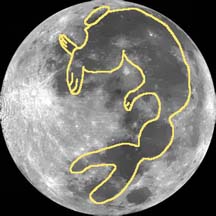
Jane's blog banner

Month: June 2009

  • Chasing Galileo – fourteen-day moon

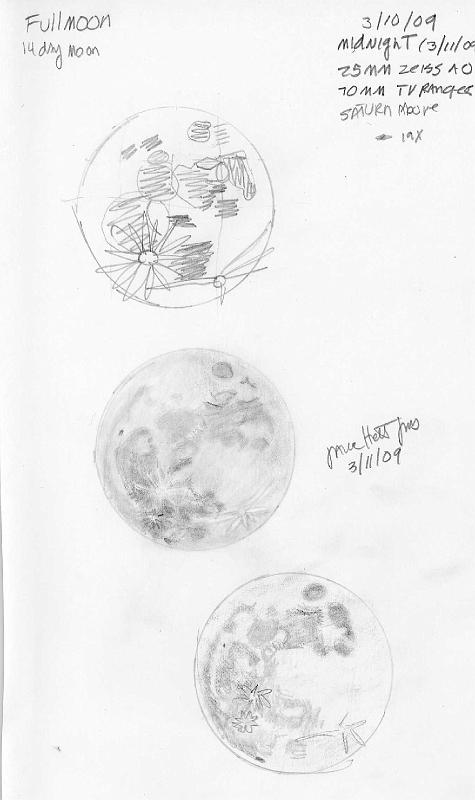
    fourteen-day (full) moon
    fourteen-day (full) moon

    The full moon rises as the sun sets on the 14th day of the lunar month. A small telescope, such as the 70mm f.8.7 Televue Ranger I’m using for this series of sketches is a perfect instrument for full moon viewing. So are binoculars. The moon is a very generous target, and even the least expensive department store telescope will provide you many hours, days, months and years of inexpensive lunar observing fun!

    The features you see on the full moon night are so different than the other nights. There are no shadows! So the features which stand out are the more reflective (bright white young craters and their ejecta) or the darker, less reflective mare.

    Many new lunar observers think the full moon is too bright to view through a telescope. It’s not, but there are some tricks you can use to make your full moon view more enjoyable. One trick I like is to use a higher power eyepiece when viewing the full moon. That higher magnification dims the apparent brightness of the full moon. Another trick is to observe the full moon next to a streetlight or normal outdoor house lighting. We hate those lights when they ruin our dark skies, but they don’t hurt lunar viewing one bit, in fact they improve it! I don’t like to use moon filters or neutral density or polarizing filters when observing the moon. They diminish the sharpness of the features I want to view.

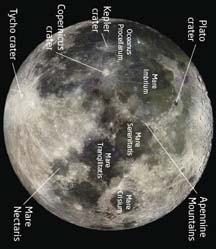
    There are so many features I can identify on these sketches, but I’ll just mention the ones I have not covered before. My center sketch seems to be a little better than the “final” lower one. I can see, in addition to the great rayed craters Copernicus, Tycho and Kepler, lots of small bright white craters or ejecta. Proclus and Messier are near Mare Crisium, but it will take a map for you to find them. Proclus is a crater that is actually visible to the unaided eye at full moon, but I didn’t capture it on my sketch very well, probably because I made this sketch after midnight on a mid-week work night!

    My photo of the fourteen-day moon
  • Chasing Galileo – sketches of the eleven-day moon

    janelunarday11

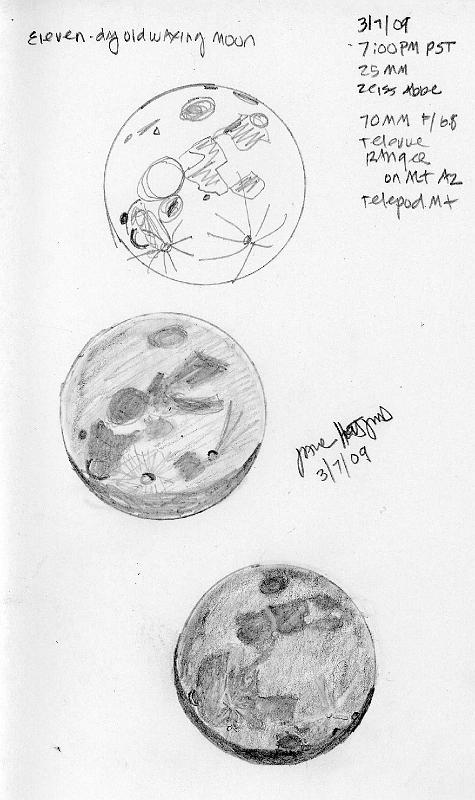
    It’s showtime! Sunlight reveals most of the lunar surface and the moon is visible all night long.

    Sinus Iridum — the Bay of Rainbows — is visible near the north part (left in my sketch) of the terminator. It’s the little half circle. The Jura Mountains ring the western edge and catch the morning sun. It looks like a smile. đŸ™‚ This is one of my favorite lunar features to view and also to sketch.

    Mare Imbrium is the large lunar mare just south (right) of Sinus Iridum. As the moon approaches full, the large craters Copernicus and Tycho take center stage. Moving left to right across the terminator we first see Copernicus. It’s 93 kilometers in diameter and its rays will be much more visible at full moon, thought they are impressive today, too!

    Tycho lies in a field of craters near the south limb. Its massive ray system is beginning to appear. Watch it over the next few nights and trace the rays as they span over 1500 kilometers. Its diameter is 85 kilometers, which makes it a little smaller than Copernicus.

    Closer to the terminator, another crater with spectacular rays at full moon appears tonight as a little white crater circle between Copernicus and the terminator. That’s Kepler! Oval Mare Humorum appears directly opposite Mare Crisium, and the look to be about the same size, which they actually are!. The small crater on the left edge of Mare Humorum is Gassendi, another lunar feature I love to sketch. Shickard is the final lunar feature on the right terminator. Wow! That was a lot of fun, to try to identify major features on a tiny 2-inch sketch! Full moon next!

    My photo of the eleven-day moon

  • Chasing Galileo – Head of Orion cluster

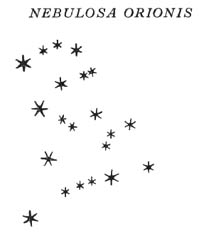
    Galileo's Head of Orion cluster
    Galileo’s Head of Orion cluster
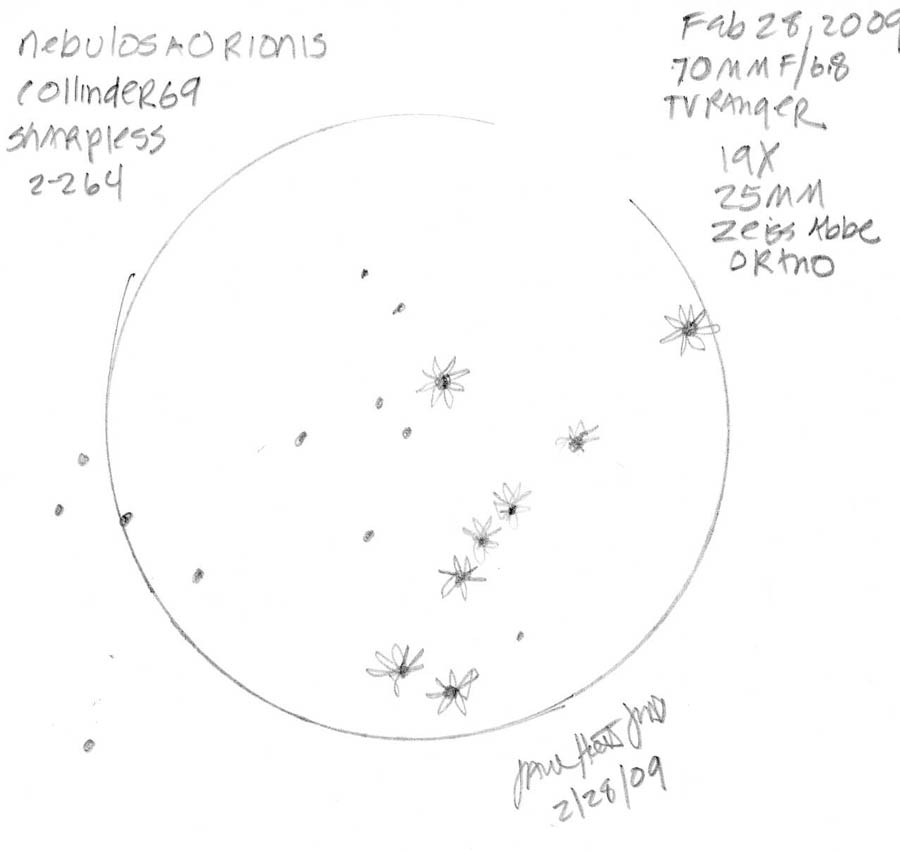
    Jane's Head of Orion cluster
    Jane’s Head of Orion cluster
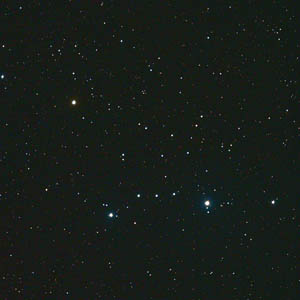
    Astrophoto of Orion Head cluster by Morris Jones
    Astrophoto of Orion Head cluster by Morris Jones
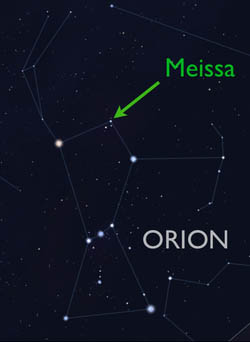
    Map of constellation Orion
    Map of the constellation Orion

    Galileo looked at the fuzzy patch surrounding the head of Orion through a telescope, and resolved many starts not previously known. He called it Nebulosa Orionis.

    Look between the shoulder stars Betelgeuse and Bellatrix of the constellation Orion. The star you see with your unaided eye is Orion 39 or Lambda Orionis. Its Arabic name is Meissa. You can find this star on Galileo’s drawing by following the stars at the bottom of the drawing. The first star at left is 37 Phi1 Orionis. Three smaller stars follow. The next one is Meissa. It’s an amazing star! Surrounding the hot class O star (which also has a double) is a 150 light year ring of gas, which you can read about at Jim Kaler’s Stars website link above.

    We now refer to the open cluster which contains this star as Collinder 69 or Sharpless 2-264.

    A hand drawn original diagram of Galileo’s 21 stars can be found in Volume 3, page 964 of the National Edition.

  • Chasing Galileo – Jupiter and the four Galilean satellites

    Galileo's drawing
    Galileo’s drawing
    my drawing
    my drawing
    my sketch of Jupiter's rotation
    my sketch of Jupiter’s rotation

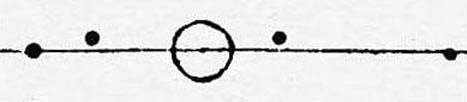
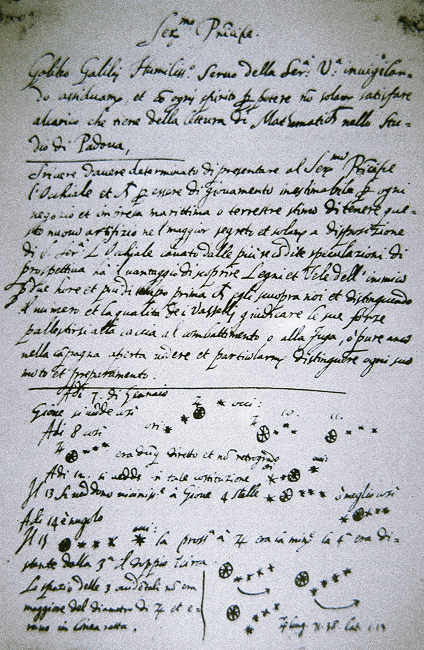
    Galileo published his observations in Sidereus Nuncius in March 1610: “On the 7th day of January in the present year, 1610, in the first hour of the following night, when I was viewing the constellations of the heavons through a telescope, the planet Jupiter presented itself to my view, and as I had prepared for myself a very excellent instrument, I noticed a circumstance which I had never been able to notice before, namely that three little stars, small but very bright, were near the planet…When on January 8th, led by some fatality, I turned again to look at the same part of the heavens, I found a very different state of things, for there were three little stars all west of Jupiter, and nearer together than on the previous night.”

    “I therefore concluded, and decided unhesitatingly, that there are three stars in the heavens moving about Jupiter, as Venus and Mercury around the Sun; which was at length established as clear as daylight by numerous other subsequent observations. These observations also established that there are not only three, but four, erratic sidereal bodies performing their revolutions around Jupiter.”

    Every amateur or accidental astronomer who first views Jupiter and its lineup of moons, is amazed at the view. Galileo’s 1610 discovery of these four moons orbiting Jupiter changed history. Looking at the Jovian moons through a small telescope, while trying to imagine Galileo’s first observations, takes my breath away!

    A page from Sidereus Nuncius: 1610

    First page of my observing log: 1989

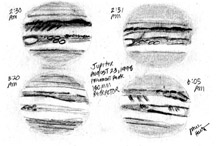
    My first sketches of the rotation of the four Galilean satellites: 1989

  • Chasing Galileo – sketches of the nine-day moon

    nine-day moon
    nine-day moon

    Lunar creature features
    Lunar creature features

    Rabbit on the full moon
    Rabbit on the full moon

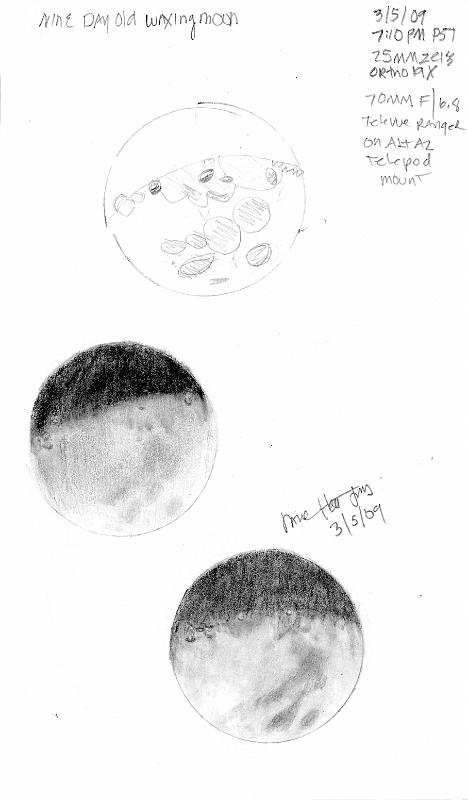
    Night owls can enjoy the nine-day moon – it’s up all night long. In my sketch, the magnificent crater Copernicus is visible on the sunlit side of the terminator – on the right side of the lunar center. It looks so insignificant right now, but at full moon, its spendid ray system is a naked-eye delight! Tonight you see the deep crater floor half lit by the sun. Here’s a closeup of Copernicus sketched through a larger telescope at higher magnification (185x versus 19x on these full disk drawings) on nearly the same day of the lunar month.

    From now until full moon, the dark lunar mare start to resemble creature features. I see half of the rabbit on the moon in my sketch. Mare Fecundatis and Mare Nectaris make the ears and Mare Tranquillatis (the Sea of Tranqulilty) makes a cute little bunny head. You can see other creatures in my February 2009 What’s Up podcast about the moon, linked below.

    As we near the full moon, the sun angle is more direct and crater wall shadows disappear. There are some other craters on the terminator tonight, which will reveal their amazing ejecta rays in a few more days when the moon is full. Towards the left edge of the terminator, Tycho is half lit now, but at full moon, its rays extend 1000 km. The spectacular walled plain Clavius is just starting to reveal its beauty. Through a telescope, when the entire crater is visible, you’ll see a dozen smaller craters on its floor.

    My What’s Up Podcast, July 2007: The phases of the moon

    My What’s Up Podcast, February 2009: Galileo’s and other first views of the moon through a telescope

    My photo of the nine-day moon

  • Chasing Galileo – sketches of the five-six day moon

    Five-day old waxing moon
    Six-day old waxing moon

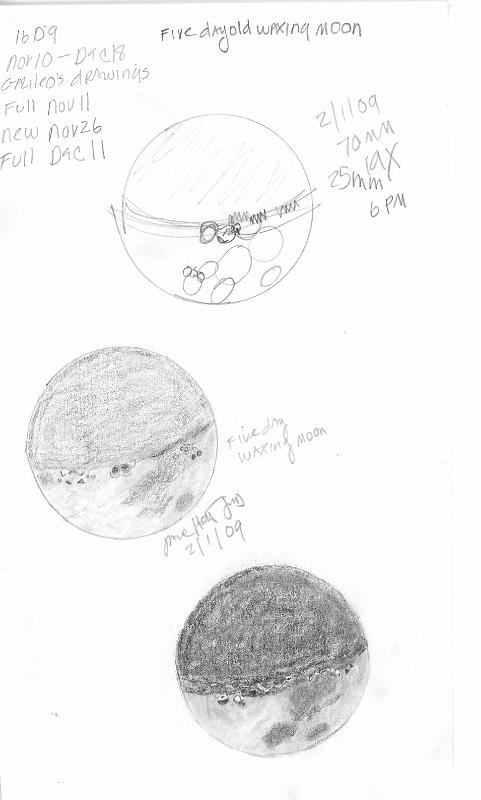
    The six-day waxing gibbous moon is visible for many hours in the evening – perfect for lunar observing and sketching. The time of my sketch was closer to the sixth day than the five day old moon. I had a hard time identifying craters using either lunar days! Note how much fainter Mare Crisium is now than on the three-day moon. Many of the features barely visible three lunar days earlier in earthshine are now lit.

    On the terminator, beginning on the right and moving to the left, I see Aristoteles and Eudoxus and sketched them as dark splotches. Montes Caucasus, the Caucasus Mountains, show as a half-circle of sunlit peaks on the terminator, cradling the Sea of Serenity. Hmmm, should I use the Latin names or the English names? A bit of both, so the more familiar names are understandable, I think. Closer to the center of the terminator, I can see Plinius, a bright white crater within the Sea of Tranquility. The Apollo 11 landing site, though not visible is just on the left edge of the Sea of Tranquility, the left-most of the two large seas touching the terminator. The large sea closer to the lower edge is Mare Fecundidatis, the Sea of Fertility.

    Moving back up to the lunar terminator are a pair of lit craters. They are Hipparchus and the small crater Horrocks (connected at right) and Albategnius. These are the two craters where the sunrise is just touching the crater walls a little more than halfway from the middle of the terminator.

    Moving along the terminator, the final 2 features I can identify (at 19x) are Gemma Frisius and Maurolycus, the last two craters on the sunlit side of the terminator on the left. I suspect the sunlit crater walls just on the unlit side of the terminator belong to the craters Walter and Purbach (to the right).

    Hitchhikers’s Guide to the moon. Select Feb. 1 or 2, 2009 to match my sketches.

    My photo of the five-six day moon

  • Chasing Galileo – sketches of the 3-day moon

    three-day old waxing moon
    three-day old waxing moon

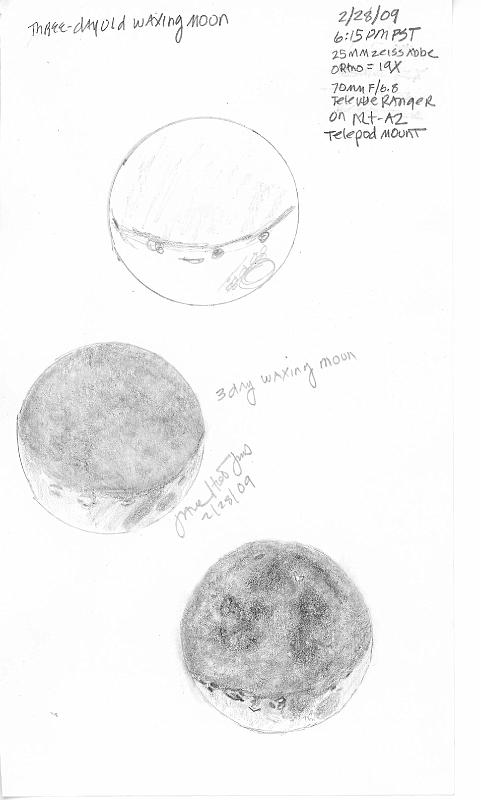
    This year, my observing project is to recreate as many of Galileo’s original telescopic observations as I can. I’ll be using my smallest telescope, a 70mm refractor, and making my sketches using a 25mm eyepiece for a magnification of 19x. Each of my lunar sketch pages will each show three sketches on the page. My first sketch is an “outline” of major features. The second sketch shows more detail, and the third is the final sketch. When I’ve matched all of Galileo’s lunar sketches, I’ll make a comparison montage.

    The three-day waxing gibbous moon is high enough above the western horizon and far enough away from the setting sun to be easily visible. Earthshine illuminates the unlit features, and sun shines on the narrow crescent. Mare Crisium (the Sea of Crisis) is the oval dark geological feature visible on the lower right edge of the three-day-old crescent moon.

    The crater Picard can be seen within the smooth surface of Mare Crisium. Along the terminator are some distinctive craters and other features, visible even at 19x. Following the terminator from right to left in my sketch, are dark Mare Fecunditatis and the large oval craters Langrenus, Vendelinus, and Petavius, all partially lit by the sunrise on their walls.

    Petavius, the third of the 4 evenly spaced, and similarly sized craters shows some of the prominent crater floor structure of central peak and rimae – which I sketched as a dark angluar line. Funerius, fourth and last of the big craters on the terminator tonight, are near the two smaller craters, Snellius and Stevenius. In my sketch, I just show the crater floors flooded with shadow.

    Earthshine reveals Mare Imbrium and Mare Serenitatis, Nubium and Humorum. And I was able to see the crater Aristarchus (the white feature top middle of the earthshine) and Plinius and Linne — the small white features in the lower middle of earthshine.

    Use the link below to Hitchhikers Guide to the Moon to identify other features.

    Hitchhikers Guide to the Moon

    Sketch of Petavius

    Sketch of Langrenus, Vandelinus, Petavius, and Furnerius a few days after full moon February 3, 2007, a 16 day-old waning moon.

    My photo of the 3-day moon

  • Chasing Galileo – sunspots

    Galileo's sunspots
    Galileo's sunspots
    My sunspots
    My sunspots

    In the summer of 1612, Galileo sketched a series of sunspots which were published in Istoria e Dimostrazioni Intorno Alle Macchie Solari e Loro Accidenti Rome, (History and Demonstrations Concerning Sunspots and their Properties), in 1613. Galileo corresponded with other scientists and artists who also were sketching the sun in the early 1600’s. He used a 16mm, f/11 Galilean refractor, and many drawings are known to have survived. He observed the sun using attenuated eyepiece (attenuated by Earth’s atmosphere when the Sun was low on the horizon at dusk) and eyepiece projection techniques.

    A lot of people repeat the story (which is really just an urban legend) that Galileo became blind by looking at the Sun through his telescope. He went blind in 1672, from a combination of cataracts and glaucoma more than half a century after publishing his sunspot sketches.

    In his sunspot letters to Mark Welser, dated May 4, 1612, Galileo mentions observing the Sun directly — but only at sunset. In its final paragraph, he mentions that his pupil Benedetto Castelli has discovered a better way to observe – using a projection method.

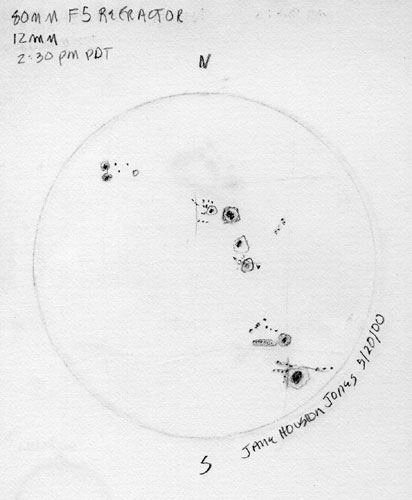
    My sunspot drawings were made mostly in 2002, near solar maximum, so I was able to see and sketch and classify hundreds of sunspots and other solar features. The one pictured here was made a few years earlier, tho’. I used three telescopes for my observations, a homemade bright yellow 6-inch f/10 Dobsonian reflector which I made in John Dobson’s telescope making class, an Orion 80mm refractor with a white-light solar filter and a Televue 70mm Ranger refractor with a Coronado h-alpha filter. I used these instruments to make daily sketches over two solar rotations (about 2 months) and completed the Astronomical League’s Sunspotter Club observing program. My 2002 solar sketches are linked below.

    Some Solar links:

    Historical Sunspot Drawing Resource Page

    My whole disk, sunspot and h-alpha drawings of the Sun

    A solar sidewalk astronomy article I wrote for the SOHO mission website

    My What’s Up podcast for May 2009 is all about the Sun