Jane's blog banner

Month: November 2009

  • A Runaway Star and the Flaming Star Nebula

    IC 405 and AE Aurigae
    IC 405 and AE Aurigae

    Stardate: Saturday November 14, 2009.
    Place: Chuckwalla Bench Observing Site
    Equipment: 12.5-inch Litebox Reflector, f/5.75 Pierrre Schwaar mirror
    Sky conditions: Better than expected (clear, steady, good transparancy, but cold)

    Mojo and I try to head out to our favorite dark sky observing spot every new moon Saturday night. Usually several of our Old Town Sidewalk Astronomer friends join us, and usually there are half a dozen telescopes. But this month we were the lone astronomers.

    Mojo has been infected by the Astrophotography virus for the past 2 years. Lucky me! I plunder his images and have included many in my monthly What’s Up podcasts. It’s not easy to find good wide field images of the constellations and low/zero power images of celestial objects, and his are really gorgeous. I love Mojo’s images of the galactic “smudges” because they show what deep sky objects really look like through a modest telescope. But he also wants to image the “eye candy” objects up close and personal, and luckily he welcomes an imaging suggestion from me every now and then.

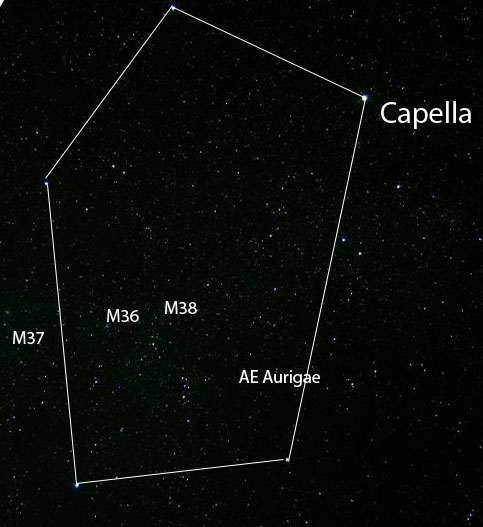
    The constellation Auriga as it appears in the November sky - center left is bright Capella
    Mojo’s Auriga – center left is bright Capella
    Rotated & annotated Auriga
    I rotated Mojo’s Auriga 120 degrees clockwise & annotated it because this is how I see it in my mind’s eye – like a house with a door

    So on this particular night, I wanted to observe one really interesting star and one really interesting deep sky object in several of the winter constellations. In Perseus, I observed Eta Persei, a spectacular gold and blue double star, and NGC 1491, a fan shaped emission nebula.

    The constellation Auriga is right next to Perseus, so I opened the good book, and by that I mean the Night Sky Observer’s Guide (NSOG) volume 1 (Autumn and Winter) to Chapter 5, Auriga the Charioteer. Under the “Interesting Stars” chapter, variable star AE Aurigae caught my attention, even thought it only garnered a rating of 3 out of 5 stars — meaning it was an “average” viewing object.

    AE Aurigae is one of the runaway stars whose proper motion can be traced back to the Orion Nebula. It is about 1500 light-years away and is an unusual O-type star with irregular light variations. It shines with the luminosity of 10,000 suns, but because of its distance is just on the edge of naked eye visability at varying magnitudes from 5.78 to 6.08. The NSOG goes on to say the star illuminates IC 405, the Flaming Star Nebula. Wow! That sounded like a very interesting object to view, despite the so-so rating. I called Mojo over to show him my project and mentioned how difficult the nearby nebula was to see visually. I could just barely see it, after trying with and without my O-lll, H-Beta and UHC filters. Only the UHC filter helped a little, and not very much. He thought it would be a challenging imaging project, and the constellation was in a great spot for astrophotography. I showed him where the object was, just next to a line of 4 stars that make up part of the front door of the “house of Auriga”, sort of where the doorbell should be. An hour of imaging later, we were both blown away the rippling waves, curling tendrils and the red color in the nebula.

    Back home the next day I did some more research on the two objects. The Spitzer Space Telescope observed the Flaming Star Nebula, an emission/reflection nebula in infrared wavelengths. Their observations show evidence of a bow shock created by the interaction between the runaway star and the nebular material. The runaway star, AE Aurigae is from the Orion association of O and B type stars. AE Aurigae and Mu Columbae were hurled out of the Orion nebula’s famous Trapezium area before the Trapezium stars were even born! Did one of the stars’ binaries go supernova and did the explosion send these stars hurtling through space in different directions? According to Jim Kaler’s Stars website the collision sent two stars out of the cluster, and the beautiful double star Iota Orionis — the brightest star in Orion’s belt — remained.

    AE Aurigae is moving north at 128k/s (80 miles per second) and is now 40 degrees north of Orion in Auriga. Mu Columbae is now 28 degrees to the south, in the constellation Columba, the Dove. That’s the constellation south of Canis Major and Lepus. Standing out under a dark sky and tracing the path from Orion to the runaway star’s location in Auriga was just mind boggling. Then I eyeballed the the path of Mu Columbae from the Orion nebula past bright Sirius down to the dog’s butt of Canis Major, and on down to Columba. Next month I’ll have to try and see the Columba runaway star.

    That was a great project for both of us! I really enjoyed observing a wild stellar object which had been studied and imaged by one of our great orbiting observatories. And Mojo enjoyed imaging an object that was practically invisible at the telescope eyepiece, but waiting for its closeup in front of his camera.

    Mojo blogs about Pinwheels, Horseheads and Flaming Stars – his projects on the same night.
  • Flying through the Leonid Storm of 1999

    s-houstonimage2

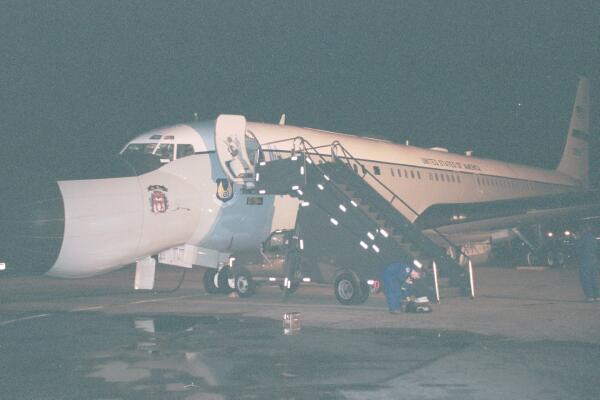
    ARIA Advanced Range Instrumentation Aircraft
    ARIA Advanced Radar Instrument Aircraft
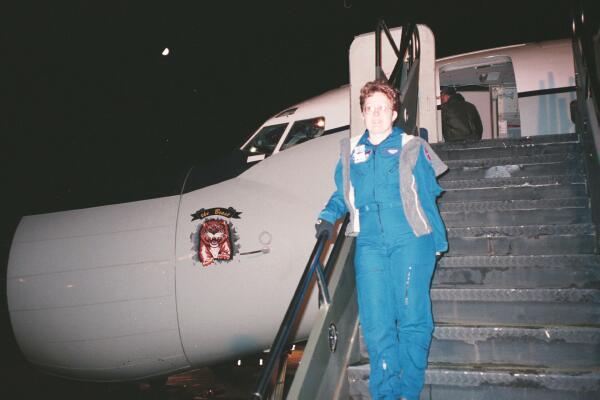
    Jane boarding the ARIA
    Jane boarding the ARIA
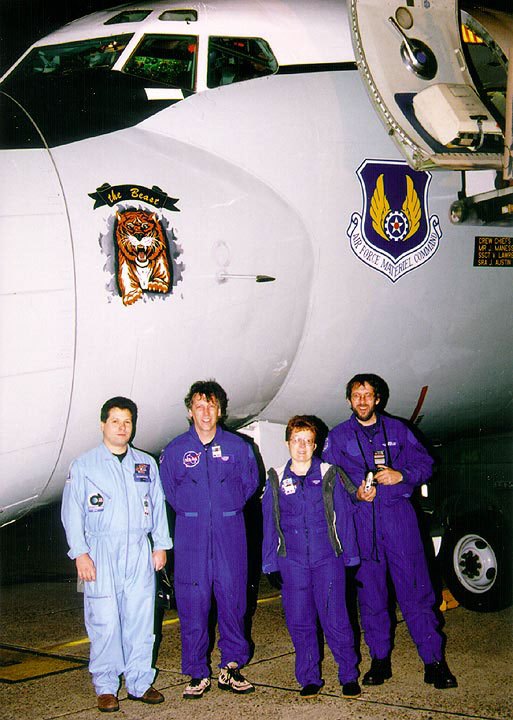
    4 of the 6 IMCU team members in front of the ARIA nose
    4 of the 6 IMCU team members in front of ARIA

    November 1999: 10 days, 40 flying hours, 65 researchers and Air Force personnel, five members of the press, seven Air Force bases (four US, two UK, one Azores), 6 amateur astronomers, three aircraft, 15,251 meteors, one amazing memory. I’d like to thank Dr. Peter Jenniskens, the Leonid MAC principal investigator for inviting me to participate on this (and other) meteor missions over the past 11 years.

    I was part of a six-person team of experienced amateur astronomers/meteor observers who were invited to fly around the world for 10 days, preparing for and then counting the Leonid Meteor Storm of 1999. We traveled from Moffat Field AFB near San Francisco over the San Andreas Fault to Edwards Air Force Base in Southern California for debriefing, badging, flight practice and setting our internal clocks a week of Leonid night flights. Then we flew across the United States and the Atlantic Ocean to England. Next, over Europe and Africa to Israel, back through the great Leonid storm to the island of Terceria in the Azores on the Mid-Atlantic Ridge. After a press conference, interviews and a celebratory dinner at Lajes Air Field we flew back to Patrick AFB in Florida for an end-of-mission party in Cocoa Beach, FL. Finally we crossed the US once again and flew right over Meteor Crater Arizona and back to Edwards AFB.

    The entire crew flew on three aircraft, the ARIA, a Boeing 707, Advanced Range Instrumentation Aircraft. It has a telemetry antenna dish in the nose of the aircraft and four INMARSAT communication channels for internet and voice mail uplink, plus lots of windows, some installed for this mission. The second aircraft was the FISTA, a modified NKC-135E tanker called the Flying Infrared Signature Technology Aircraft, with 20 upward-looking window ports. The third aircraft, a C-130 provided airlift support for parts and emergency repair capability for the FISTA and ARIA aircraft. They also provided a global command and control platform for mission coordination.

    Once the wheels were in the well, we headed for McGuire AFB in New Jersey to refuel for the trans-Atlantic flight. We took off at midnight from McGuire, and had a practice setup and observing run as we crossed the Atlantic. Seven hours later we landed at Mildenhall AFB near Cambridge. We counted 10 Leonids and 10 sporadics per hour during the practice run. We observed the Aurora Borealis and sprites, upward lightening strikes, thought to be induced by meteors.

    On the second night flight we flew from England to Israel. We tested and calibrated our instruments, then observed and recorded 15 – 20 Leonids per hour, after making comets and giving talks at an elementary school near Lakenheath RAF Base.

    On the third flight night we flew from Ben Gurion Airport in Israel to Lajes Air Field on Terceria Island in the Azores. This was the night we chased the Leonids and raced the sunrise. We observed the peak of the Leonid Storm of 1999 from 40,000 feet!

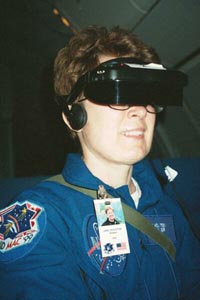
    My team, the IMCU (Intensified Meteor Counting Unit) used intensified CCD cameras aimed out the windows of the ARIA. Some cameras covered the horizon to 30 degrees above, and some from 30-60 degrees. The cameras were connected to video headsets. As we viewed the intensified images we captured Leonids and sporadic meteors by mouse clicks reported to counting software. We observed and counted a ZHR (Zenithal Hourly Rate) of 2300 Leonids per hour. I personally observed 2700 Leonids on storm night alone. Our total was over 15,000!

    On the fourth night from the Azores to Florida, we observed all night long again to collect data and measure the sporadic meteor count. Sprites and elves were captured by the airglow measuring camera on this night.

    The final flight took us from Florida back to Edwards Air Force Base. We all looked out the windows in the bright daylight and saw the remnant of an earlier cosmic collision – Arizona’s Meteor Crater!

    From the press:

    Astrobiologists on a NASA mission to study the Leonid meteors were in the right place at the right time to study a rare natural phenomenon — a meteor storm.

    At the peak of the storm, which occurred at 02:10 GMT, Nov. 18, 1999, the Leonid meteors were falling from the sky at a rate of 2,200 per hour. A meteor shower is classified as a storm when the rate exceeds 1,000 meteors per hour.

    Sixty researchers aboard the $1 million joint NASA-Air Force mission hollered and hugged as the Leonids barrage intensified, and the jets traced slow circular routes over the Mediterranean between North Africa and Cyprus. Individual meteors soon multiplied to a half-dozen white streaks screaming over the horizon at 40 miles per second.

    ”I’m not on Cloud 9 – I’m above it!” quipped Jane Houston of the California Meteor Society, one of several amateur astronomers on the meteor-counting team. A total of 15,251 meteors were counted during the six-hour observation period on the overnight flight from Israel to the Azores.

    Near real-time data on the number of meteors falling per hour was provided to NASA and the U.S. Air Force by a team of amateur astronomers who counted the meteors using virtual reality goggles and laptop computers. The meteor counting team was aboard the ARIA (Advanced Range Instrumentation Aircraft), one of two aircraft provided by the United States Air Force to support this mission. The data was sent from the ARIA, an EC-18 aircraft, to the ground via the TDRS satellite system. NASA and the Air Force are joint sponsors of the 1999 Leonid Multi-instrument Airborne Campaign.

    Leonid Multi-Instrument Aircraft Campaign team, 1998-2002 (I’m bottom row, third from left)

    Leonid memories 1998-2002

    Jane Houston’s Leonid 1999 diary

  • Dorothea Klumpke, airborne Leonid pioneer

    Dorothea Klumpke
    Dorothea Klumpke

    As I prepare a blog down memory lane, recalling my own airborne observations of the 1999 Leonid Storm, I wanted to share the adventures of the first woman airborne Leonid pioneer, Dorothea Klumpke.

    Over one hundred years ago, American born astronomer Dorothea Klumpke flew through the Leonids in a balloon. She was the first women to observe a Leonid meteor shower from above the earth. Below are excerpts from published reports about her adventure. I hope her deeds inspire you to step outside in the mornings of November 17th and 18th and observe the Leonid meteor shower this year.

    Exactly a century before the Leonid Storm of 1999, European scientists made plans to launch balloons to observe the Leonid meteor show of mid-November 1899. “I do not know what good fairy overheard my wish to take a trip in the blue sky.” Dorothea Klumpke wrote of her voyage in the balloon, La Centaure. “My surprise was great when I learned the French Society of Aerial Navigation had chosen me for the astronomical expedition of the Leonids. After reflection I accepted the unexpected invitation. I had the great mysterious and alluring anticipation of an ascent in a balloon.”

    The Leonids of 1799, 1833, and 1866 were magnificent and were confidently predicted to fill the skies with shooting stars once again in 1899. But these predictions fell far short of reality. By 1:00 a.m. on November 16th, as Klumpke waited to go aloft in La Centaure, she already knew of the disappointing reports from a flight on the previous night. Undaunted that the Leonids had failed to appear, she resolved to go ahead with her planned program.

    The balloon La Centaure, bathed in the light of the full Moon, rose over Paris into a bitter wind a few minutes before 1:00 a.m. on November 16, 1899.

    They tossed off the ballast sacks and soon the pilot, a secretary and Klumpke ascended to a height of more than 1600 feet and drifted westward over Normandy towards the English Channel. The sky was clear and pure, and despite the light of a nearly full Moon, fifth magnitude stars were visible. They saw 30 meteors during five hours of observing, of which half were Leonids. Seven hours after launch La Centaure made a dawn landing near a small coastal village. Dorothea wrote that all three occupants were “inwardly enriched a thousandfold by the wonderful experiences of the past night.”

    The seven hour flight was a scientific disappointment: only 15 Leonids were observed. But it was a great milestone for women in science. At age 38 Klumpke had become the first woman to make astronomical observations above the earth’s surface, augmenting an illustrious career that would continue well into the 20th century.

    In the late 1930’s Dorothea Klumpke Roberts endowed the Astronomical Society of the Pacific with a gift of $2,000 in honor of her parents and husband. The interest from this endowment was used to sponsor a variety of educational programs, including a series of Klumpke-Roberts lectures. In 1974 this program was renamed the Klumpke-Roberts Award. This international annual award honors an individual or group making significant contributions to the public understanding of astronomy.

    This article was compiled by Jane Houston Jones and Don Stone, past President and and Treasurer of AANC, the
    Astronomical Association of Northern California
    .

    Leonids 1998-2002, part 1. Flying through the Leonid Storm of 1999

  • Halloween Sidewalk Astronomy – Tradition!

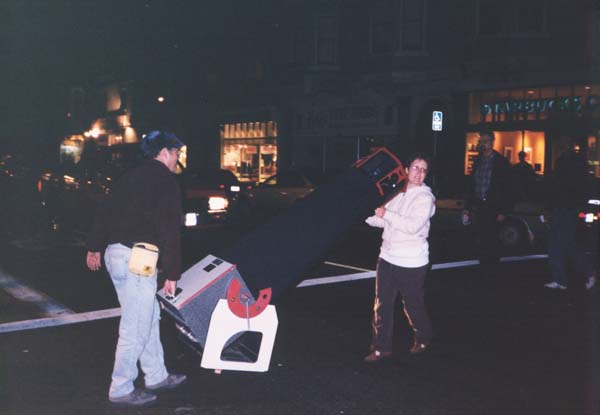
    Hauling a telescope across the streets of San Francisco about 10 years ago
    Hauling a telescope across the streets of San Francisco
    Jane-Orion plus Canis Major and Canis Minor
    Jane-Orion plus Canis Major and Canis Minor
    Mojo demonstrating where to find Jupiter's moons
    Mojo demonstrating where to find Jupiter’s moons
    Getting some eye candy
    Getting some eye candy

    Sidewalk Astronomers have been setting up telescopes on Halloween as long as there have been sidewalk astronomers!

    When we lived in the San Francisco Bay Area, we’d cross the Golden Gate Bridge from home and head to the Castro District of San Francisco on Halloween. It was crazy! Tens or maybe hundreds of thousands of revelers flock to the Castro on Halloween but I think we were the only ones with telescopes!

    That Halloween sidewalk astronomy tradition continues in San Francisco to this day. And now that we live in southern California we’re carrying on the tradition in our new home town.

    On Halloween, everyone with a telescope becomes a sidewalk astronomer. If there is a clear sky and a moon or planet to see, telescopes appear in front yards around the world. Astronomers love sharing the views, and a captive audience makes front yard astronomy a lot of fun for everyone.

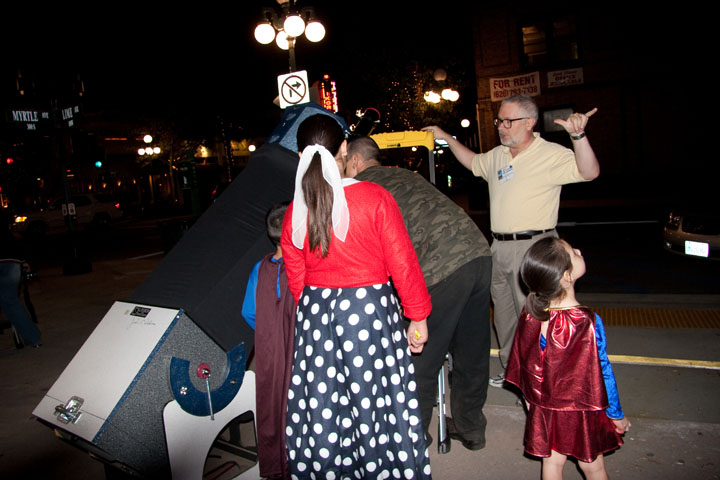
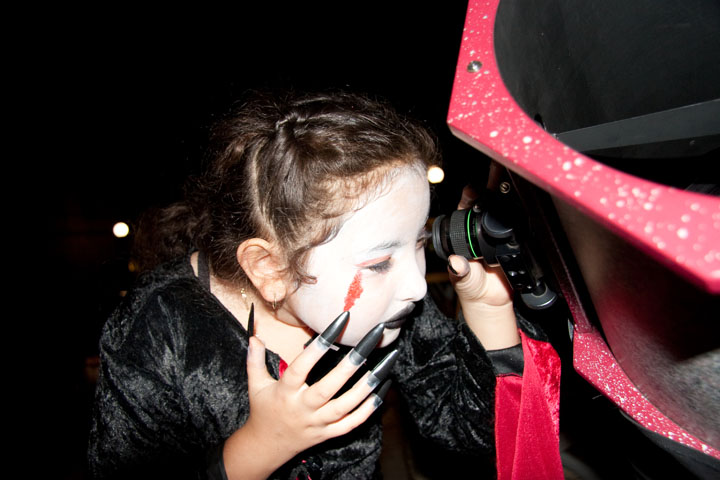
    The magic of sidewalk astronomy took over Library Park in Monrovia,CA minutes after we arrived. On this Halloween night, our club had 5 telescopes set up. Soon, princesses, superheroes and zombies alike said wow at our eyepieces! People stayed and looked through the telescopes for a long time. Even groups of teens, on their way to some event stopped for a look at Jupiter and the moon. They said wow too!

    When I told one group of teenage girls that I didn’t have candy, but had bookmarks instead, one girl said “I love reading”. Every girl wanted their own bookmark. Later, a young boy, when he received a picture of Jupiter said “I am putting this picture on the wall in my room”.

    Sharing views of the moon and planets on Halloween is a great tradition. Pass it on!

    our club, the Old Town Sidewalk Astronomers

    Photo Album from our Sidewalk Astronomy Halloween weekend October 30-31, 2009

    A spooky list of telescope targets. Look if you dare!