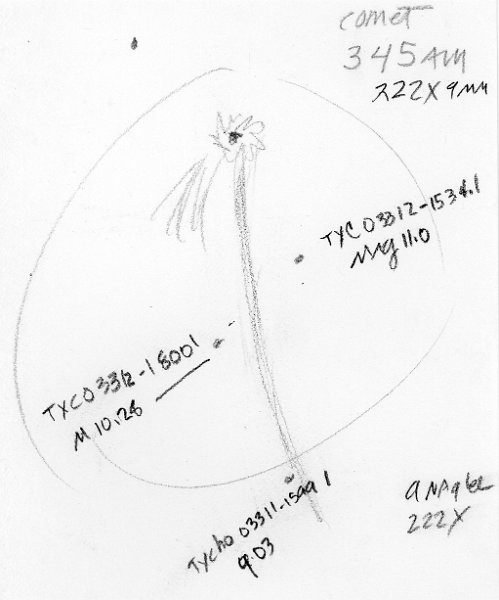
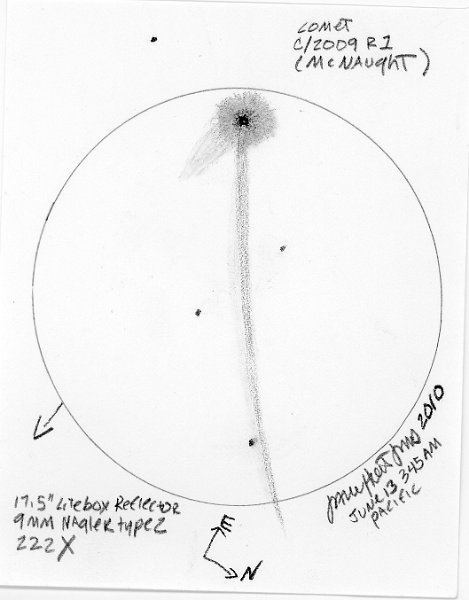
Use a chart like this to locate where to look for your objectCan you find the constellation Perseus and comet McNaught in Mojo’s lovely skyscape?Mojo's photo of Comet McNaughtQuick comet sketch with notes. See the long ion tail, the bright coma, and the short dust tail in my sketchesComet C/2009 R1 (McNaught) June 13, 3:45 am from Chuckwalla Bench observing site, Colorado Desert. Lat 33N, Long 114W, Elev 1400 ft
I wish everyone in the world could see just one comet! Right now, there is one visible just as the dawn brightens the night sky. Unfortunately, it’s not easy or convenient to see this one, and in another ten days it will disappear below our horizon. It’s just barely visible to the unaided eye. Timing your viewing window is tricky, too. You have to find a balance between the time the comet rises high enough to see, and the coming of dawn, which robs the night of its darkness and guidepost stars an hour or two later.
Here are some tips to help you have a successful comet viewing experience now or in the future. When you first hear about a visible comet, you can usually find some online sky charts from astronomy magazines such as Sky and Telescope and Astronomy. Many online sources can offer guidelines and observations, too.
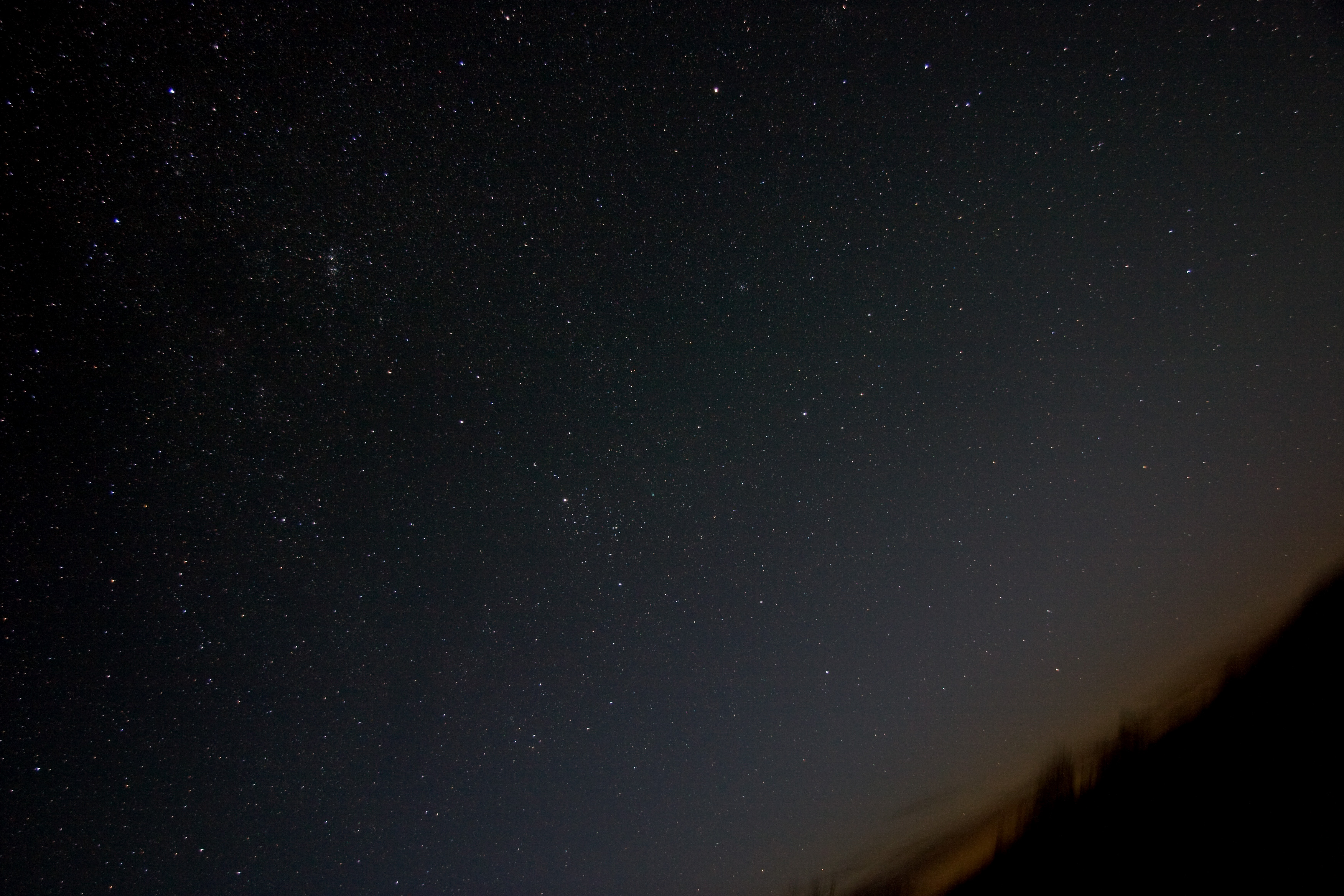
Star charts are fine, but you have to go out and navigate the real sky to find unfamiliar constellations. From the city, or close to dawn, this is a real challenge. You may only see a few bright stars in the sky. Try to see the stars making up the constellation Perseus in Mojo’s image. I’ll admit, it isn’t easy, especially when you are rushing against time. Now, compare his image to the star chart. And you’ll soon see the figure of the hero, Perseus, starting to emerge.
I use the familiar “W” shaped constellation Cassiopeia as a signpost to locate Perseus. Then I see Perseus with his two running legs, joined at the bright star Alpha Perseus (Mirfak). Nearby you can see the naked-eye open cluster known as either Melotte 20 or the Alpha Perseii cluster. Next, I make a mental triangle out of Alpha, Delta and Kappa Perseii, the three bright stars closest to the comet shown on the star chart.
Finally, I aim my binoculars at the triangle of stars and hold my breath. Then I see it, and I quietly say “hello” to the swift celestial traveller. I get chills every time I see a comet. And this time is no different. A little green fuzzball is right where the comet should be.
Now I jump into action. I dust the cobwebs out of my brain, as well as I can at 3:45 am in the morning. I’ve just woken up from a short nap. I quickly sketch what I see in the eyepiece of my big telescope, taking care to mark any stars nearby, and note the time. Then I call everyone who is awake over for a look. We all move sluggishly in the near dawn light, like we are walking through sandy molasses. We share views with one another, through binoculars and a variety of telescopes large and small.
Overhead, the Milky Way has disappeared, and the glow of twilight grows brighter. I have yet another predawn observing target, so I quickly make a second sketch with a little more detail. Then I nod goodnight to the beautiful green comet, aim my binoculars just a little to the east and wait. It will be nearly one hour before Mercury will rise over the mountains.
This comet is making its first approach around the sun, in its long hyperbolic orbit from the Oort Cloud. At the time of my observation, the comet was 0.6 AU from the Sun and 1.1 AU from Earth. By the end of June, it will be lost to our view. It reaches perihelion on July 2nd when it is about 0.4 AU from the sun. Then it will fade and be seen no more.
Added postscript: According to this Space.com article, the comet may be visible “after June 22 both in the evening sky for a short while just after sunset very low above the north-northwest horizon and in the morning sky just before sunrise very low above the north-northeast horizon.” I’ll update if/when I learn more.
See more of Mojo’s photos from this observing night.
Join our Old Town Sidewalk Astronomers email list and find out when our next dark sky outing will be. Or join us at our next in-town new telescope users clinic and planet/moon viewing event. Hey, that’s tonight, June 19! Clinic (RSVP required) begins before dark at 7 p.m. Star Party continues until 9:30 p.m. at Library Park in Monrovia, CA.
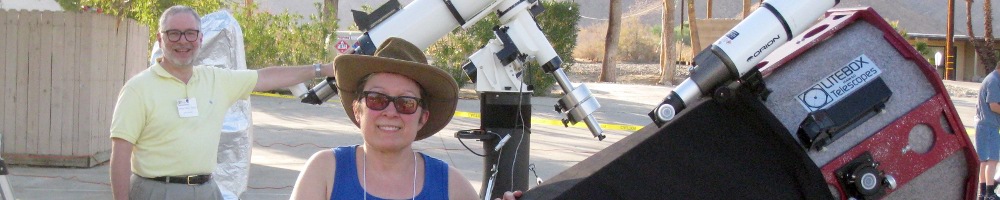
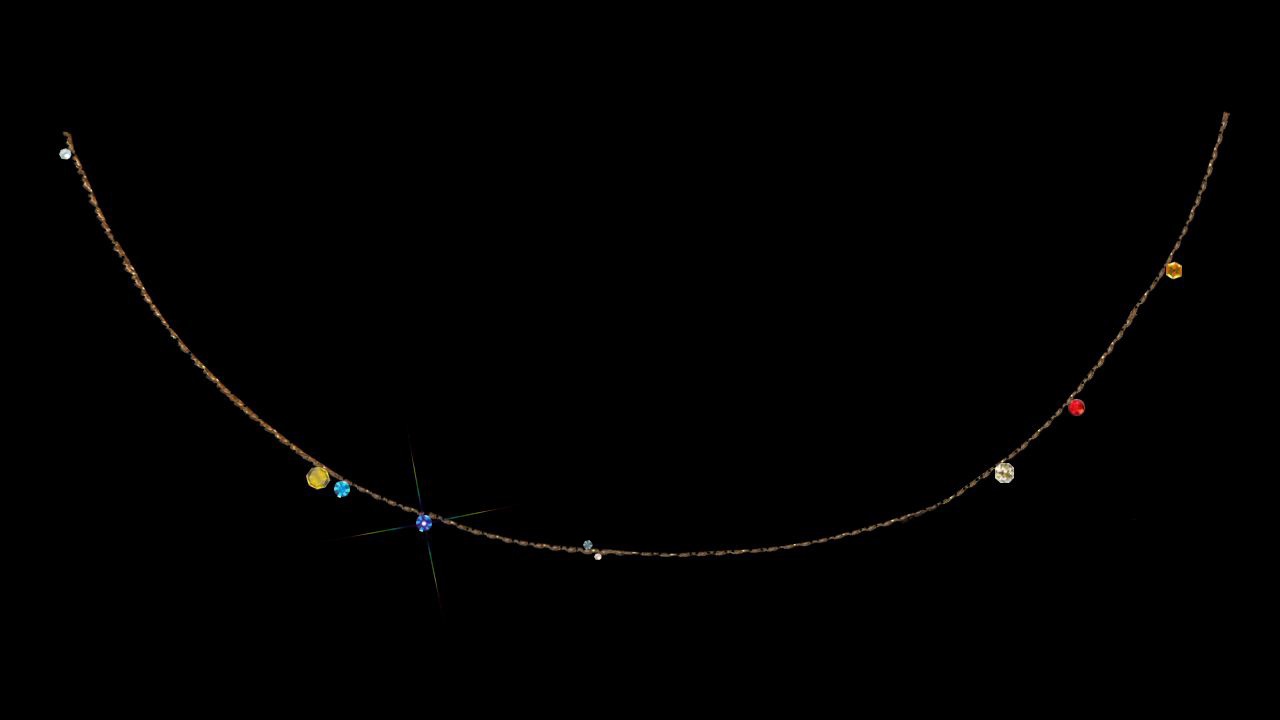
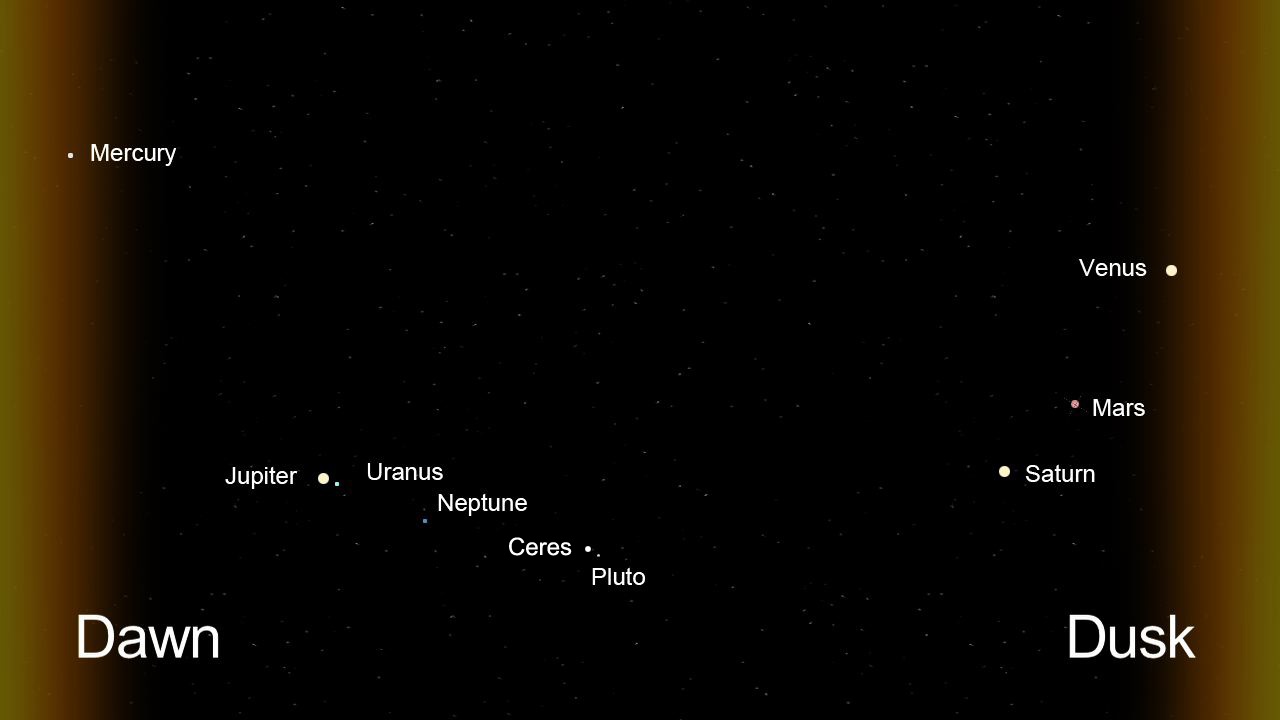
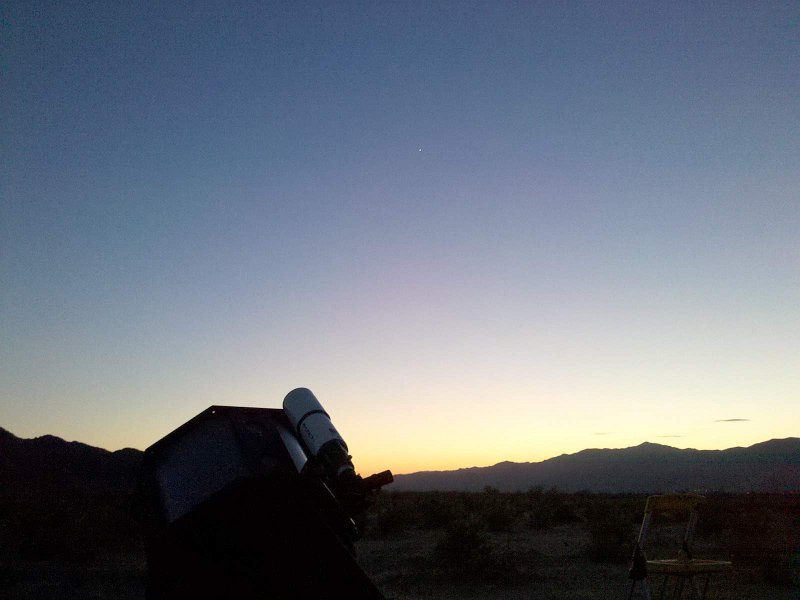
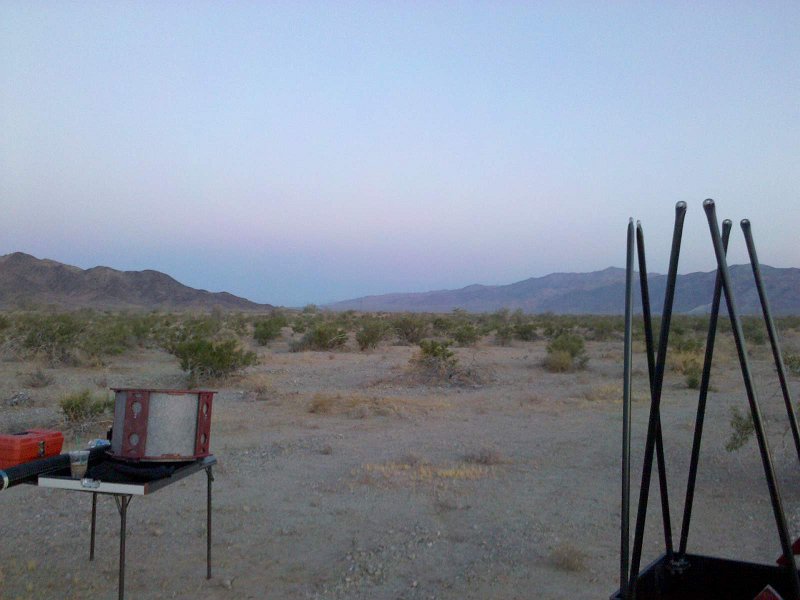
Setting up my favorite Pluto hunting telescope, a 17.5 inch f/4.5 Litebox reflector. Oh, in case you were wondering, its name is Hagrid. All my telescopes have names. Chuckwalla Bench horizonsEarth shadow at sunset, and Mojo setting up his astrophotography rigA starry necklace spans the sky from dusk to dawnThe planetary lineup from dusk to dawnTwo planets, Venus and Earth at sunsetM24 cluster and 60 day path of PlutoDo you see the Sagittarius teapot and the Milky Way "steam" rising from the spout? How about M24, the huge Sagittarius starcloud (the oval of stars 1pm above center) where Pluto hides?Earth shadow at sunriseBonus picture: This is the "naked eye" view of the sky where Comet McNaught can be found. Can you see the green comet near the Perseus Cluster? If not go to Mojo's Blog for closeup. Click to enlarge. It took binoculars for most of us to spot the first time. 🙂
Every couple of years I get the yearning to see all the planets in one night. Saturday night, June 12 seemed like the perfect opportunity. Our Old Town Sidewalk Astronomers club planned an outing to our regular observing spot, Chuckwalla Bench, which has very good horizons. We needed good horizons to catch Mercury rising just before sunrise.
Here are my planet observations, in observing order. All distances are listed in astronomical units and represent the distance from Earth on June 12, 2010, the night of my observations.
Earth! Facing away from the setting sun, the Eastern horizon turned shades of blue above the pinkish sky. That’s the shadow of the Earth! The dark blue band seems to rise above the landscape and spans 180 degrees. The pinkish sky above the shadow is the antitwilight arch. As the sun sets, the boundary between the reddened (pink) color and the horizon grows until it blends with the darkening night sky. The same thing happens at dawn of course. Look for it, and tell me what you see!
Venus! The first “star” to appear in our sky after sunset was Venus. Through the telescopes its gibbous phase is unmistakable! Its distance from Earth is 1.2 AU (astronomical units).
Mars! I was not expecting to see any features on Mars, since it is so far away and so small. Mars is 1.7 AU from Earth, but only half the diameter of Earth. I was surprised that I could see some dark markings, through a small refractor. When we checked a Mars map for the time of the observation, the large dark feature Syrtis Major was indeed right smack on the central meridian – the imaginary line in the center of the planet facing Earth at that moment.
Saturn! What’s not to love about Saturn! The brownish cloud bands contrasted against the butterscotch hued planetary globe. The slender ring, appearing nearly edge-on, bisected the planet, showing a tiny glimmer of sunlight shining on the north side of the rings. Several moons were visible, though one of the larger ones, Dione, was transiting (crossing in front of) the planet on this night. I spotted Mimas and Enceladus — tiny beacons of light — hovering near the edge of the rings. Titan and Hyperion were on the same side, only further away. Rhea was on the other side. Dione’s shadow marched across the face of the planet for astrophotographers to capture. I didn’t see it visually. Distance from Earth is 9.4 AU right now.
Pluto! This small icy world is 30 AU away from Earth. Once a planet, it is now a dwarf planet. But that doesn’t alter my enjoyment of seeing it through a telescope. For the past few years, Pluto has been marching slowly towards the richest part of our Milky Way galaxy making it a challenging object to confirm in backyard telescopes. Right now it is found skimming the Northern border of M24, the Milky Way Star Cloud. That’s a lot of stars to wade through to find one dwarf planet!
I printed out star charts showing just the few surrounding stars and Pluto, indicating the motion over the evening so I could go back and verify the observation closer to dawn. I also made zoomed out charts, showing larger and larger areas of the region. I had some galactic luck this month! A small open cluster called NGC6603 was nearby to Pluto within the larger M24 open cluster. A few distinctive star patterns separated the dwarf planet from the small star cluster, and I was able to easily starhop and make a positive ID. With Pluto bagged, I was feeling confident about the rest of my planetary to-do list.
Note: From July 4th through the 8th Pluto will pass in front of a dark nebula on the Northwest border of the M24 named B92. This should make the tiny magnitude 14 speck-of-a-former-planet easy to spot.
Ceres, another ex-planet was nearby so I hopped over to have a look at it. Ceres spent half a century after its discovery in 1801 as our 8th planet. Then it was demoted to an asteroid, but its significance was cemented by its designation, 1 Ceres. After many years working the solar system as chief #1 asteroid or minor planet, in 2006 Ceres was promoted to dwarf planethood along with Pluto. Ceres is 1.8 AU from Earth, by the way.
With the dwarf planet observations under my belt, I took a short nap to allow Jupiter, Uranus and Neptune to rise higher in the sky.
Uranus and Jupiter! When two planets are at opposition at nearly the same time they appear to pass each other from our viewing vantage point on Earth. This year we will see Jupiter pass Uranus, then appear to loop backwards–in retrograde–passing near Uranus a second time, then resuming its forward motion with third final close pass. The next time this will happen is 2037, so you might want to aim your binoculars at this pretty pair of planets this year. This is the first pas de deux, so you have many months to view the dance of the two gas giants. Through the telescope, Jupiter, which is 5.1 AU from Earth, looked unusual to me. It was my first look at the planet since the Southern Equatorial Band disappeared. A few months ago, this chunky ruddy band went missing.
Uranus has a beautiful aquamarine color. It has several moons just on the border of visibility through large amateur telescopes. I was able to spot three of the brighter moons of this planet — the ones farthest from the planet’s glow. Titania and Oberon on one side and Ariel on the other. A big ‘scope and good dark and steady skies help to see the faint moons! Uranus is 20 AU from Earth. Try looking up at Jupiter in a dark sky and see if you can spot a blue-green “star” nearby.
Neptune! Neptune sports an azure-blue hue and appears like a tiny disc. It’s nearly 30 AU away near the southern tip of Capricornus. At this time of year, that means waiting until 3 am or later for a view.
Now I had snagged all the planets except Mercury. It would be rising an hour before sunrise at 5:30 am, but the elevation of hills on the SE horizon were difficult to measure. I kept my eyes on the Pleaides star cluster as Mercury would rise directly below the famous cluster. By 4 am, with an hour and a half until sunrise, the sky was already brightening. First, the glorious Milky Way faded until it was nothing but a memory. Then, one by one the constellations disappeared, except for their brightest starry ambassadors. I steadied my binoculars as the Pleiades or “Seven Sisters” disappeared one by one. I kept the remaining Pleiades stars in my binocular view while moved back and forth, scanning the horizon for Mercury. Soon the rays of pending dawn punctuated the horizon, and I worried that I’d miss it as sunrise made the landscape visible once again. I could still see some of the Pleiades, and kept looking for over 45 minutes. Finally, just a few minutes before 5:00 am, a bright beacon appeared on the horizon. It was Mercury! I had seen ten planets in the span of nine hours!
The nine hours passed so quickly. With sunrise comes daylight and the views of the night sky fade from view but not from memory. Join us out in the desert sometime or find a local astronomy club closer to you so you can see these wonders of our solar system for yourself! You really have to see this!
December 1690 sketch of new dark spot on Jupiter by G. D. Cassini and changes to the spot over 18 daysMy first sketch of SL 9 impacts on Jupiter July 18, 1994.My July 26, 2009 sketch of the impact on Jupiter, discovered by Anthony Wesley (upper left 11-o’clock spot)
Anthony Wesley's preliminary (a raw frame from his video) showing new impact of Jupiter, June 3, 2010
On June 3, 2010, shortly before dawn in New South Wales, Australia, Anthony Wesley was imaging Jupiter. He saw a bright flash visually, and captured it on video. He quickly sent out an alert to imagers and scientists, followed soon with a preliminary raw frame from his video. Christopher Go also imaged this flash at the same time from the Philippines, and he also alerted the scientific and imaging communities.
The word spread like wildfire, and soon amateur and professional astronomers around the world were calculating when the impact area would rotate around the planet, to be hopefully visible from their own location, telescope or observatory. Would the impact leave a scar? No one knew for sure, but more observations were needed.
We’ve seen and documented three impacts to hit Jupiter since 1994 — but how many have we missed? Impact events leave no long-lasting scars on the surface of Jupiter. Jupiter’s bruises fade away.
Any science enthusiast who remembers 1994 will never forget the buildup to Shoemaker-Levy 9’s amazing impacts into Jupiter that summer. I have many sketches of what I observed visually those first nights when the world saw predicted cometary fragments hit Jupiter and leave visible impact scars. Astronomy clubs around the world saw increases in membership because of the press coverage.
I took my homemade 10-inch reflector telescope out on my back deck and observed and sketched Jupiter every clear night in the summer of 1994. I was, unwittingly at the time, continuing the tradition of citizen scientist recordings of visual astronomical observations — a tradition which goes back thousands of years.
Last year I was researching historical astronomical observations for my International Year of Astronomy (IYA) podcast series. I learned that Giovanni Domenico Cassini not only first saw Jupiter’s great red spot (called Jupiter’s permanent spot) in 1665, but he also observed and documented other large spots in December 1690.
Cassini’s sketched this feature over eighteen days in December 1690. His sketches show changes in the feature over time. His observations were published in 1792 as “Nouvelles descouvertes dans le globe de Jupiter.”
Today’s citizen scientists around the world observe their targets nearly every clear night. And when they see something unusual they immediately alert their community of colleagues. Sometimes, like in this case, other eyes or images confirm the observation. And when it is amazing enough, the world’s greatest eyes – Earth-based telescopes like Gemini, Keck, IRTF and even the orbiting Hubble Telescope — take aim.
Their eyes from Earth and space will make observations to delve deeper into Jupiter’s mysteries. Their data will complement observations of astronomy’s citizen scientists whose round-the clock and round-the-world nightly records are the eyes on the sky.