Jane's blog banner

Month: November 2011

  • Autumn observing – around the South Galactic Pole

    Herald-Bobroff Astroatlas
    Herald-Bobroff Astroatlas
    Grus and Telescopium
    Astroatlas B Chart page for Grus and Telescopium, well below Capricornus and Sagittarius
    NGC131 and 134 and a 5-spot of mag 10 stars
    NGC131 and 134 and a 5-spot of mag 10 stars
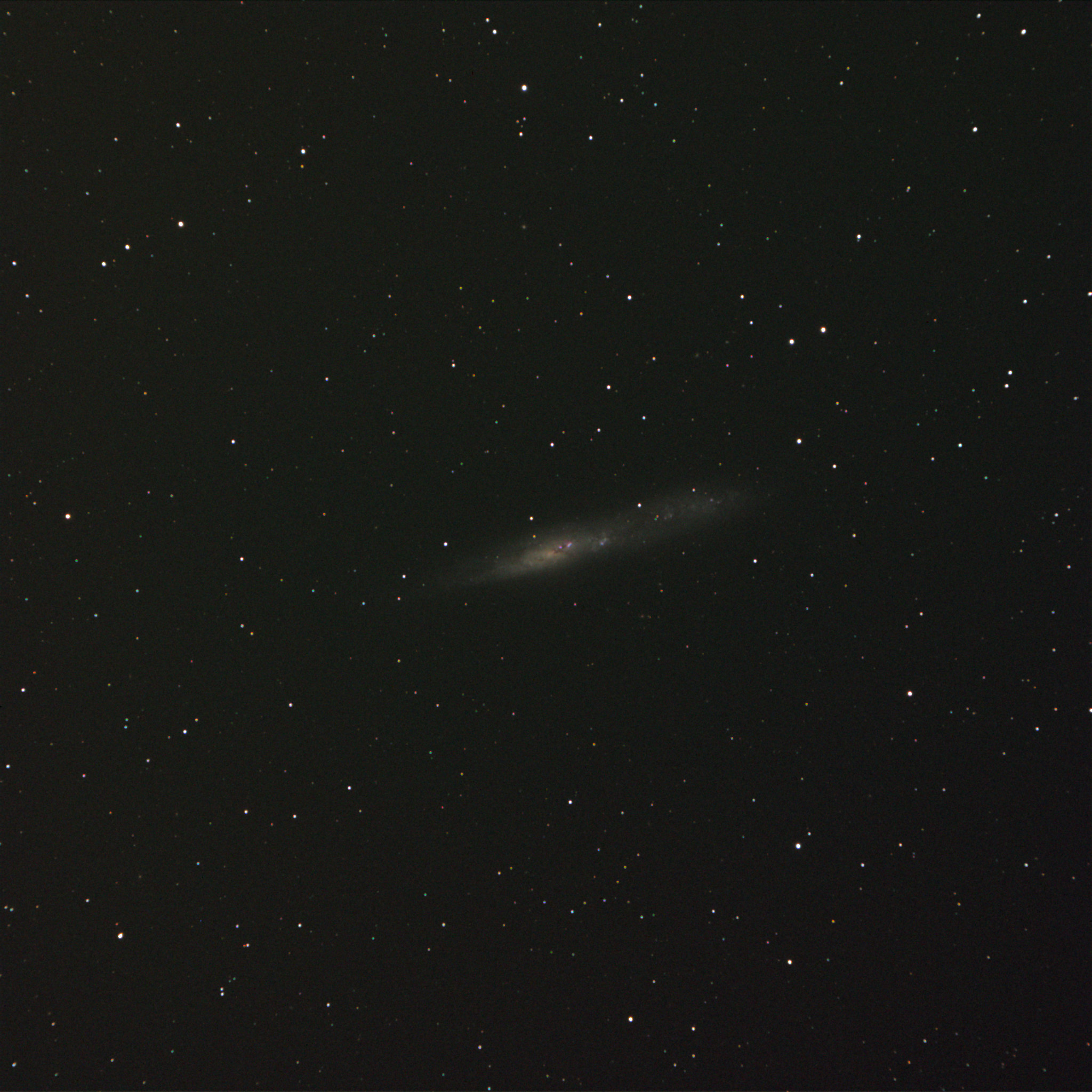
    NGC55
    NGC55 image by Morris Jones, used with permission 😉

    While Mojo and I were observing at Amboy Crater on October 22, 2011, Cliff, another observer at the site pointed out the constellation Grus, The Crane, low on the southern horizon. Grus isn’t a constellation I’ve paid attention to before – you need to be able to see down to the southern horizon in the fall, and you need to be observing at +34N Latitude or further south. If you can see well below Capricornus, Sagittarius and Sculptor in the autumn, give it a try!

    None of the star charts I brought on that occasion showed Grus, but I had just the startool at home for the following weekends (October 29) outing — the Herald-Bobroff Astroatlas! I hadn’t needed this lovely atlas since my 1999 Ayer’s Rock Australian observing trip with 20 other astronomers, and welcomed reacquainting myself with it. The atlas begins with the A Charts – wide swaths of the sky, showing several entire constellations. From there you are directed to the B Charts (image at your left), showing smaller segments of the sky and bright stars. The C Charts (9th mag stars and 14th mag. deep sky objects) are where I headed for this night’s observing, but in the past I have drilled down to the D (11th mag. stars and 15th mag deep sky objects), E and F charts for detail showing Coma and Virgo galaxy clusters and the Magellanic Clouds.

    There aren’t any bright galaxies to hunt for in the constellation Grus, and observing low to the horizon doesn’t afford the best views, either. But even so, I quickly observed the top ten or so – including some lovely galaxy clusters. First I went for NGC7590 and 7599, a pretty pair of spiral galaxies discovered by John Herschel and Charles Dunlop. I didn’t see the distant Abell 1111 cluster, 2 billion light years away, just the two brighter galaxies.

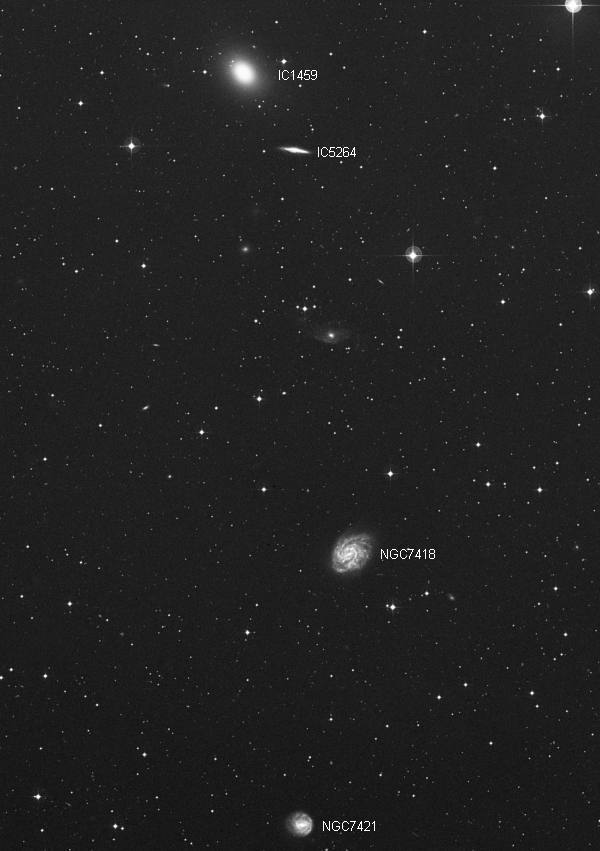
    Next I hunted down a group of galaxies near NGC7418 – a face-on spiral galaxy nestled in a pretty string just below Fomalhaut on the Grus Sculptor border. Here’s a photo of the galaxies I observed. 7418 was discovered by Sir John Herschel at the Cape of Good Hope with an 18-inch f/13 speculum telescope in 1847. A supernova erupted in this galaxy in 1983. And Allan Sandage (1975, Astrophysical Journal, 202, 563-582) notes that this galaxy is a member of the IC1459 Grus Group.

    Well after midnight on this perfect observing night, our friend Dave came over and told me he had just observed some objects he had not logged before. “A pair of galaxies, with a little dice-shaped asterism of five stars next to it”. Soon I was on my own hunt for NGC131 and 134. It’s to the lower left of big open cluster Blanco 1 on the star chart. The smaller 131 was discovered by John Herschel in 1834, and the larger 134 was discovered in 1826 by James Dunlop in Australia. They are part of our local group of galaxies (LGG), and the galaxy group is also known as LGG-007 located 63 to 82 million lights years away. My sketch is to the left.

    This part of the sky is littered with easy to find galaxies, and I spent several hours hopping from one to another. I was observing NGC55, an interesting barred irregular galaxy only 7 million light years away. It’s one of the closest galaxies to our own local group! I encouraged Mojo image it, even though it was low to the horizon. I love his image, and it looked a lot like this through the eyepiece, too. I made a rough sketch of the galaxy, and when I looked at Mojo’s image we both showed the pretty lineup of stars outlining the galaxy.

    This is just a sample of the dozens of galaxies I looked at in the deep southern sky on a late October evening. Fall offers long nights of darkness for galaxy starved amateur astronomers tired of all the bright milky way objects of summer. So ladies and gentleman, start your telescopes, and point as low as you can go. Aim your telescopes where the wings of the southern birds Grus and Phoenix fly. If you can’t go that low, Sculptor offers dozens of amazing objects to view. Open your atlas to the constellations around the South Galactic Pole near Sculptor, and you’ll enjoy hours of surfing the southern skies.

    Here are Mojo’s Astrophotos from October 29, 2011. I enjoyed visually observing these objects, and then seeing these postcards sent from the universe through Mojo’s astrophotography.

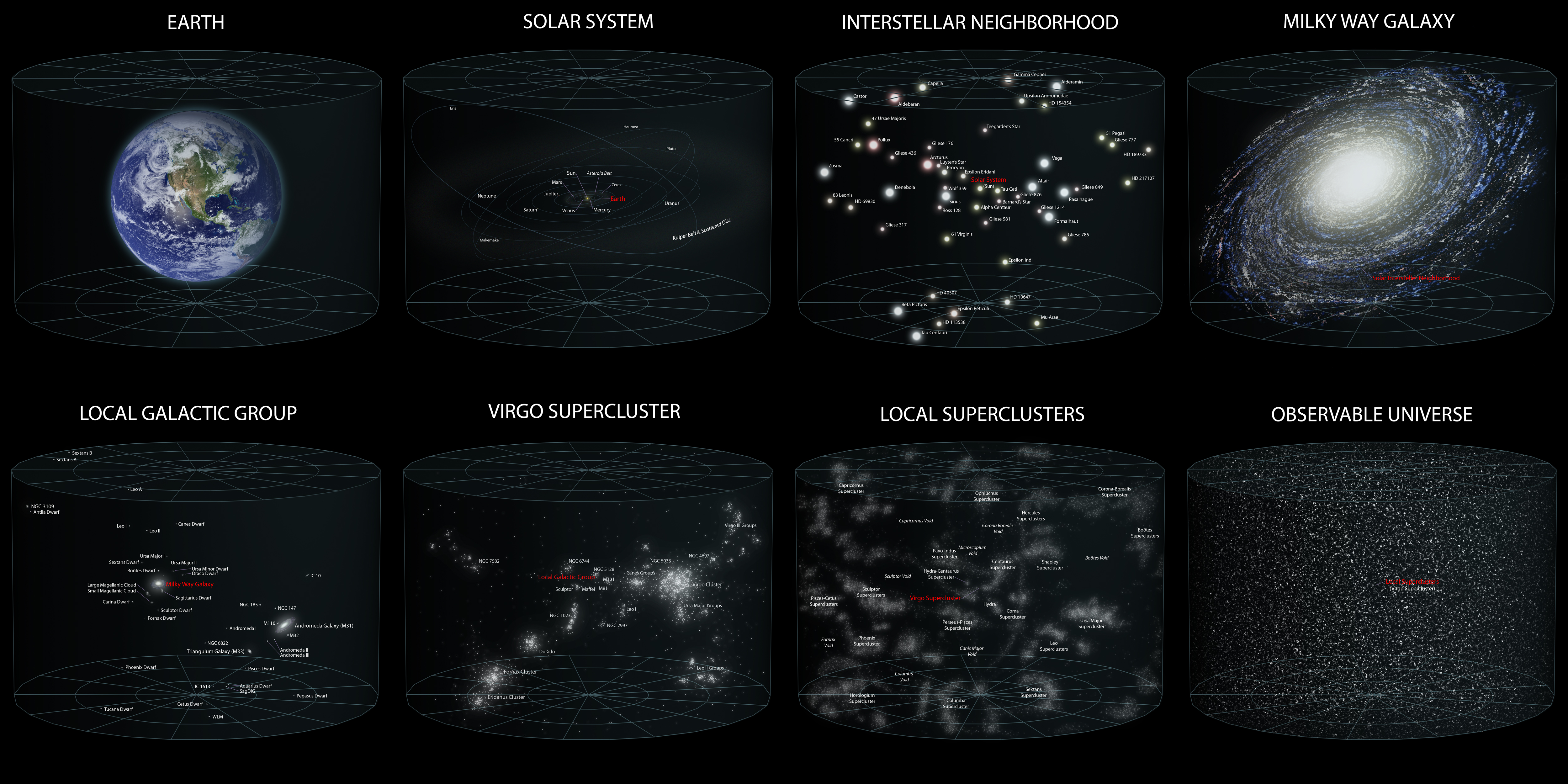
    Diagram of the Observable Universe

    Review of the Herald-Bobroff Astroatlas

    Images showing our observing spot at sunset and waiting for moonset

  • Watching asteroids fly by

    It was 23°F inside the observatory while we were observing the asteroid
    It was 23°F inside the observatory while we were observing the asteroid
    Asteroid 2005 YU55 sketched November 8, 2011
    Asteroid 2005 YU55 sketched November 8, 2011

    Asteroid 2005 YU55 wasn’t my first visual observation of an asteroid passing near Earth, but preparing to view it brought back some great memories of our first one, asteroid 2002 NY40, nearly ten years ago.

    Here’s a little writeup about both observations. First up, Tuesday night’s observing of Asteroid 2005 YU55. It’s 400 meters (1,300 feet) in diameter. On November 8, 2011 it passed 0.85 lunar distances (324,600 kilometers or 201,700 miles) from the Earth. It has been studied by radar using NASA’s Deep Space Network’s Mars Antenna in California’s Mojave Desert. The Herschel Space Observatory took some measurements in the far-infrared. The Swift Telescope observed it, too. Oh, also legions of amateur astronomers imaged, sketched and observed this “once in-a lifetime” event, including me!

    Tuesday afternoon, I drove 100 miles to a friend’s private observatory near Mt. Pinos. I knew as soon as I looked at the sky that I’d never find the asteroid in my telescope. The near full moon wiped out all the fainter stars I’d need for star-hopping to the asteroid. It was 30°F upon arrival, snow on the ground, and it got colder as soon as the sun set – to a low of 23°F.

    After an hour, Steve, the owner of the observatory found asteroid 2005 YU55. He was stunned at the movement as it zipped across the eyepiece view. Three of us took turns stepping up a ladder to reach the wide field eyepiece atop his 14-inch reflector. The 1 degree field of view in the eyepiece we used is equal the apparent diameter of two side-by-side full moons. We took turns watching the faint asteroid move for about a minute or two, then letting the next person have a look. It took the asteroid about 9 minutes to traverse the eyepiece field. My sketch shows the asteroid’s motion in about 2 minutes, and this star chart gives you an idea what the we saw in the sky and in the eyepiece.

    You can see the constellation Pegasus high overhead on the star chart. That’s where we were aiming. As we tried to follow the faint asteroid in the eyepiece, we each made a triangle out of slightly (magnitude 9 and 10) brighter stars which the 11th magnitude asteroid would pass by. That way we had fixed objects to anchor our view of the motion.

    This was no glittering diamonds on black velvet view. The nearly full moon was right next to where we were looking, and it brightened the sky and the ground. Only the brightest stars were visible. “It was a fast-moving ghost against other fixed ghosts in the moonlit background sky”, described Steve. I saw a grey poppy seed moving against a grey felt sky. It made us gasp in amazement that we were looking at it with our own eyes, especially since it was so small and so faint! After an hour or so of viewing, we packed up and headed back home, 100 miles away.

    Now, here’s a little trip down memory lane for me – my first asteroid flyby on August 17, 2002.

    On August 17 and 18, 2002, Asteroid 2002 NY40 zipped past Earth 1.3 lunar distances – 530,000 kilometers or 330,000 miles away. From 9:30 to 10:30 p.m. on August 17th our deck in suburban San Rafael, CA was filled with telescopes. We invited astro friends over for a spur-of-the-moment asteroid party, gambling that our inland location would be fog-free, unlike many of the usual astro spots.

    After a quick dinner, a dozen of us stepped out on the deck. Mojo was the first to spot the swift 9th magnitude asteroid 2002 NY40 in his 14.5-inch f/4.8 LITEBOX reflector. Our friend Jim also found it in his 8-inch LX-10. Our friend Stacy was happy to spot the moon in her new 10-inch dob without a finder. For a good hour we kept the asteroid in Mojo’s scope. All our pals got to see the asteroid whiz through the field of view several times through two telescopes.

    Both observations were amazing. You can always go back and look at videos and images, but you only get one chance to see celestial events like these with your own eyes. And I plan to try and observe every once-in-a-lifetime event that I can. 🙂

    Nasa JPL Press Release about the November 8th close flyby of 2005 YU55

    Nasa Science News about the close flyby of 2002 NY40