Jane's blog banner

Category: Uncategorized

  • A Dreamcatcher, And A Blanket Of Stars

    Red Willow dreamcatcher with Big Dipper and Milky Way
    Red Willow Dreamcatcher with Big Dipper and Milky Way
    The Fisher Stars, painting courtesy of Edwin Bighetti, Mathais Colomb First Nation
    The Fisher Stars, painting courtesy of Edwin Bighetti, Mathais Colomb First Nation
    Wesakaychak Pointing - courtesy of Edwin Bighetti, Mathais Colomb First Nation
    Wesakaychak Pointing – courtesy of Edwin Bighetti, Mathais Colomb First Nation

    In March 2010, I was invited to be the keynote speaker at the Manitoba First Nations Education Resource Centre’s annual Science and Career Fair. Two participating schools from the Nisichawayasihk Cree Nation in Nelson House, Manitoba invited me to visit their community. So in November 2010 I spent two days with the students, teachers at the K-8th grade Otetiskiwin Kiskinwamahtowekamik School, and the 9-12th grade Nisichawayasihk Neyo Ohtinwak Collegiate.

    After a day of school presentations in early November, I was invited to a community gathering of shared songs, the music of flute, hand and water drums, and stories from several storytellers. Joe Mercredi, a school cultural coordinator and a wonderful storyteller told several stories, after he played the flute – a six-hole flute made of mountain juniper by Navajo flute maker Jonah Thompson. Joe makes flutes, too, but he chose this one for this night because “it has a sweeter voice than his own,” he told me recently. Joe also helped me remember the stories he told that night two months ago. He told me that all stories are related to each other. How we remember them depends on what we need to learn at the time.

    His first story is a variation of the Dakota Woodpecker Flute story. A poor young boy with no male relatives lived with his mother. He was friends with the chief’s daughter. They were good friends and spent much time together. When of age, he asked the chief for her hand. The chief questioned his ability to support his daughter. He was mortified and left the camp. After some days he fell asleep under an old cedar tree and was woken up by a woodpecker up in the tree. This being in the time when animals could speak to men, a conversation ensued and the young man was gifted with the first flute. In the end the two become a couple and the young man found fame and fortune as a flute maker. This story can be found in one of the Joseph Bruchac series “Keepers of the Earth/Sky/Night/Life” books.

    Joe then held his Dreamcatcher, and told this story. Red Willow Woman was a woman who taught the children in her community until her death, and, when given the choice by the Great Mystery to be returned to her people, she chose to return as a red willow to demonstrate that every one has the ability to achieve greatness if one reaches beyond one’s limits. Red willow forms the frame of the Dreamcatcher.

    You can see the big dipper stars (or Fisher stars) on the right side of the woven web within the red willow frame. And you can see a chaotic jumble of stars on the left. The legend of how Fisher became the Big Dipper and how animals of long ago decided to share summer and winter, and how the fisher came to be in the northern sky is told by Murdo Scribe, and is known as Murdo’s Story.

    Long ago, in one part of the animal world and bird world it was always summer and in the other half of the world it was very cold with no warm weather. The northern animals and birds had to find summer. Fisher (a small wolverine) carried summer, and the summer animals chased him. They shot at him and an arrow hit Fisher and took him to the northern skies, with the summer. Fisher still lives in the northern sky, and summer is now shared with all animals and birds everywhere. Fisher can be found circling the North Star. Some people call him the big dipper.

    The Dreamcatcher is formed from two willow branches depicting strength and softness intertwined — the need for give-and-take in a respectful loving relationship. Joe decided to map the Big and Little Dippers in the Dreamcatcher. But just like in the Wisakechak story of the Milky Way, he mapped the big dipper, but the trickster, Wisakechak decided to mess up some of the stars. You can see an extra star in the big dipper.

    Legend tells that Wisakechak was meticulous in his placement of the stars, but Fox wanted Wisakechak to play with him, and got tired of waiting for him to finish so he grabbed the blanket of stars and scattered them all over the place. Those stars represent the Milky Way. If you look in the winter sky you will see Wisakechak (sometimes spelled Wesakaychak and many other ways, too) pointing to the Pleaides, which figure in many other legends. Wisakechak is represented by the constellation Orion.

    You can see the big dipper stars in the web of the Dreamcatcher. The handle star, Alkaid is near the top of the Dreamcatcher , and you can see the bowl stars at 3 o’clock. There is one “extra” star woven into the web near the bowl, put there by the trickster, Wisakechak. And you also see the other stars from the blanket of stars Fox threw into the sky on the left side of the Dreamcatcher below the center hole. You’ll also see the thirteen tie-points, where the sinew is tied to the willow hoop. These thirteen ties represent the 13 new moons of a year.

    After Joe finished his stories of Red Willow Woman, Wisakechak, the Fisher stars, and the Milky Way, he walked over to me and gave me his Dreamcatcher. As I look at my Dreamcatcher now, three months after my visit, I can still hear the drums, the flute and the stories of the stars I heard in Nelson House that snowy November night. Now, when I read Murdo’s Story I can see how all of these stories are related.

    Murdo Scribe was born in Norway House, Manitoba and was a World War II veteran with the Canadian Army. After the war he returned to a life of fishing, trapping and seasonal work. In 1975, he was appointed coordinator of the Traditional Individualized Education Program with the Native Education Branch of the Manitoba Department of Education. He wrote many stories based on his own experiences and those of the elders he had known.

    I thank Joe Mercredi, who is a master storyteller, maker of flutes, weaver of dreamcatchers for sharing these stories with me. I must also thank science educator Wilfred Buck, of the Manitoba First Nations Education Resource Centre, who I met two years ago at the NYAA (Ontario) Starfest when he gave a talk about Atchakosuk: The Spirit Lights Up Above . I have been slowly learning more about the spirit lights above. Two years ago, Wilfred ended his presentation with a quote from one elder, “We are blessed to live under a blanket of stars.”

    I will do the same.
  • Free Telescope to first caller (updated 1/1/2012)

    Updated 1/1/2012

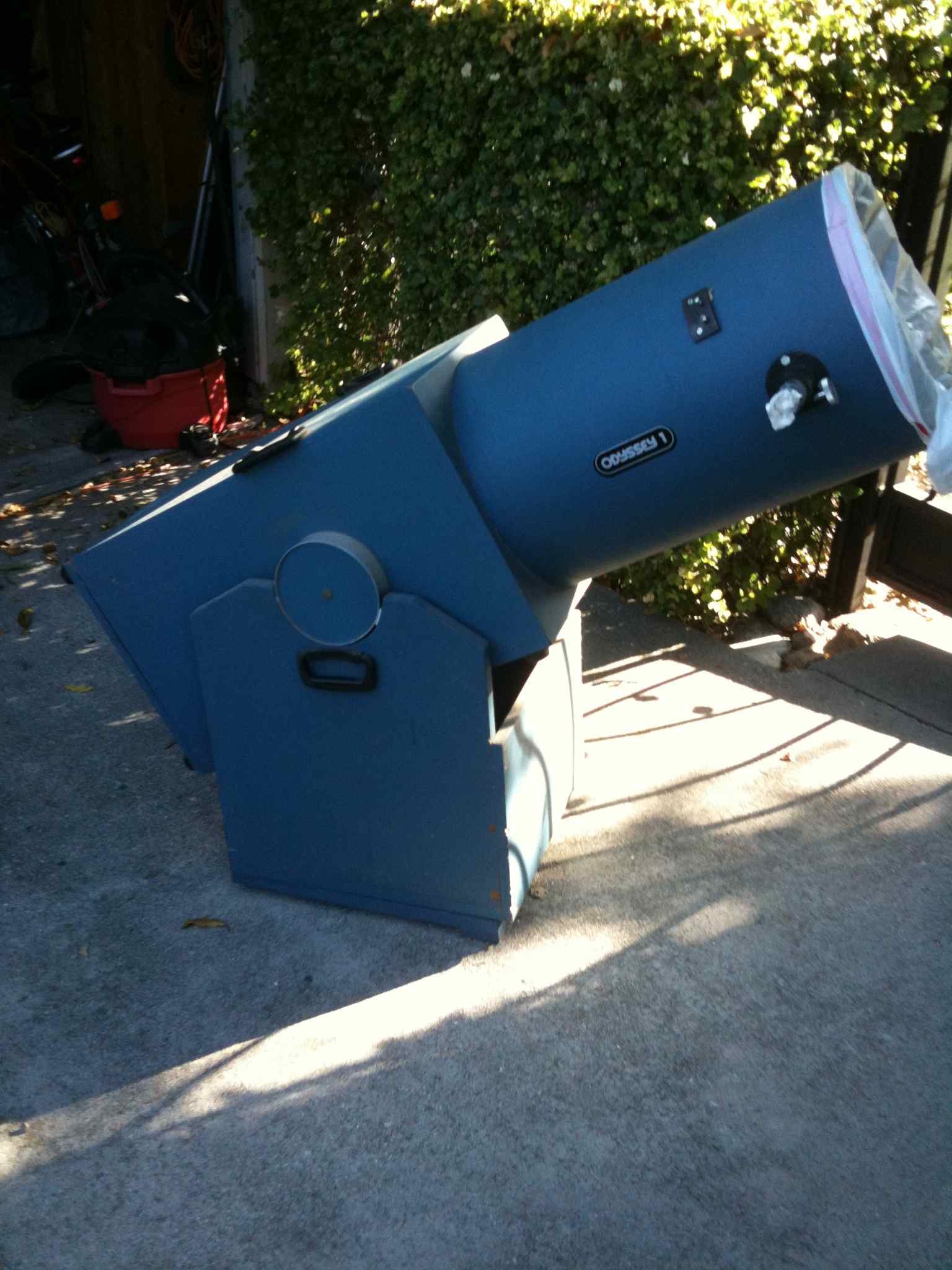
    Before – 13.1-inch f/4.5 Coulter Odyssey 1
    After – – note the original blue ground board

    Update: A colleague at work had a telescope he wanted to give away. I advertised it and found someone who wanted it. Here’s a before and after image. The telescope has been reincarnated as you can see from the second picture, which was taken December 31, 2011 at our Old town Monrovia sidewalk astronomy event.

    Original post: Jane says “this is a classic blue-tube Coulter 13.1 inch f/4.5 reflector.” It has a nice short 5-foot tube, so you won’t even need a ladder. You’ll need some storage room for this telescope, and I’m not gonna lie to you, this is one heavy telescope. You can learn a little bit about this classic Coulter scope here. When Steve sent me this pictures this morning, it took me on this trip down memory lane.

    See the red tubed 17.5-incher on this page? My sleek 17.5 inch Litebox reflector started out as a big red 300 pound 17.5-inch f/4.5 Coulter Odyssey II, owned by a Stanford professor, who had died. His wife called John Dobson to find out how how she could get it into the hands of a sidewalk astronomer. John and I drove down the peninsula to see it and give her some advice on a price. I brought my checkbook, just in case. John crawled into the storage shed, past the cobwebs, over the lawn furniture and under the christmas tree and exclaimed out to me “I think it is one of ours.”

    I bought it on the spot for $400.00 and have used it now for almost 15 years.

    The prof used to haul this behemoth to his ranch in a red El Dorado. I imagine that sight — that huge red telescope in the back of that red El Dorado — rolling down the freeway towards the Sierra foothills, every time I use the scope. I had to rent a panel truck to get it home to Marin County, and to take it to its first light star party on Mt. Tamalpais in Marin County many years ago. I remember my first look through that big, red ugly duckling of a telescope. The Swan Nebula. It was spectacular! That 17.5 inch mirror is now in my 17.5 inch Litebox truss tube reflector, and I take out to the desert or to the national parks every single month. The big red sonotube and hefty black particleboard mount have long since met their maker, literally. Bless Coulter Telescope’s Jim Bragington of Idylwild, CA for making mass-produced large telescopes back in the 1980’s.

    Here’s what Steve has to say about the scope. I elaborated a little once I saw the pictures. It is truly “one of ours”, as John Dobson said so many years ago. It screams “take me out to the sidewalk.”

    It’s a Dobson design Coulter “Odyssey I” reflecting telescope, 13.1″ f/4.5 mirror, with Celestron finder scope and three eyepieces, approx 25 years old. Dobsons are great for “deep sky” objects like nebula and galaxies. Body is plywood with concrete-form tube (heavy cardboard sonotube), total length approx 5′. Base is plywood/particle board, has Teflon elevation bearings, azimuth bearing probably Teflon but I’m not sure. Base and body are in fair to good shape, base has been repaired. Primary mirror glass in in very good condition, approx. 1 1/2″ center thickness, with coating in fair to good shape (minor and small imperfections, shown in photographs). Eyepieces are marked H, M and L, all in good shape.

  • Halloween Sidewalk Astronomy – Tradition!

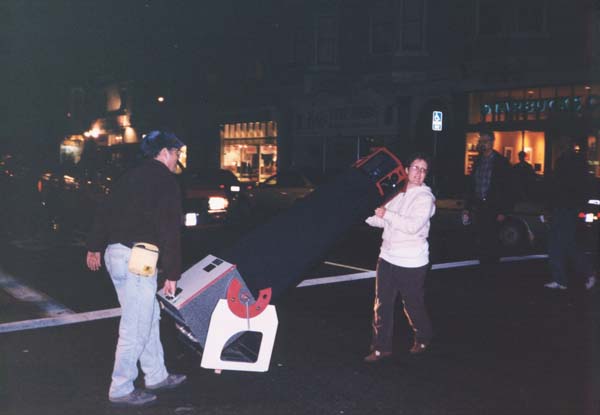
    Hauling a telescope across the streets of San Francisco about 10 years ago
    Hauling a telescope across the streets of San Francisco
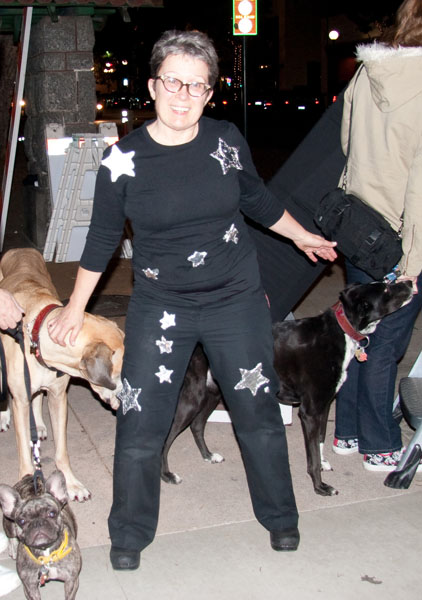
    Jane-Orion plus Canis Major and Canis Minor
    Jane-Orion plus Canis Major and Canis Minor
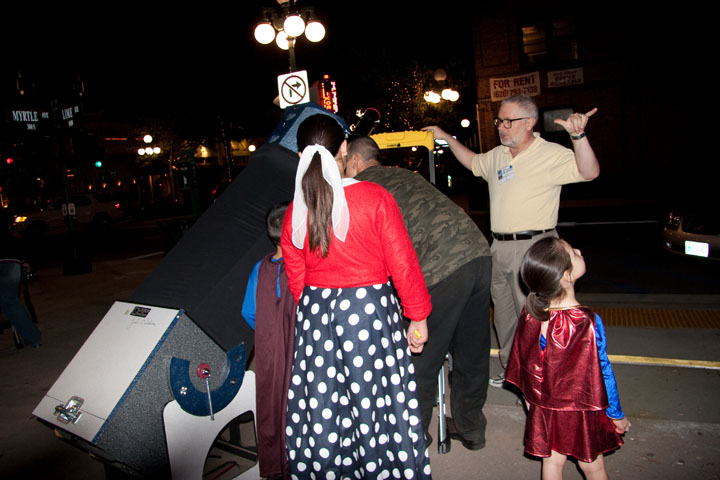
    Mojo demonstrating where to find Jupiter's moons
    Mojo demonstrating where to find Jupiter’s moons
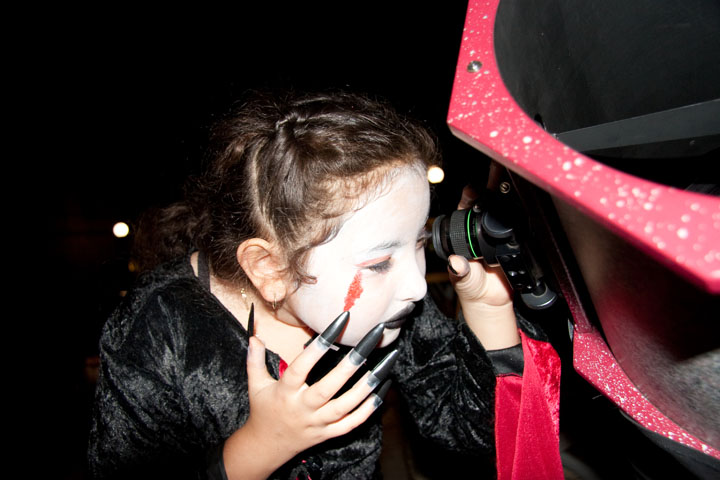
    Getting some eye candy
    Getting some eye candy

    Sidewalk Astronomers have been setting up telescopes on Halloween as long as there have been sidewalk astronomers!

    When we lived in the San Francisco Bay Area, we’d cross the Golden Gate Bridge from home and head to the Castro District of San Francisco on Halloween. It was crazy! Tens or maybe hundreds of thousands of revelers flock to the Castro on Halloween but I think we were the only ones with telescopes!

    That Halloween sidewalk astronomy tradition continues in San Francisco to this day. And now that we live in southern California we’re carrying on the tradition in our new home town.

    On Halloween, everyone with a telescope becomes a sidewalk astronomer. If there is a clear sky and a moon or planet to see, telescopes appear in front yards around the world. Astronomers love sharing the views, and a captive audience makes front yard astronomy a lot of fun for everyone.

    The magic of sidewalk astronomy took over Library Park in Monrovia,CA minutes after we arrived. On this Halloween night, our club had 5 telescopes set up. Soon, princesses, superheroes and zombies alike said wow at our eyepieces! People stayed and looked through the telescopes for a long time. Even groups of teens, on their way to some event stopped for a look at Jupiter and the moon. They said wow too!

    When I told one group of teenage girls that I didn’t have candy, but had bookmarks instead, one girl said “I love reading”. Every girl wanted their own bookmark. Later, a young boy, when he received a picture of Jupiter said “I am putting this picture on the wall in my room”.

    Sharing views of the moon and planets on Halloween is a great tradition. Pass it on!

    our club, the Old Town Sidewalk Astronomers

    Photo Album from our Sidewalk Astronomy Halloween weekend October 30-31, 2009

    A spooky list of telescope targets. Look if you dare!

  • Shuttle Discovery lands at Edwards AFB 9/11/09

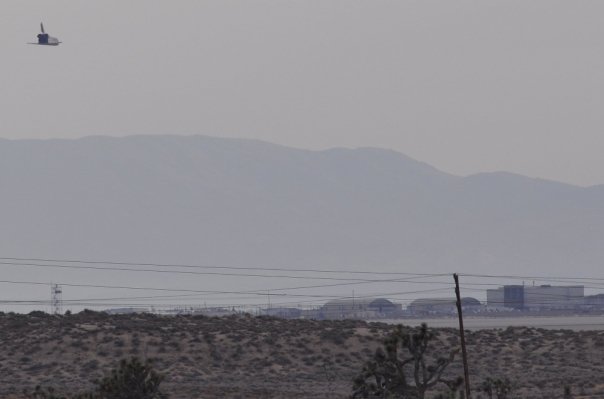
    Look for shuttle right of the contrail in my photo.
    Look for the shuttle to the right of the contrail in my photo (click on the image for full res version)
    Shuttle and ground in one image
    Shuttle and ground in one image. This photo and the rest of these photos courtesy of Gary Spiers
    Space shuttle Discovery
    Space shuttle Discovery
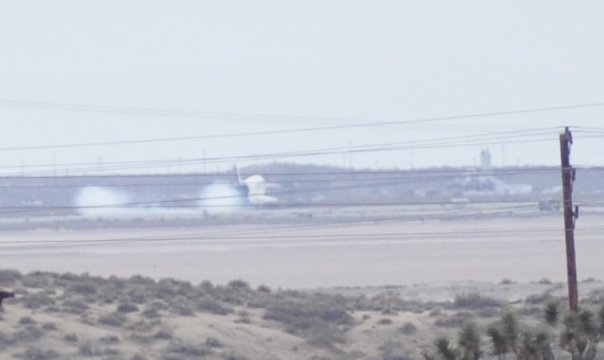
    Touchdown - twin dustplumes from gear touching down
    Touchdown – twin dustplumes from gear touching down
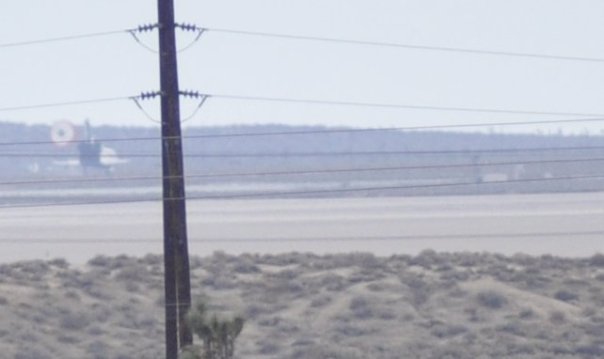
    Parachute deploys
    Parachute deploys

    NASADryden tweeted at 9:58 a.m. “We’ve been called up to support a potential shuttle landing today, see web for details http://www.nasa.gov/centers”

    1:35 p.m. “Shuttle will land at Edwards today, deorbit burn scheduled for 4:47 PDT, landing at 5:53 PDT”

    With landing scheduled at 5:53 p.m. PDT September 11, 2009 fellow astronomer Gary Spiers and I sped from Pasadena to Edwards Air Force Base to see one of if not possibly the last California landing of a space shuttle. We left Pasadena at 3:15 p.m. for the 2 plus hour drive.

    Navigator Gary scoped out the viewing choices while I drove. We passed Palmdale and headed for Rogers Dry Lake. Soon we saw groups of cars off California State Highway 58, and we headed further down the highway for a higher vantage point at the Northeast side of the lake bed. We turned off at the historic 20 Mule Team Road.

    I was receiving the Twitter updates from NASA Dryden on my cell phone. We arrived about a half hour before touchdown and setup camera gear in the 102 degree late-afternoon heat.

    We picked a perfect viewing spot. The shuttle would pass directly overhead on its loop from the West to runway 22 at Edwards Air Force Base. You can see the ground track, including the close range track of orbit 219 here.

    Here are the exciting tweets from NASADryden, which I passed along to the folks nearby:

    “15 minutes until touchdown, less than 1,000 miles away 5:38 PM Sep 11th

    Discovery is less than 700 miles away

    Right on ground track, 11 minutes until touchdown. Everything looking good

    Less than 277 to go, traveling at 7 times the speed of sound

    Approaching the CA coastline

    7.5 minutes till touchdown

    Discovery is 78 miles from Edwards

    Just heard the sonic boom here at Dryden! Discovery will be here soon!

    3 minutes till touchdown

    All eyes at Dryden are on the runway!

    Shuttle Discovery has landed at Edwards AFB, welcome back!

    Wheels stopped on Discovery with the National Anthem playing in the background. I love this country and NASA! ”

    Gary and I were snapping photos and recording video as honking, applause, whistles and cheers erupted from people inside, and alongside over 125 cars parked on the overpass, offramp shoulder, on and off 20 Mule Team Road.

    Soon the big rig drivers and other space enthusiasts were pulling off the shoulder and driving back to their daily life. Next to us Brad and Judy from Visalia lamented the dead battery in their camera as they planned to drive three hours back home. We exchanged email addresses and I’ll be sending them this report, photos and video of our first, and maybe last real-time up-close view of a shuttle landing.

    These photos courtesy of Gary Spiers whose images were shot using a Nikon D90 body with a Nikon 300mm F2.8 lens. My video and a few pre-landing snapshots were shot using a Pentax Optio M60 compact camera. Taken from 20 Mule Train Road on the Northeast side of the Rogers Dry Lake at the intersection of California Highway 58 and 20 Mule Team Road on September 11, 2009. We were over 5 miles away from the landing strip, but you can just barely see the dustplumes and parachute deployment at 1 min 42 seconds into my video.

    My video of Discovery Landing

    My video of Discovery Landing
  • Sidewalk Solar Astronomy

    I’m Jane Houston Jones. During the work week, I’m a Senior Outreach Specialist at the Jet Propulsion Laboratory in California where I coordinate informal education for the Cassini Mission to Saturn. It’s an exciting job, writing about Saturn, answering questions from the public, and working with museums and planetariums. I’m also the Twitter “voice” of the Cassini spacecraft, tweeting 140-character micro blogs “from” the spacecraft to over 9,000 enthusiastic Twitter followers. And I coordinate a 450-member international outreach network called the Saturn Observation Campaign .

    Once a month I develop a podcast called “What’s Up” which features a different monthly stargazing sight like the sun, moon or a planet, tied to a NASA mission. May 2009 is all about the sun!

    Outreach may be my day job, but since I am a sidewalk astronomer too, astronomical outreach is also my hobby! I belong to the Old Town Sidewalk Astronomers club. We like to show the sun, moon and planets to the community while conducting sidewalk astronomy events.

    Sidewalk astronomy is an informal way of bringing the universe to your community. On a sunny day I might take one of my telescopes down to a busy sidewalk in my town, park the car, unload and aim a solar safe telescope at the sun. I make sure that I have a ladder or step stool so the younger visitors can reach the eyepiece. I also have a sign on the telescope explaining to people never to look “directly” at the sun, or without a trained astronomer using a solar safe telescope. Before heading out, I take a look at several solar websites like SOHO and print out that day’s solar activity images. This way I can point out any interesting features to my guests, or if I have a helper, he or she can show the people in line what to expect at the telescope eyepiece.

    I have telescopes equipped with two kinds of filters and I bring both of them out on the sidewalk. One has a white light filter that shows how the sun looks to the unaided eye. The viewer sees the photosphere, or the apparent surface of the sun, which has a temperature of 6,000 Celsius. You can say this is the sun you can “see” or what you see through a projection onto a piece of paper.

    The other is an h-Alpha filter, which shows just one wavelength of light –the red light of hydrogen (wavelength of 656.3 nanometers). With this we see the next highest layer of the sun – the chromosphere (temperature between 6,000 and 20,000 C.) We need a filter to see this layer because the brighter photosphere layer below washes out the fainter chromosphere, just like a bright streetlight would wash out the light of a flashlight. What you see through an h-Alpha filter are ribbony dark colored filaments against the disk and prominences on the edge, many times longer than the diameter of the Earth!

    Often, my Old Town Sidewalk Astronomers members are asked by a scout troop or an elementary school to bring a solar telescope to camp or school or a local museum and we are more than happy to oblige. We ask the coordinator to check a few things about the location and time of the proposed event to see if there are trees or buildings in the way of the sun at the time they want to hold their event. I also ask the requester to choose a rain delay date in case we are clouded or rained out. And I always have a reserve “indoor” hands-on-activity in case of rain.

    If you don’t have a solar telescope, you might ask your local astronomy club to help out. If you have a telescope already, you can make solar filters or purchase them. I’ve made solar filters for almost all of my telescopes using the plans below and have purchased filters for the other telescopes. Both white light and h-alpha filters are available anywhere telescopes are sold. Solar projection using a pinhole projection is another safe way to view the sun. No matter what method or equipment you use, your viewers, just like mine, will be thrilled to have looked at their own star!

    Useful resources:
    Make your own solar filter:
    Make a pinhole projector: