Jane's blog banner

Tag: Add new tag

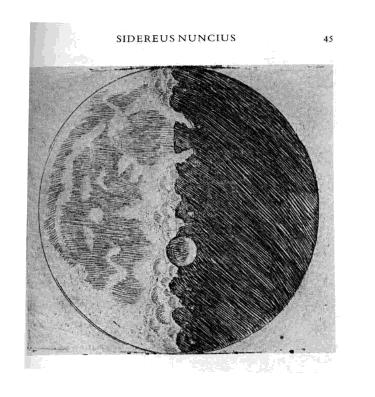
  • Chasing Galileo – 21-day old moon comparison

    galileomoon

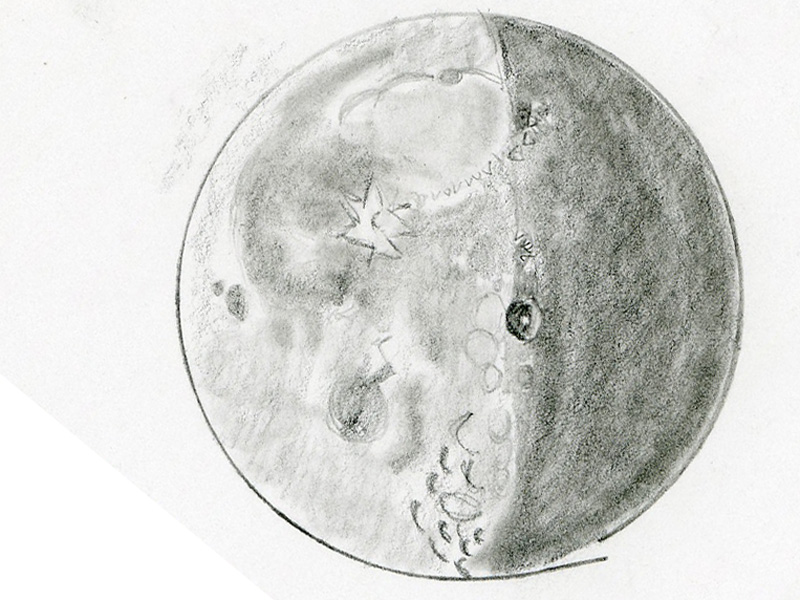
    My sketch of the moon same lunar day as Galileo's engraving
    My sketch of the moon same lunar day as Galileo’s sketch

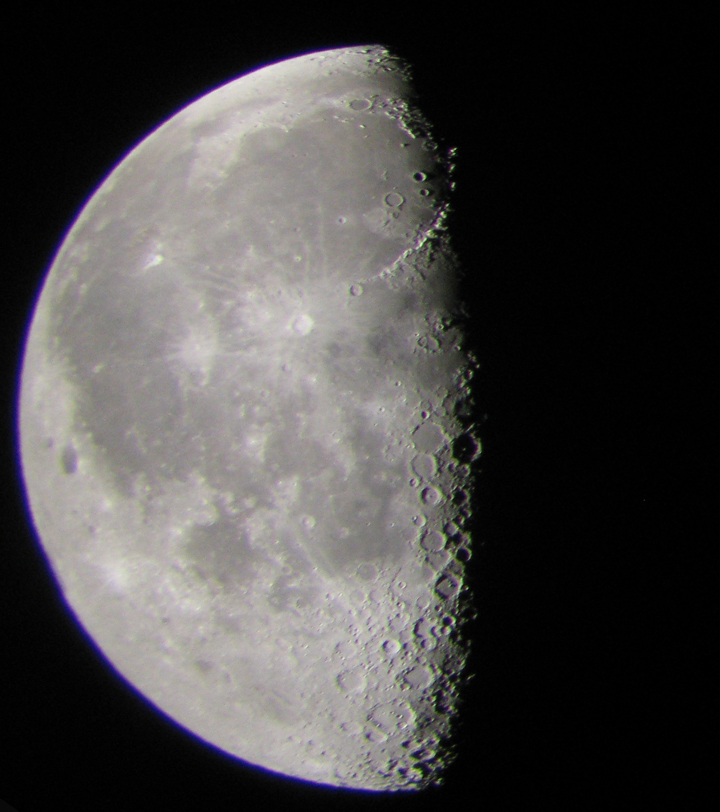
    Image take at eyepiece of 70mm TV Ranger while sketching on 7/14/09
    Image take at eyepiece of 70mm TV Ranger while sketching on 7/14/09

    Galileo’s drawing of the third quarter moon was made on December 18, 1609 according to widely accepted dates calculated by lunar scientist Ewen Whitaker. He used the solar colongitude and the latitude of the subsolar point on the moon to determine the position of the terminator. You can read more about it here on the Reliving Galileo’s Observations page (sorry, this link is gone as of Oct 2011). Refer to his Journal for the History of Astronomy, Vol. 9, p.155 Galileo’s Lunar Observations and the Dating of the Composition of Sidereus Nuncius article.

    You’ll have to scroll through the long article to find the colongitude and solar latitude of the original four engravings and seven small drawings. But you’ll find modern dates with a similar view of the moon. I was delighted to find that my sketch made on July 14, 2009 matched one of the 4 engraving dates!

    The predicted “modern” dates refer to the pattern of lighting and the position of the terminator relative to the surface features. Libration will make the craters and other features displaced somewhat with respect to Galileo’s drawings. Most folks do not actually see any resemblance between now and then, but it is a great project – sketching Galileo’s 400 year-old moon in a 21st century way.

    There is a quite a bit of agreement about the ”center” crater in Galileo’s sketch. It is most likely Albategnius. It was just on the terminator in my sketch too, and I accidentally made the crater a little larger than it really is. It’s just human nature I guess. Other features I can ID on both Galileo’s and my drawing are Mare Imbrium on both sides of the terminator, including some higher parts of Montes Caucasus lit on the unlit side of the terminator. I also can match the ghostly but well-lit trio of Ptolemaeus, Alphonsus and Arzachel just next to Albategnius on Galileo’s sketch, and I saw and sketched them too. Other sunlit Mare – Humorum (left) and Nubium (right) below Albagetnius also match up nicely.
  • Chasing Galileo: Jupiter and Neptune in the same field of view

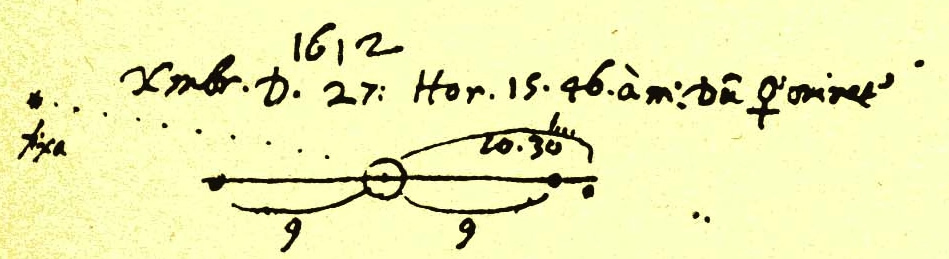
    Galileo noted a fixt star (at left), now known to be Neptune
    Galileo noted a fixt star (at left), now known to be Neptune on this sketch from December 28, 1612
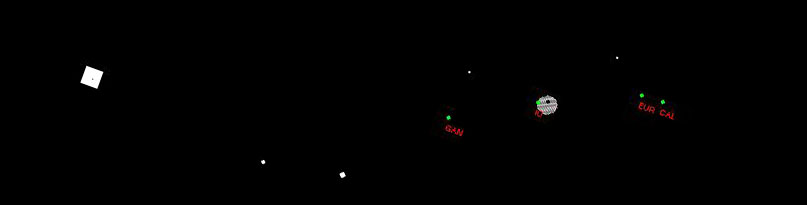
    Skymap Pro chart of Jupiter and Neptune (square at left), December 28, 1612
    Skymap Pro chart of Jupiter and Neptune (the square at left), December 28, 1612
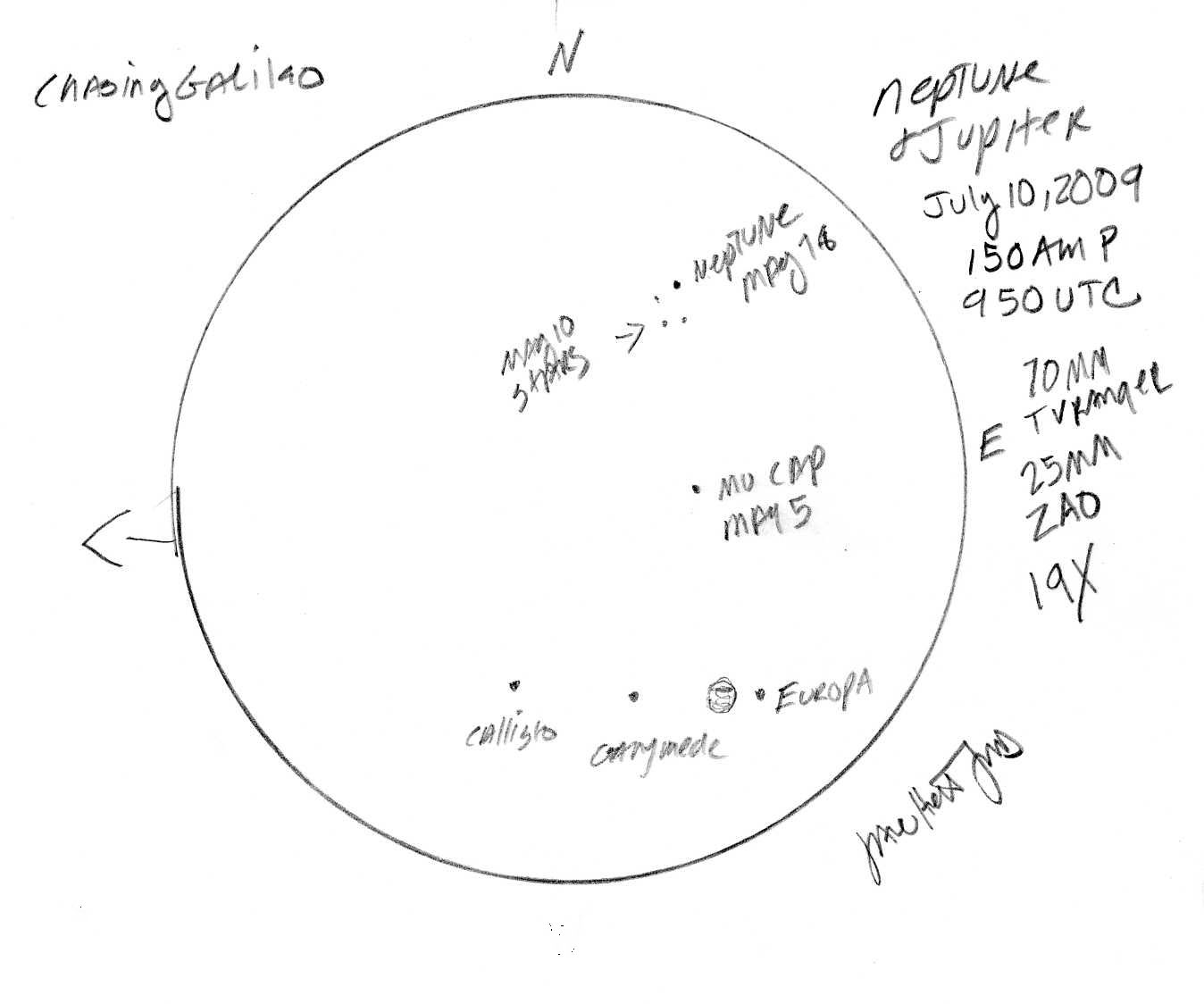
    My sketch of Neptune with Jupiter and the Galilean moons
    My sketch of Neptune with Jupiter and the Galilean moons

    Galileo made the first recorded observation of Neptune in 1612 when Neptune appeared to be close to Jupiter from his viewpoint on Earth. The”fixed star” Galileo noted to left of Jupiter (the left most star) on his December 28, 1612 sketch was actually Neptune! The two planets appear close to each other several times this year.

    This year, both planets come to opposition in August and for several months on either side of opposition, the two planets appear to temporarily move backwards against the background stars. This is called retrograde motion, and they pass near each other three times this year. On May 26, the planets were only 23′ (or 23 arc minutes) apart.  On July 9th, near when I made my sketch, the two planets appeared 33.5′ apart.  And on December 21, the Winter Solstice, you can look for Neptune below Jupiter, 32′ distant.  This is a great time to easily see both planets in the same low power field of view through a telescope! At higher magnification, they won’t be in the same telescopic field of view, but you’ll find Neptune with just a small nudge or “go-to” to the North.

    Galileo observed Neptune in December 28, 1612 and again one month later on January 27, 1613. Then, on the next night, he noted that the two stars seemed further apart. If he had observed the two objects again on the next few nights he would have realized that one of the “stars” was moving.

    If you have a chance to look at Jupiter in July 2009, you’ll easily spot Neptune if you know where to look. Here is a star chart for July 25th showing the location of both planets low in the southeast at 11:30 p.m. They are rising, and will be higher in the sky later on. And here is a closeup star chart showing the tip of Capricornus. Use this chart to locate Jupiter in your eyepiece, and then you can easily follow the stars to Neptune. These star charts are made by Sky Map Software.

    Neptune’s color in the telescope view is striking! It stands out as a bluish star to the north of Jupiter – about twice the distance north as the width of Jupiter and moons. After I sketched the pair of planets, I revved up the charting software, Sky Map Pro, and entered December 28, 1612. I was amazed to see the planets and moons layed out nearly as Galileo observed them. This may sound silly to you, but that 400 year-old view of the planetary lineup on 21st century software just took my breath away!

  • Chasing Galileo – fourteen-day moon

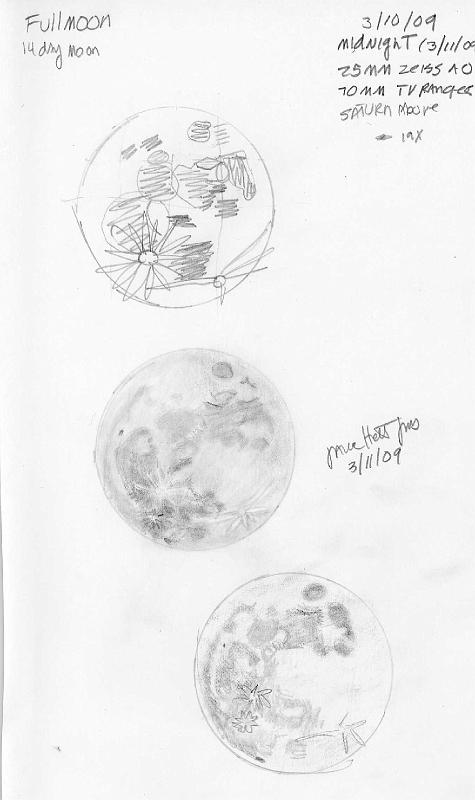
    fourteen-day (full) moon
    fourteen-day (full) moon

    The full moon rises as the sun sets on the 14th day of the lunar month. A small telescope, such as the 70mm f.8.7 Televue Ranger I’m using for this series of sketches is a perfect instrument for full moon viewing. So are binoculars. The moon is a very generous target, and even the least expensive department store telescope will provide you many hours, days, months and years of inexpensive lunar observing fun!

    The features you see on the full moon night are so different than the other nights. There are no shadows! So the features which stand out are the more reflective (bright white young craters and their ejecta) or the darker, less reflective mare.

    Many new lunar observers think the full moon is too bright to view through a telescope. It’s not, but there are some tricks you can use to make your full moon view more enjoyable. One trick I like is to use a higher power eyepiece when viewing the full moon. That higher magnification dims the apparent brightness of the full moon. Another trick is to observe the full moon next to a streetlight or normal outdoor house lighting. We hate those lights when they ruin our dark skies, but they don’t hurt lunar viewing one bit, in fact they improve it! I don’t like to use moon filters or neutral density or polarizing filters when observing the moon. They diminish the sharpness of the features I want to view.

    There are so many features I can identify on these sketches, but I’ll just mention the ones I have not covered before. My center sketch seems to be a little better than the “final” lower one. I can see, in addition to the great rayed craters Copernicus, Tycho and Kepler, lots of small bright white craters or ejecta. Proclus and Messier are near Mare Crisium, but it will take a map for you to find them. Proclus is a crater that is actually visible to the unaided eye at full moon, but I didn’t capture it on my sketch very well, probably because I made this sketch after midnight on a mid-week work night!

    My photo of the fourteen-day moon

  • Chasing Galileo – Head of Orion cluster

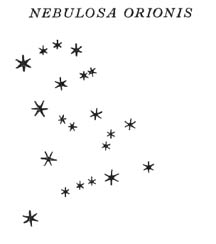
    Galileo's Head of Orion cluster
    Galileo’s Head of Orion cluster
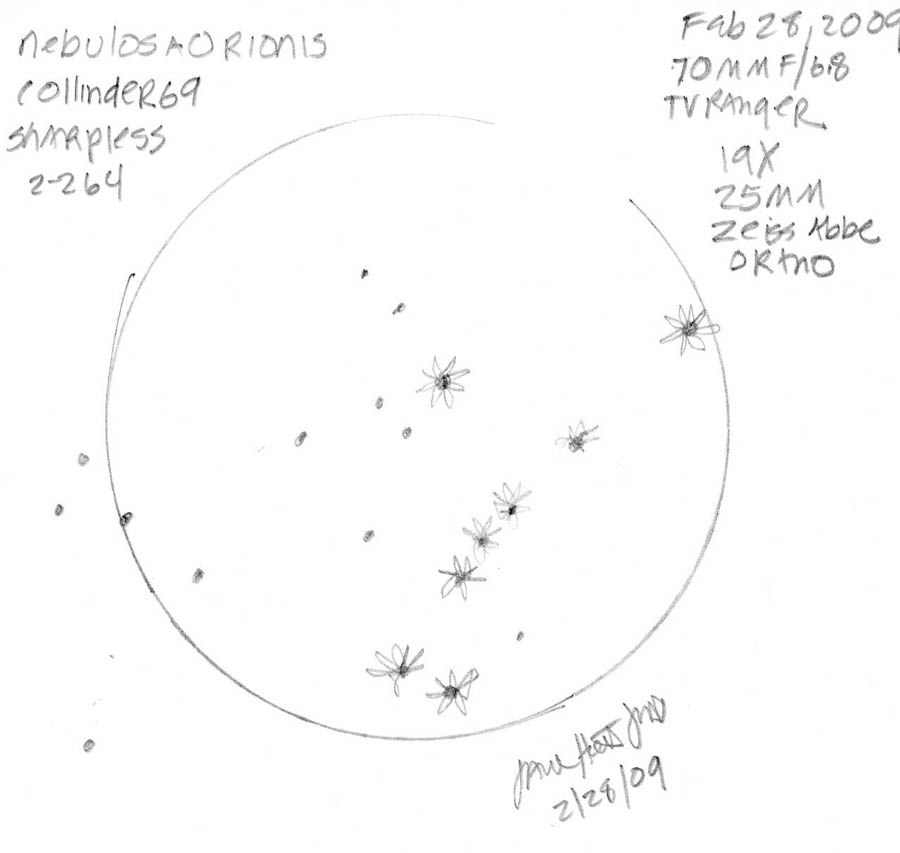
    Jane's Head of Orion cluster
    Jane’s Head of Orion cluster
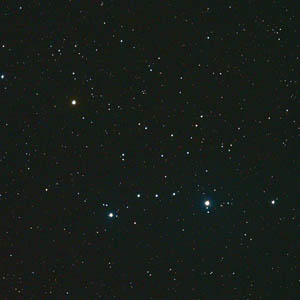
    Astrophoto of Orion Head cluster by Morris Jones
    Astrophoto of Orion Head cluster by Morris Jones
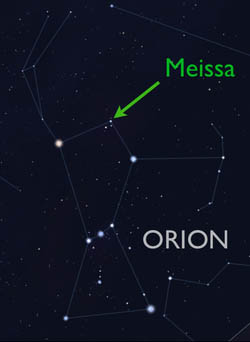
    Map of constellation Orion
    Map of the constellation Orion

    Galileo looked at the fuzzy patch surrounding the head of Orion through a telescope, and resolved many starts not previously known. He called it Nebulosa Orionis.

    Look between the shoulder stars Betelgeuse and Bellatrix of the constellation Orion. The star you see with your unaided eye is Orion 39 or Lambda Orionis. Its Arabic name is Meissa. You can find this star on Galileo’s drawing by following the stars at the bottom of the drawing. The first star at left is 37 Phi1 Orionis. Three smaller stars follow. The next one is Meissa. It’s an amazing star! Surrounding the hot class O star (which also has a double) is a 150 light year ring of gas, which you can read about at Jim Kaler’s Stars website link above.

    We now refer to the open cluster which contains this star as Collinder 69 or Sharpless 2-264.

    A hand drawn original diagram of Galileo’s 21 stars can be found in Volume 3, page 964 of the National Edition.