Jane's blog banner

Tag: ARIA

  • Counting meteors from Amboy Crater – Lyrids 2012

    Amboy Crater at dawn
    Amboy Crater at dawn
    2012 Lyrid Meteor Shower Meteor Profile showing peak near 04h-06h UTC
    2012 Lyrid Meteor Shower Meteor Profile showing peak near 04h-06h UTC
    My visual meteor observing report with 30 minute (or less) intervals, and magnitude distribution
    My visual meteor observing report with 30 minute (or less) intervals, and magnitude distribution

    Saturday night, April 21, Mojo and I headed to our new favorite dark sky spot, Amboy Crater, one of the darkest observing locations in the US. This spot has great horizons and its remoteness keeps all but the serious observers away, though we’ve met delightful observing buddies at this spot. Our one way drive from Monrovia, CA is 170 miles, fyi.

    After a night of observing, you can’t beat the morning hike to Amboy Crater, a 6,000 year old volcanic cinder cone, either. Even in the summer it’s cool at dawn. Look carefully at the oxidized lava beds as you follow the hiking trail to the crater and you might find some Chuckwalla lizards! Chuckwallas can reach 16 inches in length, weigh up to 2 pounds and are specially adapted for desert living. Chuckwallas are my very favorite herps, well, next to the desert tortoise, that is.

    The peak of the Lyrids occured at 1:30 a.m. Eastern (10:30 Pacific). The constellation Lyra was barely above my horizon at that hour. This meant the highest rates were probably recorded several time zones east of my California location. I set up my observing area, shut my eyes until about 11:00 p.m., and then I managed to observe straight through the night — from 11:40 p.m. until just before dawn at 5:16 (6:40h – 12:16h UT).

    Here are a few tips I use to prepare myself for a night of meteor counting. First, I read Bob Lunsford’s weekly meteor shower recap on the Yahoo meteorobs group email list which discusses amateur meteor astronomy. It’s a good place to “lurk” and learn.

    Bob wrote “The Lyrid (LYR) shower is expected to reach maximum activity on the night of April 21/22 with rates up to 15 shower members per hour. The radiant is located at 18:08 (272) +33. This area of the sky is actually located in extreme eastern Hercules, eight degrees southwest of the brilliant blue-white star Vega (Alpha Lyrae). The radiant is best placed just before the break of dawn when the radiant lies highest in the sky. While Lyrid meteors can be seen in both hemispheres, the north is favored as the radiant lies much higher in the sky. Rates will fall rapidly after maximum and little activity will be seen the remainder of the week. At 48km/sec. the Lyrids would produce meteors of medium-swift velocity. It should be noted that the Lyrids can occasionally produce bright meteors of fireball class magnitude.

    Next I familiarized myself with the spring sky and printed out some all-sky charts, marking the radiant between Lyra’s bright star Vega, and the Keystone section of Hercules. I then decided where to look — 50-70 degrees above the horizon, 20-40 degrees away from the radiant. I selected the area around the bright star Arcturus in the constellation Bootes. When counting meteors you don’t want to look directly at the radiant as the meteors will look like short streaks, or points of light.

    For this shower the rates were not expected to be too high, so I decided to record (for my first time) the magnitude of each meteor. I made a note of the magnitude of Saturn, Mars and Venus and re-familiarized myself with the magnitudes of many bright stars nearby during my prep time. Then, I selected two small constellations (Corona Borealis, and the head of Draco) which contain magnitude 2-5 stars and memorized their magnitude.

    Armed with all these stellar magnitudes, I settled down and waited for it to get dark. Once it did, I began the first important observation — estimating the limiting magnitude. The limiting magnitude is the magnitude of the faintest star near the zenith that the observer can detect using the slightly averted naked eye. It defines both the condition of the sky’s clarity and the quality of the observer’s eyes. I keep a set of these charts on a clipboard and take them with me on all observing trips, even if I am not observing meteors. Every 30-45 minutes, between my half-hour counting sessions, I re-counted the stars in the selected areas, to note any changes in the sky clarity or the condition of my own eyes.

    In a nutshell my skies were Magnitude 6.5, which is very dark. Weather conditions: clear, 98 degrees at sunset, 62 degrees at dawn. It was a shirtsleeve weather night almost all night long, tho’ I put on a fleece jacket at about 4 a.m.

    Between 11:40 p.m.and 5:16 a.m. (06:40h – 12:16h UT) I counted 36 Lyrids, 6 Sporadics and 2 Anthelion meteors. A quarter of the Lyrids I saw were very bright -1 or brighter meteors. I took short breaks between counting sessions to re-estimate the limiting magnitude, have a snack, check on what Mojo was imaging through his telescope, stargaze through my own scope, etc.

    06:40h-07:10h UT – 7 Lyrids
    07:30h-08:00h UT – 3 Lyrids
    08:15h-08:45h UT – 5 Lyrids, 1 sporadic
    08:50h-09:20h UT – 5 Lyrids, 1 sporadic
    09:30h-10:00h UT – 6 Lyrids, 2 sporadics
    10:05h-10:25h UT – 1 Lyrids, 1 sporadics, 1 Anthelion
    Break to look at Saturn, have a snack, scan Milky Way
    10:59h-11:29h UT – 2 Lyrids, 1 Anthelion
    11:30h-12:00h UT – 7 Lyrids (2 fireballs!)
    12:01h-12:16h UT – 1 sporadic

    You can see that I saw the most meteors just as I was getting started (which was near the peak) and again near dawn (when Lyra was at its highest in the sky). Just before 5 a.m. 12h UT both Mojo and I saw a very bright bollide, greenish in color in the western sky. I estimated its magnitude at -5, brighter than Venus. It probably was much brighter. Coincidentally, 3 hours later an even more impressive bollide streaked across the California Sierra foothills, and broke up in the atmosphere, sprinkling meteorites over a wide populated area. Both of these bollides were Lyrid fireballs!

    My other Meteor blogs and adventures

    Flying through the Leonid Storm of 1999 – aboard USAF’s ARIA from Edwards AFB

    Leonids 2002 – aboard NASA’s DC-8 from Dryden Flight Research Center

    Observing meteors from the city – yes you can!

    My meteor observing gear

    January Quadrantids and a demoted constellation

    August Perseids and meteor recording tips
    Lyrid 4/22/12 fireball movie with radiant map

    Mojo’s astrophotography from Lyrid shower night

  • Flying through the Leonid Storm of 1999

    s-houstonimage2

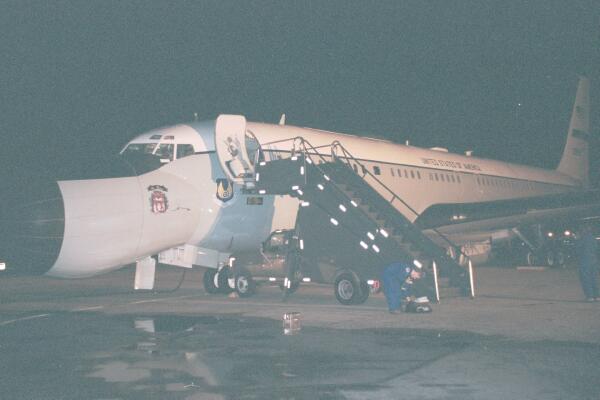
    ARIA Advanced Range Instrumentation Aircraft
    ARIA Advanced Radar Instrument Aircraft
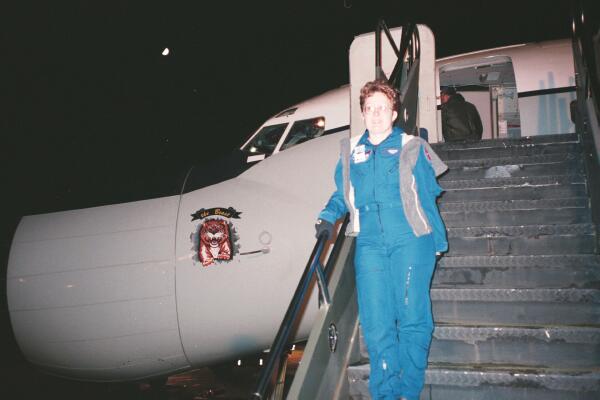
    Jane boarding the ARIA
    Jane boarding the ARIA
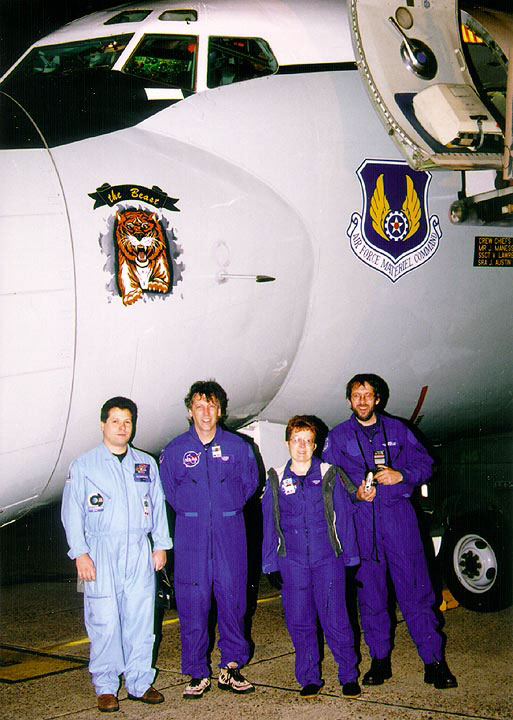
    4 of the 6 IMCU team members in front of the ARIA nose
    4 of the 6 IMCU team members in front of ARIA

    November 1999: 10 days, 40 flying hours, 65 researchers and Air Force personnel, five members of the press, seven Air Force bases (four US, two UK, one Azores), 6 amateur astronomers, three aircraft, 15,251 meteors, one amazing memory. I’d like to thank Dr. Peter Jenniskens, the Leonid MAC principal investigator for inviting me to participate on this (and other) meteor missions over the past 11 years.

    I was part of a six-person team of experienced amateur astronomers/meteor observers who were invited to fly around the world for 10 days, preparing for and then counting the Leonid Meteor Storm of 1999. We traveled from Moffat Field AFB near San Francisco over the San Andreas Fault to Edwards Air Force Base in Southern California for debriefing, badging, flight practice and setting our internal clocks a week of Leonid night flights. Then we flew across the United States and the Atlantic Ocean to England. Next, over Europe and Africa to Israel, back through the great Leonid storm to the island of Terceria in the Azores on the Mid-Atlantic Ridge. After a press conference, interviews and a celebratory dinner at Lajes Air Field we flew back to Patrick AFB in Florida for an end-of-mission party in Cocoa Beach, FL. Finally we crossed the US once again and flew right over Meteor Crater Arizona and back to Edwards AFB.

    The entire crew flew on three aircraft, the ARIA, a Boeing 707, Advanced Range Instrumentation Aircraft. It has a telemetry antenna dish in the nose of the aircraft and four INMARSAT communication channels for internet and voice mail uplink, plus lots of windows, some installed for this mission. The second aircraft was the FISTA, a modified NKC-135E tanker called the Flying Infrared Signature Technology Aircraft, with 20 upward-looking window ports. The third aircraft, a C-130 provided airlift support for parts and emergency repair capability for the FISTA and ARIA aircraft. They also provided a global command and control platform for mission coordination.

    Once the wheels were in the well, we headed for McGuire AFB in New Jersey to refuel for the trans-Atlantic flight. We took off at midnight from McGuire, and had a practice setup and observing run as we crossed the Atlantic. Seven hours later we landed at Mildenhall AFB near Cambridge. We counted 10 Leonids and 10 sporadics per hour during the practice run. We observed the Aurora Borealis and sprites, upward lightening strikes, thought to be induced by meteors.

    On the second night flight we flew from England to Israel. We tested and calibrated our instruments, then observed and recorded 15 – 20 Leonids per hour, after making comets and giving talks at an elementary school near Lakenheath RAF Base.

    On the third flight night we flew from Ben Gurion Airport in Israel to Lajes Air Field on Terceria Island in the Azores. This was the night we chased the Leonids and raced the sunrise. We observed the peak of the Leonid Storm of 1999 from 40,000 feet!

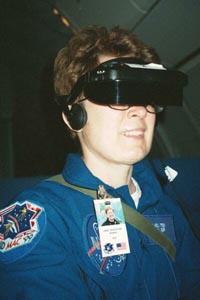
    My team, the IMCU (Intensified Meteor Counting Unit) used intensified CCD cameras aimed out the windows of the ARIA. Some cameras covered the horizon to 30 degrees above, and some from 30-60 degrees. The cameras were connected to video headsets. As we viewed the intensified images we captured Leonids and sporadic meteors by mouse clicks reported to counting software. We observed and counted a ZHR (Zenithal Hourly Rate) of 2300 Leonids per hour. I personally observed 2700 Leonids on storm night alone. Our total was over 15,000!

    On the fourth night from the Azores to Florida, we observed all night long again to collect data and measure the sporadic meteor count. Sprites and elves were captured by the airglow measuring camera on this night.

    The final flight took us from Florida back to Edwards Air Force Base. We all looked out the windows in the bright daylight and saw the remnant of an earlier cosmic collision – Arizona’s Meteor Crater!

    From the press:

    Astrobiologists on a NASA mission to study the Leonid meteors were in the right place at the right time to study a rare natural phenomenon — a meteor storm.

    At the peak of the storm, which occurred at 02:10 GMT, Nov. 18, 1999, the Leonid meteors were falling from the sky at a rate of 2,200 per hour. A meteor shower is classified as a storm when the rate exceeds 1,000 meteors per hour.

    Sixty researchers aboard the $1 million joint NASA-Air Force mission hollered and hugged as the Leonids barrage intensified, and the jets traced slow circular routes over the Mediterranean between North Africa and Cyprus. Individual meteors soon multiplied to a half-dozen white streaks screaming over the horizon at 40 miles per second.

    ”I’m not on Cloud 9 – I’m above it!” quipped Jane Houston of the California Meteor Society, one of several amateur astronomers on the meteor-counting team. A total of 15,251 meteors were counted during the six-hour observation period on the overnight flight from Israel to the Azores.

    Near real-time data on the number of meteors falling per hour was provided to NASA and the U.S. Air Force by a team of amateur astronomers who counted the meteors using virtual reality goggles and laptop computers. The meteor counting team was aboard the ARIA (Advanced Range Instrumentation Aircraft), one of two aircraft provided by the United States Air Force to support this mission. The data was sent from the ARIA, an EC-18 aircraft, to the ground via the TDRS satellite system. NASA and the Air Force are joint sponsors of the 1999 Leonid Multi-instrument Airborne Campaign.

    Leonid Multi-Instrument Aircraft Campaign team, 1998-2002 (I’m bottom row, third from left)

    Leonid memories 1998-2002

    Jane Houston’s Leonid 1999 diary