Jane's blog banner

Tag: binoculars

  • What’s Up in 2013 at a glance

    All year long, astronomers have been writing about Comet ISON: will it sizzle or will it fizzle? Both! Here’s my What’s Up video, with December status (written in mid November, but luckily, the comet didn’t completely fizzle)

    ISON in December 2013

      Comet ISON first spotted by amateur astronomer Bruce Gary and has been imaged by many eagle-eyed observers with good astrophotography equipment since mid August. A selection of images and data are shown here. I’ll update this frequently as more is understood about Comet ISON. Meanwhile, here is a wesbite with current Comet ISON magnitude and location which is constantly updated!

      Comet ISON survived its close pass of the sun on November 28. Scientists are unsure what is actually left of the comet. A fragmented nucleus? Nothing but orbiting dust? Stay tuned!

      Here’s an excellent Star Chart showing Comet ISON’s path in November, courtesy of Skyhound’s Skytools3 software. (These are the charts I use for my own deep sky observing.) The chart has not been updated for December as of November 30th.

      Latest visible comet news here.

    December 2013

      ISON will be visible both before dawn and after sunset this month, though it is fading as of November 30th! It will appear higher in the sky at dawn than at sunset, providing a better chance to see it. During the second half of December, Comet ISON should fade rapidly as it moves north. It will be closest to Earth in its orbit on December 26.

      You may have noticed a very bright ‘star’ in the western sky. That’s Venus! Venus shines at its very brightest, magnitude -4.9 this month. It sets about three hours after sunset at the beginning of the month and one and a half hours after sunset at the end of the month. This is a great month to view the dramatic changes in the apparent diameter and phases of Venus as it races towards its conjunction with the sun. The first observations of the phases of Venus were made by Galileo in 1610!

      Mars continues to grow brighter and rises near midnight, and Jupiter rises earlier in the evening, heralding the best viewing season for Jupiter watchers.

      The beautiful Geminid meteor shower will only slightly be marred by moonlight on the night of December 13 and 14. The radiant lies near Gemini with brilliant Jupiter above and the constellation Orion below. From a dark sky, but even from the city, the mighty hunter Orion is easily visible in the southeast sky. Take a look at Orion’s shoulder star, red Betelgeuse and its knee star, blue Rigel and the Orion Nebula.southwestern horizon.

      The Milky Way and all the visible planets and comets should encourage stargazers to escape the city lights this month. Join me in the California Desert November 30, at MOjave National Preserve. We have no chance to See ISON for another week, but there are other nice comets, planets, stars, and dark sky objects too enjoy from dusk to dawn.

        If Comet ISON survives its perihelion pass we should have a spectacular view of the comet’s dust tail in December.

        The times to look will be just after dusk, low to the horizon at sunset, and higher at dawn for northern latitudes the first half of the month. On December 1, look for a pretty diagonal lineup of the comet, Mercury and the crescent moon just before sunrise in the southeast. Then for the second half of the month, the comet becomes circumpolar. It will appear near the constellation Draco on December 26th, when it is half an a.u. (0.42 a.u.to be exact) from Earth. Will the comets’ tail span a quarter of the sky? I’ll update this as more info is available.

        Jupiter reaches opposition January 4th, 2014, and rises earlier in the evening. Venus bright as it ever gets – a whopping magnitude -4.9. It will be a fabulous view – a particularly good astrophoto and sketching target as it grows in diameter, but shrinks in phase. Mars increases in brightness and rises earlier (after midnight). Mars will be a great target for 2014.

      That’s all for this year, I’m Jane Houston Jones

  • A morning comet

    Use a chart like this to locate where to look for your object
    Can you find the constellation Perseus and comet McNaught in Mojo’s lovely skyscape?
    Mojo's photo of Comet McNaught
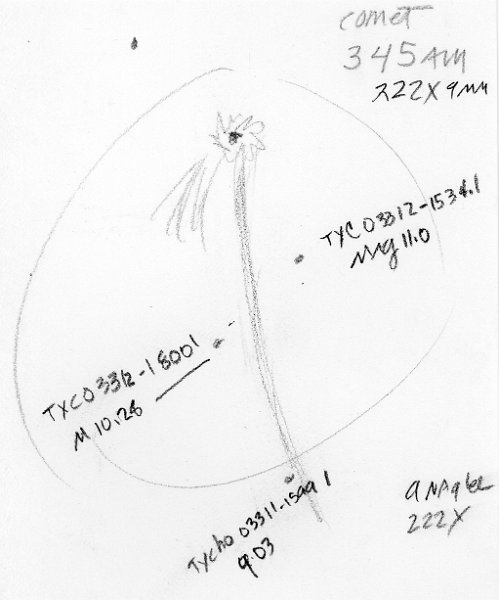
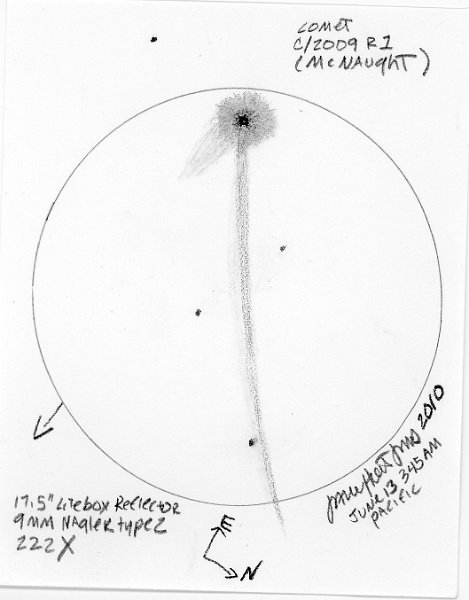
    Quick comet sketch with notes. See the long ion tail, the bright coma, and the short dust tail in my sketches
    Comet C/2009 R1 (McNaught) June 13, 3:45 am from Chuckwalla Bench observing site, Colorado Desert. Lat 33N, Long 114W, Elev 1400 ft

    I wish everyone in the world could see just one comet! Right now, there is one visible just as the dawn brightens the night sky. Unfortunately, it’s not easy or convenient to see this one, and in another ten days it will disappear below our horizon. It’s just barely visible to the unaided eye. Timing your viewing window is tricky, too. You have to find a balance between the time the comet rises high enough to see, and the coming of dawn, which robs the night of its darkness and guidepost stars an hour or two later.

    Here are some tips to help you have a successful comet viewing experience now or in the future. When you first hear about a visible comet, you can usually find some online sky charts from astronomy magazines such as Sky and Telescope and Astronomy. Many online sources can offer guidelines and observations, too.

    Star charts are fine, but you have to go out and navigate the real sky to find unfamiliar constellations. From the city, or close to dawn, this is a real challenge. You may only see a few bright stars in the sky. Try to see the stars making up the constellation Perseus in Mojo’s image. I’ll admit, it isn’t easy, especially when you are rushing against time. Now, compare his image to the star chart. And you’ll soon see the figure of the hero, Perseus, starting to emerge.

    I use the familiar “W” shaped constellation Cassiopeia as a signpost to locate Perseus. Then I see Perseus with his two running legs, joined at the bright star Alpha Perseus (Mirfak). Nearby you can see the naked-eye open cluster known as either Melotte 20 or the Alpha Perseii cluster. Next, I make a mental triangle out of Alpha, Delta and Kappa Perseii, the three bright stars closest to the comet shown on the star chart.

    Finally, I aim my binoculars at the triangle of stars and hold my breath. Then I see it, and I quietly say “hello” to the swift celestial traveller. I get chills every time I see a comet. And this time is no different. A little green fuzzball is right where the comet should be.

    Now I jump into action. I dust the cobwebs out of my brain, as well as I can at 3:45 am in the morning. I’ve just woken up from a short nap. I quickly sketch what I see in the eyepiece of my big telescope, taking care to mark any stars nearby, and note the time. Then I call everyone who is awake over for a look. We all move sluggishly in the near dawn light, like we are walking through sandy molasses. We share views with one another, through binoculars and a variety of telescopes large and small.

    Overhead, the Milky Way has disappeared, and the glow of twilight grows brighter. I have yet another predawn observing target, so I quickly make a second sketch with a little more detail. Then I nod goodnight to the beautiful green comet, aim my binoculars just a little to the east and wait. It will be nearly one hour before Mercury will rise over the mountains.

    This comet is making its first approach around the sun, in its long hyperbolic orbit from the Oort Cloud. At the time of my observation, the comet was 0.6 AU from the Sun and 1.1 AU from Earth. By the end of June, it will be lost to our view. It reaches perihelion on July 2nd when it is about 0.4 AU from the sun. Then it will fade and be seen no more.

    Added postscript: According to this Space.com article, the comet may be visible “after June 22 both in the evening sky for a short while just after sunset very low above the north-northwest horizon and in the morning sky just before sunrise very low above the north-northeast horizon.” I’ll update if/when I learn more.

    See more of Mojo’s photos from this observing night.

    Read my other observing writeup from this same night.

    Join our Old Town Sidewalk Astronomers email list and find out when our next dark sky outing will be. Or join us at our next in-town new telescope users clinic and planet/moon viewing event. Hey, that’s tonight, June 19! Clinic (RSVP required) begins before dark at 7 p.m. Star Party continues until 9:30 p.m. at Library Park in Monrovia, CA.