Jane's blog banner

Tag: comet sketches

  • My first view of Comet PanSTARRS 3/11/13

    Sunday morning (Sunday March 10) we drove home from a wonderful Amboy Crater observing night. As we drove up our street, we have a good view of Mt. Wilson and the telescopes, as you can see here. My Comet PanSTARRS sketches (and astrophotos tomorrow) from near the Mt. Wilson Observatory (but on the other side of the mountain) are below.
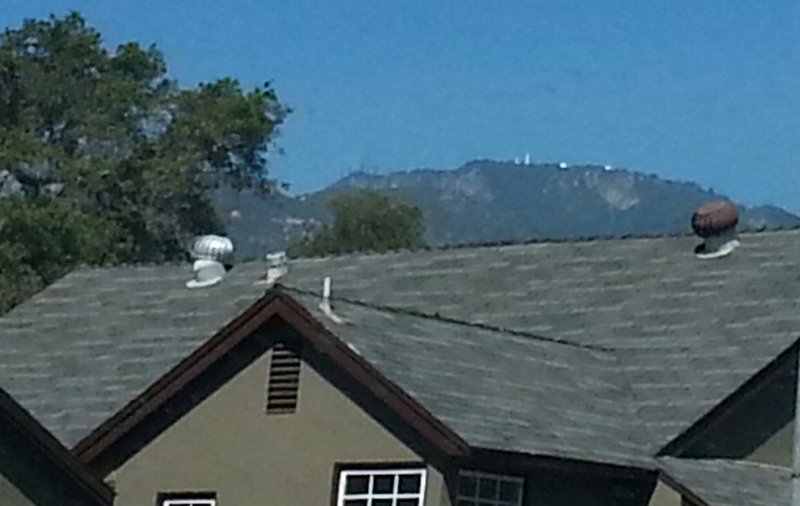
    http://pMt. Wilson 100 & 60-inch telescope domes and solar telescopes from home
    Mt. Wilson 100 & 60-inch telescope domes and solar telescopes from home

    I drove past the telescopes on Angeles Crest Highway 2 to catch a glimpse of the comet. From home, Mt. Wilson is about 7 miles away as the crow flies. Not being a crow, I drove 13 miles to work, then 3 miles to Angeles Crest Freeway, then up 20+ miles and 5,200 feet in elevation on the mountain highway to get this view — that’s the historic 100-inch Mt Wilson Hooker telescope dome and the two solar telescopes on the ridge.
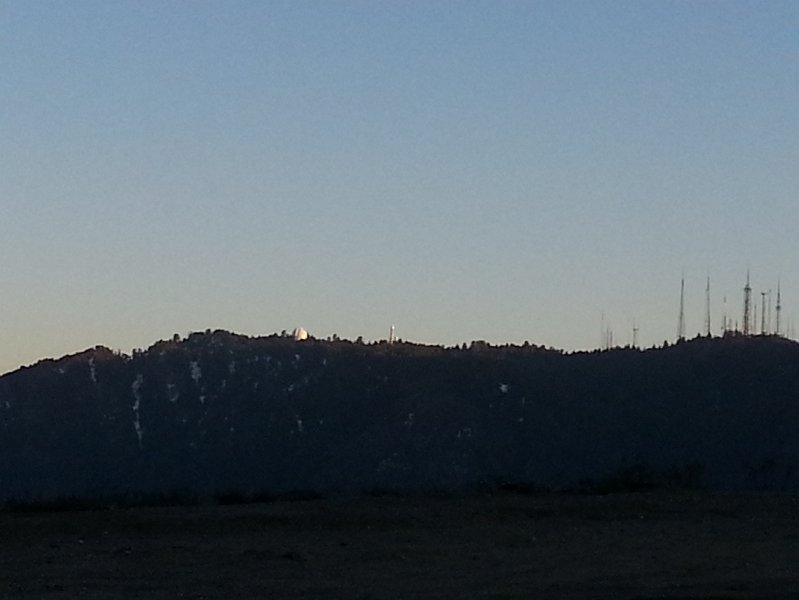
    Passing Mt. Wilson telescopes from Angeles Crest Highway
    Passing Mt. Wilson telescopes from Angeles Crest Highway

    We arrived at our viewing location, 23.5 miles up the hill, milepost 48.34, 34d 18′ 26″ N Latitude 118d 00’54” W Longitude, altitude 5266 ft before sunset – the Chileo turnout just before the Caltrans yard on Angeles Crest Highway. I am indebted to my friend Steve Edberg, who has observed on these pullouts since the 1970’s. We passed many other spots which he has observed from, but which didn’t have the required “dip” in altitude, which provided a view of the western horizon depressed to a further 1 degree.
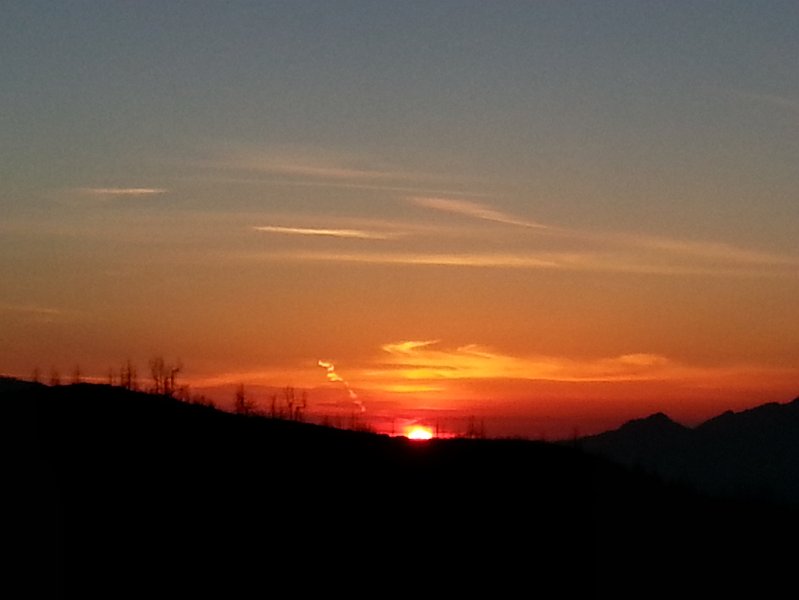
    Sunset (and green flash) at my comet viewing spot on Angeles Crest Highway
    Sunset (and green flash) at my comet viewing spot on Angeles Crest Highway

    We had to wait over a half hour after sunset for the twilight sky to darken. Civil twilight occurred at 7:22 p.m. PDT, when the sun dipped 6 degrees below the horizon. We scanned the sky, not only looking for the comet, but for the moon, too. But the new moon was only about 6 hours old (new at 12:52 p.m. Pacific Daylight Time March 11, and impossible to see). Thanks to Steve Edberg for explaining “horizon depression”:”Due to our elevation, looking down from 5,266 feet, the terrain horizon in the distance was lower than horizontal, so we could look “down” far enough that we gained one degree more of viewing potential. This dip of the horizon doesn’t include the terrestrial refraction at the apparent horizon, which often “raises” astronomical objects (meaning they set later than airless geometry predicts)”.

    Here is what we did see, beginning at 7:34 p.m.

    Here is my first sketch. Showing what Comet PanSTARRS looks like through 7 x 50 binoculars with a 7 degree field of view. We were unable to see it naked-eye. I couldn’t get both the horizon and the comet in the same binocular field of view.
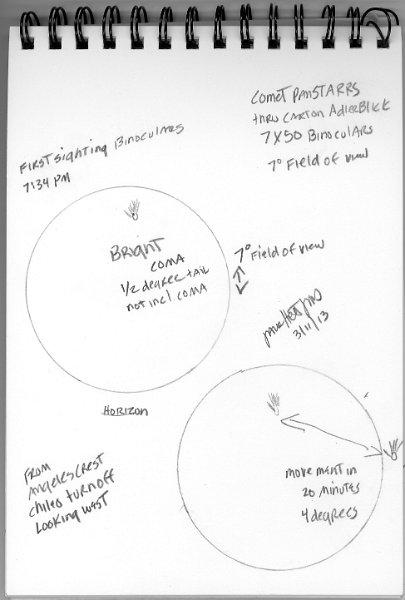
    Sketches show my binocular view - this is what Comet PanSTARRS looked like through binoculars
    Sketches show my binocular view – this is what Comet PanSTARRS looked like through binoculars

    Here is the final view through bigger binoculars just before the comet was lost in the haze. Celestron 9 x 63 binos, with a 5 degree field of view. It was amazing to watch the speedy comet move!
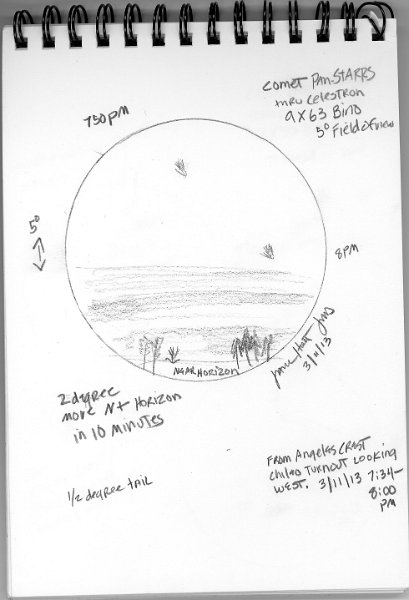
    Last views of Comet PanSTARRS (on first observation)
    Last views of Comet PanSTARRS (on first observation)

    NASA’s Prime Time for PANSTARRS Toolkit with charts, and observations and more.

    What’s Up PanSTARR Edition Podcast

  • A morning comet

    Use a chart like this to locate where to look for your object
    Can you find the constellation Perseus and comet McNaught in Mojo’s lovely skyscape?
    Mojo's photo of Comet McNaught
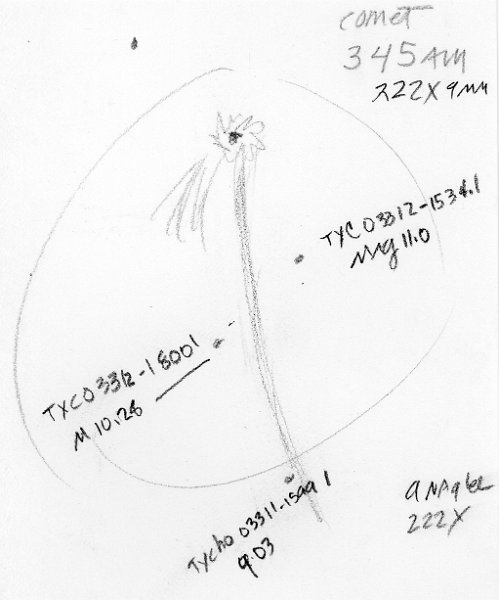
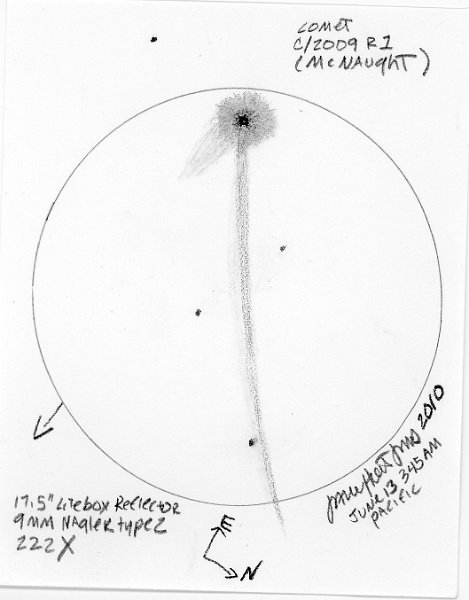
    Quick comet sketch with notes. See the long ion tail, the bright coma, and the short dust tail in my sketches
    Comet C/2009 R1 (McNaught) June 13, 3:45 am from Chuckwalla Bench observing site, Colorado Desert. Lat 33N, Long 114W, Elev 1400 ft

    I wish everyone in the world could see just one comet! Right now, there is one visible just as the dawn brightens the night sky. Unfortunately, it’s not easy or convenient to see this one, and in another ten days it will disappear below our horizon. It’s just barely visible to the unaided eye. Timing your viewing window is tricky, too. You have to find a balance between the time the comet rises high enough to see, and the coming of dawn, which robs the night of its darkness and guidepost stars an hour or two later.

    Here are some tips to help you have a successful comet viewing experience now or in the future. When you first hear about a visible comet, you can usually find some online sky charts from astronomy magazines such as Sky and Telescope and Astronomy. Many online sources can offer guidelines and observations, too.

    Star charts are fine, but you have to go out and navigate the real sky to find unfamiliar constellations. From the city, or close to dawn, this is a real challenge. You may only see a few bright stars in the sky. Try to see the stars making up the constellation Perseus in Mojo’s image. I’ll admit, it isn’t easy, especially when you are rushing against time. Now, compare his image to the star chart. And you’ll soon see the figure of the hero, Perseus, starting to emerge.

    I use the familiar “W” shaped constellation Cassiopeia as a signpost to locate Perseus. Then I see Perseus with his two running legs, joined at the bright star Alpha Perseus (Mirfak). Nearby you can see the naked-eye open cluster known as either Melotte 20 or the Alpha Perseii cluster. Next, I make a mental triangle out of Alpha, Delta and Kappa Perseii, the three bright stars closest to the comet shown on the star chart.

    Finally, I aim my binoculars at the triangle of stars and hold my breath. Then I see it, and I quietly say “hello” to the swift celestial traveller. I get chills every time I see a comet. And this time is no different. A little green fuzzball is right where the comet should be.

    Now I jump into action. I dust the cobwebs out of my brain, as well as I can at 3:45 am in the morning. I’ve just woken up from a short nap. I quickly sketch what I see in the eyepiece of my big telescope, taking care to mark any stars nearby, and note the time. Then I call everyone who is awake over for a look. We all move sluggishly in the near dawn light, like we are walking through sandy molasses. We share views with one another, through binoculars and a variety of telescopes large and small.

    Overhead, the Milky Way has disappeared, and the glow of twilight grows brighter. I have yet another predawn observing target, so I quickly make a second sketch with a little more detail. Then I nod goodnight to the beautiful green comet, aim my binoculars just a little to the east and wait. It will be nearly one hour before Mercury will rise over the mountains.

    This comet is making its first approach around the sun, in its long hyperbolic orbit from the Oort Cloud. At the time of my observation, the comet was 0.6 AU from the Sun and 1.1 AU from Earth. By the end of June, it will be lost to our view. It reaches perihelion on July 2nd when it is about 0.4 AU from the sun. Then it will fade and be seen no more.

    Added postscript: According to this Space.com article, the comet may be visible “after June 22 both in the evening sky for a short while just after sunset very low above the north-northwest horizon and in the morning sky just before sunrise very low above the north-northeast horizon.” I’ll update if/when I learn more.

    See more of Mojo’s photos from this observing night.

    Read my other observing writeup from this same night.

    Join our Old Town Sidewalk Astronomers email list and find out when our next dark sky outing will be. Or join us at our next in-town new telescope users clinic and planet/moon viewing event. Hey, that’s tonight, June 19! Clinic (RSVP required) begins before dark at 7 p.m. Star Party continues until 9:30 p.m. at Library Park in Monrovia, CA.