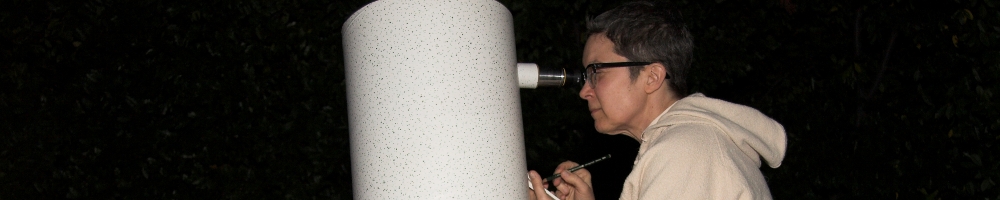


Saturday night, April 21, Mojo and I headed to our new favorite dark sky spot, Amboy Crater, one of the darkest observing locations in the US. This spot has great horizons and its remoteness keeps all but the serious observers away, though we’ve met delightful observing buddies at this spot. Our one way drive from Monrovia, CA is 170 miles, fyi.
After a night of observing, you can’t beat the morning hike to Amboy Crater, a 6,000 year old volcanic cinder cone, either. Even in the summer it’s cool at dawn. Look carefully at the oxidized lava beds as you follow the hiking trail to the crater and you might find some Chuckwalla lizards! Chuckwallas can reach 16 inches in length, weigh up to 2 pounds and are specially adapted for desert living. Chuckwallas are my very favorite herps, well, next to the desert tortoise, that is.
The peak of the Lyrids occured at 1:30 a.m. Eastern (10:30 Pacific). The constellation Lyra was barely above my horizon at that hour. This meant the highest rates were probably recorded several time zones east of my California location. I set up my observing area, shut my eyes until about 11:00 p.m., and then I managed to observe straight through the night — from 11:40 p.m. until just before dawn at 5:16 (6:40h – 12:16h UT).
Here are a few tips I use to prepare myself for a night of meteor counting. First, I read Bob Lunsford’s weekly meteor shower recap on the Yahoo meteorobs group email list which discusses amateur meteor astronomy. It’s a good place to “lurk” and learn.
Bob wrote “The Lyrid (LYR) shower is expected to reach maximum activity on the night of April 21/22 with rates up to 15 shower members per hour. The radiant is located at 18:08 (272) +33. This area of the sky is actually located in extreme eastern Hercules, eight degrees southwest of the brilliant blue-white star Vega (Alpha Lyrae). The radiant is best placed just before the break of dawn when the radiant lies highest in the sky. While Lyrid meteors can be seen in both hemispheres, the north is favored as the radiant lies much higher in the sky. Rates will fall rapidly after maximum and little activity will be seen the remainder of the week. At 48km/sec. the Lyrids would produce meteors of medium-swift velocity. It should be noted that the Lyrids can occasionally produce bright meteors of fireball class magnitude.”
Next I familiarized myself with the spring sky and printed out some all-sky charts, marking the radiant between Lyra’s bright star Vega, and the Keystone section of Hercules. I then decided where to look — 50-70 degrees above the horizon, 20-40 degrees away from the radiant. I selected the area around the bright star Arcturus in the constellation Bootes. When counting meteors you don’t want to look directly at the radiant as the meteors will look like short streaks, or points of light.
For this shower the rates were not expected to be too high, so I decided to record (for my first time) the magnitude of each meteor. I made a note of the magnitude of Saturn, Mars and Venus and re-familiarized myself with the magnitudes of many bright stars nearby during my prep time. Then, I selected two small constellations (Corona Borealis, and the head of Draco) which contain magnitude 2-5 stars and memorized their magnitude.
Armed with all these stellar magnitudes, I settled down and waited for it to get dark. Once it did, I began the first important observation — estimating the limiting magnitude. The limiting magnitude is the magnitude of the faintest star near the zenith that the observer can detect using the slightly averted naked eye. It defines both the condition of the sky’s clarity and the quality of the observer’s eyes. I keep a set of these charts on a clipboard and take them with me on all observing trips, even if I am not observing meteors. Every 30-45 minutes, between my half-hour counting sessions, I re-counted the stars in the selected areas, to note any changes in the sky clarity or the condition of my own eyes.
In a nutshell my skies were Magnitude 6.5, which is very dark. Weather conditions: clear, 98 degrees at sunset, 62 degrees at dawn. It was a shirtsleeve weather night almost all night long, tho’ I put on a fleece jacket at about 4 a.m.
Between 11:40 p.m.and 5:16 a.m. (06:40h – 12:16h UT) I counted 36 Lyrids, 6 Sporadics and 2 Anthelion meteors. A quarter of the Lyrids I saw were very bright -1 or brighter meteors. I took short breaks between counting sessions to re-estimate the limiting magnitude, have a snack, check on what Mojo was imaging through his telescope, stargaze through my own scope, etc.
06:40h-07:10h UT – 7 Lyrids
07:30h-08:00h UT – 3 Lyrids
08:15h-08:45h UT – 5 Lyrids, 1 sporadic
08:50h-09:20h UT – 5 Lyrids, 1 sporadic
09:30h-10:00h UT – 6 Lyrids, 2 sporadics
10:05h-10:25h UT – 1 Lyrids, 1 sporadics, 1 Anthelion
Break to look at Saturn, have a snack, scan Milky Way
10:59h-11:29h UT – 2 Lyrids, 1 Anthelion
11:30h-12:00h UT – 7 Lyrids (2 fireballs!)
12:01h-12:16h UT – 1 sporadic
You can see that I saw the most meteors just as I was getting started (which was near the peak) and again near dawn (when Lyra was at its highest in the sky). Just before 5 a.m. 12h UT both Mojo and I saw a very bright bollide, greenish in color in the western sky. I estimated its magnitude at -5, brighter than Venus. It probably was much brighter. Coincidentally, 3 hours later an even more impressive bollide streaked across the California Sierra foothills, and broke up in the atmosphere, sprinkling meteorites over a wide populated area. Both of these bollides were Lyrid fireballs!
My other Meteor blogs and adventures
Flying through the Leonid Storm of 1999 – aboard USAF’s ARIA from Edwards AFB
Leonids 2002 – aboard NASA’s DC-8 from Dryden Flight Research Center
Observing meteors from the city – yes you can!
January Quadrantids and a demoted constellation
August Perseids and meteor recording tips