Jane's blog banner

Tag: Galileo Telescope

  • Chasing Galileo – sunspots

    Galileo's sunspots
    Galileo's sunspots
    My sunspots
    My sunspots

    In the summer of 1612, Galileo sketched a series of sunspots which were published in Istoria e Dimostrazioni Intorno Alle Macchie Solari e Loro Accidenti Rome, (History and Demonstrations Concerning Sunspots and their Properties), in 1613. Galileo corresponded with other scientists and artists who also were sketching the sun in the early 1600’s. He used a 16mm, f/11 Galilean refractor, and many drawings are known to have survived. He observed the sun using attenuated eyepiece (attenuated by Earth’s atmosphere when the Sun was low on the horizon at dusk) and eyepiece projection techniques.

    A lot of people repeat the story (which is really just an urban legend) that Galileo became blind by looking at the Sun through his telescope. He went blind in 1672, from a combination of cataracts and glaucoma more than half a century after publishing his sunspot sketches.

    In his sunspot letters to Mark Welser, dated May 4, 1612, Galileo mentions observing the Sun directly — but only at sunset. In its final paragraph, he mentions that his pupil Benedetto Castelli has discovered a better way to observe – using a projection method.

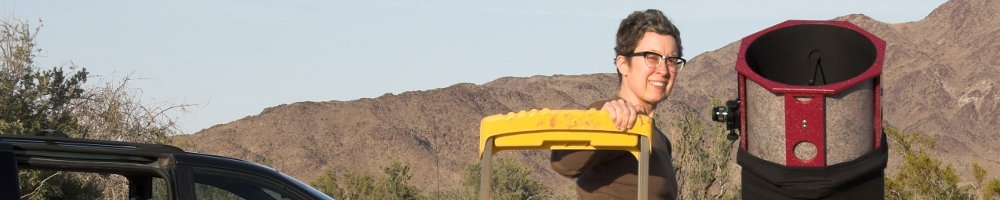
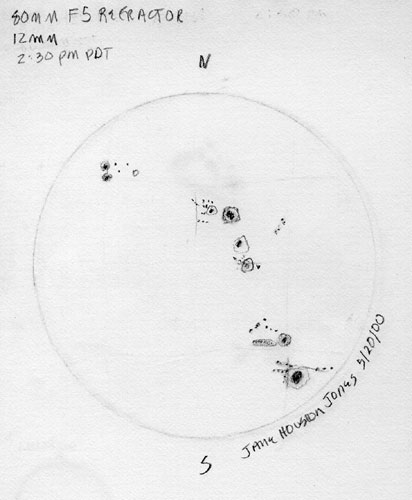
    My sunspot drawings were made mostly in 2002, near solar maximum, so I was able to see and sketch and classify hundreds of sunspots and other solar features. The one pictured here was made a few years earlier, tho’. I used three telescopes for my observations, a homemade bright yellow 6-inch f/10 Dobsonian reflector which I made in John Dobson’s telescope making class, an Orion 80mm refractor with a white-light solar filter and a Televue 70mm Ranger refractor with a Coronado h-alpha filter. I used these instruments to make daily sketches over two solar rotations (about 2 months) and completed the Astronomical League’s Sunspotter Club observing program. My 2002 solar sketches are linked below.

    Some Solar links:

    Historical Sunspot Drawing Resource Page

    My whole disk, sunspot and h-alpha drawings of the Sun

    A solar sidewalk astronomy article I wrote for the SOHO mission website

    My What’s Up podcast for May 2009 is all about the Sun
  • Chasing Galileo: sketches through a small refractor

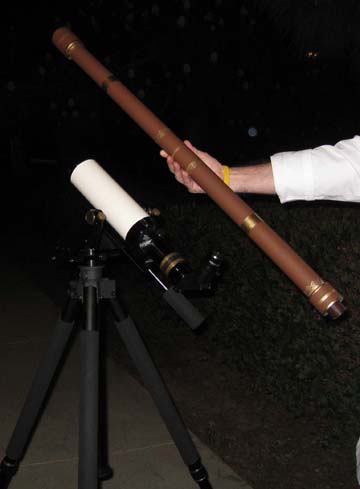
    Galileo replica and my TVRanger
    Galileo telescope replica and my TV Ranger
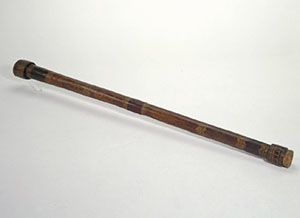
    Galileo's 1609 telescope
    Galileo's 1609 telescope
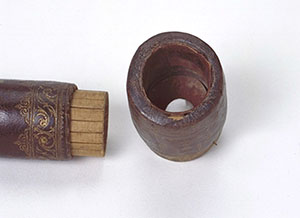
    There were separate housings at either end for the objective and the eyepiece
    There were separate housings at either end for the objective and the eyepiece

    When I started thinking about how to integrate International Year of Astronomy into my 2009 What’s Up podcasts I naturally focused on Galileo’s first observations through a telescope 400 years ago. Over the first months of 2009 I had collected a gallery of Galileo’s first sketches, watercolors and engravings. These historic observations suggested a project I’ve been wanting to do for some time — to recreate all of Galileo’s astronomical sketches through a similar sized instrument.

    Galileo made his first telescope, a spyglass that magnified 3x in June or July 1609. Next he made an eight-powered instrument and presented it to the Venetian Senate in August. His next telescope, which magnified twenty-one times is the one he used to observe the bumps and shadows on the moon, Jupiter and its moons, and individual stars within patchy nebulae. These first observations were unveiled to the world in his book, Sidereus Nuncius published in March 1610.

    Galileo’s telescope, pictured above has a objective diameter of 37 mm and a focal length of 980 mm. The instrument’s magnification is 21. My Televue Ranger (ED Doublet Apochromatic refractor) has an objective diameter of 70mm, a focal length of 480mm, and using a 25mm Zeiss Abbe Orthoscopic eyepiece, yields a comparable magnification of 19. The field of view, however is dramatically different between the two instruments. Galileo’s longer focal length and smaller objective (which he also stopped down to lessen chromatic aberation) give a relatively small field of view  – 15 degrees. My shorter focal length and larger aperture instrument has triple that FOV.

    What this means is that a telescopic view of Venus through both instruments will show the same size Venus, but in my ‘scope there will be more “sky” around Venus, and in Galileo’s there will be mostly Venus. A view of the moon is a different matter. Just a portion of the moon is visible at any one time through Galileo’s scope and the entire moon is visible through mine.

    Galileo’s drawings and watercolor paintings of the moon inspired me to sketch what I see through the eyepiece. I’ve been sketching since first light with my own first telescope over 20 years ago. This year, I’ll be honoring Galileo and celebrating the 400th anniversary of telescopic observations by creating 21st century sketches through a small refractor. I hope this journey back 400 years to revisit Galileo’s observations encourages you to look up. And I hope you’ll enjoy my sketches standing side-by-side with these historic first astronomical observations through a telescope!

    NPR story: Galileo’s Telescope Travels Far, Sees Farther

    Galileo’s telescope: specifications and images