

Springtime is my favorite observing season. In the course of an evening you can face away from our own galaxy and feast your eyes on other Milky Ways, while tracking down some of the most spectacular objects tangled among the stars and dust of our own galaxy.
Omega Centauri is one of them. It’s the largest of the 150+ globular clusters discovered in our own Milky Way Galaxy. There may be even more undiscovered globular clusters hidden behind the gas and dust of our galaxy. Omega Centauri was discovered by Edmund Halley in 1677 as a nebula, but it had been listed in Ptolemy’s catalog 2000 years ago as a star! It’s located about 15,800 light-years from Earth and contains several million Population II stars. The stars in its center are so crowded that they are estimated to average only 0.1 light years away from each other. It is about 12 billion years old, and there is some speculation that Omega Centauri may be the core of a dwarf galaxy which was disrupted, destroyed and absorbed in an encounter with the Milky Way.
This spectacular object is well known to southern hemisphere observers, but it may come as a surprise that it can be seen from many northern hemisphere locations as well. If you are south of the 25th parallel or 25° (degrees) North latitude you should be able to see it 20° above the horizon, and located 35° below Virgo’s great blue-white star, Spica. I’ve observed it from 37° North (Lake Sonoma, CA) several times (from a hill with a negative horizon) and at 33° N in this writeup, where it appeared less than 20° above the horizon definitely! It’s been seen from 42° North as well, from a very flat horizon. It’s a naked eye object, but often the horizon is hazy, so scan with binoculars if you don’t see it with your eyes.

To find Omega Centauri, you’ll first have to find Spica, the brightest star in Virgo. It helps right now that golden Saturn is near by. To find Spica, continue the curve of the big dipper handle and “arc to Arcturus, and then spike to Spica”. Spica transits — when it reaches its highest point in the sky — at around midnight daylight saving time. Use this table of transit times for major solar system objects and bright stars and select your observing dates, object (Spica in this case) and your location and press “compute”. “Alt” next to the transit time at your location indicates Spica’s altitude above the horizon. Spica and Omega Centauri transit at the same time, so look about 35° (one clenched fist is 10°) directly below Spica to look for an oval hazy cluster the size of the full moon. Can you see individual stars? Does it look round or oval? Try with your eyes, then with binoculars.
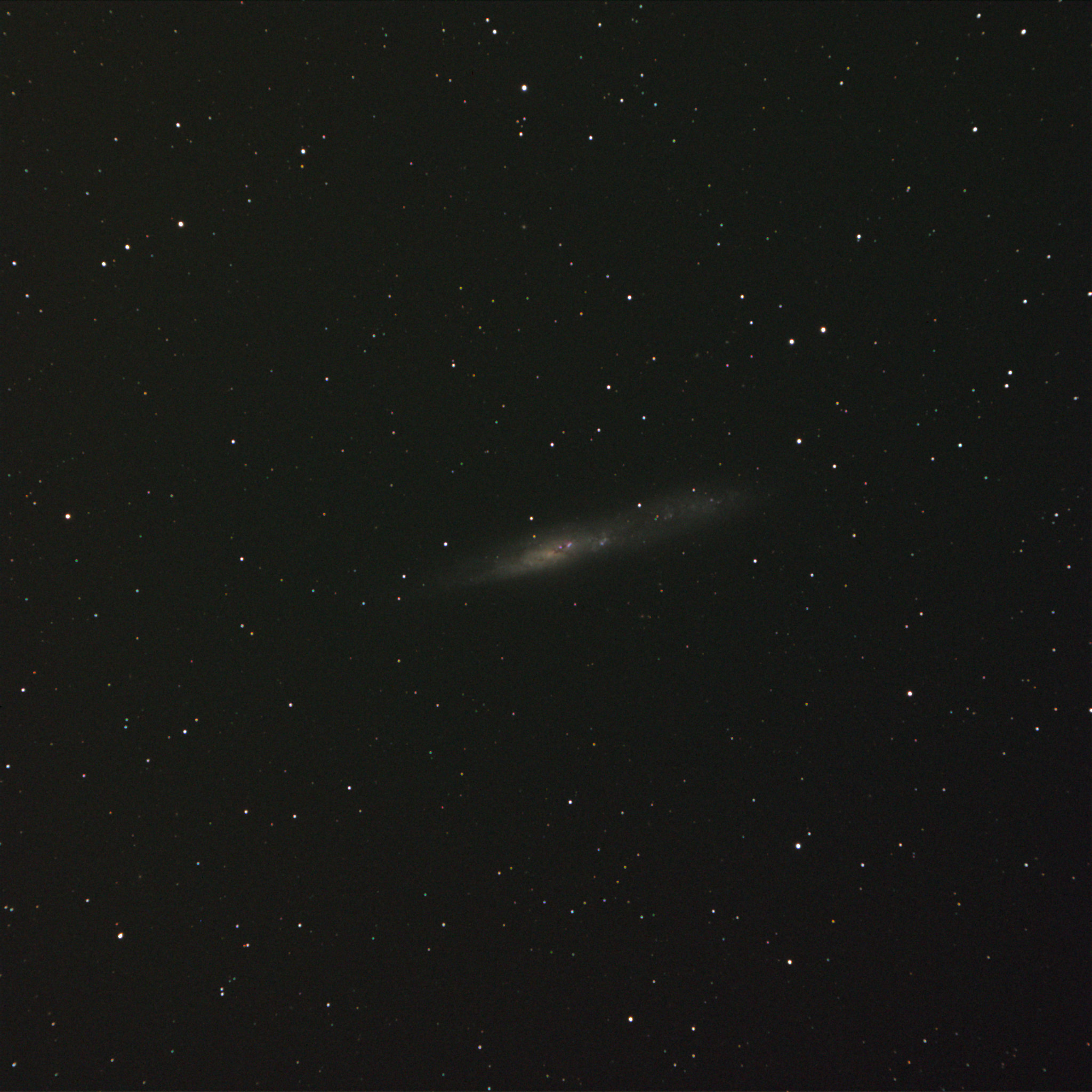
After confirming my view of Omega Centauri and making this little sketch (sketch view as seen through my binoculars), I opened my Herald Bobroff AstroAtlas to the Centaurus constellation pages and looked at what else was in the vicinity of Omega Centauri. I remembered a favorite galaxy, NGC5128, officially named Centaurus A, but nicknamed the hamburger galaxy for obvious reasons. Now I’ve seen both of these objects from Australian skies where they are not hugging the horizon. But even through a partially cloudy horizon, I was able to see this fabulous object, with its dark dust lane bisecting the oval galaxy.
NGC5128 is one of the closest radio galaxies to Earth, so its active galactic nucleus has been extensively studied by professional astronomers, and a supernova was detected in the galaxy’s dust lane in 1986. The Spitzer Space Telescope studies have confirmed that Centaurus A is colliding with and devouring a smaller spiral galaxy! Centaurus A is located approximately 4° north of Omega Centauri, and because the galaxy has a high surface brightness and relatively large angular size (2/3 the apparent size of Omega Centauri), it’s visible to the naked eye under good conditions. My sketch was made with difficulty, by aiming my 14.5-inch reflector (with a 10mm Radian eyepiece for 200x) nearly horizontal and half-perched uncomfortably on the bottom step of my observing ladder.

Before moving on, I observed another object in the southern sky line between Spica and Omega Centauri, Globular Cluster M68, or NGC4590 in the constellation Hydra. I sketched an oval glow of stars within a diffuse squarish haze of fainter stars.
Now it was time to get vertical and observe some other objects higher in the sky. The beautiful constellation Leo was still well placed in the southwest sky after midnight. I opened my Night Sky Observer’s Guide Volume 2, the Spring and Summer volume to Leo. Gamma Leonis, or Algeiba, is a beautiful deep yellow/orange and pale yellow double star in the sickle (or backwards question mark or lion’s mane) of Leo’s head. Next, I moved to a fascinating red dwarf, Wolf 359, near the famous Leo galaxies M95, M96 and the Leo “trio” of galaxies. Wolf 359 moves 4.71″ (arcseconds) per year or 8′(arcminutes) in a century. It’s the third closest star to the sun, at 7.75 light years away. Only Alpha Centauri and Barnard’s Star are closer. At magnitude 13.6 (similar to Pluto’s magnitude) it’s faint, but the striking red color helps distinguish it from the other nearby stars.
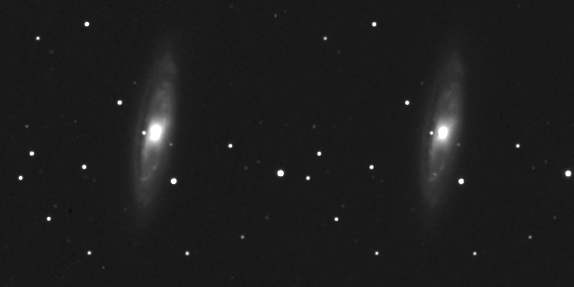
Leo 1 near Regulas, Leo’s heart was my next target. A faint dwarf galaxy overshadowed by bright Regulus is a member of the local group of galaxies, and may be one of the most distant satellites of the Milky Way. Faint NGC2903 — a very pretty magnitude 9 barred spiral galaxy tangled in the starry lion’s mane was worth a sketch. It’s 31 million light years away, local but not attached to any local galaxy group. I had to go and have a look at the supernova in Leo’s M65 galaxy – here is Mojo’s animation of M65,combining two images of M65, one shot on 3/9/13 at Amboy Crater, and one shot on 4/6/13 at Chuckwalla Bench located at N 33° 39′ 37″, W 115° 32′ 26″
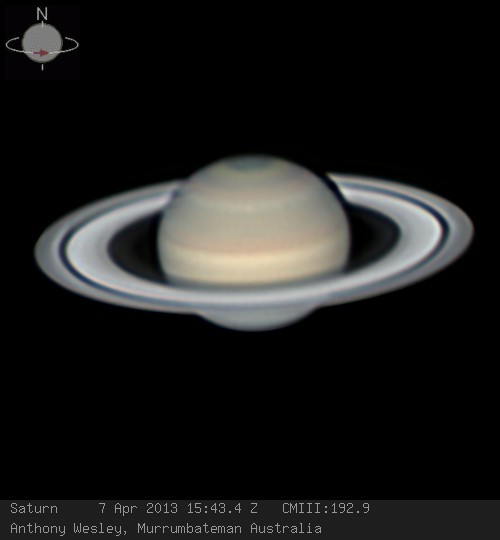
It dawned on me I hadn’t observed Saturn yet. Under fabulous steady skies, I was able to pump up the magnification of my 15-inch Litebox reflector to over 300x using a 6mm Televue Radian eyepiece. When I say “my” 14.5-inch Litebox, I mean Mojo’s — I have a 12.5-inch and 17.5-inch version of these fabulous time machines. 🙂 This image taken by Anthony Wesley the same night shows Saturn as I viewed it. My visual view was not quite this vivid, but the contrast of the colors is very similar to what I saw, including the dark north polar region, so famous in the Cassini North Polar Hexagon images. The distinct band colors and darker north polar area I saw and sketched were varying shades of butterscotch and chocolate.
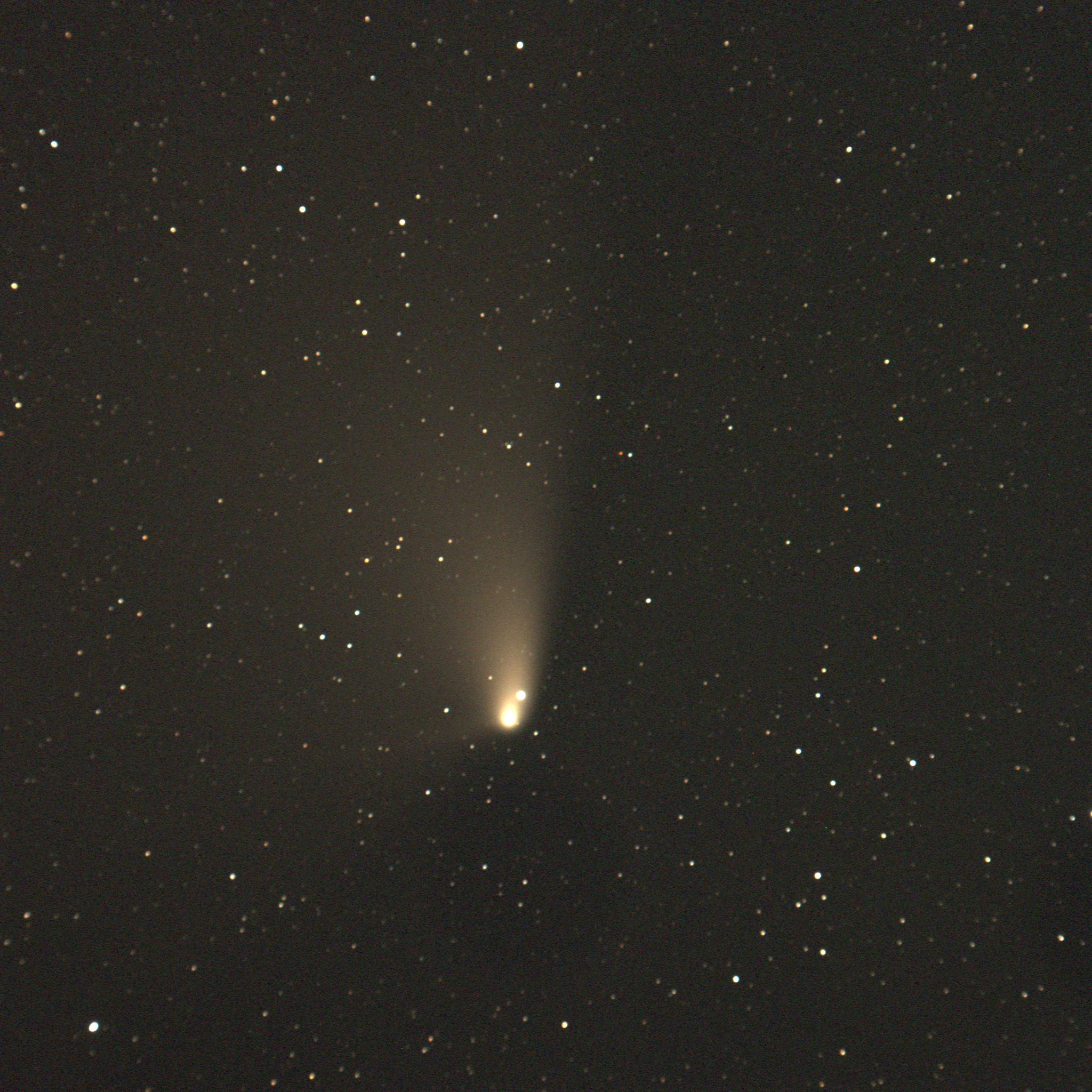
All that was left now was Comet PanSTARRS, and we had to wait until about 4:00 a.m. for Andromeda to rise in the northeastern sky. I observed it in my 7×50 Carton Adlerblick binoculars quickly and then pooped out and went to sleep until well after dawn. Mojo stayed up and took this lovely image, plus several more including a time sequence showing the comet’s motion. It’s really worth a look and a read and here’s the link. Until next dark sky observing night on May 11, I’m signing off!