Jane's blog banner

Tag: Juno

  • Mission Juno Launch, August 5, 2011

    The day before launch – Atlas V in 551 configuration (5-meter payload fairing, 5 solid rocket strap-ons). Under the fairing is a Centaur second stage and Juno.
    Launch 12:25 p.m. EDT August 5, 2011
    Bound for Jupiter – a plume sundial. You can tell the time of launch by the shadow of the plume – the sun is nearly overhead

    Two weeks after I started work at NASA’s Jet Propulsion Laboratory in late 2003 I was given my first “real” assignment. I was asked to sit in on Mission Juno’s design meetings and write the E/PO (Education and Public Outreach) proposal outline for the mission, a page-and-a-half summary with a budget. It was exciting to delve into a new kind of out-of-this-world work and begin a dream-come-true job as the informal and public outreach person on the Cassini Mission, with occasional planetary mission proposal writing forays.

    Fast forward nearly 8 years and I find myself sitting in the shadows of Kennedy Space Center writing a blog about my own adventures at the launch of the mission which launched my own career at JPL. There will be many blogs, photo essays, and tweets from the 150 Tweetup attendees and many other launch guests. Mojo was one of the lucky 150 attendees at the tweetup and his blog is here.

    My job at the launch was threefold. My first role was at the NASA tweetup itself. I’ve been the @CassiniSaturn Twitter persona since June 2008, and so I was working the tweetup backing up my outer planetary mission buddy @NasaJuno on Twitter duty the hours leading up to, at and after launch. I was also on hand to talk about NASA’s Year of the Solar System and show my What’s Up podcast during the hour just before launch at the Tweetup.

    My second job was to organize a “star party” for the launch guests and create a flyer for all the attendees. The guests included the Juno mission’s invited Goldstone Apple Valley Radio Telescope Program students and educators, who came out to my star party. Each of the several thousand launch goodie bags had that star chart flyer featuring Saturn, the moon, Jupiter and Vesta, with a link to my What’s Up for August 2011 podcast and to NASA’s Year of the Solar System website outreach material. The podcast and website feature the Juno mission and planetary windy worlds like Saturn and Jupiter this month.

    My third role was to participate in the Planetary Science Mission Directorate’s “Scientists in Action” webcast, live-streamed to museum audiences remotely. Museum audiences all over the country, and probably the world, watched this and other Juno launch programming.

    In addition to the “work,” I was also a starry-eyed space girl at the NASA Tweetup, and was beyond excited to see my first launch. Just like the others, I was lapping up all the speaker comments and tweeting from @jhjones like crazy, when I wasn’t tweeting from @CassiniSaturn or @NASAJuno. I was stunned at the amazing bus tour stops, in spite of the sweltering heat. And I soaked up the electric camaraderie and atmosphere of everyone at the Tweetup program.

    Although it was a “you had to be there” kind of event, I hope these pictures and tales give you a taste of the magic that is NASA. I almost can’t believe I get to go to NASA planetary mission launches at Cape Canaveral/Kennedy Space Center for work! And share the excitement of Cassini, Juno, and next month, Grail with informal education outreach! I’m not on cloud nine, I’m above it!
    My Juno launch photo album

    The NASA Juno website

    Juno launch videos

  • Another perfect stargazing night

    Observing report, dark sky weekend, October, 2009, Chuckwalla Bench

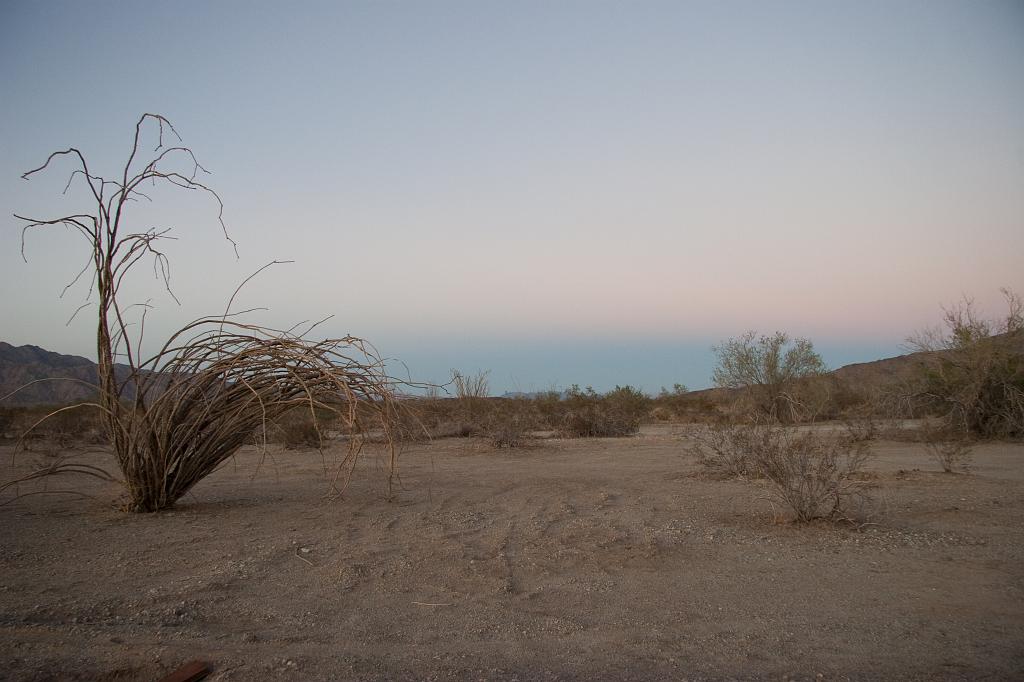
    A perfect night begins with Earth's shadow climbing in the east
    A perfect night begins with Earth's shadow climbing in the east
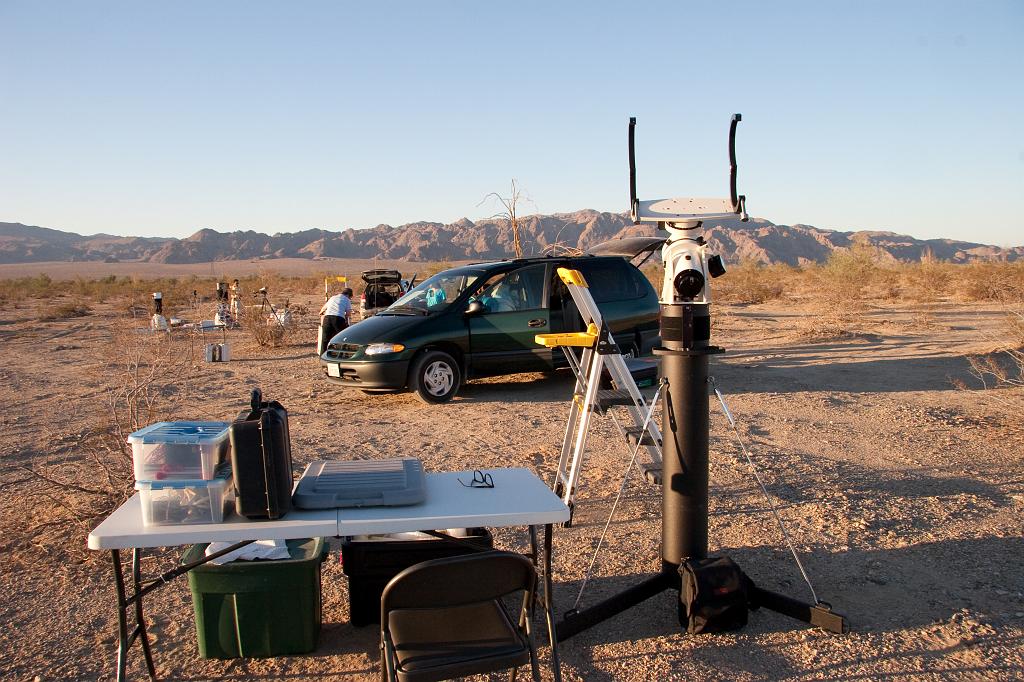
    One one side of the Green Van is the imaging zone
    One one side of the green van is the Imaging zone
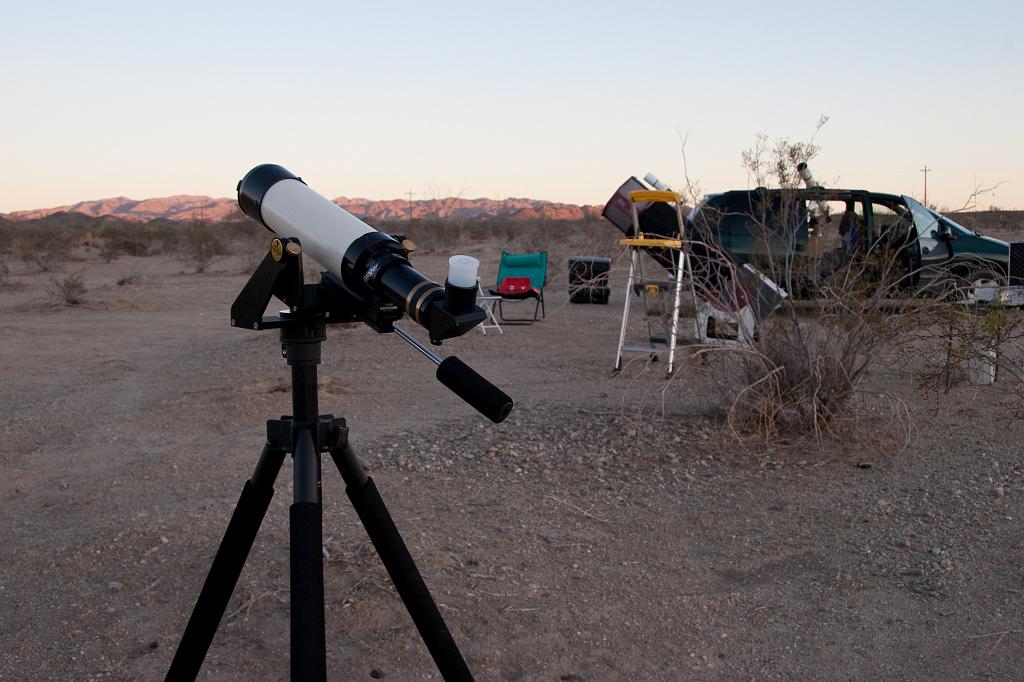
    On the other side of the Green Van is the visual observing zone
    On the other side of the green van is the visual observing zone

    When the clear sky chart reads perfect, we can’t wait to get out to our favorite dark sky observing site, Chuckwalla Bench. I wondered what would happen when Mojo started dabbling in the dark art of imaging. I’m the old fashioned alt-az dob girl, and now my hubby would be keeping warm at the star party with the heat from electonic power supplies and batteries. Poor me! I pouted (for only about a year or so) before I learned to love the dark arts, and we now happily observe and image with only our 1998 green Dodge Caravan separating “his” imaging zone and “her” visual observing zone.

    New moon Saturday night in October 2009 was another perfect observing night in the Colorado desert of Southern California. Temperatures were in the 90’s before the sunset, and cooled to about 65 by 2 a.m. when we took a pre-dawn snooze. Humidity remained in the teens.

    Last month we had a great time combining visual observing and imaging. On the “visual” side of the observing field Gary and I were struggling to confirm our main project for the night, the asteroid Juno. Mojo was imaging the same target, and a quick look at his Juno image confirmed the star fields we were looking at visually. It was a lot of fun!

    This month Gary and I were hunting down NGC 7640, a pretty elongated barred spiral galaxy just 4 degrees to the south of the popular Blue Snowball planetary nebula. This mag 12 galaxy should have been easy to find but its low surface brightness made it a challenge. It took my 17.5-incher to provide a great view, and then Gary was able to see it in his 12.5 incher too. In my scope the long and narrow galaxy’s core seemed bright, long and twisted, and the spiral arms were visible as wisps off both edges. We called Mojo over for a look and he thought it would make a nice imaging project, which it did!

    Next it was Mojo who suggested a target he had imaged would make a nice project for us push-to observers. NGC 7541 is called a “showpiece” galaxy group in the Night Sky Observers Guide in Pisces. Soon I had a gorgeous visual view of this pretty pair of galaxies in my telescope, and called Mojo over for a view.

    The other benefit of Mojo’s new hobby is that I can “suggest” targets for him to image. Then I can use them in my What’s Up podcast series. I used 4 of his lovely images in October’s Podcast about the Andromeda Galaxy. See if you can spot them. Two are views of the Andromeda galaxy. One shows the whole galaxy, and the other shows the galaxy as a smudge — exactly as it looks in a modest visual telescope. The other two are Milky Way images, one showing a washed out Milky Way (what most people actually see) with Jupiter and the other is his very pretty image of M52 and the Bubble Nebula, some of our own Milky Way’s jewels.

    So it is possible to combine imaging and visual observing, and I look forward to our next outing! I’m preparing my “Honey Do” list of imaging targets to “suggest” to Mojo already. 🙂