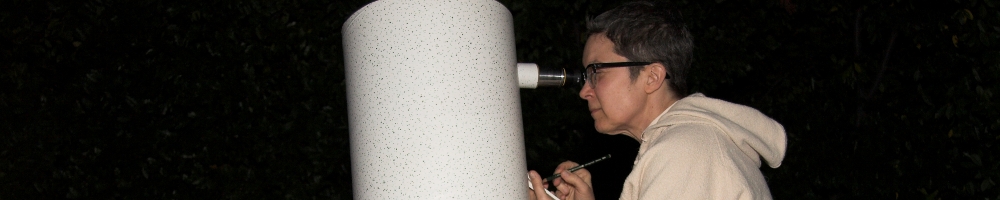
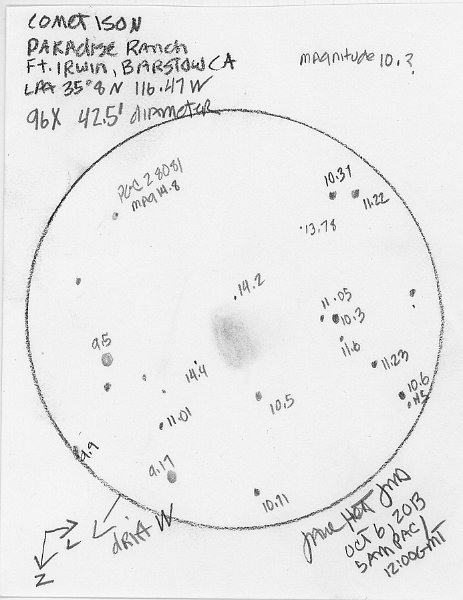
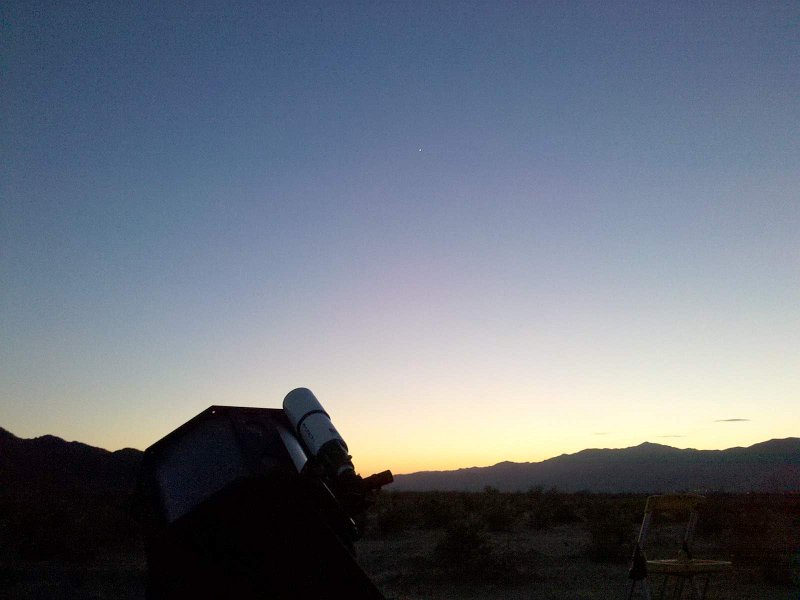
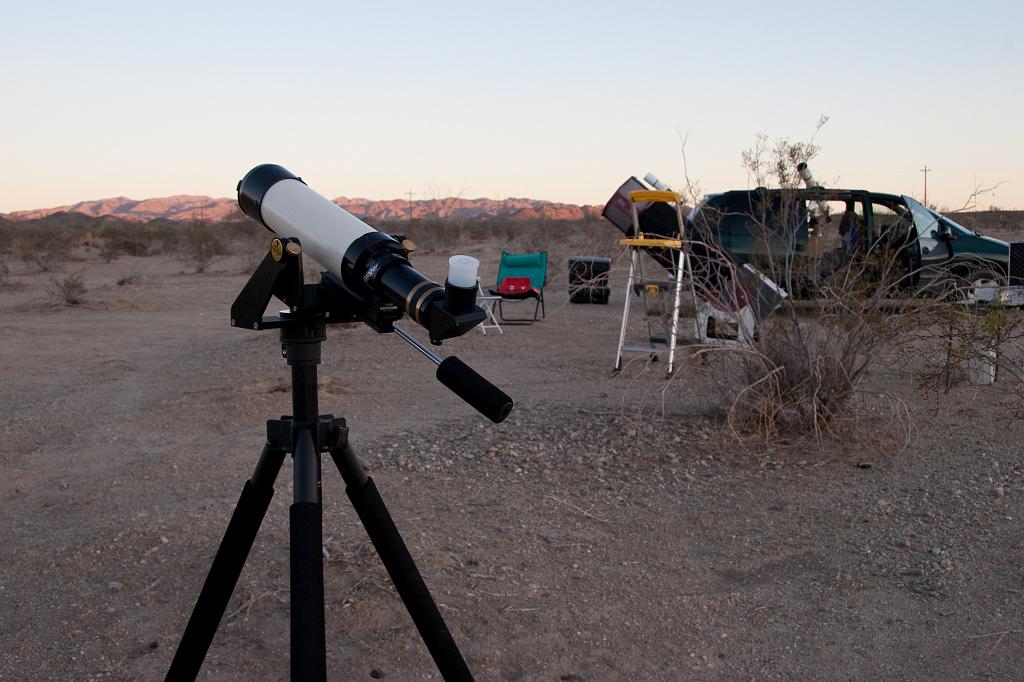
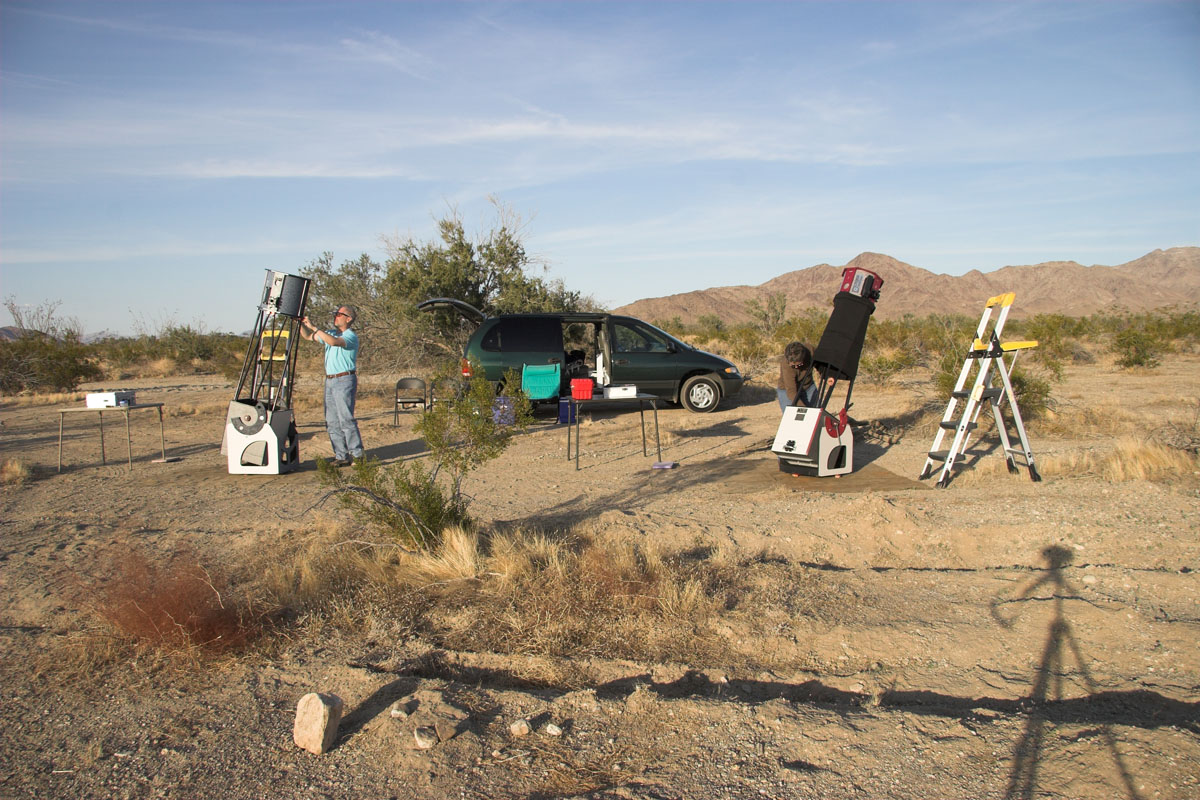
All year long, astronomers have been writing about Comet ISON: will it sizzle or will it fizzle? I was chomping at the bit, waiting for the visual magnitude to brighten enough to try viewing this comet through my own telescope (shown on the right). Finally, the weekend, a dark sky, comet magnitude and perfect weather all came together Saturday night, October 5th and Sunday morning, October 6th.
First, backtrack 16 years. I fondly recall the great comet of 1997 – Comet C/1995 O1, Comet Hale-Bopp, which ruled the skies for 18 months. When it passed perihelion on April 1, 1997, it was brighter than all stars in the sky except for Sirius. With its 50 degree long tails it spanned the evening sky, and was the talk of the town, the water cooler and even led the commute chatter among the passengers in my van pool. Everybody saw it. I sketched it. Astronomy clubs flourished with eager new stargazers. Telescopes were literally flying off the shelf. Then, two years after it faded from view, in April 1999, I observed Comet Hale-Bopp from Ayers Rock in the Australian Outback, through my 12.5-inch telescope, as it scooted in front of the Large Magellanic Cloud. It was over 8 AU/700 million miles away, as far away as Saturn is from Earth. I’ve been remembering the anticipation then the excitement of Hale-Bopp while impatiently waiting for ISON.
Comet ISON’s magnitude is somewhere in the magnitude 10-11? range at the time of my Sunday morning sketch, tho’ all the sources I use show different magnitudes. On October 5, when I observed and made this little sketch these three sources I regularly use show different magnitudes. Magnitude 10.6 here. Magnitude 10.7 here. And magnitude 10 (or even brighter 9.something) here.
So for my observation, I thought it would be more interesting to show the magnitude of many of the the nearby stars I could see in my eyepiece. I used my 12.5-inch f/6.75 reflector and a 19mm Nagler Panoptic eyepiece for a magnification of 96x. Conditions were spectacular, very steady seeing at 5:00 am, and away from the the Zodiacal Light and Milky Way the limiting magnitude had been an impressive 6.5. I was able to see three 14.0 magnitude stars, two very near the comet. I tried higher and lower magnification (over 200x and under 50x) and couldn’t see the comet in any eyepiece over 125x. The sketch shows the comet a bit brighter than it really appeared. It was like an oval puff of barely-there cloud with a brighter condensed area, I assume was the coma. It was much larger than I was expecting. No tail visible. Can’t wait to observe and sketch it again on October 26th despite a big bright moon and November 2nd which should be a perfect moonless viewing night. Until then, I’m looking forward to hearing about more visible reports. Photos are great, but star-stuff hitting your eyes is the best!
All year long, astronomers have been writing about Comet ISON: will it sizzle or will it fizzle? Both! Here’s my What’s Up video, with December status (written in mid November, but luckily, the comet didn’t completely fizzle)
ISON in December 2013
Comet ISON first spotted by amateur astronomer Bruce Gary and has been imaged by many eagle-eyed observers with good astrophotography equipment since mid August. A selection of images and data are shown here. I’ll update this frequently as more is understood about Comet ISON. Meanwhile, here is a wesbite with current Comet ISON magnitude and location which is constantly updated!
Comet ISON survived its close pass of the sun on November 28. Scientists are unsure what is actually left of the comet. A fragmented nucleus? Nothing but orbiting dust? Stay tuned!
Here’s an excellent Star Chart showing Comet ISON’s path in November, courtesy of Skyhound’s Skytools3 software. (These are the charts I use for my own deep sky observing.) The chart has not been updated for December as of November 30th.
ISON will be visible both before dawn and after sunset this month, though it is fading as of November 30th! It will appear higher in the sky at dawn than at sunset, providing a better chance to see it. During the second half of December, Comet ISON should fade rapidly as it moves north. It will be closest to Earth in its orbit on December 26.
You may have noticed a very bright ‘star’ in the western sky. That’s Venus! Venus shines at its very brightest, magnitude -4.9 this month. It sets about three hours after sunset at the beginning of the month and one and a half hours after sunset at the end of the month. This is a great month to view the dramatic changes in the apparent diameter and phases of Venus as it races towards its conjunction with the sun. The first observations of the phases of Venus were made by Galileo in 1610!
Mars continues to grow brighter and rises near midnight, and Jupiter rises earlier in the evening, heralding the best viewing season for Jupiter watchers.
The beautiful Geminid meteor shower will only slightly be marred by moonlight on the night of December 13 and 14. The radiant lies near Gemini with brilliant Jupiter above and the constellation Orion below. From a dark sky, but even from the city, the mighty hunter Orion is easily visible in the southeast sky. Take a look at Orion’s shoulder star, red Betelgeuse and its knee star, blue Rigel and the Orion Nebula.southwestern horizon.
The Milky Way and all the visible planets and comets should encourage stargazers to escape the city lights this month. Join me in the California Desert November 30, at MOjave National Preserve. We have no chance to See ISON for another week, but there are other nice comets, planets, stars, and dark sky objects too enjoy from dusk to dawn.
If Comet ISON survives its perihelion pass we should have a spectacular view of the comet’s dust tail in December.
The times to look will be just after dusk, low to the horizon at sunset, and higher at dawn for northern latitudes the first half of the month. On December 1, look for a pretty diagonal lineup of the comet, Mercury and the crescent moon just before sunrise in the southeast. Then for the second half of the month, the comet becomes circumpolar. It will appear near the constellation Draco on December 26th, when it is half an a.u. (0.42 a.u.to be exact) from Earth. Will the comets’ tail span a quarter of the sky? I’ll update this as more info is available.
Jupiter reaches opposition January 4th, 2014, and rises earlier in the evening. Venus bright as it ever gets – a whopping magnitude -4.9. It will be a fabulous view – a particularly good astrophoto and sketching target as it grows in diameter, but shrinks in phase. Mars increases in brightness and rises earlier (after midnight). Mars will be a great target for 2014.
The day before launch – Atlas V in 551 configuration (5-meter payload fairing, 5 solid rocket strap-ons). Under the fairing is a Centaur second stage and Juno.Launch 12:25 p.m. EDT August 5, 2011Bound for Jupiter – a plume sundial. You can tell the time of launch by the shadow of the plume – the sun is nearly overhead
Two weeks after I started work at NASA’s Jet Propulsion Laboratory in late 2003 I was given my first “real” assignment. I was asked to sit in on Mission Juno’s design meetings and write the E/PO (Education and Public Outreach) proposal outline for the mission, a page-and-a-half summary with a budget. It was exciting to delve into a new kind of out-of-this-world work and begin a dream-come-true job as the informal and public outreach person on the Cassini Mission, with occasional planetary mission proposal writing forays.
Fast forward nearly 8 years and I find myself sitting in the shadows of Kennedy Space Center writing a blog about my own adventures at the launch of the mission which launched my own career at JPL. There will be many blogs, photo essays, and tweets from the 150 Tweetup attendees and many other launch guests. Mojo was one of the lucky 150 attendees at the tweetup and his blog is here.
My job at the launch was threefold. My first role was at the NASA tweetup itself. I’ve been the @CassiniSaturn Twitter persona since June 2008, and so I was working the tweetup backing up my outer planetary mission buddy @NasaJuno on Twitter duty the hours leading up to, at and after launch. I was also on hand to talk about NASA’s Year of the Solar System and show my What’s Up podcast during the hour just before launch at the Tweetup.
My second job was to organize a “star party” for the launch guests and create a flyer for all the attendees. The guests included the Juno mission’s invited Goldstone Apple Valley Radio Telescope Program students and educators, who came out to my star party. Each of the several thousand launch goodie bags had that star chart flyer featuring Saturn, the moon, Jupiter and Vesta, with a link to my What’s Up for August 2011 podcast and to NASA’s Year of the Solar System website outreach material. The podcast and website feature the Juno mission and planetary windy worlds like Saturn and Jupiter this month.
My third role was to participate in the Planetary Science Mission Directorate’s “Scientists in Action” webcast, live-streamed to museum audiences remotely. Museum audiences all over the country, and probably the world, watched this and other Juno launch programming.
In addition to the “work,” I was also a starry-eyed space girl at the NASA Tweetup, and was beyond excited to see my first launch. Just like the others, I was lapping up all the speaker comments and tweeting from @jhjones like crazy, when I wasn’t tweeting from @CassiniSaturn or @NASAJuno. I was stunned at the amazing bus tour stops, in spite of the sweltering heat. And I soaked up the electric camaraderie and atmosphere of everyone at the Tweetup program.
Although it was a “you had to be there” kind of event, I hope these pictures and tales give you a taste of the magic that is NASA. I almost can’t believe I get to go to NASA planetary mission launches at Cape Canaveral/Kennedy Space Center for work! And share the excitement of Cassini, Juno, and next month, Grail with informal education outreach! I’m not on cloud nine, I’m above it!
The moon's summer and winter path, courtesy NASA's Starchild websiteThe winter’s moon – a smiling crescent just after sunset Feb 5, 2011 (click to see moon upper center) Closeup of winter crescent moonThe summer's "backwards C" crescent moon at sunset, late June 2007 (click to see moon in lower right)Closeup of summer crescent moon
Have you ever wondered why the crescent moon looks like a smile in the winter and spring and like a backwards “C” in the summer and fall? It looked like a smile right now – below, next to and above Jupiter for several days after the February new moon. You can see the same waxing (getting bigger) crescent in early March 2011. Just look in the western sky after sunset beginning the day after new moon, on about March 5 or 6th. You’ll also see Jupiter and Mercury just above the horizon an hour after sunset.
Early birds can see a repeat of the waning (getting smaller) crescent moon phase a few days before the new moon, too. Look in east the last days of February up until new moon on March 4th. That bright object sharing the dawn skies with the crescent moon is the planet Venus! You can read more about moon phases here on the EarthSky website.
The best way to understand the reason why, is to look where the sun is, and how and where it shines on the moon. Draw an imaginary line connecting the setting sun, the moon, and any other planets that appear in the sky. That imaginary line is the ecliptic – the path the sun takes through the stars. It’s also the Earth and planets’ orbital plane. You can think of it as a projection of Earth’s plane on a sky sphere. The planets orbit the Sun, and the moon orbits the Earth and so you will always find the planetary lineup along the ecliptic.
In the winter and spring, the ecliptic appears almost vertical and arcs higher in the sky. The moons’ lit side faces the sun. That makes the waxing crescent moon look like a smile, or a boat, or the old moon in the new moons’ arms once light reflected off the Earth – called earthshine – reveals the unlit disk of the moon lit by reflected from Earth.
In the summer/fall, the ecliptic has a lower or shallower angle in the sky, and the lit crescent, as always, faces the sun, showing us a lit crescent facing the sun, which appears like a backwards “C”. I could write more, but instead, I’ll let you enjoy the images from our own observing sessions in the winter and the summer, and then get out and see the crescent moon for yourself soon.
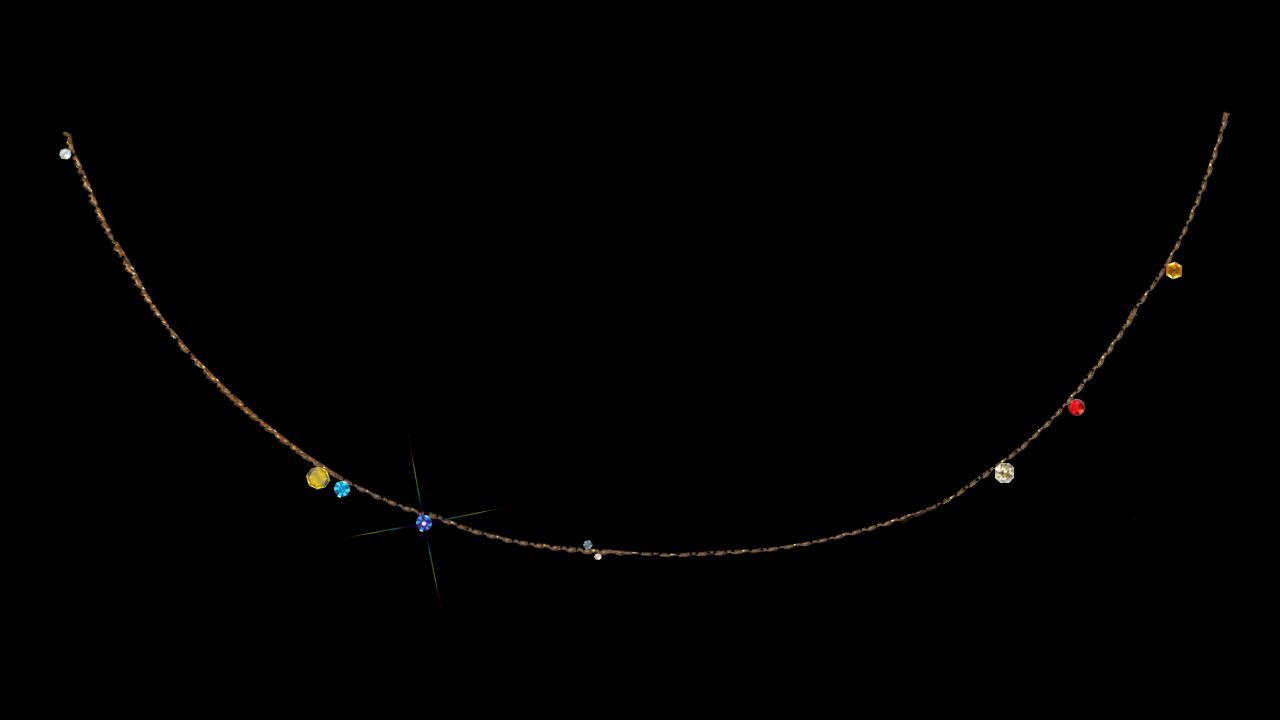
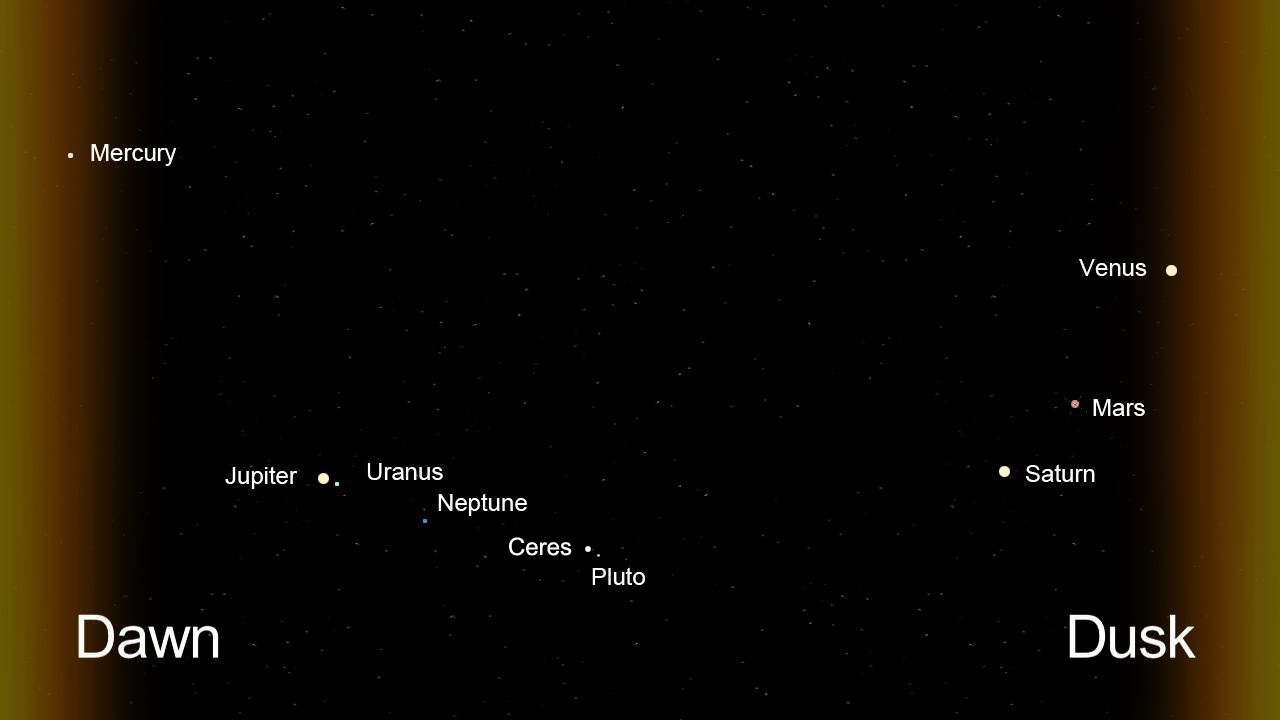
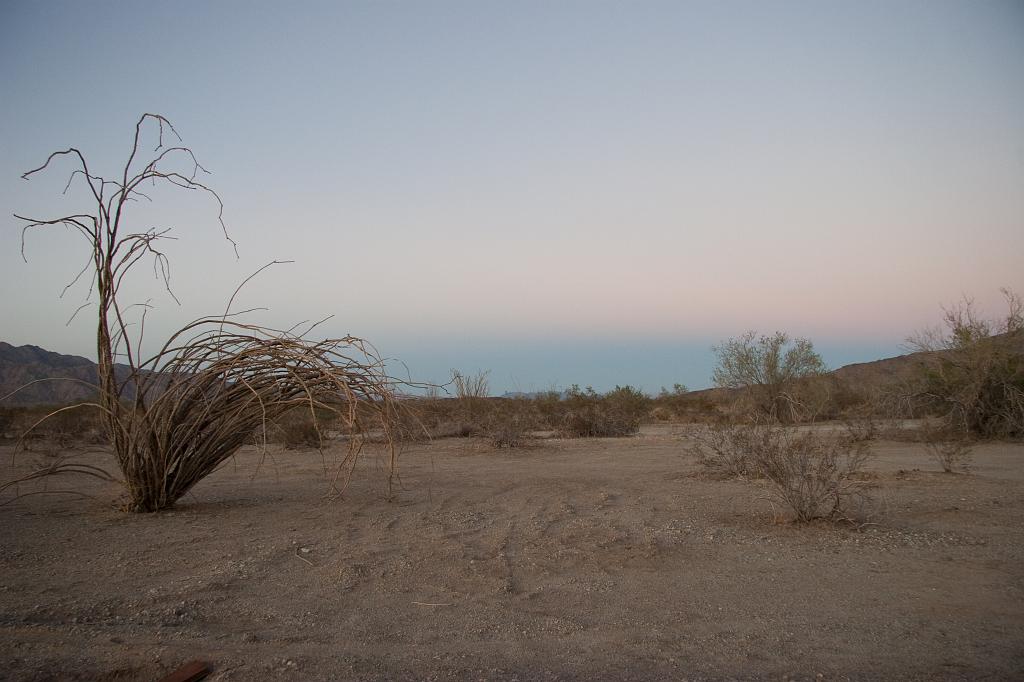
Setting up my favorite Pluto hunting telescope, a 17.5 inch f/4.5 Litebox reflector. Oh, in case you were wondering, its name is Hagrid. All my telescopes have names. Chuckwalla Bench horizonsEarth shadow at sunset, and Mojo setting up his astrophotography rigA starry necklace spans the sky from dusk to dawnThe planetary lineup from dusk to dawnTwo planets, Venus and Earth at sunsetM24 cluster and 60 day path of PlutoDo you see the Sagittarius teapot and the Milky Way "steam" rising from the spout? How about M24, the huge Sagittarius starcloud (the oval of stars 1pm above center) where Pluto hides?Earth shadow at sunriseBonus picture: This is the "naked eye" view of the sky where Comet McNaught can be found. Can you see the green comet near the Perseus Cluster? If not go to Mojo's Blog for closeup. Click to enlarge. It took binoculars for most of us to spot the first time. 🙂
Every couple of years I get the yearning to see all the planets in one night. Saturday night, June 12 seemed like the perfect opportunity. Our Old Town Sidewalk Astronomers club planned an outing to our regular observing spot, Chuckwalla Bench, which has very good horizons. We needed good horizons to catch Mercury rising just before sunrise.
Here are my planet observations, in observing order. All distances are listed in astronomical units and represent the distance from Earth on June 12, 2010, the night of my observations.
Earth! Facing away from the setting sun, the Eastern horizon turned shades of blue above the pinkish sky. That’s the shadow of the Earth! The dark blue band seems to rise above the landscape and spans 180 degrees. The pinkish sky above the shadow is the antitwilight arch. As the sun sets, the boundary between the reddened (pink) color and the horizon grows until it blends with the darkening night sky. The same thing happens at dawn of course. Look for it, and tell me what you see!
Venus! The first “star” to appear in our sky after sunset was Venus. Through the telescopes its gibbous phase is unmistakable! Its distance from Earth is 1.2 AU (astronomical units).
Mars! I was not expecting to see any features on Mars, since it is so far away and so small. Mars is 1.7 AU from Earth, but only half the diameter of Earth. I was surprised that I could see some dark markings, through a small refractor. When we checked a Mars map for the time of the observation, the large dark feature Syrtis Major was indeed right smack on the central meridian – the imaginary line in the center of the planet facing Earth at that moment.
Saturn! What’s not to love about Saturn! The brownish cloud bands contrasted against the butterscotch hued planetary globe. The slender ring, appearing nearly edge-on, bisected the planet, showing a tiny glimmer of sunlight shining on the north side of the rings. Several moons were visible, though one of the larger ones, Dione, was transiting (crossing in front of) the planet on this night. I spotted Mimas and Enceladus — tiny beacons of light — hovering near the edge of the rings. Titan and Hyperion were on the same side, only further away. Rhea was on the other side. Dione’s shadow marched across the face of the planet for astrophotographers to capture. I didn’t see it visually. Distance from Earth is 9.4 AU right now.
Pluto! This small icy world is 30 AU away from Earth. Once a planet, it is now a dwarf planet. But that doesn’t alter my enjoyment of seeing it through a telescope. For the past few years, Pluto has been marching slowly towards the richest part of our Milky Way galaxy making it a challenging object to confirm in backyard telescopes. Right now it is found skimming the Northern border of M24, the Milky Way Star Cloud. That’s a lot of stars to wade through to find one dwarf planet!
I printed out star charts showing just the few surrounding stars and Pluto, indicating the motion over the evening so I could go back and verify the observation closer to dawn. I also made zoomed out charts, showing larger and larger areas of the region. I had some galactic luck this month! A small open cluster called NGC6603 was nearby to Pluto within the larger M24 open cluster. A few distinctive star patterns separated the dwarf planet from the small star cluster, and I was able to easily starhop and make a positive ID. With Pluto bagged, I was feeling confident about the rest of my planetary to-do list.
Note: From July 4th through the 8th Pluto will pass in front of a dark nebula on the Northwest border of the M24 named B92. This should make the tiny magnitude 14 speck-of-a-former-planet easy to spot.
Ceres, another ex-planet was nearby so I hopped over to have a look at it. Ceres spent half a century after its discovery in 1801 as our 8th planet. Then it was demoted to an asteroid, but its significance was cemented by its designation, 1 Ceres. After many years working the solar system as chief #1 asteroid or minor planet, in 2006 Ceres was promoted to dwarf planethood along with Pluto. Ceres is 1.8 AU from Earth, by the way.
With the dwarf planet observations under my belt, I took a short nap to allow Jupiter, Uranus and Neptune to rise higher in the sky.
Uranus and Jupiter! When two planets are at opposition at nearly the same time they appear to pass each other from our viewing vantage point on Earth. This year we will see Jupiter pass Uranus, then appear to loop backwards–in retrograde–passing near Uranus a second time, then resuming its forward motion with third final close pass. The next time this will happen is 2037, so you might want to aim your binoculars at this pretty pair of planets this year. This is the first pas de deux, so you have many months to view the dance of the two gas giants. Through the telescope, Jupiter, which is 5.1 AU from Earth, looked unusual to me. It was my first look at the planet since the Southern Equatorial Band disappeared. A few months ago, this chunky ruddy band went missing.
Uranus has a beautiful aquamarine color. It has several moons just on the border of visibility through large amateur telescopes. I was able to spot three of the brighter moons of this planet — the ones farthest from the planet’s glow. Titania and Oberon on one side and Ariel on the other. A big ‘scope and good dark and steady skies help to see the faint moons! Uranus is 20 AU from Earth. Try looking up at Jupiter in a dark sky and see if you can spot a blue-green “star” nearby.
Neptune! Neptune sports an azure-blue hue and appears like a tiny disc. It’s nearly 30 AU away near the southern tip of Capricornus. At this time of year, that means waiting until 3 am or later for a view.
Now I had snagged all the planets except Mercury. It would be rising an hour before sunrise at 5:30 am, but the elevation of hills on the SE horizon were difficult to measure. I kept my eyes on the Pleaides star cluster as Mercury would rise directly below the famous cluster. By 4 am, with an hour and a half until sunrise, the sky was already brightening. First, the glorious Milky Way faded until it was nothing but a memory. Then, one by one the constellations disappeared, except for their brightest starry ambassadors. I steadied my binoculars as the Pleiades or “Seven Sisters” disappeared one by one. I kept the remaining Pleiades stars in my binocular view while moved back and forth, scanning the horizon for Mercury. Soon the rays of pending dawn punctuated the horizon, and I worried that I’d miss it as sunrise made the landscape visible once again. I could still see some of the Pleiades, and kept looking for over 45 minutes. Finally, just a few minutes before 5:00 am, a bright beacon appeared on the horizon. It was Mercury! I had seen ten planets in the span of nine hours!
The nine hours passed so quickly. With sunrise comes daylight and the views of the night sky fade from view but not from memory. Join us out in the desert sometime or find a local astronomy club closer to you so you can see these wonders of our solar system for yourself! You really have to see this!
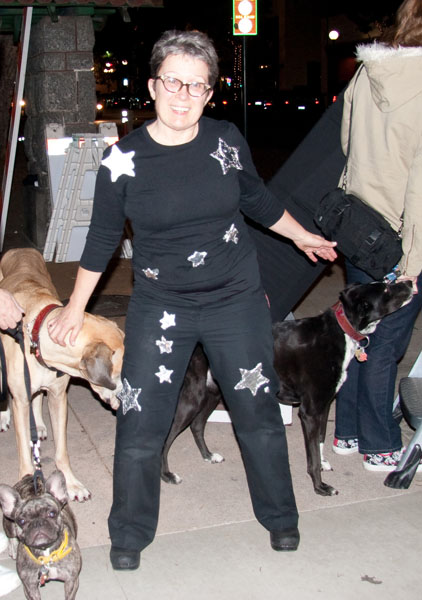
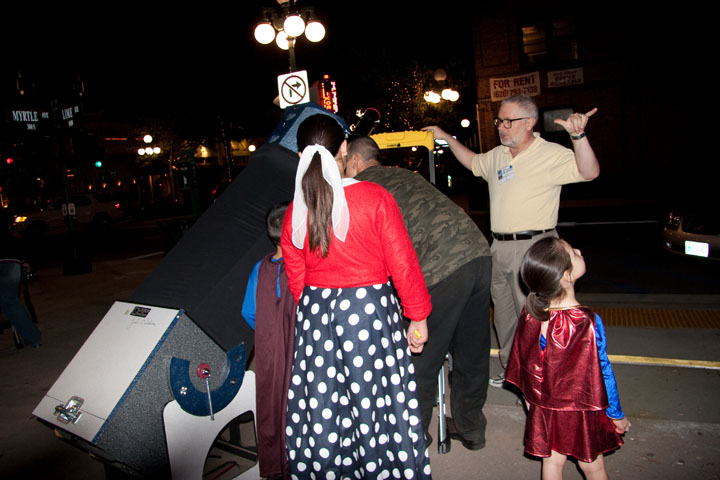
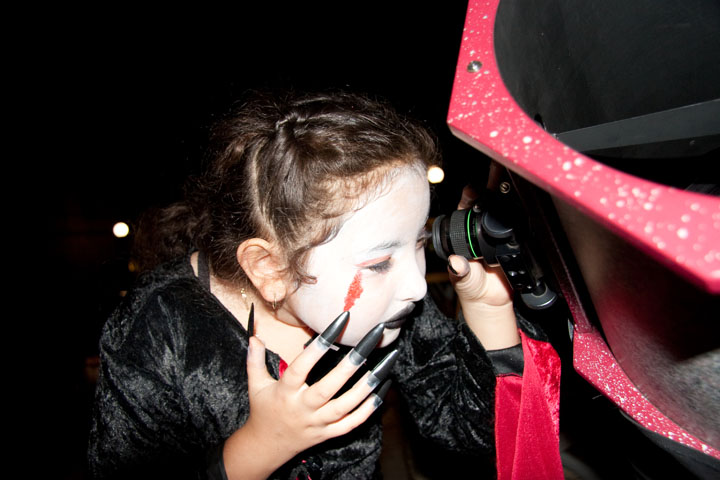
Hauling a telescope across the streets of San FranciscoJane-Orion plus Canis Major and Canis MinorMojo demonstrating where to find Jupiter’s moonsGetting some eye candy
Sidewalk Astronomers have been setting up telescopes on Halloween as long as there have been sidewalk astronomers!
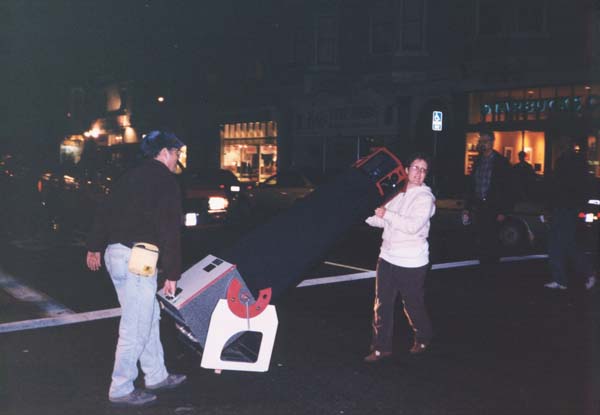
When we lived in the San Francisco Bay Area, we’d cross the Golden Gate Bridge from home and head to the Castro District of San Francisco on Halloween. It was crazy! Tens or maybe hundreds of thousands of revelers flock to the Castro on Halloween but I think we were the only ones with telescopes!
That Halloween sidewalk astronomy tradition continues in San Francisco to this day. And now that we live in southern California we’re carrying on the tradition in our new home town.
On Halloween, everyone with a telescope becomes a sidewalk astronomer. If there is a clear sky and a moon or planet to see, telescopes appear in front yards around the world. Astronomers love sharing the views, and a captive audience makes front yard astronomy a lot of fun for everyone.
The magic of sidewalk astronomy took over Library Park in Monrovia,CA minutes after we arrived. On this Halloween night, our club had 5 telescopes set up. Soon, princesses, superheroes and zombies alike said wow at our eyepieces! People stayed and looked through the telescopes for a long time. Even groups of teens, on their way to some event stopped for a look at Jupiter and the moon. They said wow too!
When I told one group of teenage girls that I didn’t have candy, but had bookmarks instead, one girl said “I love reading”. Every girl wanted their own bookmark. Later, a young boy, when he received a picture of Jupiter said “I am putting this picture on the wall in my room”.
Sharing views of the moon and planets on Halloween is a great tradition. Pass it on!
Observing report, dark sky weekend, October, 2009, Chuckwalla Bench
A perfect night begins with Earth's shadow climbing in the eastOne one side of the green van is the Imaging zoneOn the other side of the green van is the visual observing zone
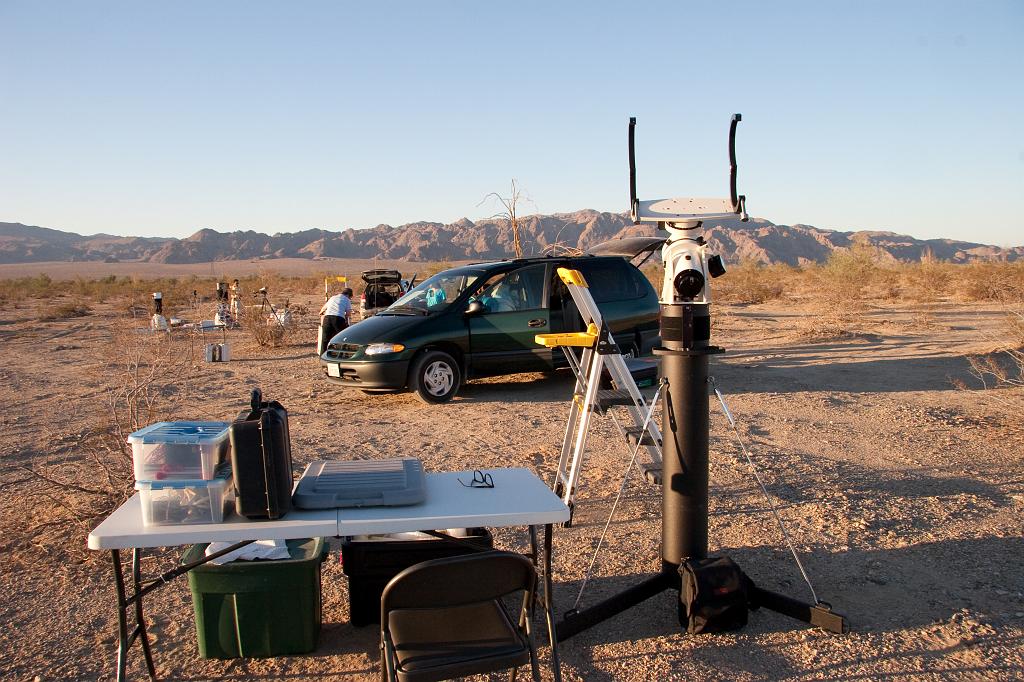
When the clear sky chart reads perfect, we can’t wait to get out to our favorite dark sky observing site, Chuckwalla Bench. I wondered what would happen when Mojo started dabbling in the dark art of imaging. I’m the old fashioned alt-az dob girl, and now my hubby would be keeping warm at the star party with the heat from electonic power supplies and batteries. Poor me! I pouted (for only about a year or so) before I learned to love the dark arts, and we now happily observe and image with only our 1998 green Dodge Caravan separating “his” imaging zone and “her” visual observing zone.
New moon Saturday night in October 2009 was another perfect observing night in the Colorado desert of Southern California. Temperatures were in the 90’s before the sunset, and cooled to about 65 by 2 a.m. when we took a pre-dawn snooze. Humidity remained in the teens.
Last month we had a great time combining visual observing and imaging. On the “visual” side of the observing field Gary and I were struggling to confirm our main project for the night, the asteroid Juno. Mojo was imaging the same target, and a quick look at his Juno image confirmed the star fields we were looking at visually. It was a lot of fun!
This month Gary and I were hunting down NGC 7640, a pretty elongated barred spiral galaxy just 4 degrees to the south of the popular Blue Snowball planetary nebula. This mag 12 galaxy should have been easy to find but its low surface brightness made it a challenge. It took my 17.5-incher to provide a great view, and then Gary was able to see it in his 12.5 incher too. In my scope the long and narrow galaxy’s core seemed bright, long and twisted, and the spiral arms were visible as wisps off both edges. We called Mojo over for a look and he thought it would make a nice imaging project, which it did!
Next it was Mojo who suggested a target he had imaged would make a nice project for us push-to observers. NGC 7541 is called a “showpiece” galaxy group in the Night Sky Observers Guide in Pisces. Soon I had a gorgeous visual view of this pretty pair of galaxies in my telescope, and called Mojo over for a view.
The other benefit of Mojo’s new hobby is that I can “suggest” targets for him to image. Then I can use them in my What’s Up podcast series. I used 4 of his lovely images in October’s Podcast about the Andromeda Galaxy. See if you can spot them. Two are views of the Andromeda galaxy. One shows the whole galaxy, and the other shows the galaxy as a smudge — exactly as it looks in a modest visual telescope. The other two are Milky Way images, one showing a washed out Milky Way (what most people actually see) with Jupiter and the other is his very pretty image of M52 and the Bubble Nebula, some of our own Milky Way’s jewels.
So it is possible to combine imaging and visual observing, and I look forward to our next outing! I’m preparing my “Honey Do” list of imaging targets to “suggest” to Mojo already. 🙂
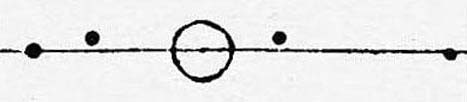
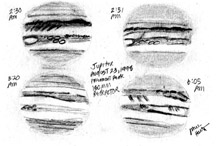
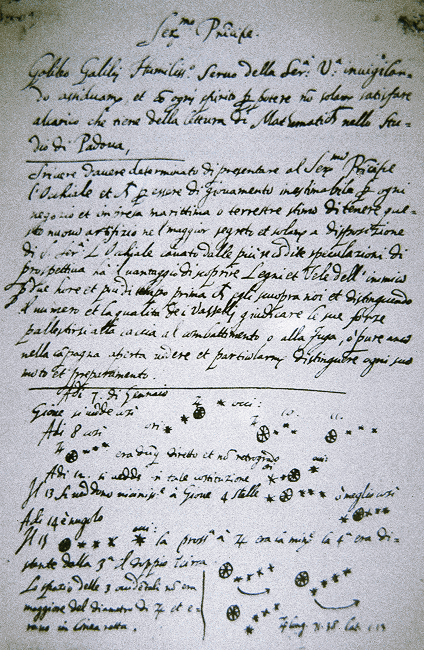
Galileo’s drawingmy drawingmy sketch of Jupiter’s rotation
Galileo published his observations in Sidereus Nuncius in March 1610: “On the 7th day of January in the present year, 1610, in the first hour of the following night, when I was viewing the constellations of the heavons through a telescope, the planet Jupiter presented itself to my view, and as I had prepared for myself a very excellent instrument, I noticed a circumstance which I had never been able to notice before, namely that three little stars, small but very bright, were near the planet…When on January 8th, led by some fatality, I turned again to look at the same part of the heavens, I found a very different state of things, for there were three little stars all west of Jupiter, and nearer together than on the previous night.”
“I therefore concluded, and decided unhesitatingly, that there are three stars in the heavens moving about Jupiter, as Venus and Mercury around the Sun; which was at length established as clear as daylight by numerous other subsequent observations. These observations also established that there are not only three, but four, erratic sidereal bodies performing their revolutions around Jupiter.”
Every amateur or accidental astronomer who first views Jupiter and its lineup of moons, is amazed at the view. Galileo’s 1610 discovery of these four moons orbiting Jupiter changed history. Looking at the Jovian moons through a small telescope, while trying to imagine Galileo’s first observations, takes my breath away!