Jane's blog banner

Tag: Litebox Telescopes

  • Spring stargazing: the Milky Way and beyond!

    Follow the dipper arc to Arcturus, then spike to Spica
    Follow the dipper arc to Arcturus, then spike to Spica
    Omega Centauri globular cluster 35 degrees below Spica
    Omega Centauri globular cluster 35 degrees below Spica

    Springtime is my favorite observing season. In the course of an evening you can face away from our own galaxy and feast your eyes on other Milky Ways, while tracking down some of the most spectacular objects tangled among the stars and dust of our own galaxy.

    Omega Centauri is one of them. It’s the largest of the 150+ globular clusters discovered in our own Milky Way Galaxy. There may be even more undiscovered globular clusters hidden behind the gas and dust of our galaxy. Omega Centauri was discovered by Edmund Halley in 1677 as a nebula, but it had been listed in Ptolemy’s catalog 2000 years ago as a star! It’s located about 15,800 light-years from Earth and contains several million Population II stars. The stars in its center are so crowded that they are estimated to average only 0.1 light years away from each other. It is about 12 billion years old, and there is some speculation that Omega Centauri may be the core of a dwarf galaxy which was disrupted, destroyed and absorbed in an encounter with the Milky Way.

    This spectacular object is well known to southern hemisphere observers, but it may come as a surprise that it can be seen from many northern hemisphere locations as well. If you are south of the 25th parallel or 25° (degrees) North latitude you should be able to see it 20° above the horizon, and located 35° below Virgo’s great blue-white star, Spica. I’ve observed it from 37° North (Lake Sonoma, CA) several times (from a hill with a negative horizon) and at 33° N in this writeup, where it appeared less than 20° above the horizon definitely! It’s been seen from 42° North as well, from a very flat horizon. It’s a naked eye object, but often the horizon is hazy, so scan with binoculars if you don’t see it with your eyes.

    NGC 5128, Centaurus A Galaxy, and NGC 5139 Omega Centauri, the largest Globular Cluster in our Milky Way
    NGC 5128, Centaurus A Galaxy, and NGC 5139 Omega Centauri, the largest Globular Cluster in our Milky Way

    To find Omega Centauri, you’ll first have to find Spica, the brightest star in Virgo. It helps right now that golden Saturn is near by. To find Spica, continue the curve of the big dipper handle and “arc to Arcturus, and then spike to Spica”. Spica transits — when it reaches its highest point in the sky — at around midnight daylight saving time. Use this table of transit times for major solar system objects and bright stars and select your observing dates, object (Spica in this case) and your location and press “compute”. “Alt” next to the transit time at your location indicates Spica’s altitude above the horizon. Spica and Omega Centauri transit at the same time, so look about 35° (one clenched fist is 10°) directly below Spica to look for an oval hazy cluster the size of the full moon. Can you see individual stars? Does it look round or oval? Try with your eyes, then with binoculars.

    After confirming my view of Omega Centauri and making this little sketch (sketch view as seen through my binoculars), I opened my Herald Bobroff AstroAtlas to the Centaurus constellation pages and looked at what else was in the vicinity of Omega Centauri. I remembered a favorite galaxy, NGC5128, officially named Centaurus A, but nicknamed the hamburger galaxy for obvious reasons. Now I’ve seen both of these objects from Australian skies where they are not hugging the horizon. But even through a partially cloudy horizon, I was able to see this fabulous object, with its dark dust lane bisecting the oval galaxy.

    NGC5128 is one of the closest radio galaxies to Earth, so its active galactic nucleus has been extensively studied by professional astronomers, and a supernova was detected in the galaxy’s dust lane in 1986. The Spitzer Space Telescope studies have confirmed that Centaurus A is colliding with and devouring a smaller spiral galaxy! Centaurus A is located approximately 4° north of Omega Centauri, and because the galaxy has a high surface brightness and relatively large angular size (2/3 the apparent size of Omega Centauri), it’s visible to the naked eye under good conditions. My sketch was made with difficulty, by aiming my 14.5-inch reflector (with a 10mm Radian eyepiece for 200x) nearly horizontal and half-perched uncomfortably on the bottom step of my observing ladder.

    M68 cluster in Hydra, NGC2903 Galaxy in Leo
    M68 cluster in Hydra, NGC2903 Galaxy in Leo

    Before moving on, I observed another object in the southern sky line between Spica and Omega Centauri, Globular Cluster M68, or NGC4590 in the constellation Hydra. I sketched an oval glow of stars within a diffuse squarish haze of fainter stars.

    Now it was time to get vertical and observe some other objects higher in the sky. The beautiful constellation Leo was still well placed in the southwest sky after midnight. I opened my Night Sky Observer’s Guide Volume 2, the Spring and Summer volume to Leo. Gamma Leonis, or Algeiba, is a beautiful deep yellow/orange and pale yellow double star in the sickle (or backwards question mark or lion’s mane) of Leo’s head. Next, I moved to a fascinating red dwarf, Wolf 359, near the famous Leo galaxies M95, M96 and the Leo “trio” of galaxies. Wolf 359 moves 4.71″ (arcseconds) per year or 8′(arcminutes) in a century. It’s the third closest star to the sun, at 7.75 light years away. Only Alpha Centauri and Barnard’s Star are closer. At magnitude 13.6 (similar to Pluto’s magnitude) it’s faint, but the striking red color helps distinguish it from the other nearby stars.

    Leo 1 near Regulas, Leo’s heart was my next target. A faint dwarf galaxy overshadowed by bright Regulus is a member of the local group of galaxies, and may be one of the most distant satellites of the Milky Way. Faint NGC2903 — a very pretty magnitude 9 barred spiral galaxy tangled in the starry lion’s mane was worth a sketch. It’s 31 million light years away, local but not attached to any local galaxy group. I had to go and have a look at the supernova in Leo’s M65 galaxy – here is Mojo’s animation of M65,combining two images of M65, one shot on 3/9/13 at Amboy Crater, and one shot on 4/6/13 at Chuckwalla Bench located at N 33° 39′ 37″, W 115° 32′ 26″
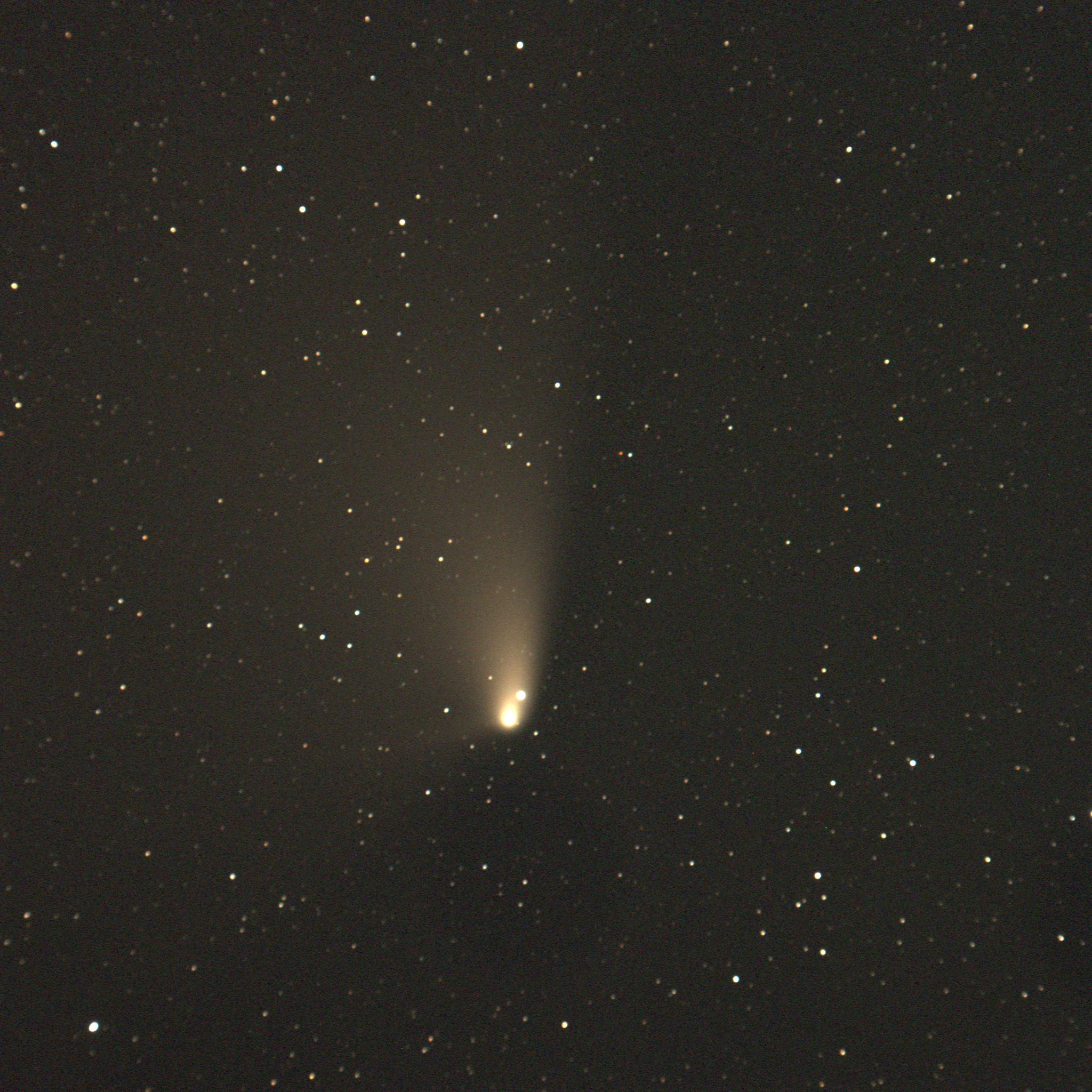
    Comet C/2011 L4 (PANSTARRS) shot before dawn on 4/7/13, five-minute exposure
    Comet C/2011 L4 (PANSTARRS) shot before dawn on 4/7/13, five-minute exposure

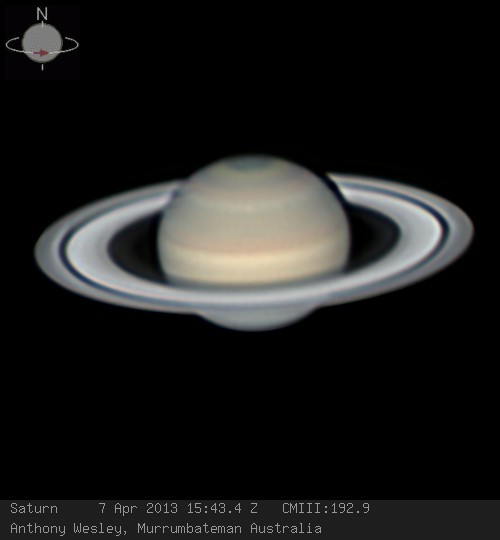
    It dawned on me I hadn’t observed Saturn yet. Under fabulous steady skies, I was able to pump up the magnification of my 15-inch Litebox reflector to over 300x using a 6mm Televue Radian eyepiece. When I say “my” 14.5-inch Litebox, I mean Mojo’s — I have a 12.5-inch and 17.5-inch version of these fabulous time machines. 🙂 This image taken by Anthony Wesley the same night shows Saturn as I viewed it. My visual view was not quite this vivid, but the contrast of the colors is very similar to what I saw, including the dark north polar region, so famous in the Cassini North Polar Hexagon images. The distinct band colors and darker north polar area I saw and sketched were varying shades of butterscotch and chocolate.

    All that was left now was Comet PanSTARRS, and we had to wait until about 4:00 a.m. for Andromeda to rise in the northeastern sky. I observed it in my 7×50 Carton Adlerblick binoculars quickly and then pooped out and went to sleep until well after dawn. Mojo stayed up and took this lovely image, plus several more including a time sequence showing the comet’s motion. It’s really worth a look and a read and here’s the link. Until next dark sky observing night on May 11, I’m signing off!
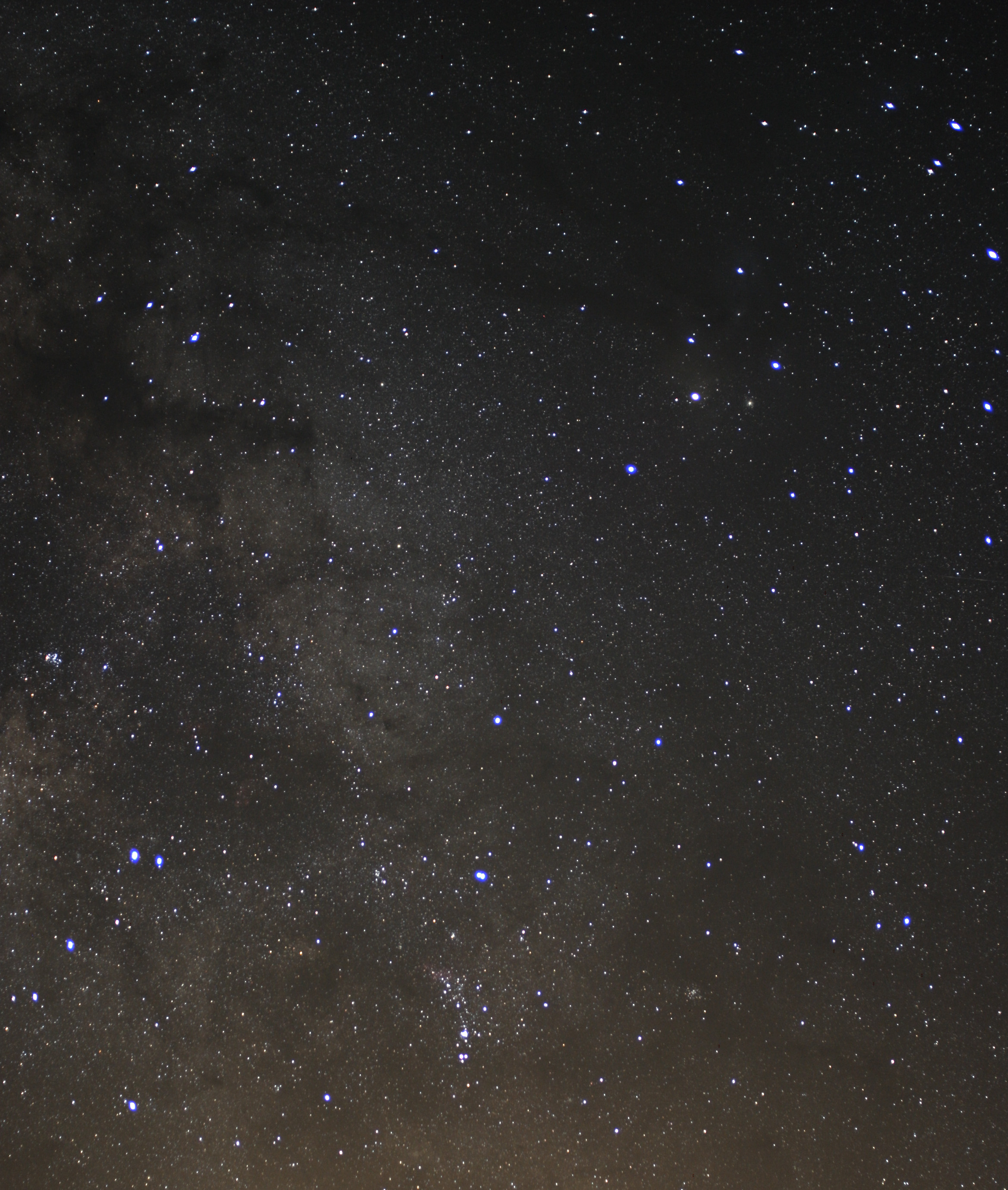
    Mojo’s images and report from the same night

  • Observing in the neighborhood

    Summer Milky Way, Scorpius and dark nebulae
    Summer Milky Way, Scorpius and dark nebulae, image by Morris Jones

    Observing near the summer solstice means a short observing night sandwiched between a late sunset and an early dawn. Rather than rush through an observing project I find it’s a great time of the year to sit back and trace familiar constellations in my minds eye, and marvel with anticipation as the eastern horizon brightens. Soon, the stars of Scorpius and Sagittarius will rise and the “clouds” on the horizon take shape as lumps and glittery clusters, bisected by dark nebulae — those mysterious star-less regions within our Milky Way Galaxy.

    It’s hard not to just sit and gaze at the unfolding spectacle. So for the first hour or two after darkness last Saturday night (June 16, 2012) I sat in my meteor observing chair and observed the sky with my own eyes. Every now and then I jumped up and eyeball-aimed Mojo’s 15-inch Litebox reflector at this cluster or that nebula. The sky conditions at Amboy Crater were near perfect.

    We have 360 degree perfect horizons at this site, with small light domes from 29 Palms, and from departing trains. Temperatures are warm with just a hint of breeze, hot before sunset, shirtsleeve observing all night long, humidity 10% rising to 20% at dawn. Conditions are dry and warm. No dew. Ever! Here’s the Clear Sky Chart for Amboy Crater.

    Lyra
    Lyra
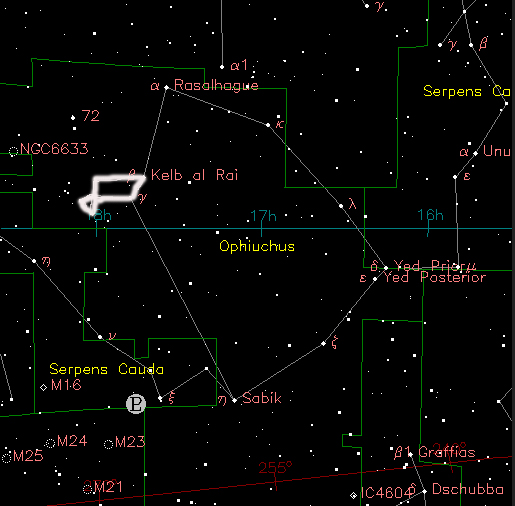
    Ophiuchus and Poniatowski's Bull
    Ophiuchus and Poniatowski's Bull
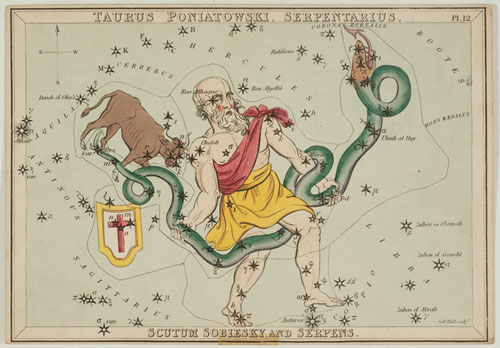
    the demoted constellation Poniatowski's Bull and Ophiuchus
    the demoted constellation Poniatowski's Bull and Ophiuchus

    As I was looking at the constellation Lyra and its gem-of-a-telescope-target, the Ring nebula, M57, I spotted an asterism nearby, in the northeastern section of Ophiuchus that looked just like Lyra, except it was upside down.

    That looked like a good place to select an observing project, so I cracked open my copy of the Night Sky Observers Guide, volume 2 Spring and Summer to the constellation Ophiuchus. I noticed this little group of stars that looked like Lyra were part of an open cluster, and that there was another pretty cluster in the neighborhood.

    Best of all, Barnard’s Star was within the cluster! Barnard’s Star is the second closest star to the Earth — only 6 light years away, shining at a faint magnitude 9.5. The Alpha Centauri system, including Proxima Centauri, together are about 4 LY away, but we can’t see them from the US. Barnard’s Star has the greatest proper motion — the angular annual movement across the line of sight against the distant stellar background of any star. It moves 10.4 seconds of arc per year. That compares to a quarter of a degree in a human lifetime, roughly the angular diameter of the full Moon.

    Amateur astronomers, carefully sketching or imaging Barnard’s Star once a year for a couple years can actually track the movement of the star. It’s a cool red dwarf. And it’s listed in Jim Kaler’s fabulous book The Hundred Greatest Stars. Jim writes “Barnard’s Star has a metal content only 10 percent that of the Sun. That coupled with its high velocity shows it to be a special, rather rare, kind of star called a “subdwarf” that more belongs to the metal-poor and ancient halo of our Galaxy (the Sun belonging to the disk). It is merely passing through our local neighborhood.”

    You’ll definitely need a star chart to find it. Here’s one showing Barnard’s Star within the Melotte 186 star cluster with pretty IC 4665 nearby. This tiny faint red dwarf is a challenge, but it’s worth it, as are the two clusters.

    The neighborhood it’s passing (to our line of sight), is through the demoted constellation Poniatowski’s Bull. This V- shaped set of stars looks like a bull’s head and horns in northeastern Ophiuchus. I see Lyra, instead, by adding a few other stars. It was named Poniatowski’s Bull (Taurus Poniatovii), to honor Stanislaus Poniatowski, King of Poland from 1764 to 1795. Named by Polish-Lithuanian astronomer and mathemetician Marcin Odlanicki Poczobutt whose observatory at Vilnius gained royal favor from the King.

    So now, when you are looking at our Milky Way, notice Vega and her constellation Lyra. Then turn your head ever so slightly to the right, and you’ll see huge Ophiucus, which looks like a big percolator coffee pot to me. It’s above and between Scorpius and Sagittarius. The left star of the “lid” of the coffeepot is part of my “upside down Lyra”.

    Nothing beats visual astronomy. Without taking the time to sit down and just look at the sky, and trace the constellations I never would have discovered this lovely demoted constellation for the first time!

    There is always something to observe that you’ve never seen before, even if it is the same old stars. That’s what makes visual astronomy my go-to hobby. Pun intended!

    Mojo’s images and writeup from the same night: predawn planets & astrophotography

    More Fast Moving Stars

    More Demoted Constellations

    Early morning hikes – the Chuckwallas of Amboy Crater

  • A Ten Planet Night

    Setting up my favorite Pluto hunting telescope, a 17.5 inch f/4.5 Litebox reflector. Oh, in case you were wondering, its name is Hagrid. All my telescopes have names.
    Chuckwalla Bench horizons
    Earth shadow at sunset, and Mojo setting up his astrophotography rig
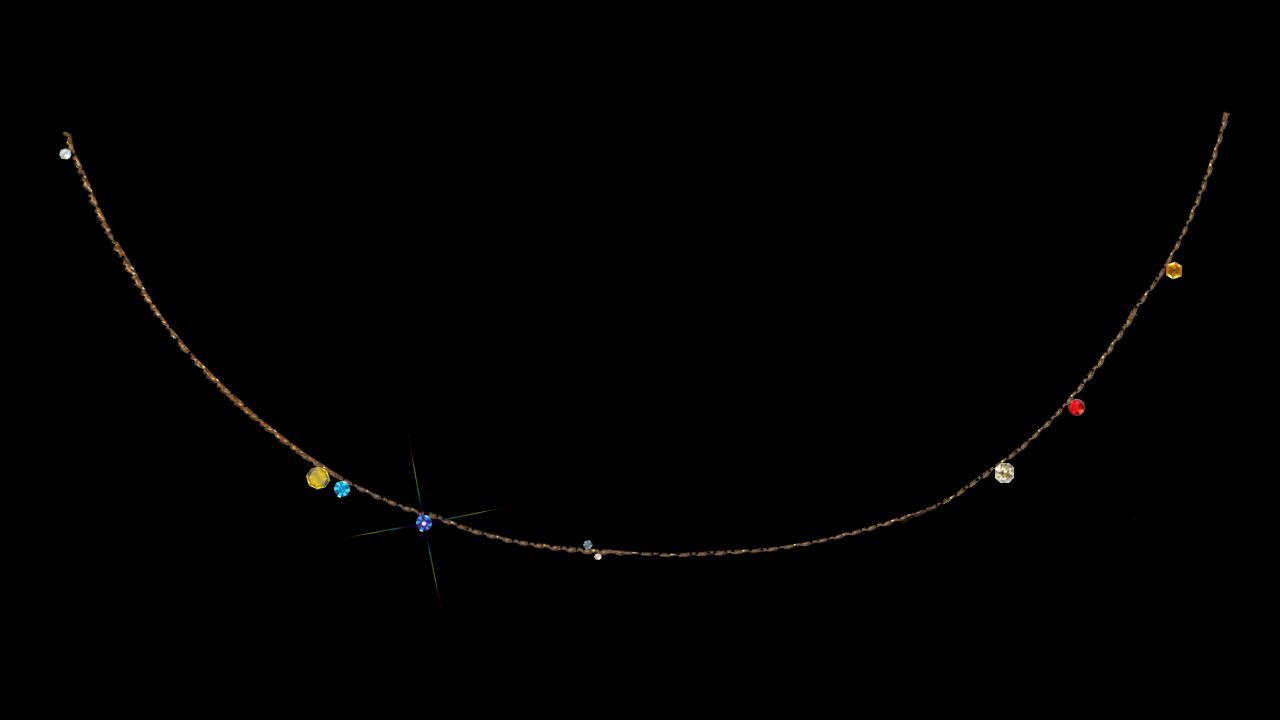
    A starry necklace spans the sky from dusk to dawn
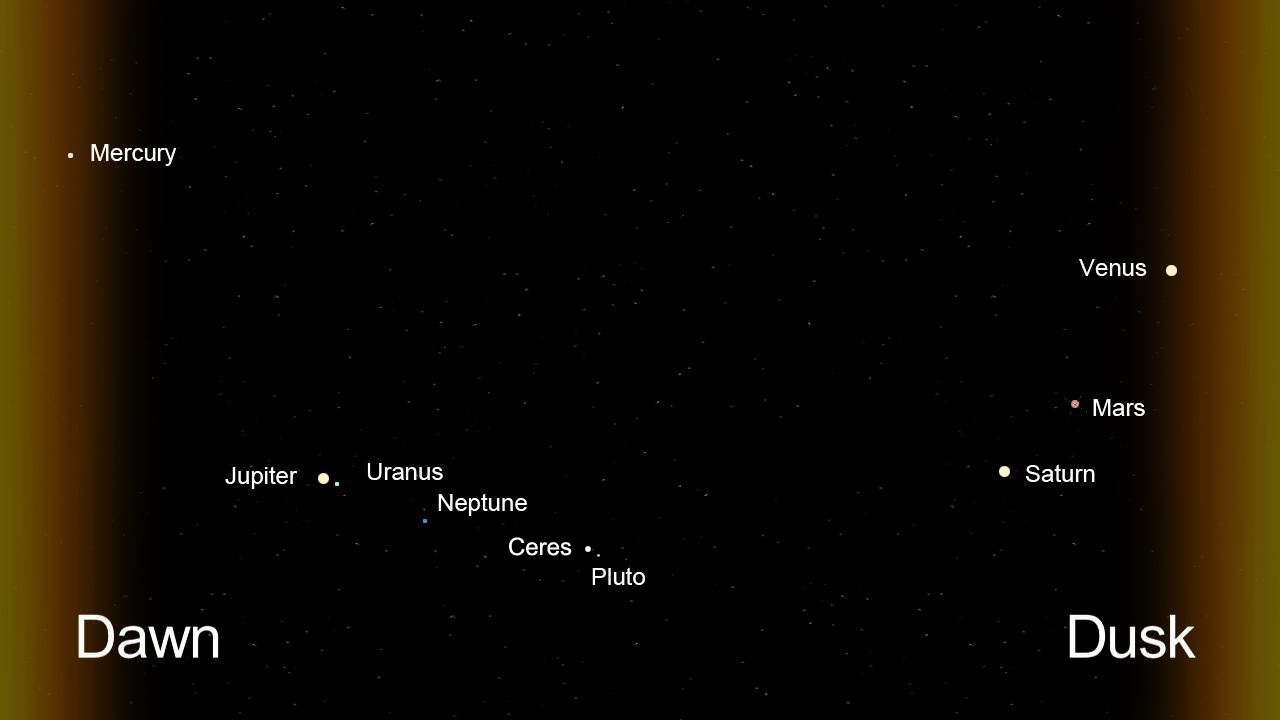
    The planetary lineup from dusk to dawn
    Two planets, Venus and Earth at sunset
    M24 cluster and 60 day path of Pluto
    Do you see the Sagittarius teapot and the Milky Way "steam" rising from the spout? How about M24, the huge Sagittarius starcloud (the oval of stars 1pm above center) where Pluto hides?
    Earth shadow at sunrise
    Bonus picture: This is the "naked eye" view of the sky where Comet McNaught can be found. Can you see the green comet near the Perseus Cluster? If not go to Mojo's Blog for closeup. Click to enlarge. It took binoculars for most of us to spot the first time. 🙂

    Every couple of years I get the yearning to see all the planets in one night. Saturday night, June 12 seemed like the perfect opportunity. Our Old Town Sidewalk Astronomers club planned an outing to our regular observing spot, Chuckwalla Bench, which has very good horizons. We needed good horizons to catch Mercury rising just before sunrise.

    Here are my planet observations, in observing order. All distances are listed in astronomical units and represent the distance from Earth on June 12, 2010, the night of my observations.

    Earth! Facing away from the setting sun, the Eastern horizon turned shades of blue above the pinkish sky. That’s the shadow of the Earth! The dark blue band seems to rise above the landscape and spans 180 degrees. The pinkish sky above the shadow is the antitwilight arch. As the sun sets, the boundary between the reddened (pink) color and the horizon grows until it blends with the darkening night sky. The same thing happens at dawn of course. Look for it, and tell me what you see!

    Venus! The first “star” to appear in our sky after sunset was Venus. Through the telescopes its gibbous phase is unmistakable! Its distance from Earth is 1.2 AU (astronomical units).

    Mars! I was not expecting to see any features on Mars, since it is so far away and so small. Mars is 1.7 AU from Earth, but only half the diameter of Earth. I was surprised that I could see some dark markings, through a small refractor. When we checked a Mars map for the time of the observation, the large dark feature Syrtis Major was indeed right smack on the central meridian – the imaginary line in the center of the planet facing Earth at that moment.

    Saturn! What’s not to love about Saturn! The brownish cloud bands contrasted against the butterscotch hued planetary globe. The slender ring, appearing nearly edge-on, bisected the planet, showing a tiny glimmer of sunlight shining on the north side of the rings. Several moons were visible, though one of the larger ones, Dione, was transiting (crossing in front of) the planet on this night. I spotted Mimas and Enceladus — tiny beacons of light — hovering near the edge of the rings. Titan and Hyperion were on the same side, only further away. Rhea was on the other side. Dione’s shadow marched across the face of the planet for astrophotographers to capture. I didn’t see it visually. Distance from Earth is 9.4 AU right now.

    Pluto! This small icy world is 30 AU away from Earth. Once a planet, it is now a dwarf planet. But that doesn’t alter my enjoyment of seeing it through a telescope. For the past few years, Pluto has been marching slowly towards the richest part of our Milky Way galaxy making it a challenging object to confirm in backyard telescopes. Right now it is found skimming the Northern border of M24, the Milky Way Star Cloud. That’s a lot of stars to wade through to find one dwarf planet!

    I printed out star charts showing just the few surrounding stars and Pluto, indicating the motion over the evening so I could go back and verify the observation closer to dawn. I also made zoomed out charts, showing larger and larger areas of the region. I had some galactic luck this month! A small open cluster called NGC6603 was nearby to Pluto within the larger M24 open cluster. A few distinctive star patterns separated the dwarf planet from the small star cluster, and I was able to easily starhop and make a positive ID. With Pluto bagged, I was feeling confident about the rest of my planetary to-do list.

    Note: From July 4th through the 8th Pluto will pass in front of a dark nebula on the Northwest border of the M24 named B92. This should make the tiny magnitude 14 speck-of-a-former-planet easy to spot.

    Ceres, another ex-planet was nearby so I hopped over to have a look at it. Ceres spent half a century after its discovery in 1801 as our 8th planet. Then it was demoted to an asteroid, but its significance was cemented by its designation, 1 Ceres. After many years working the solar system as chief #1 asteroid or minor planet, in 2006 Ceres was promoted to dwarf planethood along with Pluto. Ceres is 1.8 AU from Earth, by the way.

    With the dwarf planet observations under my belt, I took a short nap to allow Jupiter, Uranus and Neptune to rise higher in the sky.

    Uranus and Jupiter! When two planets are at opposition at nearly the same time they appear to pass each other from our viewing vantage point on Earth. This year we will see Jupiter pass Uranus, then appear to loop backwards–in retrograde–passing near Uranus a second time, then resuming its forward motion with third final close pass. The next time this will happen is 2037, so you might want to aim your binoculars at this pretty pair of planets this year. This is the first pas de deux, so you have many months to view the dance of the two gas giants. Through the telescope, Jupiter, which is 5.1 AU from Earth, looked unusual to me. It was my first look at the planet since the Southern Equatorial Band disappeared. A few months ago, this chunky ruddy band went missing.

    Uranus has a beautiful aquamarine color. It has several moons just on the border of visibility through large amateur telescopes. I was able to spot three of the brighter moons of this planet — the ones farthest from the planet’s glow. Titania and Oberon on one side and Ariel on the other. A big ‘scope and good dark and steady skies help to see the faint moons! Uranus is 20 AU from Earth. Try looking up at Jupiter in a dark sky and see if you can spot a blue-green “star” nearby.

    Neptune! Neptune sports an azure-blue hue and appears like a tiny disc. It’s nearly 30 AU away near the southern tip of Capricornus. At this time of year, that means waiting until 3 am or later for a view.

    Now I had snagged all the planets except Mercury. It would be rising an hour before sunrise at 5:30 am, but the elevation of hills on the SE horizon were difficult to measure. I kept my eyes on the Pleaides star cluster as Mercury would rise directly below the famous cluster. By 4 am, with an hour and a half until sunrise, the sky was already brightening. First, the glorious Milky Way faded until it was nothing but a memory. Then, one by one the constellations disappeared, except for their brightest starry ambassadors. I steadied my binoculars as the Pleiades or “Seven Sisters” disappeared one by one. I kept the remaining Pleiades stars in my binocular view while moved back and forth, scanning the horizon for Mercury. Soon the rays of pending dawn punctuated the horizon, and I worried that I’d miss it as sunrise made the landscape visible once again. I could still see some of the Pleiades, and kept looking for over 45 minutes. Finally, just a few minutes before 5:00 am, a bright beacon appeared on the horizon. It was Mercury! I had seen ten planets in the span of nine hours!

    The nine hours passed so quickly. With sunrise comes daylight and the views of the night sky fade from view but not from memory. Join us out in the desert sometime or find a local astronomy club closer to you so you can see these wonders of our solar system for yourself! You really have to see this!

    Mojo’s report/astrophotos from the same night

    Jane’s June 2010 What’s Up podcast: “A Planetary Necklace”

    Mercury Rising A nine planet observing night in 2001.

  • A Runaway Star and the Flaming Star Nebula

    IC 405 and AE Aurigae
    IC 405 and AE Aurigae

    Stardate: Saturday November 14, 2009.
    Place: Chuckwalla Bench Observing Site
    Equipment: 12.5-inch Litebox Reflector, f/5.75 Pierrre Schwaar mirror
    Sky conditions: Better than expected (clear, steady, good transparancy, but cold)

    Mojo and I try to head out to our favorite dark sky observing spot every new moon Saturday night. Usually several of our Old Town Sidewalk Astronomer friends join us, and usually there are half a dozen telescopes. But this month we were the lone astronomers.

    Mojo has been infected by the Astrophotography virus for the past 2 years. Lucky me! I plunder his images and have included many in my monthly What’s Up podcasts. It’s not easy to find good wide field images of the constellations and low/zero power images of celestial objects, and his are really gorgeous. I love Mojo’s images of the galactic “smudges” because they show what deep sky objects really look like through a modest telescope. But he also wants to image the “eye candy” objects up close and personal, and luckily he welcomes an imaging suggestion from me every now and then.

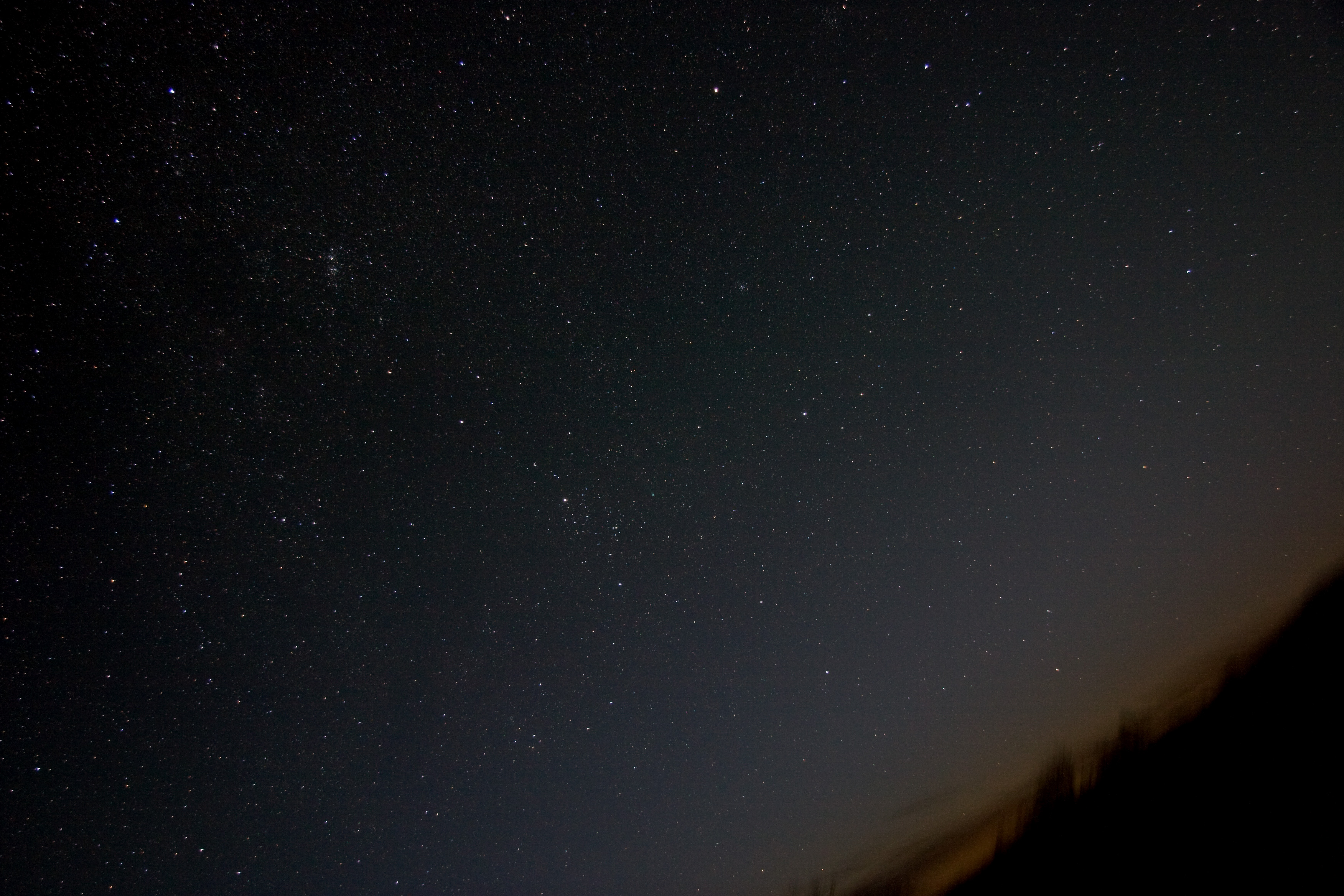
    The constellation Auriga as it appears in the November sky - center left is bright Capella
    Mojo’s Auriga – center left is bright Capella
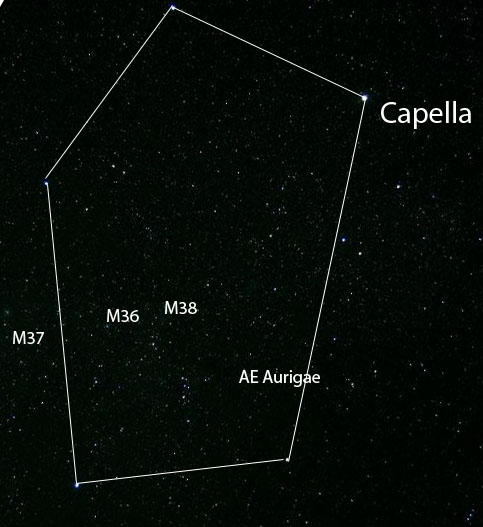
    Rotated & annotated Auriga
    I rotated Mojo’s Auriga 120 degrees clockwise & annotated it because this is how I see it in my mind’s eye – like a house with a door

    So on this particular night, I wanted to observe one really interesting star and one really interesting deep sky object in several of the winter constellations. In Perseus, I observed Eta Persei, a spectacular gold and blue double star, and NGC 1491, a fan shaped emission nebula.

    The constellation Auriga is right next to Perseus, so I opened the good book, and by that I mean the Night Sky Observer’s Guide (NSOG) volume 1 (Autumn and Winter) to Chapter 5, Auriga the Charioteer. Under the “Interesting Stars” chapter, variable star AE Aurigae caught my attention, even thought it only garnered a rating of 3 out of 5 stars — meaning it was an “average” viewing object.

    AE Aurigae is one of the runaway stars whose proper motion can be traced back to the Orion Nebula. It is about 1500 light-years away and is an unusual O-type star with irregular light variations. It shines with the luminosity of 10,000 suns, but because of its distance is just on the edge of naked eye visability at varying magnitudes from 5.78 to 6.08. The NSOG goes on to say the star illuminates IC 405, the Flaming Star Nebula. Wow! That sounded like a very interesting object to view, despite the so-so rating. I called Mojo over to show him my project and mentioned how difficult the nearby nebula was to see visually. I could just barely see it, after trying with and without my O-lll, H-Beta and UHC filters. Only the UHC filter helped a little, and not very much. He thought it would be a challenging imaging project, and the constellation was in a great spot for astrophotography. I showed him where the object was, just next to a line of 4 stars that make up part of the front door of the “house of Auriga”, sort of where the doorbell should be. An hour of imaging later, we were both blown away the rippling waves, curling tendrils and the red color in the nebula.

    Back home the next day I did some more research on the two objects. The Spitzer Space Telescope observed the Flaming Star Nebula, an emission/reflection nebula in infrared wavelengths. Their observations show evidence of a bow shock created by the interaction between the runaway star and the nebular material. The runaway star, AE Aurigae is from the Orion association of O and B type stars. AE Aurigae and Mu Columbae were hurled out of the Orion nebula’s famous Trapezium area before the Trapezium stars were even born! Did one of the stars’ binaries go supernova and did the explosion send these stars hurtling through space in different directions? According to Jim Kaler’s Stars website the collision sent two stars out of the cluster, and the beautiful double star Iota Orionis — the brightest star in Orion’s belt — remained.

    AE Aurigae is moving north at 128k/s (80 miles per second) and is now 40 degrees north of Orion in Auriga. Mu Columbae is now 28 degrees to the south, in the constellation Columba, the Dove. That’s the constellation south of Canis Major and Lepus. Standing out under a dark sky and tracing the path from Orion to the runaway star’s location in Auriga was just mind boggling. Then I eyeballed the the path of Mu Columbae from the Orion nebula past bright Sirius down to the dog’s butt of Canis Major, and on down to Columba. Next month I’ll have to try and see the Columba runaway star.

    That was a great project for both of us! I really enjoyed observing a wild stellar object which had been studied and imaged by one of our great orbiting observatories. And Mojo enjoyed imaging an object that was practically invisible at the telescope eyepiece, but waiting for its closeup in front of his camera.

    Mojo blogs about Pinwheels, Horseheads and Flaming Stars – his projects on the same night.