
Jane's blog banner

Tag: Mare Humorum

  • Chasing Galileo – 21-day old moon comparison

    galileomoon

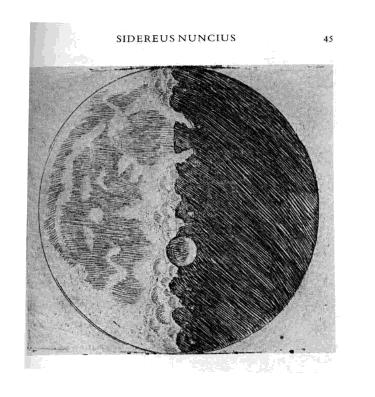
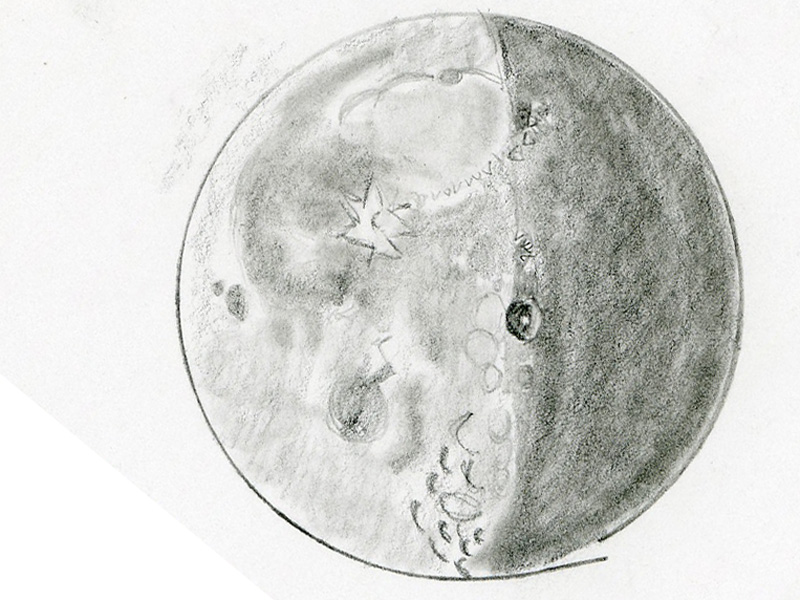
    My sketch of the moon same lunar day as Galileo's engraving
    My sketch of the moon same lunar day as Galileo’s sketch

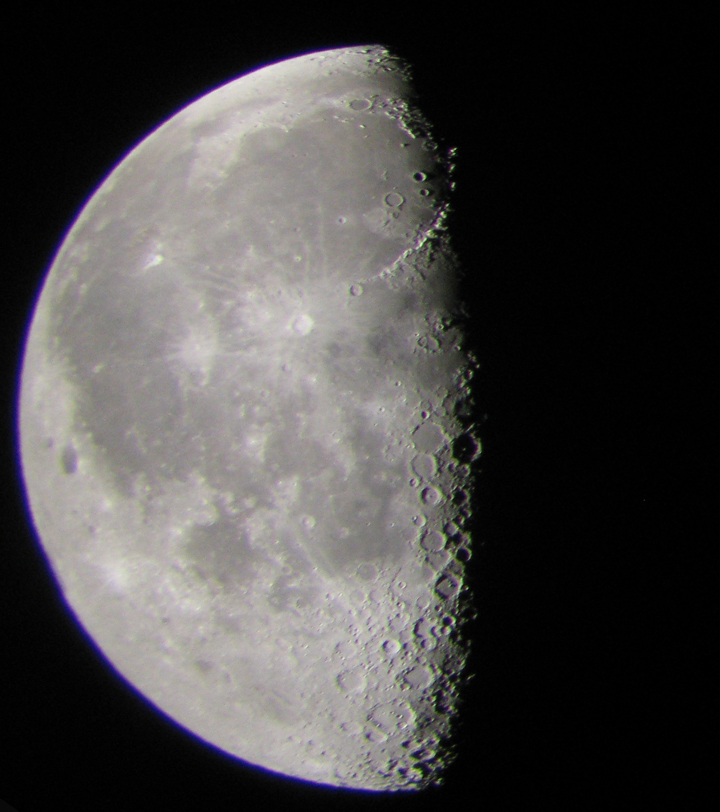
    Image take at eyepiece of 70mm TV Ranger while sketching on 7/14/09
    Image take at eyepiece of 70mm TV Ranger while sketching on 7/14/09

    Galileo’s drawing of the third quarter moon was made on December 18, 1609 according to widely accepted dates calculated by lunar scientist Ewen Whitaker. He used the solar colongitude and the latitude of the subsolar point on the moon to determine the position of the terminator. You can read more about it here on the Reliving Galileo’s Observations page (sorry, this link is gone as of Oct 2011). Refer to his Journal for the History of Astronomy, Vol. 9, p.155 Galileo’s Lunar Observations and the Dating of the Composition of Sidereus Nuncius article.

    You’ll have to scroll through the long article to find the colongitude and solar latitude of the original four engravings and seven small drawings. But you’ll find modern dates with a similar view of the moon. I was delighted to find that my sketch made on July 14, 2009 matched one of the 4 engraving dates!

    The predicted “modern” dates refer to the pattern of lighting and the position of the terminator relative to the surface features. Libration will make the craters and other features displaced somewhat with respect to Galileo’s drawings. Most folks do not actually see any resemblance between now and then, but it is a great project – sketching Galileo’s 400 year-old moon in a 21st century way.

    There is a quite a bit of agreement about the ”center” crater in Galileo’s sketch. It is most likely Albategnius. It was just on the terminator in my sketch too, and I accidentally made the crater a little larger than it really is. It’s just human nature I guess. Other features I can ID on both Galileo’s and my drawing are Mare Imbrium on both sides of the terminator, including some higher parts of Montes Caucasus lit on the unlit side of the terminator. I also can match the ghostly but well-lit trio of Ptolemaeus, Alphonsus and Arzachel just next to Albategnius on Galileo’s sketch, and I saw and sketched them too. Other sunlit Mare – Humorum (left) and Nubium (right) below Albagetnius also match up nicely.
  • Chasing Galileo – sketches of the eleven-day moon

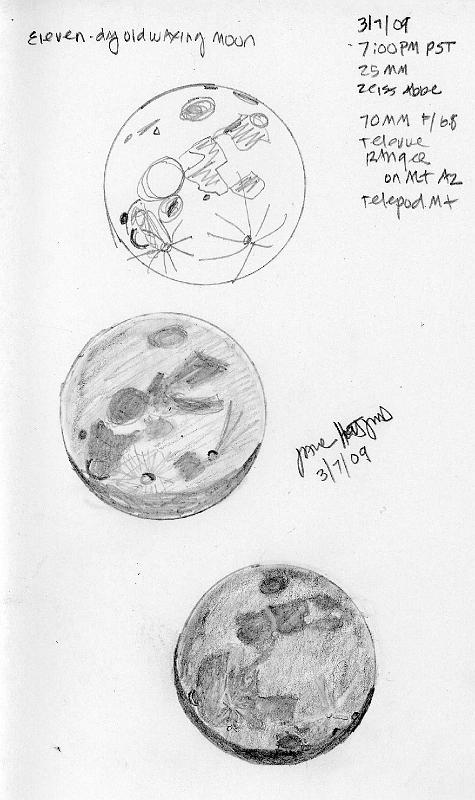
    janelunarday11

    It’s showtime! Sunlight reveals most of the lunar surface and the moon is visible all night long.

    Sinus Iridum — the Bay of Rainbows — is visible near the north part (left in my sketch) of the terminator. It’s the little half circle. The Jura Mountains ring the western edge and catch the morning sun. It looks like a smile. 🙂 This is one of my favorite lunar features to view and also to sketch.

    Mare Imbrium is the large lunar mare just south (right) of Sinus Iridum. As the moon approaches full, the large craters Copernicus and Tycho take center stage. Moving left to right across the terminator we first see Copernicus. It’s 93 kilometers in diameter and its rays will be much more visible at full moon, thought they are impressive today, too!

    Tycho lies in a field of craters near the south limb. Its massive ray system is beginning to appear. Watch it over the next few nights and trace the rays as they span over 1500 kilometers. Its diameter is 85 kilometers, which makes it a little smaller than Copernicus.

    Closer to the terminator, another crater with spectacular rays at full moon appears tonight as a little white crater circle between Copernicus and the terminator. That’s Kepler! Oval Mare Humorum appears directly opposite Mare Crisium, and the look to be about the same size, which they actually are!. The small crater on the left edge of Mare Humorum is Gassendi, another lunar feature I love to sketch. Shickard is the final lunar feature on the right terminator. Wow! That was a lot of fun, to try to identify major features on a tiny 2-inch sketch! Full moon next!

    My photo of the eleven-day moon

  • Chasing Galileo – sketches of the 3-day moon

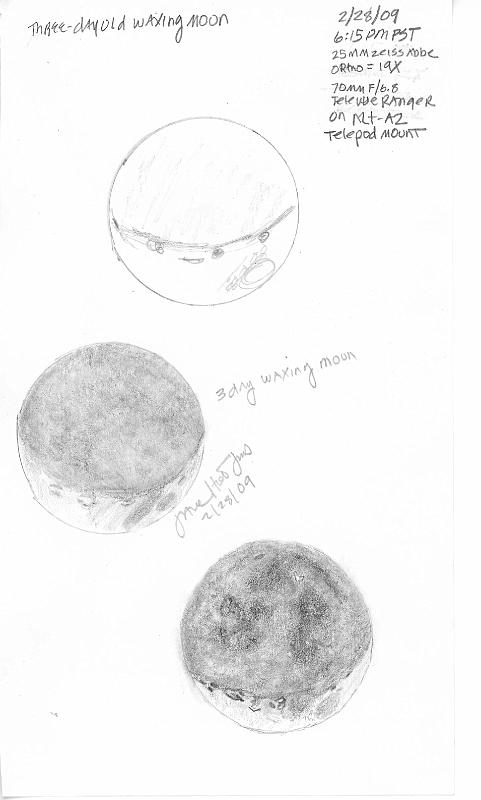
    three-day old waxing moon
    three-day old waxing moon

    This year, my observing project is to recreate as many of Galileo’s original telescopic observations as I can. I’ll be using my smallest telescope, a 70mm refractor, and making my sketches using a 25mm eyepiece for a magnification of 19x. Each of my lunar sketch pages will each show three sketches on the page. My first sketch is an “outline” of major features. The second sketch shows more detail, and the third is the final sketch. When I’ve matched all of Galileo’s lunar sketches, I’ll make a comparison montage.

    The three-day waxing gibbous moon is high enough above the western horizon and far enough away from the setting sun to be easily visible. Earthshine illuminates the unlit features, and sun shines on the narrow crescent. Mare Crisium (the Sea of Crisis) is the oval dark geological feature visible on the lower right edge of the three-day-old crescent moon.

    The crater Picard can be seen within the smooth surface of Mare Crisium. Along the terminator are some distinctive craters and other features, visible even at 19x. Following the terminator from right to left in my sketch, are dark Mare Fecunditatis and the large oval craters Langrenus, Vendelinus, and Petavius, all partially lit by the sunrise on their walls.

    Petavius, the third of the 4 evenly spaced, and similarly sized craters shows some of the prominent crater floor structure of central peak and rimae – which I sketched as a dark angluar line. Funerius, fourth and last of the big craters on the terminator tonight, are near the two smaller craters, Snellius and Stevenius. In my sketch, I just show the crater floors flooded with shadow.

    Earthshine reveals Mare Imbrium and Mare Serenitatis, Nubium and Humorum. And I was able to see the crater Aristarchus (the white feature top middle of the earthshine) and Plinius and Linne — the small white features in the lower middle of earthshine.

    Use the link below to Hitchhikers Guide to the Moon to identify other features.

    Hitchhikers Guide to the Moon

    Sketch of Petavius

    Sketch of Langrenus, Vandelinus, Petavius, and Furnerius a few days after full moon February 3, 2007, a 16 day-old waning moon.

    My photo of the 3-day moon