Jane's blog banner

Tag: NASA

  • NASA Social at Dryden Flight Research Center, May 4, 2012

    This way to the first @DrydenSocial
    This way to the first @DrydenSocial
    New NASA Social lanyard, badge and patch, old tweetup pins
    New NASA Social lanyard, badge and patch, old tweetup pins
    Here I am inside the Astronaut CTV (Crew Transport Vehicle) I would have laid down on the bed I'm sitting on, but I was too excited!
    Here I am inside the Astronaut CTV (Crew Transport Vehicle) I would have laid down on the bed I’m sitting on, but I was too excited!
    Here are the fabulous handouts and books for the attendees
    Here are the fabulous handouts and books for the attendees
    My other car is not an F-18 Hornet :-(
    My other car is not an F-18 Hornet 🙁

    I was one of the lucky attendees at the first NASA Social at Dryden Flight Research Center last Friday, May 4, 2012. Here’s my first blog about the event — a play-by-play rundown of the speakers and tours on the agenda. NASA selects attendees who use social media, so naturally we’re encouraged to share the experience. Who wouldn’t want to do that, anyway? Here’s my social self for you to follow if you’d like: @jhjones on Twitter and JaneHoustonJones on Facebook. My NASA video podcast, What’s Up, with RSS feed and iTunes link is here, on YouTube here, and expanded with educational activites, starcharts and web links here.

    But, first of all, I’d like to offer my sincere thanks to the Dryden Office of Strategic Communications team for a flawless and exhilarating experience! Thank you Kevin, Lisa, Terry, Beth, Leslie, and the many others who put this event together. Thanks to the speakers, the pilots, and the many interpreters, managers, AV team, oh, gosh thanks everyone at the Dryden Flight Research Center for allowing 50 Aeronautical geeks/social media savants into your world for a day. We really appreciated it!

    In looking over the agenda, I noticed a url below every single speaker’s name and most of the aircraft and other venues we visited. What a brilliant addition to the program!

    Introductions
    Kevin Rohrer, Chief of the Office of Strategic Communications Kevin’s Bio
    Stuff I learned: Kevin makes his own beer, and drinks it too!

    Welcome
    David McBride, Center Director David’s bio
    Stuff I learned: Dryden has the most manned launches of ANY @NASA center! And David watches my What’s Up podcast via itunes on his iPad.

    History of Dryden Flight Research Center
    Christian Gelzer, Chief Historian About Dryden Stuff I learned: Dryden started in 1946 to test the X-1 and find out if supersonic flight was possible (and survivable).

    Sonic Booms
    Ed Haering, NASA Aerospace Engineer
    Sonic Booms
    Dryden sonic boom research Stuff I learned: “The boom you heard today started in 1947. You look out on the lake bed and realize how blessed you are to be doing this.”

    Historical aircraft tour
    Pete Merlin, Dryden Historian
    X-1E
    LLRV-Lunar Landing Research Vehicle Stuff I learned: The LLRV was used to study and analyze piloting techniques needed to fly and land the Apollo Lunar Module in the moon’s airless environment
    M2-F1 lifting body I learned: M=Manned, F= Flight. The wingless, lifting body aircraft design was initially conceived as a means of landing an aircraft horizontally after atmospheric reentry.

    Global Hawk (unmanned)
    Phil Hill, NOAA Pilot
    Global Hawk Learned: is an unmanned aircraft for high-altitude, long-duration Earth science missions. 111,000 nautical mile range, 30-hour endurance.

    Ikhana (Predator B unmanned)
    Hernan Posada, Mark Pestana
    Ikhana – unmanned science demonstration aircraft. I learned Mark Pestana’s daughter is an intern at JPL, in fact, I’m meeting her tomorrow I met her two days ago and took her on a tour of JPL’s Space Flight Operations Facility “Darkroom”. And I learned Ikhana is a Choctaw Native American word for “intelligent, conscious, or aware, and this drone is used to conduct long-duration Earth observations. One more thing I learned: Mark Designs NASA Mission Patches in his spare time!

    Gulfstream- III
    Ethan Baumann and Natalie Spivey, NASA Engineers
    Gulfstream-III Learned – it’s a multi-role cooperative research platform testbed for a variety of flight research experiments.

    Dryden Pilots
    Nils Larson, Acting Chief pilot Nils’ bio
    Stuff I heard: Great quotes on working at Dryden: “”You look out at the lakebed and you think ‘It’s so cool’…It’s like being paid to eat ice cream.” “U-2 most difficult plane to fly, F/A-18 most fun, F-15 is the Cadillac” Why did you choose @nasaDryden? “Dryden is Mecca for test pilots” “flew between 90 & 100 different planes, blimps, etc. U2 is fun to fly because it can have bad day!”

    Link to all Dryden Pilots (warning, includes many astronauts who worked here at Dryden.)

    Lunch Break in the Dryden cafe – I had chicken salad with pilots in flight suits! @Camilla_SDO seated (perched) at the next table, gave me the stink-eye >.< Automatic Collision Avoidance Technology Mark Skoog, Project Manager Automatic Collision Avoidance Technology Link to awesome avoidance vids posted soon. I learned to follow the lunch break with collision avoidance videos. Wow!

    Flight Opportunities Program
    John Kelly, NASA Program Manager
    3 min Flight Opportunities vid Stuff I learned: Flight Opportunities system has tested orbital emergency surgery techniques and fire extinguishers prior to use on ISS, helping private companies test in more space-like environs, gets suborbital flights for payloads needing to fly in 0g, stuff like that.

    Experimental Fabrication Lab
    Ed Swan, Structural Fabrication Branch Chief
    Experimental Fabrication Labs What I learned: Best quips of the day. “No aircraft flies here without something pointy sticking out of it.” and “What was your most interesting job?” / “Cutting a four-engine airplane in half.” “@NASADryden understands that parts need to be perfect, they give us our time. Parts can be worth millions in data. Best Quote: “You have a whole project waiting on the part, you don’t have time to tweet”. Here’s another Fabrication Lab feature.

    Life Support
    Phillip Wellner, Aircrew Life Support Technician
    Dryden Aircrew Life Support Systems Stuff I learned: If a pilot flew above the Armstrong limit using only an oxygen mask and no pressure suit, the water wetting his lungs would boil as would the saliva in his mouth. Blood would boil too.
    Stuff I watched: Phillip inflated a SR-71 flight suit with a shop vac, High-altitude flight suit fashion show, Helmet foo. Stuff I ate: high altitude Chicken a la king, Sloppy Joes, applesauce in a silvery toothpaste-ish tube.

    Flight Load Labs
    Larry Hudson, Chief Test Supervisor
    Flight Loads Lab What I learned: Watched a plane flap its wings during flight load testing in fast motion. Large quartz lamps apply radiant energy to test airframes to simulate heat in flight. Flight Loads Lab tests not only structural loads, but heat and environmental loads, too!

    Photography
    Jim Ross, Multimedia Supervisor
    Jim Ross link. Stuff I learned: Astronaut Gordon Fullerton, retired, former Chief Pilot at Dryden is mentioned in nearly every presentation. He referred to Jim Ross (and other video/photog staff) as “self loading baggage” with a wink, I bet. (I tweeted that!) Bonus: We all got autographed shuttle/747 picture by Jim (#NASA904 and #OV103).

    Videography
    Lori Losey, Senior Video Producer/Director
    Here’s the video we saw. Lori Losey award writeup. What I learned: Awesome presentation, more great quotes from Lori: I have the best seat in the house. “You can Puke in a bag at 3G’s. You tie it off, put it in your suit, and keep filming.” “Compressed my spine, dislocated my shoulder, bruises from harnesses.”

    Hangar 4802 (Aircraft tour and F-18 cockpit photos)
    F-18 Hornet aircraft It was an FA-18 flyover test with a sonic boom for the @DrydenSocial!
    Crew Transportation Vehicle Learned: Seven seats (and a few beds) for seven Shuttle astronauts in the Crew Transport Vehicle.
    YO-3 Only 11 YO-3’s built in the Vietnam era and this is the only remaining functional one. Used for baseline sound tests (it’s very quiet) YO-3A propeller: 78 layers of birch.
    T-34 At Dryden, the T-34C is primarily used for chasing remotely piloted unmanned air vehicles which fly slower than NASA’s F-18’s mission support aircraft can fly. It is also used for required pilot proficiency flying.
    T-48 This is the 1st time the public has been allowed to see the X-48C Hybrid Wing Body.
    Gulfstream II NASA 944, one of four Gulfstream II Shuttle Training Aircraft, arrived at NASA’s Dryden Flight Research Center from the Johnson Space Center in Houston Aug. 19 in preparation for its retirement and eventual static display.
    Beechcraft Kingair One of Dryden’s King Air aircraft, NASA 801, (N801NA) serves as a testbed for various research projects, and is also flown for a range of mission support activities.

    Media and blog links

    May 1, 2012 feature Behind the Scenes @NASADryden

    May 7, 2012 feature NASA Social: Behind the Scenes at Dryden

    See what the #DrydenSocial attendees tweeted here!

    Flying through the Leonid Storm of 2002, aboard NASA Dryden’s DC-8 Airborne Research Laboratory with Astronaut Gordon Fullerton as our pilot. Lots of interior DC-8 photos of our scientific equipment, too.

  • Mission Juno Launch, August 5, 2011

    The day before launch – Atlas V in 551 configuration (5-meter payload fairing, 5 solid rocket strap-ons). Under the fairing is a Centaur second stage and Juno.
    Launch 12:25 p.m. EDT August 5, 2011
    Bound for Jupiter – a plume sundial. You can tell the time of launch by the shadow of the plume – the sun is nearly overhead

    Two weeks after I started work at NASA’s Jet Propulsion Laboratory in late 2003 I was given my first “real” assignment. I was asked to sit in on Mission Juno’s design meetings and write the E/PO (Education and Public Outreach) proposal outline for the mission, a page-and-a-half summary with a budget. It was exciting to delve into a new kind of out-of-this-world work and begin a dream-come-true job as the informal and public outreach person on the Cassini Mission, with occasional planetary mission proposal writing forays.

    Fast forward nearly 8 years and I find myself sitting in the shadows of Kennedy Space Center writing a blog about my own adventures at the launch of the mission which launched my own career at JPL. There will be many blogs, photo essays, and tweets from the 150 Tweetup attendees and many other launch guests. Mojo was one of the lucky 150 attendees at the tweetup and his blog is here.

    My job at the launch was threefold. My first role was at the NASA tweetup itself. I’ve been the @CassiniSaturn Twitter persona since June 2008, and so I was working the tweetup backing up my outer planetary mission buddy @NasaJuno on Twitter duty the hours leading up to, at and after launch. I was also on hand to talk about NASA’s Year of the Solar System and show my What’s Up podcast during the hour just before launch at the Tweetup.

    My second job was to organize a “star party” for the launch guests and create a flyer for all the attendees. The guests included the Juno mission’s invited Goldstone Apple Valley Radio Telescope Program students and educators, who came out to my star party. Each of the several thousand launch goodie bags had that star chart flyer featuring Saturn, the moon, Jupiter and Vesta, with a link to my What’s Up for August 2011 podcast and to NASA’s Year of the Solar System website outreach material. The podcast and website feature the Juno mission and planetary windy worlds like Saturn and Jupiter this month.

    My third role was to participate in the Planetary Science Mission Directorate’s “Scientists in Action” webcast, live-streamed to museum audiences remotely. Museum audiences all over the country, and probably the world, watched this and other Juno launch programming.

    In addition to the “work,” I was also a starry-eyed space girl at the NASA Tweetup, and was beyond excited to see my first launch. Just like the others, I was lapping up all the speaker comments and tweeting from @jhjones like crazy, when I wasn’t tweeting from @CassiniSaturn or @NASAJuno. I was stunned at the amazing bus tour stops, in spite of the sweltering heat. And I soaked up the electric camaraderie and atmosphere of everyone at the Tweetup program.

    Although it was a “you had to be there” kind of event, I hope these pictures and tales give you a taste of the magic that is NASA. I almost can’t believe I get to go to NASA planetary mission launches at Cape Canaveral/Kennedy Space Center for work! And share the excitement of Cassini, Juno, and next month, Grail with informal education outreach! I’m not on cloud nine, I’m above it!

    My Juno launch photo album

    The NASA Juno website

    Juno launch videos

  • Shuttle Discovery lands at Edwards AFB 9/11/09

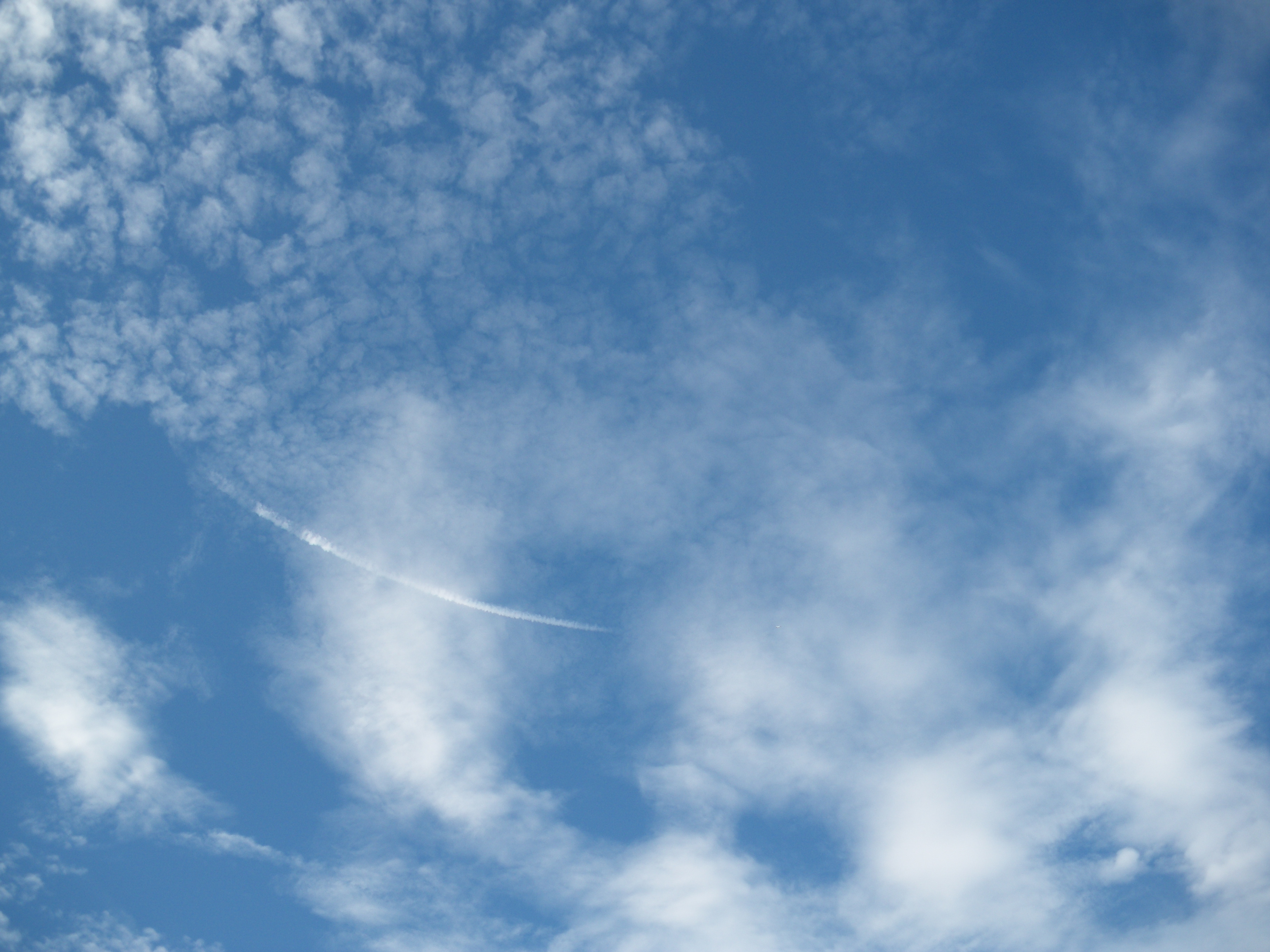
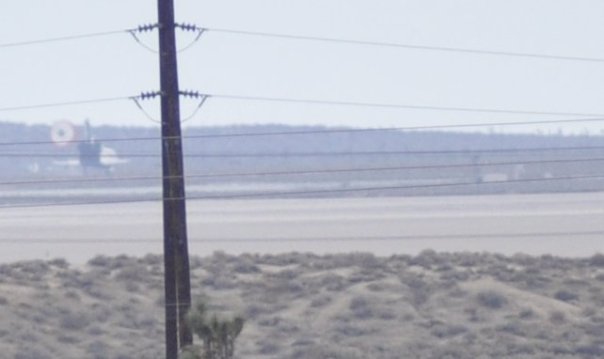
    Look for shuttle right of the contrail in my photo.
    Look for the shuttle to the right of the contrail in my photo (click on the image for full res version)
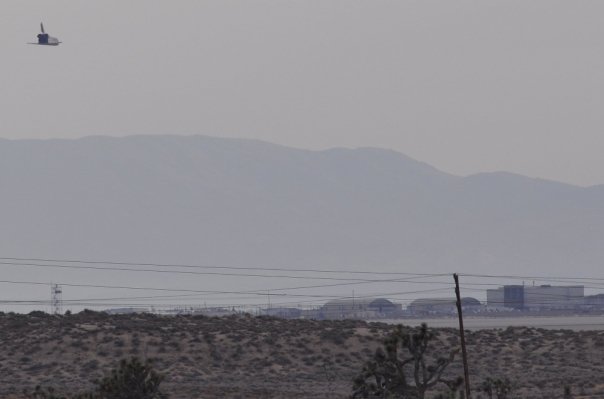
    Shuttle and ground in one image
    Shuttle and ground in one image. This photo and the rest of these photos courtesy of Gary Spiers
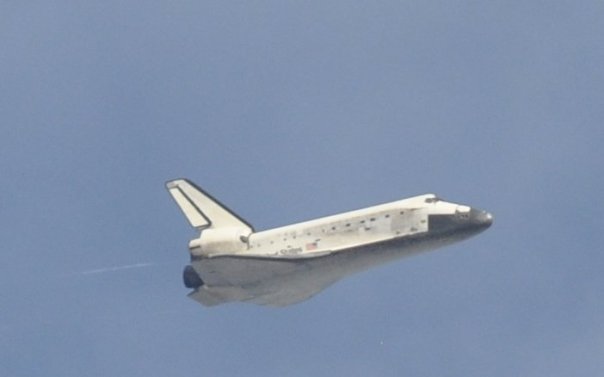
    Space shuttle Discovery
    Space shuttle Discovery
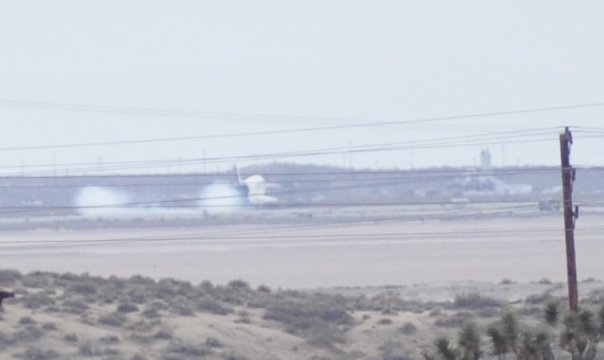
    Touchdown - twin dustplumes from gear touching down
    Touchdown – twin dustplumes from gear touching down
    Parachute deploys
    Parachute deploys

    NASADryden tweeted at 9:58 a.m. “We’ve been called up to support a potential shuttle landing today, see web for details http://www.nasa.gov/centers”

    1:35 p.m. “Shuttle will land at Edwards today, deorbit burn scheduled for 4:47 PDT, landing at 5:53 PDT”

    With landing scheduled at 5:53 p.m. PDT September 11, 2009 fellow astronomer Gary Spiers and I sped from Pasadena to Edwards Air Force Base to see one of if not possibly the last California landing of a space shuttle. We left Pasadena at 3:15 p.m. for the 2 plus hour drive.

    Navigator Gary scoped out the viewing choices while I drove. We passed Palmdale and headed for Rogers Dry Lake. Soon we saw groups of cars off California State Highway 58, and we headed further down the highway for a higher vantage point at the Northeast side of the lake bed. We turned off at the historic 20 Mule Team Road.

    I was receiving the Twitter updates from NASA Dryden on my cell phone. We arrived about a half hour before touchdown and setup camera gear in the 102 degree late-afternoon heat.

    We picked a perfect viewing spot. The shuttle would pass directly overhead on its loop from the West to runway 22 at Edwards Air Force Base. You can see the ground track, including the close range track of orbit 219 here.

    Here are the exciting tweets from NASADryden, which I passed along to the folks nearby:

    “15 minutes until touchdown, less than 1,000 miles away 5:38 PM Sep 11th

    Discovery is less than 700 miles away

    Right on ground track, 11 minutes until touchdown. Everything looking good

    Less than 277 to go, traveling at 7 times the speed of sound

    Approaching the CA coastline

    7.5 minutes till touchdown

    Discovery is 78 miles from Edwards

    Just heard the sonic boom here at Dryden! Discovery will be here soon!

    3 minutes till touchdown

    All eyes at Dryden are on the runway!

    Shuttle Discovery has landed at Edwards AFB, welcome back!

    Wheels stopped on Discovery with the National Anthem playing in the background. I love this country and NASA! ”

    Gary and I were snapping photos and recording video as honking, applause, whistles and cheers erupted from people inside, and alongside over 125 cars parked on the overpass, offramp shoulder, on and off 20 Mule Team Road.

    Soon the big rig drivers and other space enthusiasts were pulling off the shoulder and driving back to their daily life. Next to us Brad and Judy from Visalia lamented the dead battery in their camera as they planned to drive three hours back home. We exchanged email addresses and I’ll be sending them this report, photos and video of our first, and maybe last real-time up-close view of a shuttle landing.

    These photos courtesy of Gary Spiers whose images were shot using a Nikon D90 body with a Nikon 300mm F2.8 lens. My video and a few pre-landing snapshots were shot using a Pentax Optio M60 compact camera. Taken from 20 Mule Train Road on the Northeast side of the Rogers Dry Lake at the intersection of California Highway 58 and 20 Mule Team Road on September 11, 2009. We were over 5 miles away from the landing strip, but you can just barely see the dustplumes and parachute deployment at 1 min 42 seconds into my video.

    My video of Discovery Landing

    My video of Discovery Landing