Jane's blog banner

Tag: Perseids

  • Viewing meteor showers from light polluted LA – not impossible!

    The white area is greater Los Angeles. I observed from my driveway in Monrovia, indicated at the "red/white" border zone marked with cross-hairs
    The white area is greater Los Angeles. I observed from my driveway in Monrovia, indicated at the "red/white" border zone marked with cross-hairs
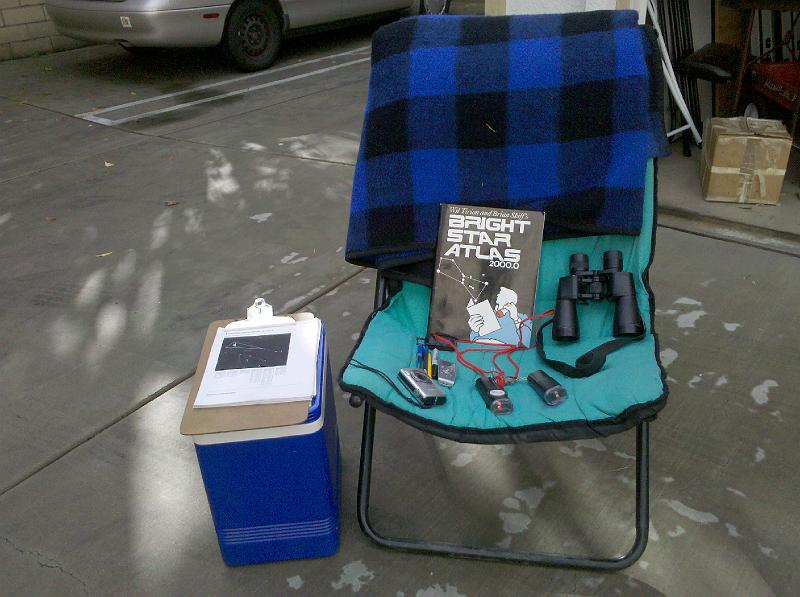
    My meteor watching setup - comfortable chair, blanket, clipboard, red flashlights, clock, binoculars, snacks
    My meteor watching setup – comfortable chair, blanket, clipboard, red flashlights, clock, binoculars, snacks
    The graph shows the ZHR (Zenithal Hourly Rate), which is the number of meteors an observer would see under a very dark sky with the radiant of the shower overhead. ZHRmax = 82 based on 1550 Quadrantids reported by 53 observers in 22 countries.
    The graph shows the ZHR (Zenithal Hourly Rate), which is the number of meteors an observer would see under a very dark sky with the radiant of the shower overhead. (this chart is being updated as more reports are submitted)

    I prefer to drive far from LA to view meteor showers from a dark sky, but those darn showers don’t always happen on weekends or days I can take off work. So this week, I observed the Quadrantid Meteor Shower from my bright moonlit Los Angeles County driveway until after midnight, snoozed until moonset at 3:00 a.m., then had a fairly decent sky from 3:00 a.m. to 5:15 a.m. when the sky started to brighten from the dawn light. Although I didn’t see many meteors, and only one before the moon set at 3:00 a.m. PST January 4th, I was thrilled with my observations.

    Take a look at this colorful map. See that white blob? That’s Los Angeles on a light pollution map. That white ribbon? That’s the California coastline. White on these maps designates the most light polluted areas in the world. There is no worse place for light pollution. LA is the model of a major metropolitan meteor-observing maelstrom of star-obscuring light pollution. This white color on the map is described in bleak terms on the Clear Sky Chart website’s light pollution map page: “The entire sky is grayish or brighter. Familiar constellations are missing stars. Fainter constellations are absent. Less than 20 stars visible over 30 degrees elevation in brighter areas. Limiting magnitude ranges from 3 to 4. Most people don’t look up.” Monrovia is on the north edge of the white blob that is Los Angeles, indicated by the cross-hair. (all those little crosses on the map are other astronomy locations). Red is the next to worst light pollution zone, and the ribbon of red color next to Los Angeles is the San Gabriel Mountain foothills. Monrovia is nestled between the Los Angeles basin and the mountains. It’s fine for moon and planets at our monthly Old Town Sidewalk Astronomy nights, not so good for meteors and anything else astronomical.

    The three oval white blobs on the left lower quadrant are Santa Catalina, San Clemente and San Nicholas Islands! The yellow, green and blue zones are in the ocean. It’s even light polluted well off the coast of Southern California!

    I usually drive 150-300 miles to one of the black teardrop shaped pin spots on this light pollution map of California. Those are the best and darkest locations for the stargazing and astrophotography we enjoy. Mojo and I prefer Amboy Crater, Hole-In-the-Wall Campground in Mojave National Preserve, and a spot near Desert Center 60 miles past Indio on I-10. We also love the dark skies at Glacier Point at Yosemite.

    But this week was the peak of the Quadrantids, and I didn’t want to drive a 6-hour round trip for 3 hours of meteor watching, especially on a work night. So I found a good spot in my driveway and it blocked a lot of the local light sources. I nestled my comfy observing chair up next to a cinder block wall. This wall, plus strategically placed tall trees blocked the moonlight and oncoming car lights from my view. To my south was not the Milky Way, but the milky gray — the color of skies over Los Angeles. I could see the big dipper stars, and part of the little dipper. Below these two constellations was the radiant of the Quadrantids. This area wouldn’t even rise until after midnight, but I wanted to say I observed the Quadrantids during the actual peak, and check for earthgrazing meteors on the horizon.

    I estimated my limiting magnitude at a dismal 3.9 using star counting charts. I settled into my meteor-watching chair, sipped some hot green tea and waited. And waited. And waited some more. From 11:00 p.m. until 12:30 p.m (PST) I saw exactly one meteor, and it wasn’t even a Quadrantid. The moon was high overhead now, and so I snoozed until moonset at 3:00 a.m. Wednesday morning.

    When my alarm went off, I headed back out to the driveway. I adjusted my chair, adjusted the dark blankets I placed over the fence between my driveway and the neighbor’s all-night security lights. By careful placement of my head, and with blankets on the fences and shrubs I had no lights shining directly at me.

    It was a little after 3 a.m. and I started observing an area above the radiant, centered on the bowl of the big dipper. My back was facing the well-lit LA basin, my view to the north was overlooking the San Gabriel mountains and Mt. Wilson Observatory. By 3:18 I had seen my first Quadrantid. At 3:30 I counted stars again. Without the moonlight, my limiting magnitude rose to a respectable 5.1 using this star counting chart. I repeated this exercise several times, until I could barely see stars after 5:00 a.m. My last limiting magnitude calculation before I packed it in was 2.9.

    This chart shows the data from 48 observers in twenty countries. Data (still coming in, I’ll update the chart a couple of times) is averaged based on the observers seeing conditions, visual acuity, cloud cover percentage, etc. You can see that the highest rates — at the peak of the Quadrantids were in excess of 80 per hour. This is the number of meteors which would be seen overhead at the zenith (in a dark sky) if the highest rate was kept steady for one hour. In reality, the highest rates last usually for only a few minutes for showers like the Quadrantids with a very narrow peak. How many did I see from my Monrovia driveway? I saw three from 3:00-3:30 a.m. and another three from 3:30-4:00 a.m. I saw five from 4:00 to 4:30 a.m. and between 4:30 and 5:00 a.m. I saw three, plus heard nearby roosters crowing! I finished the observing with 2 more Quadrantids between 5:00 and 5:15 a.m. and was heralded by a veritable rooster symphony as the sky brightened. My total count over a little more than 2 hours was 16 lovely Quadrantids, two sporadics, and one Anthelion! Here’s my report which I submitted to the International Meteor Organization. Amazingly, this number is almost exactly the prediction from NASA’s Meteor Fluxtimator when I entered Quadrantids from downtown Los Angeles on the 3rd and 4th of January 2012. How about that! You can observe a meteor shower from Los Angeles!

    Here’s the meteor shower calendar for 2012

    Interested in counting meteors? Here’s the IMO Visual meteor observing form plus instructions and FAQs

    More about the Quadrantids and their namesake constellation, Quadrans Muralis
    Post-Perseid depression (or how to observe meteor showers)

    Perseids from Amboy Crater (a dark sky site)

  • Meteor observing tips – updated old blog for 2015

    My meteor shower first aid kit
    Waiting for moonset on Perseid night 2010, observing from Amboy Crater, CA
    Notice elevated rates from August 7th-15th, and a secondary peak on the 17th, and the 20th?

    Here’s what you can expect to see from a dark sky observing for several hours like the 2010 Perseids which peaked on a moonless night like this year.

    I enjoy observing meteor showers from the darkest sky I can drive to in one night. Here’s where I go, what I bring (and don’t bring), and how I observe.

    You will want a comfy chair that supports your neck. I bring a clipboard with blank sheets of paper and Finnish Triangle limiting magnitude star charts to determine my limiting magnitude throughout the night.

    I also pack binoculars, but not for observing meteors. I just like to have them with me to look at galaxies and star clusters when not counting meteors. I leave my telescope at home, too. I bring a digital clock that doesn’t emit any light, a red flashlight, pencils, an audio recorder, and a cooler full of snacks and water. I keep on hand layers of clothes, a blanket or sleeping bag, and hand-warmers for cool nights. For comfort, I carry a first aid kit including eye drops, chap stick, and sting-ease for bug bites. One more thing I keep handy – a piece of string, in case I want to trace a meteor to its radiant by holding it up to the streak of light.

    I don’t keep any light emitting devices within eyesight – no cell phone, no interior car lights, no telescope mounts or cameras that emit or blink light. You don’t have to be that drastic about darkness, but I often drive a long way to a dark sky and want to see faint meteors. Any car or phone light will ruin my dark adaptation. It can take up to an hour for your eyes to adjust again. If a car or a friend stops by, I will just take a break, or shut my eyes until the light is gone.

    Once I am ready to begin observing, I scan the area of the sky I plan to watch. Note! You don’t have to look in the direction of the radiant. The Perseids all appear to radiate from (fly out of) a point – the radiant – in the constellation Perseus, and so they will appear everywhere. That’s where the string or shoelace are helpful — to trace the meteor back to its point of origin. Then I memorize the magnitudes of familiar stars nearby so I can accurately note the meteor magnitudes on my observing paper – one sheet for every 15 minutes I plan to observe. The info all ends up on this visual observing form, prepared from all the raw data. Then I sit in my comfy chair, clipboard on my lap, and wait for that first meteor to streak across my viewing field.

    2015 Perseids – Live updates!

    My accounts of the 1998-2002 Leonid Storm Multi-Instrument Aircraft Campaign (MAC)

    My account of the 2007 Aurigid Outburst, Perseid MAC

    2011 Draconids MAC

  • The Perseids from Amboy Crater

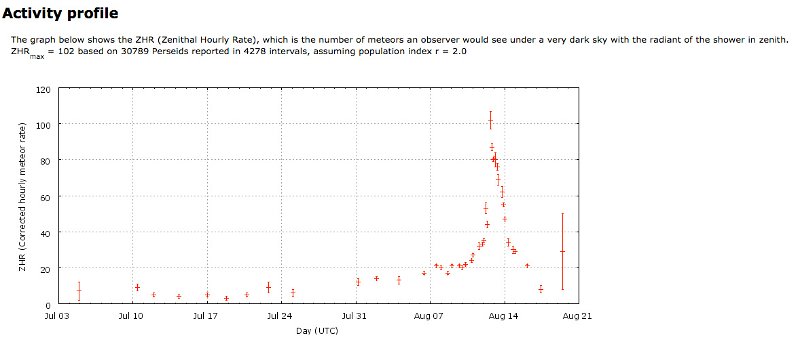
    Perseid Peak Aug 12-13 18h-7h UT
    My Perseid count Aug 13 06h-11h UT
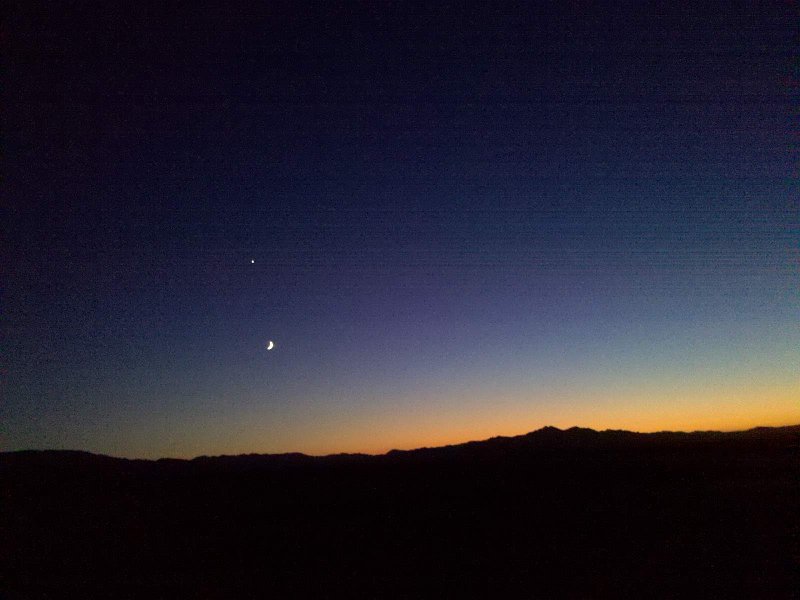
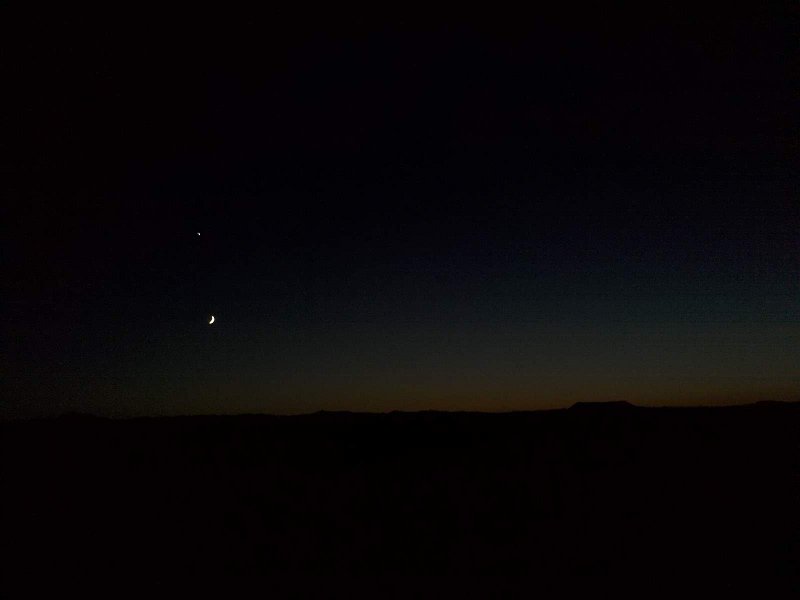
    Sunset at Amboy Crater, with moon and Venus
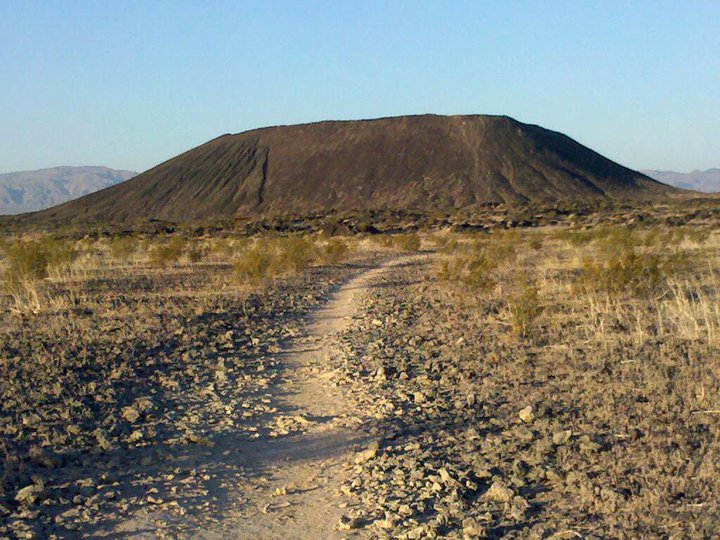
    Amboy Crater by day

    For the past year I’ve been traveling to dark skies to observe and count meteors during the major showers. Armed with a clipboard and a comfy chair, I stare at a section of the sky, hoping to see members of the well known showers, and contribute my data to that of other meteor observers around the world.

    This writeup is really about how I observed, recorded and submitted my 2010 Perseid meteor shower data to the International Meteor Organization. I hope I inspire you to try it, even if you don’t submit your paperwork the first time. (I didn’t, in fact it took me longer to fill out the paperwork the first time than it did to actually observe the meteors!).

    The first chart shows the peak of the Perseids – August 12-13 between 18h and 7h Universal Time. That means for people like me on the west coast of the US, the peak was nearly over before I started counting! It’s important for worldwide observers to keep counting, because many showers have secondary peaks or other characteristics.

    The second chart is my data. Before I arrived at the site, I recorded the latitude, longitude, elevation and name of my observing location. This is easy to do using your GPS devices these days. I wrote down my name, my IMO codename (JONJH) and the shower (Per for Perseids). I decided not to try and identify individual minor showers though there were many. I called all non-Perseids Sporadics.

    Before I began observing, and several times during the night I assessed the darkness of the sky using Limiting Magnitude star charts. This field is identified as LM on my observing form. The IMO says: “The darker and more transparent the sky and the more sensitive your eyes, the more meteors you can see. To use your observations for scientific analyses a quantitative characterization of these factors has to be established. The limiting magnitude (which is defined as being the magnitude of the faintest star near the zenith that the observer can detect using the slightly averted naked eye) defines both the condition of the sky’s clarity and the quality of the observer’s eyes.”

    I keep a set of these charts on a clipboard and assess the sky darkness every time I observe. My assessment was a very high limiting magnitude. I could see magnitude 6.5 stars with my unaided eyes.

    On a clipboard, I clipped a bunch of blank sheets of paper – one piece for each hour of the night. I wrote down each meteor I observed and noted the time using a nearby clock. I also wrote down the magnitude of each meteor – using a shorthand of 5 magnitudes of brightness. (F for faint-mag. 4, B for bright mag. 1, etc. J for Jupiter bright bolides) I had a selection of stars in the area already memorized for comparison against the Perseids. For spectacular meteors, I plotted them on star charts I had printed out for this purpose.

    In a nutshell: Mag 6.5 skies, clear, 80 degrees overnight. Amboy Crater, one of the darkest observing locations in the US, was a great location for meteor observing.

    Between 9 and 11 p.m. (04h-06h UT) I unofficially saw about a dozen mostly very bright meteors while setting up my chair, eating dinner, etc. I didn’t start seriously recording the meteors until 11 p.m. (06h UT)
    04h-05h UT – 2 Perseids, 1 sporadic
    05h-06h UT – 4 perseids, 3 sporadics **the first Perseid came in at 9:34 p.m.
    06h-07h UT – 15 Persieds, 12 sporadics
    07h-08h UT – I took a nap
    08h-09h UT – 27 Perseids, 8 sporadics
    09:19-03:19 – 43 Perseids, 3 sporadics didn’t take a break since the rates were so high…
    03:20-04:20 – 39 Perseids 1 sporadics (with a 7 minute break)

  • A warm-up act for the Perseids

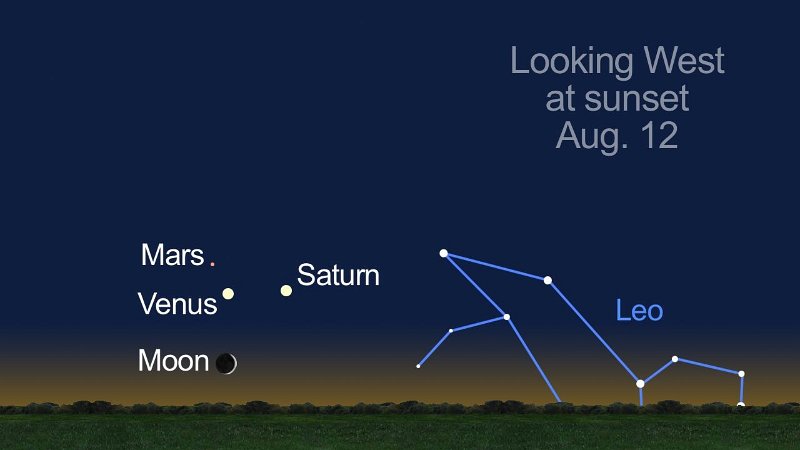
    See the moon and planets low in the west August 12
    See the moon and planets low in the west August 12, courtesy NASA/JPL-Caltech
    The view from Earth - the planetary lineup in orbital perspective
    The view from Earth – the planetary lineup in orbital perspective courtesy NASA’s Solar System Simulator, courtesy NASA/JPL-Caltech
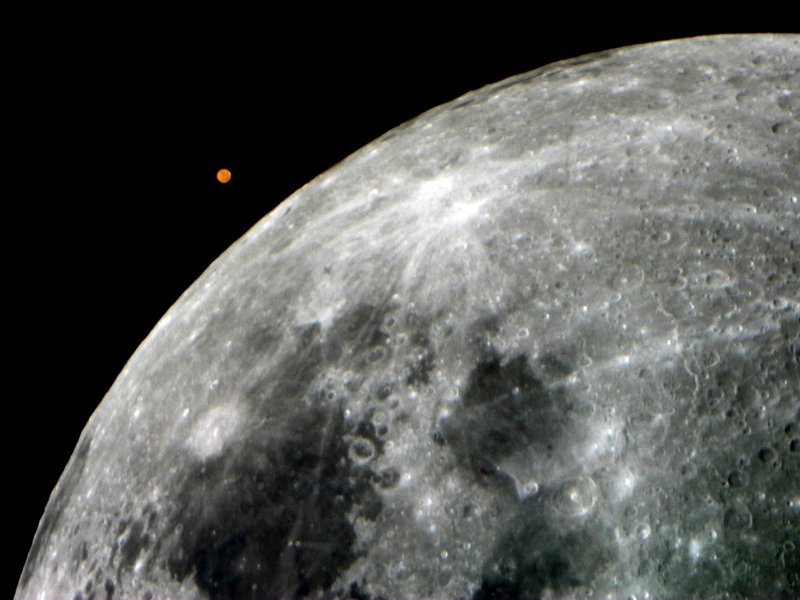
    Mars and moon imaged same day with same equipment (in 2005)
    Mars and moon imaged same day with same equipment (in 2005) courtesy Jim Keen
    A trio of planets, without the moon August 7, 2010
    A trio of planets, without the moon August 7, 2010, courtesy Morris Jones

    Are you eager to see the annual Perseids on Thursday night? You’ll have to wait until after 10:00 p.m. local time to see them, so why not pass the time until showtime by viewing the planets right from your doorstep? Step outside for the planetary warm-up act.

    All you have to do is look towards the west as soon as the sun sets. Bright Venus is the first to appear. It’s really bright, and you can’t miss it! Now, hold your clenched fist up to the sky covering Venus. To the right of Venus, about 1/2 of a clenched fist away is a second planet. That’s Saturn. And to the upper left of Venus is another planet… That’s Mars.

    But wait, there’s more! Look below Venus for the slender crescent moon. If you don’t see the moon, look again Friday night – it will be a larger crescent to the left of Venus a day later.

    Though the three planets appear together in our line-of-sight they are really far apart from each other and from us on Earth. Mars is about 300 million km (186 million miles) from Earth, while Venus is 112 million km/70 million miles distant. Saturn? It’s 1,535 million km/954 million miles from Earth right now. The moon? 363 thousand km, or only 225 thousand miles away. It’s fun to compare the size of the moon and Mars, especially if you received that annual email (which incorrectly) states that Mars will be as big as the moon this month. Do the math. It’s impossible!

    The Solar System Simulator is a great public resource for geeks. You can see any planet or spacecraft from any vantage point on any date you select. I picked August 12th to show the view of the planets and moon from Earth.

    I hope you can sense the three-dimensional orbits of nearby Venus, far-away Mars and distant Saturn. Have some fun with it! Every day the Cassini Mission website shows a view of Saturn from Earth, from Cassini, and right now Enceladus, as we close in on a flyby of that exciting moon later this week.

    In this image of the moon and Mars, Jim Keen made a “true-to-life” size comparison. He made a “blended” image of the Moon and Mars back in July 2005. He recalls, “I had set up my telescope in my backyard and stuck a camera on the back of it. I took separate images of the Moon and Mars – both of which were “up”, but in separate areas of the sky – and later combined the two images to get one, showing the actual size difference using the same equipment, same camera, same magnification, and taken within a few minutes of each other.”

    Jim’s image shows the apparent size of the moon and Mars really nicely! If he took the same image this month, Mars would appear super tiny! In the 2005 image Mars was about 50 million miles from Earth, and today it is 186 million miles away.

    The final image shows the trio of planets imaged Saturday night August 7th by my hubby, Morris (aka Mojo) Jones. Click on the image to see the two fainter planets above Venus. He posted several images in his blog post called Sky full of planets and lightning. It’s really worth a read! The lightning was amazing Saturday night!

    I hope this little planetary warm up act will whet your appetite for more sky watching this week. The Perseids will be a real spectacle, especially if you can get away from the city lights. I’ve pretty much decided to head out to the Mojave desert and see the star show from Amboy Crater. Clear Skies everyone, and happy solar system observing to you all!

    California Clear Sky Chart Black dots indicate the darkest observing areas. Amboy Crater, on the southern border of Mojave National Preserve is the closest “black dot” dark observing area and will require a drive of over 200 miles for Thursday’s Perseids.

    NASA’s Solar System Simulator Check out where the Voyagers are right now!

    My Mars in August website, updated each year since 2005.