Jane's blog banner

Tag: Sagittarius

  • Observing in the neighborhood

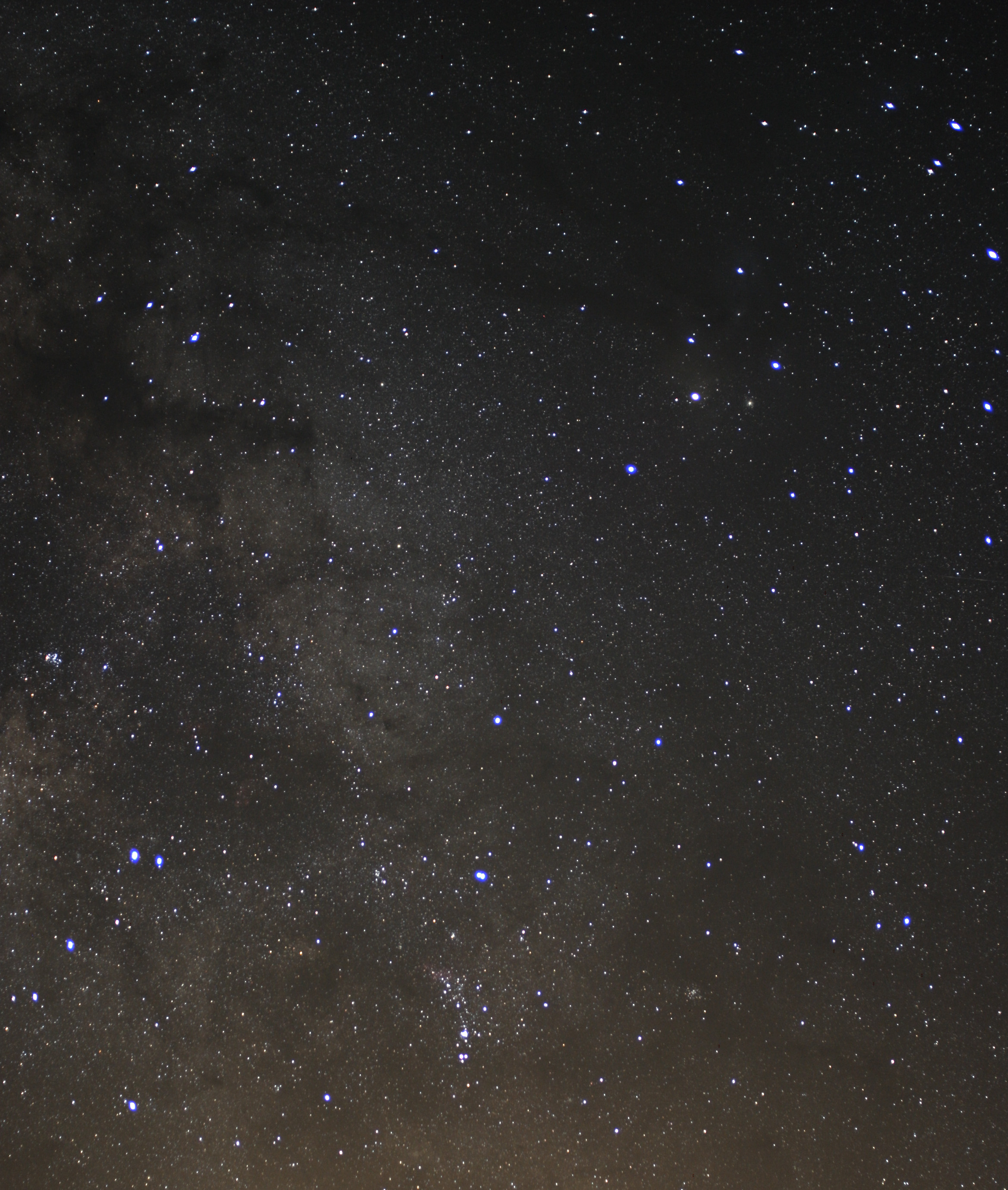
    Summer Milky Way, Scorpius and dark nebulae
    Summer Milky Way, Scorpius and dark nebulae, image by Morris Jones

    Observing near the summer solstice means a short observing night sandwiched between a late sunset and an early dawn. Rather than rush through an observing project I find it’s a great time of the year to sit back and trace familiar constellations in my minds eye, and marvel with anticipation as the eastern horizon brightens. Soon, the stars of Scorpius and Sagittarius will rise and the “clouds” on the horizon take shape as lumps and glittery clusters, bisected by dark nebulae — those mysterious star-less regions within our Milky Way Galaxy.

    It’s hard not to just sit and gaze at the unfolding spectacle. So for the first hour or two after darkness last Saturday night (June 16, 2012) I sat in my meteor observing chair and observed the sky with my own eyes. Every now and then I jumped up and eyeball-aimed Mojo’s 15-inch Litebox reflector at this cluster or that nebula. The sky conditions at Amboy Crater were near perfect.

    We have 360 degree perfect horizons at this site, with small light domes from 29 Palms, and from departing trains. Temperatures are warm with just a hint of breeze, hot before sunset, shirtsleeve observing all night long, humidity 10% rising to 20% at dawn. Conditions are dry and warm. No dew. Ever! Here’s the Clear Sky Chart for Amboy Crater.

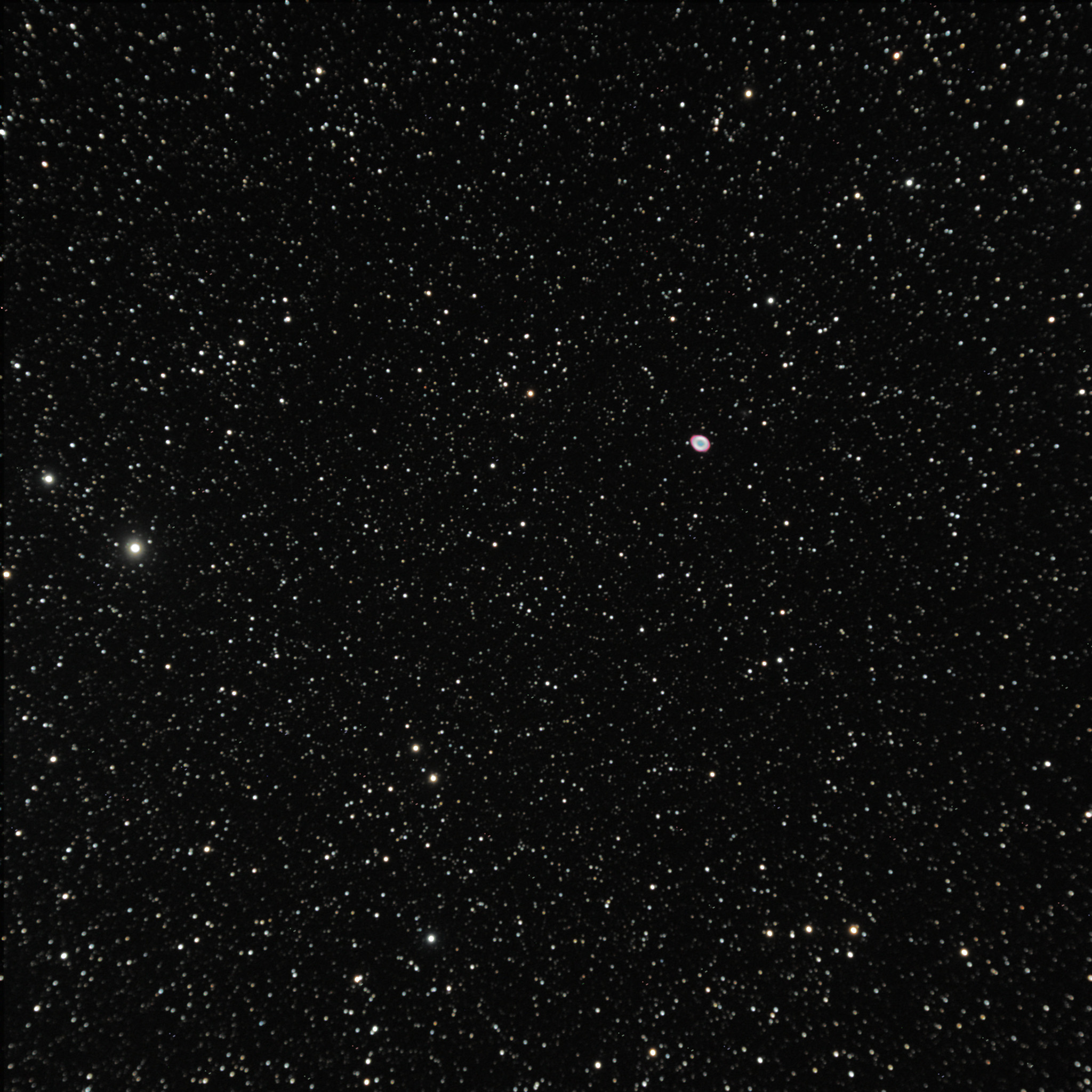
    Lyra
    Lyra
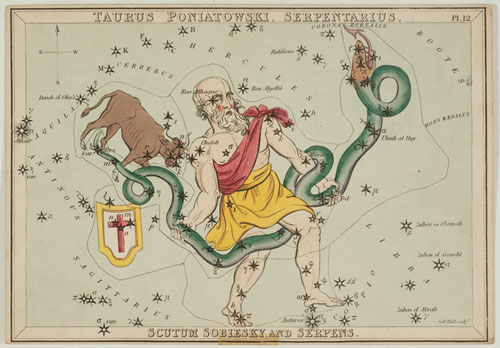
    Ophiuchus and Poniatowski's Bull
    Ophiuchus and Poniatowski's Bull
    the demoted constellation Poniatowski's Bull and Ophiuchus
    the demoted constellation Poniatowski's Bull and Ophiuchus

    As I was looking at the constellation Lyra and its gem-of-a-telescope-target, the Ring nebula, M57, I spotted an asterism nearby, in the northeastern section of Ophiuchus that looked just like Lyra, except it was upside down.

    That looked like a good place to select an observing project, so I cracked open my copy of the Night Sky Observers Guide, volume 2 Spring and Summer to the constellation Ophiuchus. I noticed this little group of stars that looked like Lyra were part of an open cluster, and that there was another pretty cluster in the neighborhood.

    Best of all, Barnard’s Star was within the cluster! Barnard’s Star is the second closest star to the Earth — only 6 light years away, shining at a faint magnitude 9.5. The Alpha Centauri system, including Proxima Centauri, together are about 4 LY away, but we can’t see them from the US. Barnard’s Star has the greatest proper motion — the angular annual movement across the line of sight against the distant stellar background of any star. It moves 10.4 seconds of arc per year. That compares to a quarter of a degree in a human lifetime, roughly the angular diameter of the full Moon.

    Amateur astronomers, carefully sketching or imaging Barnard’s Star once a year for a couple years can actually track the movement of the star. It’s a cool red dwarf. And it’s listed in Jim Kaler’s fabulous book The Hundred Greatest Stars. Jim writes “Barnard’s Star has a metal content only 10 percent that of the Sun. That coupled with its high velocity shows it to be a special, rather rare, kind of star called a “subdwarf” that more belongs to the metal-poor and ancient halo of our Galaxy (the Sun belonging to the disk). It is merely passing through our local neighborhood.”

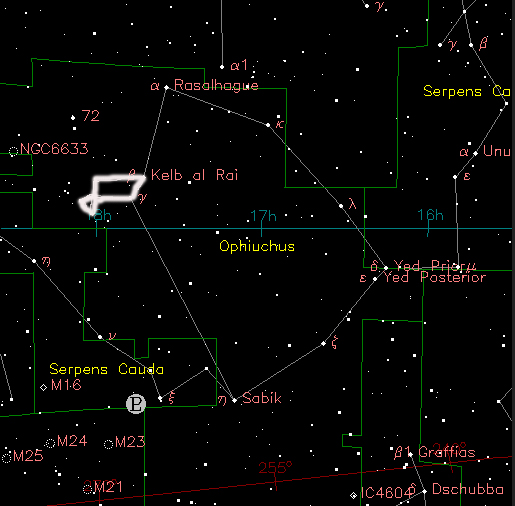
    You’ll definitely need a star chart to find it. Here’s one showing Barnard’s Star within the Melotte 186 star cluster with pretty IC 4665 nearby. This tiny faint red dwarf is a challenge, but it’s worth it, as are the two clusters.

    The neighborhood it’s passing (to our line of sight), is through the demoted constellation Poniatowski’s Bull. This V- shaped set of stars looks like a bull’s head and horns in northeastern Ophiuchus. I see Lyra, instead, by adding a few other stars. It was named Poniatowski’s Bull (Taurus Poniatovii), to honor Stanislaus Poniatowski, King of Poland from 1764 to 1795. Named by Polish-Lithuanian astronomer and mathemetician Marcin Odlanicki Poczobutt whose observatory at Vilnius gained royal favor from the King.

    So now, when you are looking at our Milky Way, notice Vega and her constellation Lyra. Then turn your head ever so slightly to the right, and you’ll see huge Ophiucus, which looks like a big percolator coffee pot to me. It’s above and between Scorpius and Sagittarius. The left star of the “lid” of the coffeepot is part of my “upside down Lyra”.

    Nothing beats visual astronomy. Without taking the time to sit down and just look at the sky, and trace the constellations I never would have discovered this lovely demoted constellation for the first time!

    There is always something to observe that you’ve never seen before, even if it is the same old stars. That’s what makes visual astronomy my go-to hobby. Pun intended!

    Mojo’s images and writeup from the same night: predawn planets & astrophotography

    More Fast Moving Stars

    More Demoted Constellations

    Early morning hikes – the Chuckwallas of Amboy Crater

  • Autumn observing – around the South Galactic Pole

    Herald-Bobroff Astroatlas
    Herald-Bobroff Astroatlas
    Grus and Telescopium
    Astroatlas B Chart page for Grus and Telescopium, well below Capricornus and Sagittarius
    NGC131 and 134 and a 5-spot of mag 10 stars
    NGC131 and 134 and a 5-spot of mag 10 stars
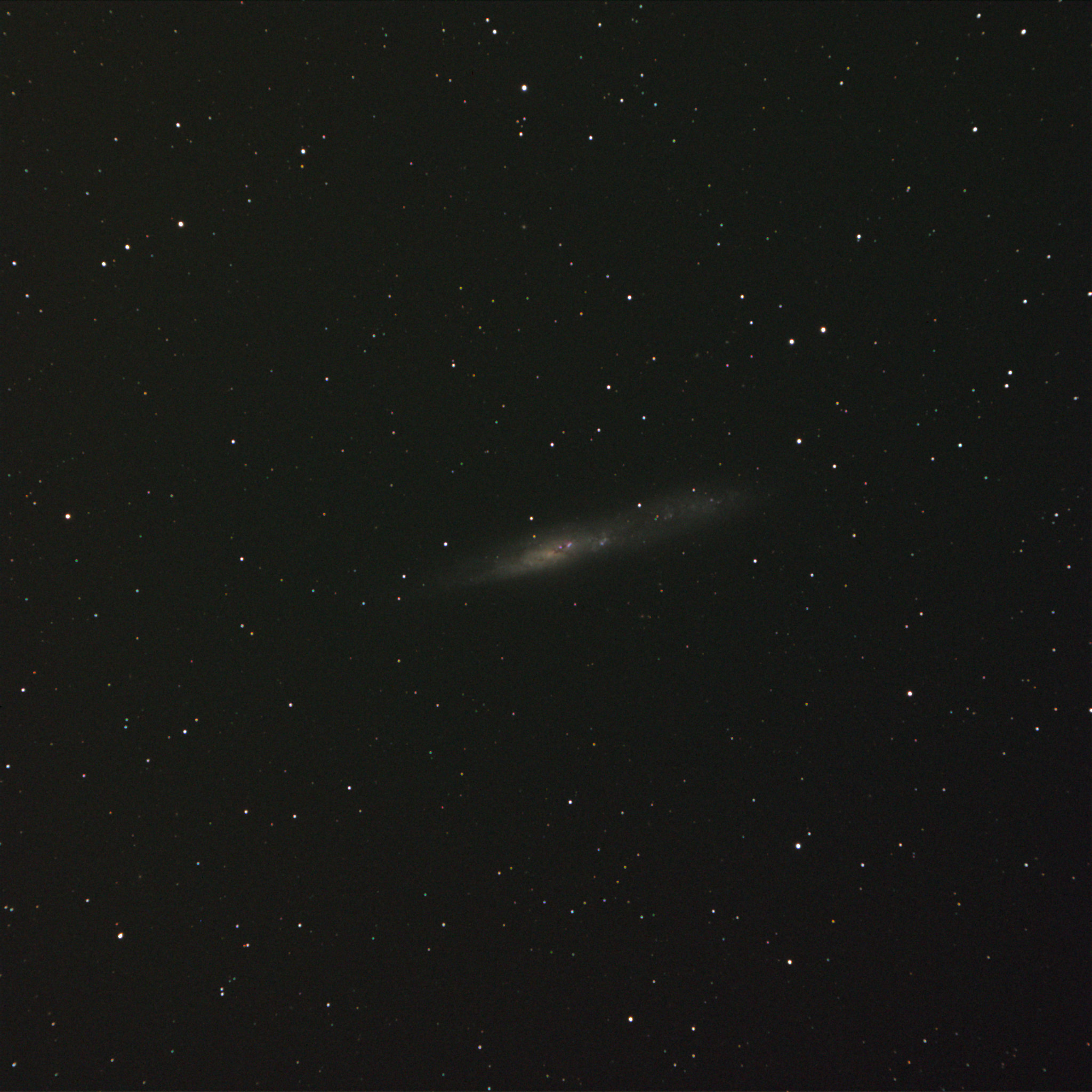
    NGC55
    NGC55 image by Morris Jones, used with permission 😉

    While Mojo and I were observing at Amboy Crater on October 22, 2011, Cliff, another observer at the site pointed out the constellation Grus, The Crane, low on the southern horizon. Grus isn’t a constellation I’ve paid attention to before – you need to be able to see down to the southern horizon in the fall, and you need to be observing at +34N Latitude or further south. If you can see well below Capricornus, Sagittarius and Sculptor in the autumn, give it a try!

    None of the star charts I brought on that occasion showed Grus, but I had just the startool at home for the following weekends (October 29) outing — the Herald-Bobroff Astroatlas! I hadn’t needed this lovely atlas since my 1999 Ayer’s Rock Australian observing trip with 20 other astronomers, and welcomed reacquainting myself with it. The atlas begins with the A Charts – wide swaths of the sky, showing several entire constellations. From there you are directed to the B Charts (image at your left), showing smaller segments of the sky and bright stars. The C Charts (9th mag stars and 14th mag. deep sky objects) are where I headed for this night’s observing, but in the past I have drilled down to the D (11th mag. stars and 15th mag deep sky objects), E and F charts for detail showing Coma and Virgo galaxy clusters and the Magellanic Clouds.

    There aren’t any bright galaxies to hunt for in the constellation Grus, and observing low to the horizon doesn’t afford the best views, either. But even so, I quickly observed the top ten or so – including some lovely galaxy clusters. First I went for NGC7590 and 7599, a pretty pair of spiral galaxies discovered by John Herschel and Charles Dunlop. I didn’t see the distant Abell 1111 cluster, 2 billion light years away, just the two brighter galaxies.

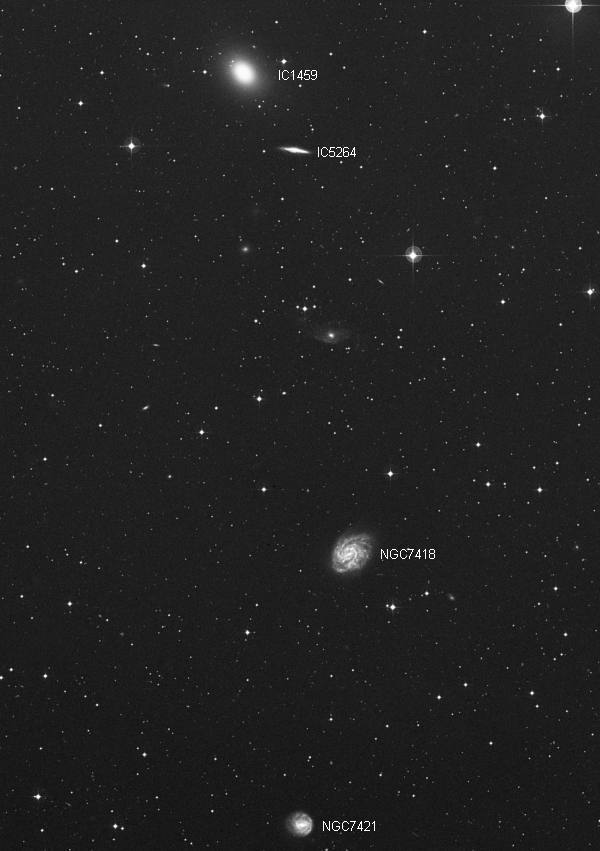
    Next I hunted down a group of galaxies near NGC7418 – a face-on spiral galaxy nestled in a pretty string just below Fomalhaut on the Grus Sculptor border. Here’s a photo of the galaxies I observed. 7418 was discovered by Sir John Herschel at the Cape of Good Hope with an 18-inch f/13 speculum telescope in 1847. A supernova erupted in this galaxy in 1983. And Allan Sandage (1975, Astrophysical Journal, 202, 563-582) notes that this galaxy is a member of the IC1459 Grus Group.

    Well after midnight on this perfect observing night, our friend Dave came over and told me he had just observed some objects he had not logged before. “A pair of galaxies, with a little dice-shaped asterism of five stars next to it”. Soon I was on my own hunt for NGC131 and 134. It’s to the lower left of big open cluster Blanco 1 on the star chart. The smaller 131 was discovered by John Herschel in 1834, and the larger 134 was discovered in 1826 by James Dunlop in Australia. They are part of our local group of galaxies (LGG), and the galaxy group is also known as LGG-007 located 63 to 82 million lights years away. My sketch is to the left.

    This part of the sky is littered with easy to find galaxies, and I spent several hours hopping from one to another. I was observing NGC55, an interesting barred irregular galaxy only 7 million light years away. It’s one of the closest galaxies to our own local group! I encouraged Mojo image it, even though it was low to the horizon. I love his image, and it looked a lot like this through the eyepiece, too. I made a rough sketch of the galaxy, and when I looked at Mojo’s image we both showed the pretty lineup of stars outlining the galaxy.

    This is just a sample of the dozens of galaxies I looked at in the deep southern sky on a late October evening. Fall offers long nights of darkness for galaxy starved amateur astronomers tired of all the bright milky way objects of summer. So ladies and gentleman, start your telescopes, and point as low as you can go. Aim your telescopes where the wings of the southern birds Grus and Phoenix fly. If you can’t go that low, Sculptor offers dozens of amazing objects to view. Open your atlas to the constellations around the South Galactic Pole near Sculptor, and you’ll enjoy hours of surfing the southern skies.

    Here are Mojo’s Astrophotos from October 29, 2011. I enjoyed visually observing these objects, and then seeing these postcards sent from the universe through Mojo’s astrophotography.

    Diagram of the Observable Universe

    Review of the Herald-Bobroff Astroatlas

    Images showing our observing spot at sunset and waiting for moonset