Jane's blog banner

Tag: Sea of Tranquility

  • Chasing Galileo – sketches of the nine-day moon

    nine-day moon
    nine-day moon

    Lunar creature features
    Lunar creature features

    Rabbit on the full moon
    Rabbit on the full moon

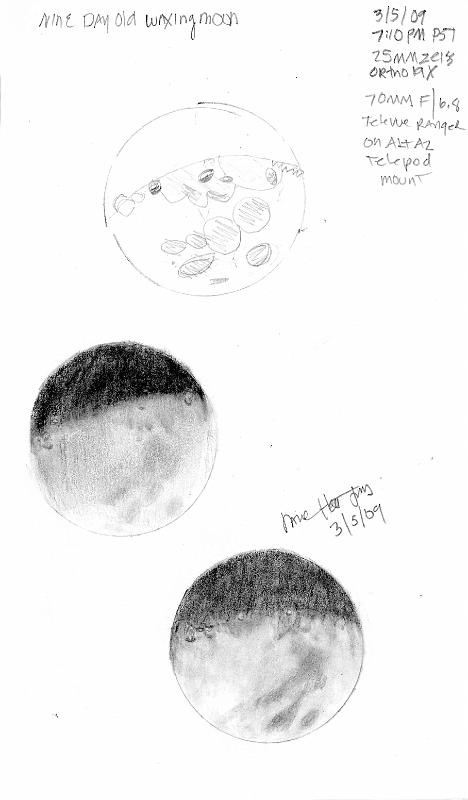
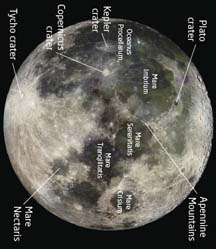
    Night owls can enjoy the nine-day moon – it’s up all night long. In my sketch, the magnificent crater Copernicus is visible on the sunlit side of the terminator – on the right side of the lunar center. It looks so insignificant right now, but at full moon, its spendid ray system is a naked-eye delight! Tonight you see the deep crater floor half lit by the sun. Here’s a closeup of Copernicus sketched through a larger telescope at higher magnification (185x versus 19x on these full disk drawings) on nearly the same day of the lunar month.

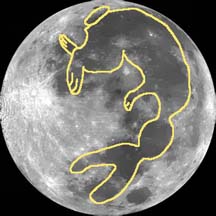
    From now until full moon, the dark lunar mare start to resemble creature features. I see half of the rabbit on the moon in my sketch. Mare Fecundatis and Mare Nectaris make the ears and Mare Tranquillatis (the Sea of Tranqulilty) makes a cute little bunny head. You can see other creatures in my February 2009 What’s Up podcast about the moon, linked below.

    As we near the full moon, the sun angle is more direct and crater wall shadows disappear. There are some other craters on the terminator tonight, which will reveal their amazing ejecta rays in a few more days when the moon is full. Towards the left edge of the terminator, Tycho is half lit now, but at full moon, its rays extend 1000 km. The spectacular walled plain Clavius is just starting to reveal its beauty. Through a telescope, when the entire crater is visible, you’ll see a dozen smaller craters on its floor.

    My What’s Up Podcast, July 2007: The phases of the moon

    My What’s Up Podcast, February 2009: Galileo’s and other first views of the moon through a telescope

    My photo of the nine-day moon
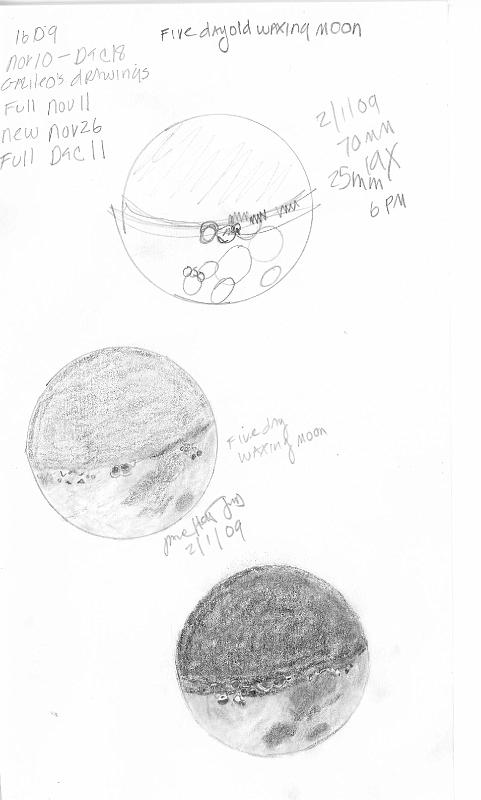
  • Chasing Galileo – sketches of the five-six day moon

    Five-day old waxing moon
    Six-day old waxing moon

    The six-day waxing gibbous moon is visible for many hours in the evening – perfect for lunar observing and sketching. The time of my sketch was closer to the sixth day than the five day old moon. I had a hard time identifying craters using either lunar days! Note how much fainter Mare Crisium is now than on the three-day moon. Many of the features barely visible three lunar days earlier in earthshine are now lit.

    On the terminator, beginning on the right and moving to the left, I see Aristoteles and Eudoxus and sketched them as dark splotches. Montes Caucasus, the Caucasus Mountains, show as a half-circle of sunlit peaks on the terminator, cradling the Sea of Serenity. Hmmm, should I use the Latin names or the English names? A bit of both, so the more familiar names are understandable, I think. Closer to the center of the terminator, I can see Plinius, a bright white crater within the Sea of Tranquility. The Apollo 11 landing site, though not visible is just on the left edge of the Sea of Tranquility, the left-most of the two large seas touching the terminator. The large sea closer to the lower edge is Mare Fecundidatis, the Sea of Fertility.

    Moving back up to the lunar terminator are a pair of lit craters. They are Hipparchus and the small crater Horrocks (connected at right) and Albategnius. These are the two craters where the sunrise is just touching the crater walls a little more than halfway from the middle of the terminator.

    Moving along the terminator, the final 2 features I can identify (at 19x) are Gemma Frisius and Maurolycus, the last two craters on the sunlit side of the terminator on the left. I suspect the sunlit crater walls just on the unlit side of the terminator belong to the craters Walter and Purbach (to the right).

    Hitchhikers’s Guide to the moon. Select Feb. 1 or 2, 2009 to match my sketches.

    My photo of the five-six day moon