
Jane's blog banner

Tag: Sidereus Nuncius

  • Chasing Galileo – Jupiter and the four Galilean satellites

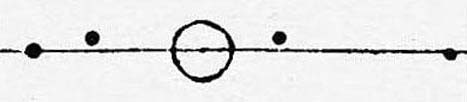
    Galileo's drawing
    Galileo’s drawing
    my drawing
    my drawing
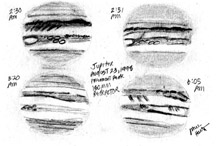
    my sketch of Jupiter's rotation
    my sketch of Jupiter’s rotation

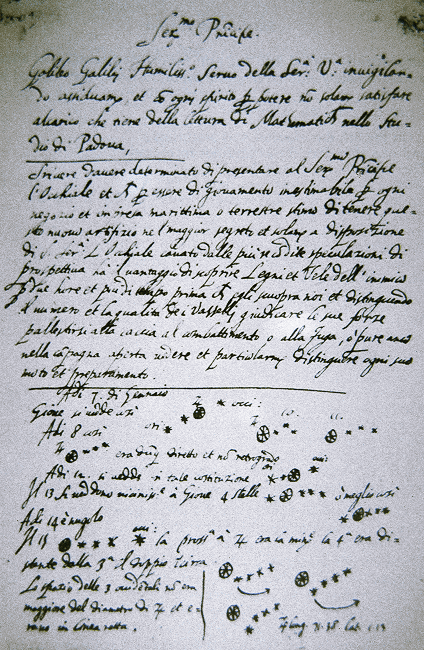
    Galileo published his observations in Sidereus Nuncius in March 1610: “On the 7th day of January in the present year, 1610, in the first hour of the following night, when I was viewing the constellations of the heavons through a telescope, the planet Jupiter presented itself to my view, and as I had prepared for myself a very excellent instrument, I noticed a circumstance which I had never been able to notice before, namely that three little stars, small but very bright, were near the planet…When on January 8th, led by some fatality, I turned again to look at the same part of the heavens, I found a very different state of things, for there were three little stars all west of Jupiter, and nearer together than on the previous night.”

    “I therefore concluded, and decided unhesitatingly, that there are three stars in the heavens moving about Jupiter, as Venus and Mercury around the Sun; which was at length established as clear as daylight by numerous other subsequent observations. These observations also established that there are not only three, but four, erratic sidereal bodies performing their revolutions around Jupiter.”

    Every amateur or accidental astronomer who first views Jupiter and its lineup of moons, is amazed at the view. Galileo’s 1610 discovery of these four moons orbiting Jupiter changed history. Looking at the Jovian moons through a small telescope, while trying to imagine Galileo’s first observations, takes my breath away!

    A page from Sidereus Nuncius: 1610

    First page of my observing log: 1989

    My first sketches of the rotation of the four Galilean satellites: 1989
  • Chasing Galileo – sketches of the moon

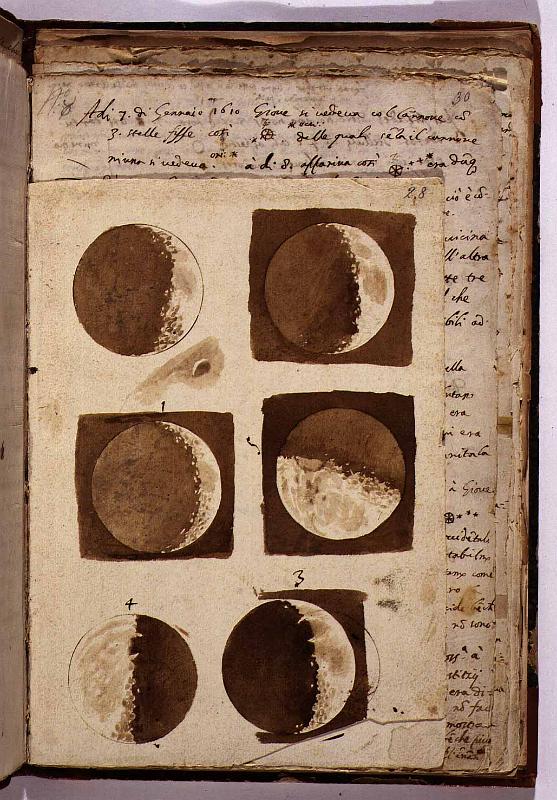
    Folio page 28 manuscript copy of Sidereus Nuncius
    Folio page 28 manuscript copy of Sidereus Nuncius
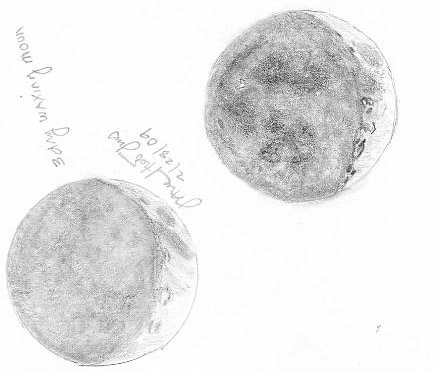
    sketch of 3-day old waxing moon 2-28-09
    sketch of 3-day old waxing moon 2-28-09
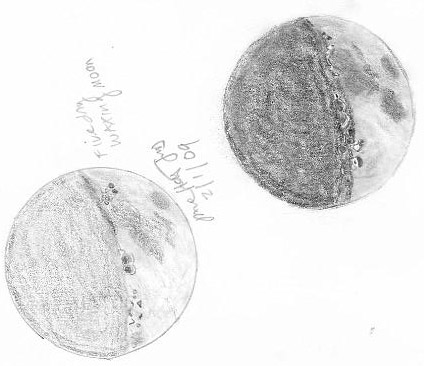
    sketch of 5-day old waxing moon
    sketch of 5-day old waxing moon
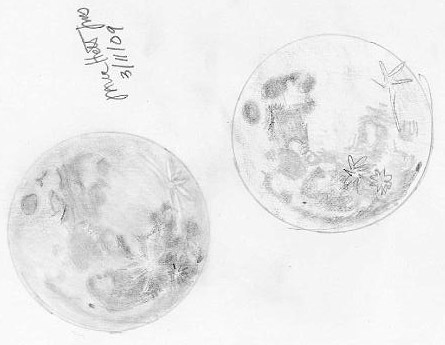
    sketch of 14-day (full) moon 3/11/09
    sketch of 14-day (full) moon 3/11/09

    Galileo’s watercolor drawings were made with brown ink wash on watercolor paper. To me, these are the most beautiful of Galileo’s astronomical renderings. When I look at the lunar terminator through my own telescopes, and hunt for interesting features to sketch, I sometime daydream, and try to imagine what Galileo thought as he surveyed these surprising lunar features. I feel a tingle every time I see the sunrise or the sunset illuminate a lunar crater floor, or escape through a crumbling wall to create a fleeting sun ray.

    I’ve been sketching the moon for about 20 years, but I’ve always focused on a small segment of the lunar terminator as my sketching target. I’d never tried to sketch the entire moon in one sitting before. Sketching the entire lunar disk is a daunting project. So I decided to make my sketches very small – three sketches to a page. I like to show my “rough sketch” first. It is sort of a outline of the major features. Then I create a finer sketch, filling in the details. Often, I make a third “final final” sketch, too.

    I used a 5″ x 8″ inch bound sketch book instead of my usual 3.5 x 5 inch 400 Series Strathmore spiral bound sketch pad. I always use my slender set of 12 mix and match Pitt pure graphite, Castell fine, and Wasserlack bold Faber-Castell graphite art set pencils. I like to keep the sketching process simple and uncluttered and the supplies compact. No table, no lights shining off my forehead, no messy products that would get on my Zeiss eyepieces or my fingers. Armed with these supplies, all I have to do is wait for the moon to become visible on a night of above-average seeing.

    Here is a partial collection of “cropped” lunar sketch pages made at the eyepiece of my 70mm Televue f/7.8 Ranger refractor. I haven’t completed my “Galileo-like” lunar sketches yet because I prefer to wait for those nights of exceptional seeing to sketch at the eyepiece, and I am in no hurry to finish this project. These crops don’t show the “rough” sketch, and are rotated to match Galileo’s brown ink wash paintings. There is one full sketch linked at the bottom of this article, and I’ll dedicate one future blog to each of the lunar sketches.

    I used one of the finest planetary eyepieces to complement my telescope — a 25mm Zeiss Abbe Orthoscopic. This gave me a 19x view of the lunar surface, similar to what you would see through a pair of binoculars, but also similar to the magnification (but not the same field of view) of Galileo’s telescope, which was 21x. Twentieth century Extra-Low Dispersion (“ED”) glass in the Televue Ranger and the exceptional quality of the Zeiss Abbe orthoscopic eyepieces plus a wider field of view give me quite an advantage, but that’s the telescope and eyepieces I have at my disposal. Lucky me!

    An example of my uncropped 3-to-a-page lunar sketches through a 70mm refractor

  • Chasing Galileo: sketches through a small refractor

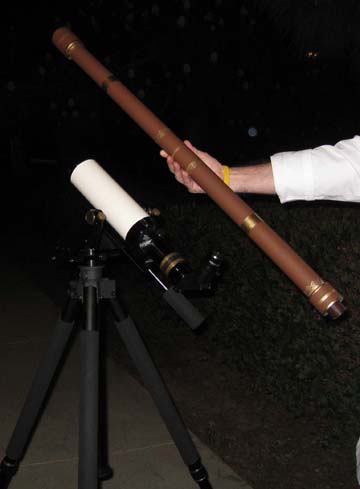
    Galileo replica and my TVRanger
    Galileo telescope replica and my TV Ranger
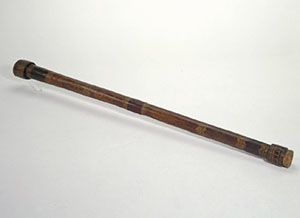
    Galileo's 1609 telescope
    Galileo's 1609 telescope
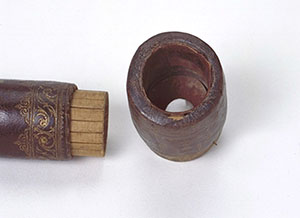
    There were separate housings at either end for the objective and the eyepiece
    There were separate housings at either end for the objective and the eyepiece

    When I started thinking about how to integrate International Year of Astronomy into my 2009 What’s Up podcasts I naturally focused on Galileo’s first observations through a telescope 400 years ago. Over the first months of 2009 I had collected a gallery of Galileo’s first sketches, watercolors and engravings. These historic observations suggested a project I’ve been wanting to do for some time — to recreate all of Galileo’s astronomical sketches through a similar sized instrument.

    Galileo made his first telescope, a spyglass that magnified 3x in June or July 1609. Next he made an eight-powered instrument and presented it to the Venetian Senate in August. His next telescope, which magnified twenty-one times is the one he used to observe the bumps and shadows on the moon, Jupiter and its moons, and individual stars within patchy nebulae. These first observations were unveiled to the world in his book, Sidereus Nuncius published in March 1610.

    Galileo’s telescope, pictured above has a objective diameter of 37 mm and a focal length of 980 mm. The instrument’s magnification is 21. My Televue Ranger (ED Doublet Apochromatic refractor) has an objective diameter of 70mm, a focal length of 480mm, and using a 25mm Zeiss Abbe Orthoscopic eyepiece, yields a comparable magnification of 19. The field of view, however is dramatically different between the two instruments. Galileo’s longer focal length and smaller objective (which he also stopped down to lessen chromatic aberation) give a relatively small field of view  – 15 degrees. My shorter focal length and larger aperture instrument has triple that FOV.

    What this means is that a telescopic view of Venus through both instruments will show the same size Venus, but in my ‘scope there will be more “sky” around Venus, and in Galileo’s there will be mostly Venus. A view of the moon is a different matter. Just a portion of the moon is visible at any one time through Galileo’s scope and the entire moon is visible through mine.

    Galileo’s drawings and watercolor paintings of the moon inspired me to sketch what I see through the eyepiece. I’ve been sketching since first light with my own first telescope over 20 years ago. This year, I’ll be honoring Galileo and celebrating the 400th anniversary of telescopic observations by creating 21st century sketches through a small refractor. I hope this journey back 400 years to revisit Galileo’s observations encourages you to look up. And I hope you’ll enjoy my sketches standing side-by-side with these historic first astronomical observations through a telescope!

    NPR story: Galileo’s Telescope Travels Far, Sees Farther

    Galileo’s telescope: specifications and images