Jane's blog banner

Category: Astro adventures and star tails

  • A morning comet

    Use a chart like this to locate where to look for your object
    Can you find the constellation Perseus and comet McNaught in Mojo’s lovely skyscape?
    Mojo's photo of Comet McNaught
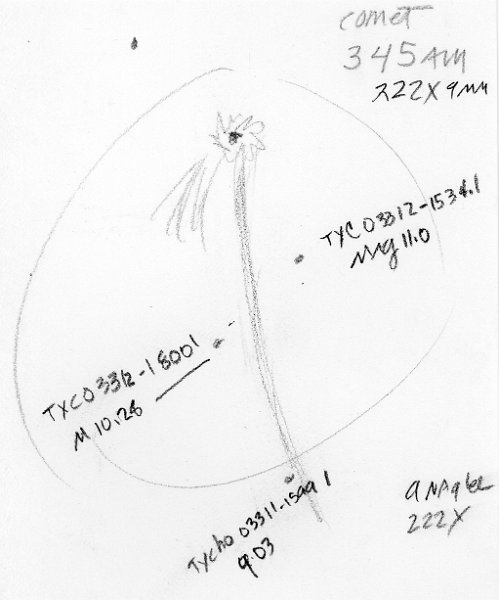
    Quick comet sketch with notes. See the long ion tail, the bright coma, and the short dust tail in my sketches
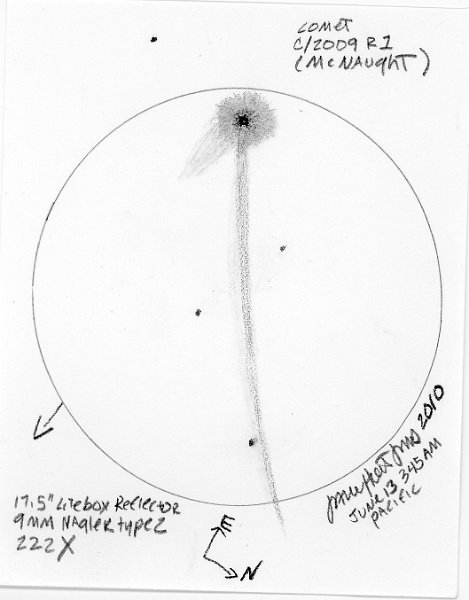
    Comet C/2009 R1 (McNaught) June 13, 3:45 am from Chuckwalla Bench observing site, Colorado Desert. Lat 33N, Long 114W, Elev 1400 ft

    I wish everyone in the world could see just one comet! Right now, there is one visible just as the dawn brightens the night sky. Unfortunately, it’s not easy or convenient to see this one, and in another ten days it will disappear below our horizon. It’s just barely visible to the unaided eye. Timing your viewing window is tricky, too. You have to find a balance between the time the comet rises high enough to see, and the coming of dawn, which robs the night of its darkness and guidepost stars an hour or two later.

    Here are some tips to help you have a successful comet viewing experience now or in the future. When you first hear about a visible comet, you can usually find some online sky charts from astronomy magazines such as Sky and Telescope and Astronomy. Many online sources can offer guidelines and observations, too.

    Star charts are fine, but you have to go out and navigate the real sky to find unfamiliar constellations. From the city, or close to dawn, this is a real challenge. You may only see a few bright stars in the sky. Try to see the stars making up the constellation Perseus in Mojo’s image. I’ll admit, it isn’t easy, especially when you are rushing against time. Now, compare his image to the star chart. And you’ll soon see the figure of the hero, Perseus, starting to emerge.

    I use the familiar “W” shaped constellation Cassiopeia as a signpost to locate Perseus. Then I see Perseus with his two running legs, joined at the bright star Alpha Perseus (Mirfak). Nearby you can see the naked-eye open cluster known as either Melotte 20 or the Alpha Perseii cluster. Next, I make a mental triangle out of Alpha, Delta and Kappa Perseii, the three bright stars closest to the comet shown on the star chart.

    Finally, I aim my binoculars at the triangle of stars and hold my breath. Then I see it, and I quietly say “hello” to the swift celestial traveller. I get chills every time I see a comet. And this time is no different. A little green fuzzball is right where the comet should be.

    Now I jump into action. I dust the cobwebs out of my brain, as well as I can at 3:45 am in the morning. I’ve just woken up from a short nap. I quickly sketch what I see in the eyepiece of my big telescope, taking care to mark any stars nearby, and note the time. Then I call everyone who is awake over for a look. We all move sluggishly in the near dawn light, like we are walking through sandy molasses. We share views with one another, through binoculars and a variety of telescopes large and small.

    Overhead, the Milky Way has disappeared, and the glow of twilight grows brighter. I have yet another predawn observing target, so I quickly make a second sketch with a little more detail. Then I nod goodnight to the beautiful green comet, aim my binoculars just a little to the east and wait. It will be nearly one hour before Mercury will rise over the mountains.

    This comet is making its first approach around the sun, in its long hyperbolic orbit from the Oort Cloud. At the time of my observation, the comet was 0.6 AU from the Sun and 1.1 AU from Earth. By the end of June, it will be lost to our view. It reaches perihelion on July 2nd when it is about 0.4 AU from the sun. Then it will fade and be seen no more.

    Added postscript: According to this Space.com article, the comet may be visible “after June 22 both in the evening sky for a short while just after sunset very low above the north-northwest horizon and in the morning sky just before sunrise very low above the north-northeast horizon.” I’ll update if/when I learn more.

    See more of Mojo’s photos from this observing night.

    Read my other observing writeup from this same night.

    Join our Old Town Sidewalk Astronomers email list and find out when our next dark sky outing will be. Or join us at our next in-town new telescope users clinic and planet/moon viewing event. Hey, that’s tonight, June 19! Clinic (RSVP required) begins before dark at 7 p.m. Star Party continues until 9:30 p.m. at Library Park in Monrovia, CA.

  • A Ten Planet Night

    Setting up my favorite Pluto hunting telescope, a 17.5 inch f/4.5 Litebox reflector. Oh, in case you were wondering, its name is Hagrid. All my telescopes have names.
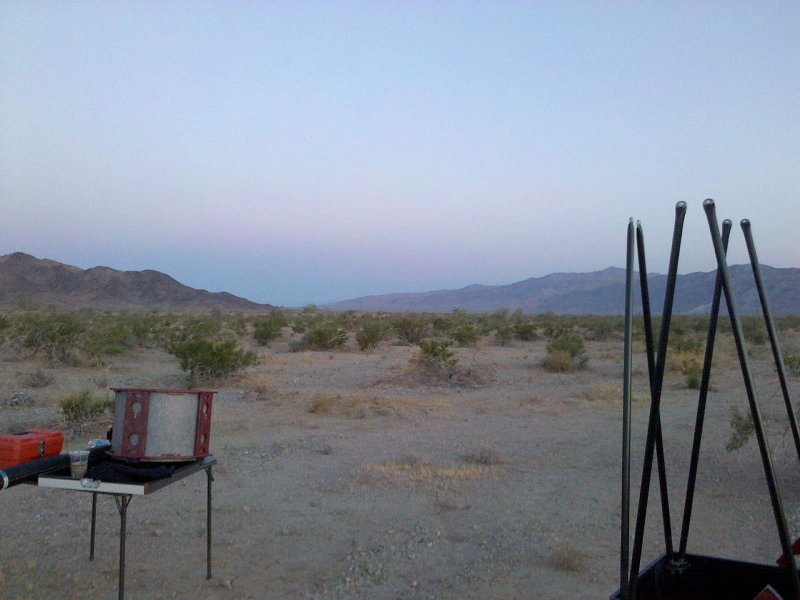
    Chuckwalla Bench horizons
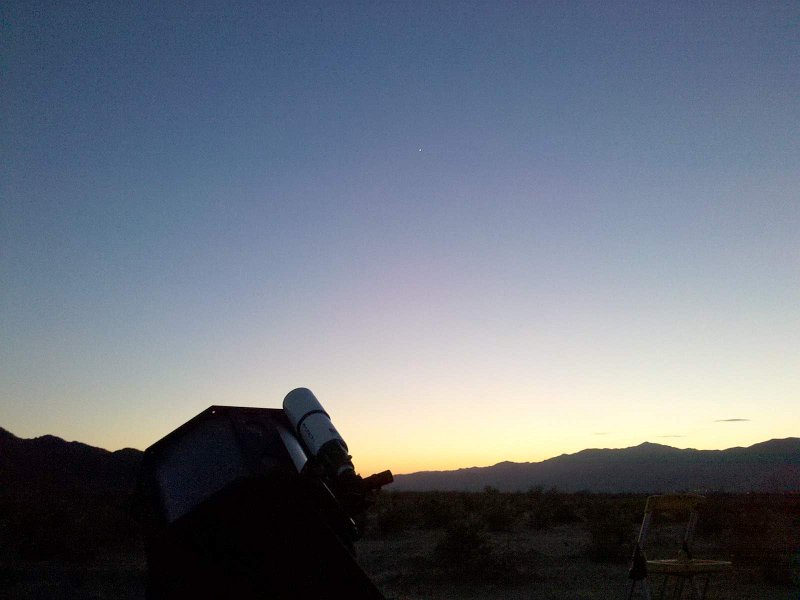
    Earth shadow at sunset, and Mojo setting up his astrophotography rig
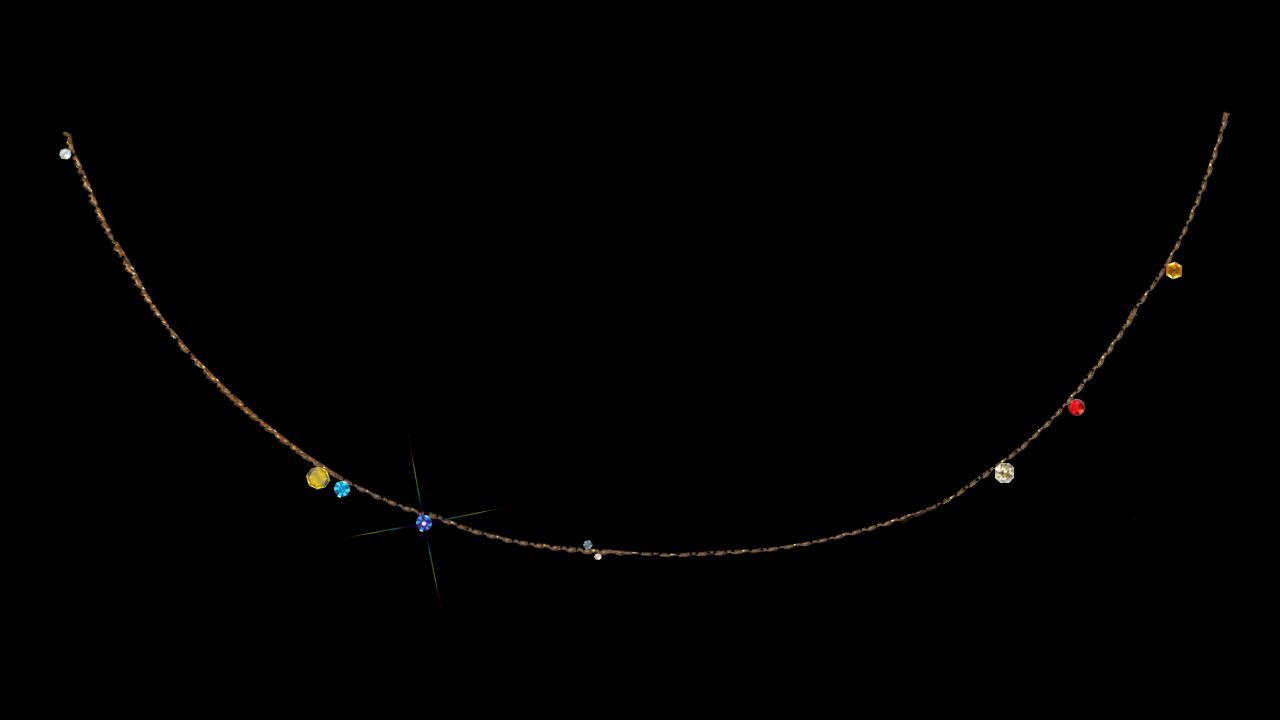
    A starry necklace spans the sky from dusk to dawn
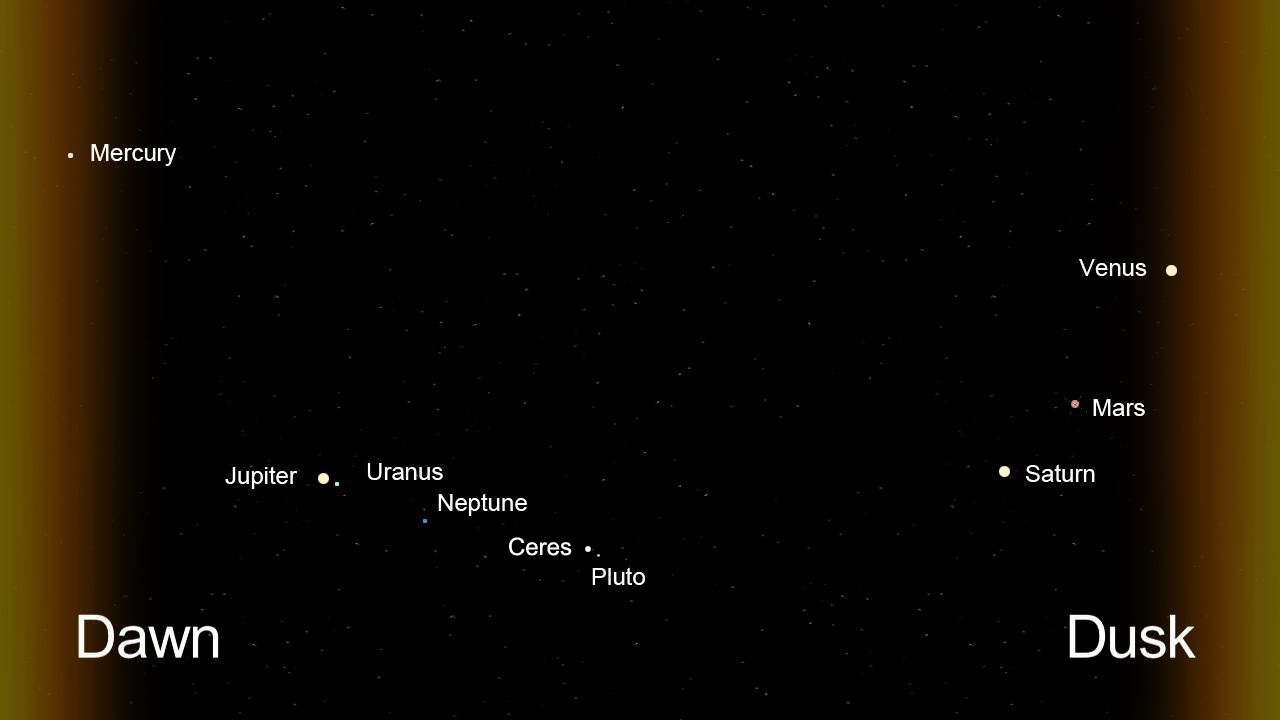
    The planetary lineup from dusk to dawn
    Two planets, Venus and Earth at sunset
    M24 cluster and 60 day path of Pluto
    Do you see the Sagittarius teapot and the Milky Way "steam" rising from the spout? How about M24, the huge Sagittarius starcloud (the oval of stars 1pm above center) where Pluto hides?
    Earth shadow at sunrise
    Bonus picture: This is the "naked eye" view of the sky where Comet McNaught can be found. Can you see the green comet near the Perseus Cluster? If not go to Mojo's Blog for closeup. Click to enlarge. It took binoculars for most of us to spot the first time. 🙂

    Every couple of years I get the yearning to see all the planets in one night. Saturday night, June 12 seemed like the perfect opportunity. Our Old Town Sidewalk Astronomers club planned an outing to our regular observing spot, Chuckwalla Bench, which has very good horizons. We needed good horizons to catch Mercury rising just before sunrise.

    Here are my planet observations, in observing order. All distances are listed in astronomical units and represent the distance from Earth on June 12, 2010, the night of my observations.

    Earth! Facing away from the setting sun, the Eastern horizon turned shades of blue above the pinkish sky. That’s the shadow of the Earth! The dark blue band seems to rise above the landscape and spans 180 degrees. The pinkish sky above the shadow is the antitwilight arch. As the sun sets, the boundary between the reddened (pink) color and the horizon grows until it blends with the darkening night sky. The same thing happens at dawn of course. Look for it, and tell me what you see!

    Venus! The first “star” to appear in our sky after sunset was Venus. Through the telescopes its gibbous phase is unmistakable! Its distance from Earth is 1.2 AU (astronomical units).

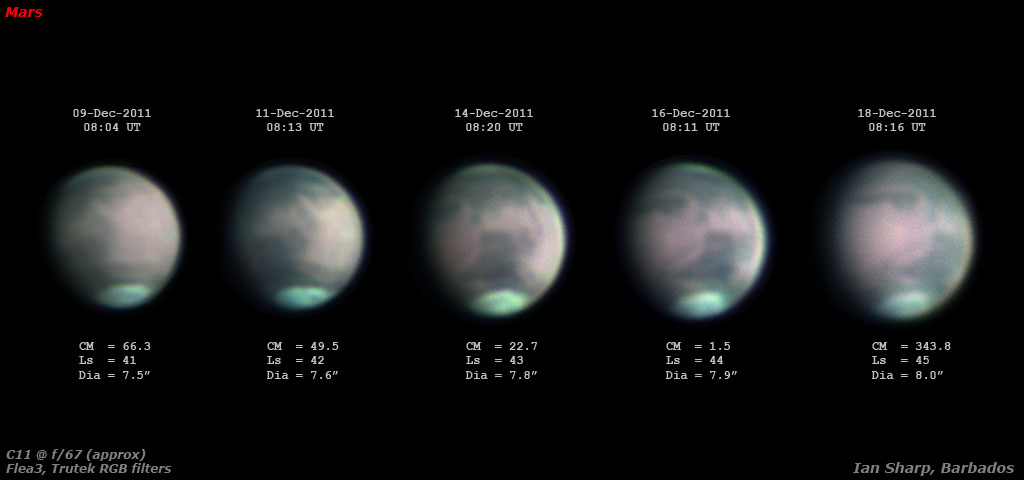
    Mars! I was not expecting to see any features on Mars, since it is so far away and so small. Mars is 1.7 AU from Earth, but only half the diameter of Earth. I was surprised that I could see some dark markings, through a small refractor. When we checked a Mars map for the time of the observation, the large dark feature Syrtis Major was indeed right smack on the central meridian – the imaginary line in the center of the planet facing Earth at that moment.

    Saturn! What’s not to love about Saturn! The brownish cloud bands contrasted against the butterscotch hued planetary globe. The slender ring, appearing nearly edge-on, bisected the planet, showing a tiny glimmer of sunlight shining on the north side of the rings. Several moons were visible, though one of the larger ones, Dione, was transiting (crossing in front of) the planet on this night. I spotted Mimas and Enceladus — tiny beacons of light — hovering near the edge of the rings. Titan and Hyperion were on the same side, only further away. Rhea was on the other side. Dione’s shadow marched across the face of the planet for astrophotographers to capture. I didn’t see it visually. Distance from Earth is 9.4 AU right now.

    Pluto! This small icy world is 30 AU away from Earth. Once a planet, it is now a dwarf planet. But that doesn’t alter my enjoyment of seeing it through a telescope. For the past few years, Pluto has been marching slowly towards the richest part of our Milky Way galaxy making it a challenging object to confirm in backyard telescopes. Right now it is found skimming the Northern border of M24, the Milky Way Star Cloud. That’s a lot of stars to wade through to find one dwarf planet!

    I printed out star charts showing just the few surrounding stars and Pluto, indicating the motion over the evening so I could go back and verify the observation closer to dawn. I also made zoomed out charts, showing larger and larger areas of the region. I had some galactic luck this month! A small open cluster called NGC6603 was nearby to Pluto within the larger M24 open cluster. A few distinctive star patterns separated the dwarf planet from the small star cluster, and I was able to easily starhop and make a positive ID. With Pluto bagged, I was feeling confident about the rest of my planetary to-do list.

    Note: From July 4th through the 8th Pluto will pass in front of a dark nebula on the Northwest border of the M24 named B92. This should make the tiny magnitude 14 speck-of-a-former-planet easy to spot.

    Ceres, another ex-planet was nearby so I hopped over to have a look at it. Ceres spent half a century after its discovery in 1801 as our 8th planet. Then it was demoted to an asteroid, but its significance was cemented by its designation, 1 Ceres. After many years working the solar system as chief #1 asteroid or minor planet, in 2006 Ceres was promoted to dwarf planethood along with Pluto. Ceres is 1.8 AU from Earth, by the way.

    With the dwarf planet observations under my belt, I took a short nap to allow Jupiter, Uranus and Neptune to rise higher in the sky.

    Uranus and Jupiter! When two planets are at opposition at nearly the same time they appear to pass each other from our viewing vantage point on Earth. This year we will see Jupiter pass Uranus, then appear to loop backwards–in retrograde–passing near Uranus a second time, then resuming its forward motion with third final close pass. The next time this will happen is 2037, so you might want to aim your binoculars at this pretty pair of planets this year. This is the first pas de deux, so you have many months to view the dance of the two gas giants. Through the telescope, Jupiter, which is 5.1 AU from Earth, looked unusual to me. It was my first look at the planet since the Southern Equatorial Band disappeared. A few months ago, this chunky ruddy band went missing.

    Uranus has a beautiful aquamarine color. It has several moons just on the border of visibility through large amateur telescopes. I was able to spot three of the brighter moons of this planet — the ones farthest from the planet’s glow. Titania and Oberon on one side and Ariel on the other. A big ‘scope and good dark and steady skies help to see the faint moons! Uranus is 20 AU from Earth. Try looking up at Jupiter in a dark sky and see if you can spot a blue-green “star” nearby.

    Neptune! Neptune sports an azure-blue hue and appears like a tiny disc. It’s nearly 30 AU away near the southern tip of Capricornus. At this time of year, that means waiting until 3 am or later for a view.

    Now I had snagged all the planets except Mercury. It would be rising an hour before sunrise at 5:30 am, but the elevation of hills on the SE horizon were difficult to measure. I kept my eyes on the Pleaides star cluster as Mercury would rise directly below the famous cluster. By 4 am, with an hour and a half until sunrise, the sky was already brightening. First, the glorious Milky Way faded until it was nothing but a memory. Then, one by one the constellations disappeared, except for their brightest starry ambassadors. I steadied my binoculars as the Pleiades or “Seven Sisters” disappeared one by one. I kept the remaining Pleiades stars in my binocular view while moved back and forth, scanning the horizon for Mercury. Soon the rays of pending dawn punctuated the horizon, and I worried that I’d miss it as sunrise made the landscape visible once again. I could still see some of the Pleiades, and kept looking for over 45 minutes. Finally, just a few minutes before 5:00 am, a bright beacon appeared on the horizon. It was Mercury! I had seen ten planets in the span of nine hours!

    The nine hours passed so quickly. With sunrise comes daylight and the views of the night sky fade from view but not from memory. Join us out in the desert sometime or find a local astronomy club closer to you so you can see these wonders of our solar system for yourself! You really have to see this!

    Mojo’s report/astrophotos from the same night

    Jane’s June 2010 What’s Up podcast: “A Planetary Necklace”

    Mercury Rising A nine planet observing night in 2001.

  • Jupiter: Past and Present Spots/Impacts

    December 1690 sketch of new dark spot on Jupiter by G. D. Cassini and changes to the spot over 18 days
    My first sketch of SL 9 impacts on Jupiter July 18, 1994.
    My July 26, 2009 sketch of the impact on Jupiter, discovered by Anthony Wesley (upper left 11-o’clock spot)

    Anthony Wesley's preliminary (a raw frame from his video) showing new impact of Jupiter, June 3, 2010

    On June 3, 2010, shortly before dawn in New South Wales, Australia, Anthony Wesley was imaging Jupiter. He saw a bright flash visually, and captured it on video. He quickly sent out an alert to imagers and scientists, followed soon with a preliminary raw frame from his video. Christopher Go also imaged this flash at the same time from the Philippines, and he also alerted the scientific and imaging communities.

    The word spread like wildfire, and soon amateur and professional astronomers around the world were calculating when the impact area would rotate around the planet, to be hopefully visible from their own location, telescope or observatory. Would the impact leave a scar? No one knew for sure, but more observations were needed.

    We’ve seen and documented three impacts to hit Jupiter since 1994 — but how many have we missed? Impact events leave no long-lasting scars on the surface of Jupiter. Jupiter’s bruises fade away.

    Any science enthusiast who remembers 1994 will never forget the buildup to Shoemaker-Levy 9’s amazing impacts into Jupiter that summer. I have many sketches of what I observed visually those first nights when the world saw predicted cometary fragments hit Jupiter and leave visible impact scars. Astronomy clubs around the world saw increases in membership because of the press coverage.

    I took my homemade 10-inch reflector telescope out on my back deck and observed and sketched Jupiter every clear night in the summer of 1994. I was, unwittingly at the time, continuing the tradition of citizen scientist recordings of visual astronomical observations — a tradition which goes back thousands of years.

    Last year I was researching historical astronomical observations for my International Year of Astronomy (IYA) podcast series. I learned that Giovanni Domenico Cassini not only first saw Jupiter’s great red spot (called Jupiter’s permanent spot) in 1665, but he also observed and documented other large spots in December 1690.

    Cassini’s sketched this feature over eighteen days in December 1690. His sketches show changes in the feature over time. His observations were published in 1792 as “Nouvelles descouvertes dans le globe de Jupiter.”

    Today’s citizen scientists around the world observe their targets nearly every clear night. And when they see something unusual they immediately alert their community of colleagues. Sometimes, like in this case, other eyes or images confirm the observation. And when it is amazing enough, the world’s greatest eyes – Earth-based telescopes like Gemini, Keck, IRTF and even the orbiting Hubble Telescope — take aim.

    Their eyes from Earth and space will make observations to delve deeper into Jupiter’s mysteries. Their data will complement observations of astronomy’s citizen scientists whose round-the clock and round-the-world nightly records are the eyes on the sky.

    Ancient Astronomical Documents

    Discovery of a Possible Impact SPOT on Jupiter Recorded in 1690

    The Shoemaker-Levy 9 Spots on Jupiter: Their Place in History

    1994 Comet Shoemaker-Levy 9 Impact

    2009 Jupiter Impact

    2010 Jupiter Impact

  • A visit to the Lunar Sample Laboratory Facility

    IMG_5703

    I'm putting my hands inside the neophrene gloves, which are now filled with nitrogen
    I’m putting my hands inside the neophrene gloves, which are now filled with nitrogen
    Jane and JPL outreach colleagues give 3 lunar samples a thumbs up.
    Jane and JPL outreach colleagues give 3 lunar samples a thumbs up.

    While attending the 41st Lunar and Planetary Sciences Conference in The Woodlands, TX (a suburb of Houston) in early March 2010, I was lucky enough to visit the Johnson Space Center’s famous Lunar Sample Processing Facility. Most of the time during my one week stay, I was setting up, staffing, and taking down an exhibit focusing on NASA/ESA missions to the Outer Planets.

    After packing the exhibit Thursday night we got a good night’s sleep and headed to Johnson Space Center, about an hour’s distance away the next morning. Every space enthusiast can visit JSC, and have a great tour. But we had a specific destination in mind — the Lunar Sample Processing Facility. How appropriate a visit, especially after a week at the Lunar and Planetary Sciences Conference!

    First, we stopped for lunch at astronaut Jose Hernandez’s family restaurant Tierra Luna Grill.

    After lunch we (we being my JPL outreach colleagues Preston Dyches, Eddie Gonzales and I) parked outside Building 31N, and walked upstairs. We donned booties to cover our shoes, and put on head-to toe white bunny suits, gloves and head covering, after removing any gold jewelry. Why? Gold and silver alloys (even 24K gold) have trace amounts of lead and lead is not allowed in the laboratory. Our cameras and cell phones were wiped down to reduce dust, and placed in an airlock. Then we entered the air shower, where any dust remaining on our bunny suits was gently filtered off, and a minute later, we walked into the Lunar Sample Laboratory Facility.

    We entered the room, filled with monochrome cabinets and tools made of steel and teflon. White clad space geeks listened intently as our tour guide, Charles Galindo, principal scientist and astrobiology lab manager (he’s very active in educational outreach) took us from cabinet to cabinet, peeling back the years of history, to reveal the why and the how behind the wow!

    Soon we were inserting our hands into the huge and awkward neophrene gloves, and touching hammers that touched real lunar samples! We walked around the room, and into the corridors, past the locked steel vault holding priceless samples collected from the surface of the moon. At one end of the room was a large case with three large lunar samples. I’ll end my little tale with a short description of these three samples.

    Lunar Sample 61016.7 was collected from Plum Crater on the Apollo 16 mission. This sample is nicknamed Big Mulie in honor of UT geologist Bill Muehlberger, and is the largest rock (11.7 kg) collected on the Apollo Missions. The sample contained 4 rock types, including anorthosite from the ancient lunar crust, age: 4.5 billlion years.

    Lunar Sample 15459 was collected from Spur Crater on the Apollo 15 mission. It is a large dense regolith breccia which contains a mineral, glass and chemical composition like that of the local soil. Here are a couple In Situ images!

    Lunar Sample 15556.0 is medium grained vesticular basalt from Apollo 15. Here are many images including thin sections. This sample was collected 60 m NE of the rim of Hadley Rille!

    When I am out with my telescopes showing the moon to my sidewalk astronomy audiences, I carry a lunar landing site map exactly like this one. The Apollo 15 landing site is easy to point out to my audiences, especially near the first quarter moon phase. It’s near the familiar lunar landmarks like the Appenines, right on the rim of the great Imbrium Impact basin.

    Hadley Rille is an observing mecca for lunatics like me. It draws me in to it, and then with a nod to space history and Apollo 15 recollections, I can’t help but try to see some of the tiny craters near the landing site. Peering through an eyepiece at the areas where men landed and walked on the moon adds a dimension to amateur astronomy which I find compelling. You will too, I’m sure!

    My complete photo album, including more site visits at JSC and the exhibit at the Lunar and Planetary Sciences Conference 2010 are here. Many thanks to Charles Galindo of JSC for taking us on this amazing adventure and to Eddie Gonzales of JPL for orchestrating the whole visit!

  • A Runaway Star and the Flaming Star Nebula

    IC 405 and AE Aurigae
    IC 405 and AE Aurigae

    Stardate: Saturday November 14, 2009.
    Place: Chuckwalla Bench Observing Site
    Equipment: 12.5-inch Litebox Reflector, f/5.75 Pierrre Schwaar mirror
    Sky conditions: Better than expected (clear, steady, good transparancy, but cold)

    Mojo and I try to head out to our favorite dark sky observing spot every new moon Saturday night. Usually several of our Old Town Sidewalk Astronomer friends join us, and usually there are half a dozen telescopes. But this month we were the lone astronomers.

    Mojo has been infected by the Astrophotography virus for the past 2 years. Lucky me! I plunder his images and have included many in my monthly What’s Up podcasts. It’s not easy to find good wide field images of the constellations and low/zero power images of celestial objects, and his are really gorgeous. I love Mojo’s images of the galactic “smudges” because they show what deep sky objects really look like through a modest telescope. But he also wants to image the “eye candy” objects up close and personal, and luckily he welcomes an imaging suggestion from me every now and then.

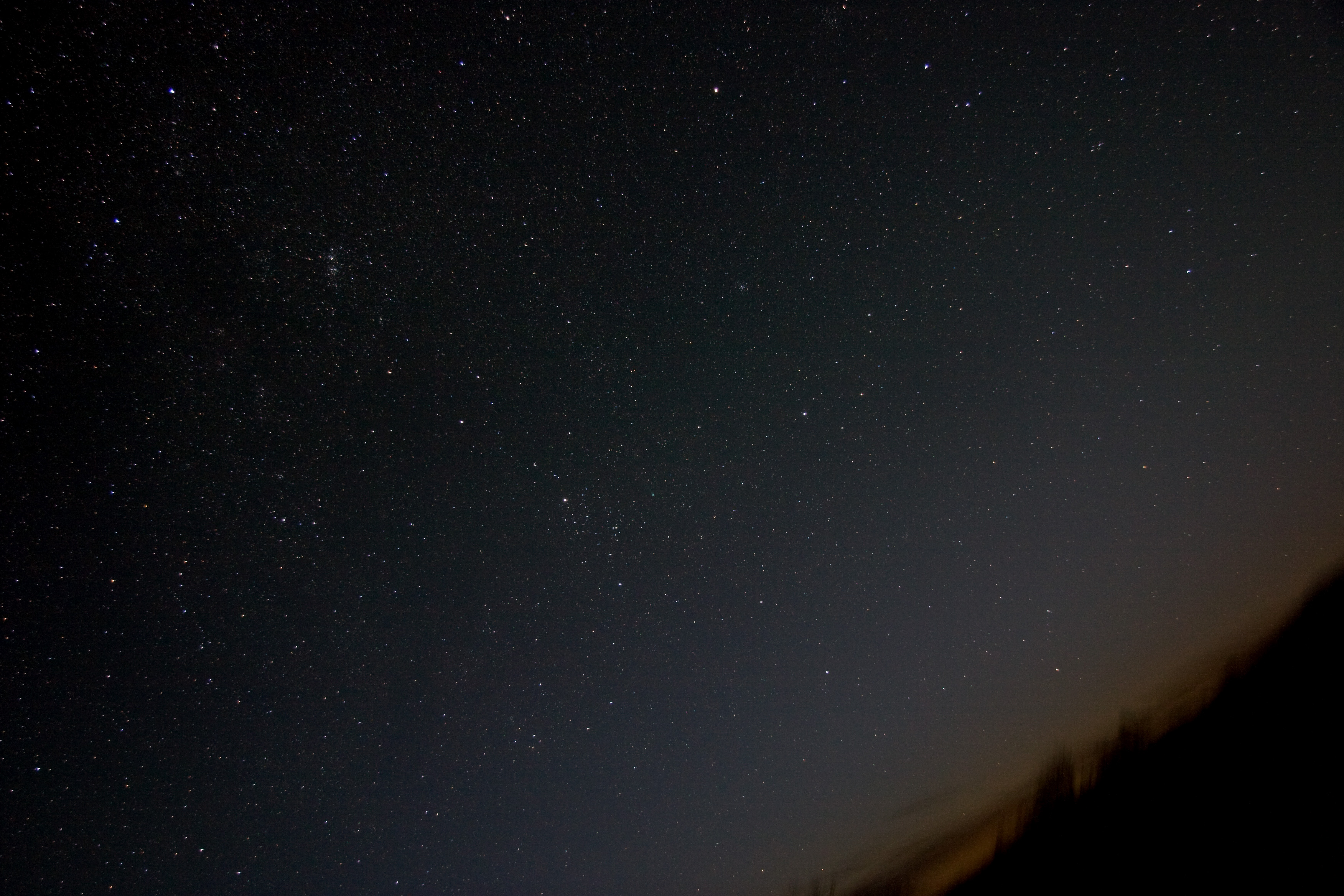
    The constellation Auriga as it appears in the November sky - center left is bright Capella
    Mojo’s Auriga – center left is bright Capella
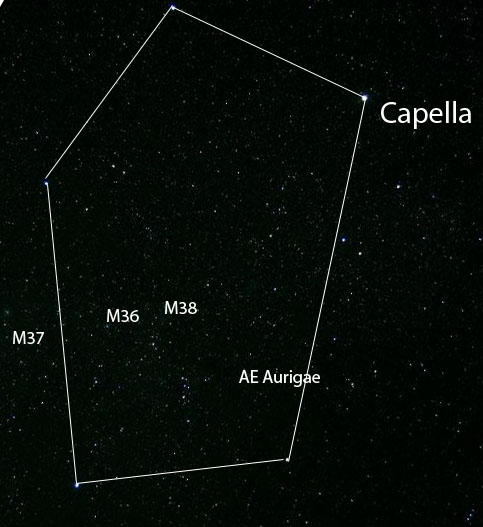
    Rotated & annotated Auriga
    I rotated Mojo’s Auriga 120 degrees clockwise & annotated it because this is how I see it in my mind’s eye – like a house with a door

    So on this particular night, I wanted to observe one really interesting star and one really interesting deep sky object in several of the winter constellations. In Perseus, I observed Eta Persei, a spectacular gold and blue double star, and NGC 1491, a fan shaped emission nebula.

    The constellation Auriga is right next to Perseus, so I opened the good book, and by that I mean the Night Sky Observer’s Guide (NSOG) volume 1 (Autumn and Winter) to Chapter 5, Auriga the Charioteer. Under the “Interesting Stars” chapter, variable star AE Aurigae caught my attention, even thought it only garnered a rating of 3 out of 5 stars — meaning it was an “average” viewing object.

    AE Aurigae is one of the runaway stars whose proper motion can be traced back to the Orion Nebula. It is about 1500 light-years away and is an unusual O-type star with irregular light variations. It shines with the luminosity of 10,000 suns, but because of its distance is just on the edge of naked eye visability at varying magnitudes from 5.78 to 6.08. The NSOG goes on to say the star illuminates IC 405, the Flaming Star Nebula. Wow! That sounded like a very interesting object to view, despite the so-so rating. I called Mojo over to show him my project and mentioned how difficult the nearby nebula was to see visually. I could just barely see it, after trying with and without my O-lll, H-Beta and UHC filters. Only the UHC filter helped a little, and not very much. He thought it would be a challenging imaging project, and the constellation was in a great spot for astrophotography. I showed him where the object was, just next to a line of 4 stars that make up part of the front door of the “house of Auriga”, sort of where the doorbell should be. An hour of imaging later, we were both blown away the rippling waves, curling tendrils and the red color in the nebula.

    Back home the next day I did some more research on the two objects. The Spitzer Space Telescope observed the Flaming Star Nebula, an emission/reflection nebula in infrared wavelengths. Their observations show evidence of a bow shock created by the interaction between the runaway star and the nebular material. The runaway star, AE Aurigae is from the Orion association of O and B type stars. AE Aurigae and Mu Columbae were hurled out of the Orion nebula’s famous Trapezium area before the Trapezium stars were even born! Did one of the stars’ binaries go supernova and did the explosion send these stars hurtling through space in different directions? According to Jim Kaler’s Stars website the collision sent two stars out of the cluster, and the beautiful double star Iota Orionis — the brightest star in Orion’s belt — remained.

    AE Aurigae is moving north at 128k/s (80 miles per second) and is now 40 degrees north of Orion in Auriga. Mu Columbae is now 28 degrees to the south, in the constellation Columba, the Dove. That’s the constellation south of Canis Major and Lepus. Standing out under a dark sky and tracing the path from Orion to the runaway star’s location in Auriga was just mind boggling. Then I eyeballed the the path of Mu Columbae from the Orion nebula past bright Sirius down to the dog’s butt of Canis Major, and on down to Columba. Next month I’ll have to try and see the Columba runaway star.

    That was a great project for both of us! I really enjoyed observing a wild stellar object which had been studied and imaged by one of our great orbiting observatories. And Mojo enjoyed imaging an object that was practically invisible at the telescope eyepiece, but waiting for its closeup in front of his camera.

    Mojo blogs about Pinwheels, Horseheads and Flaming Stars – his projects on the same night.

  • Flying through the Leonid Storm of 1999

    s-houstonimage2

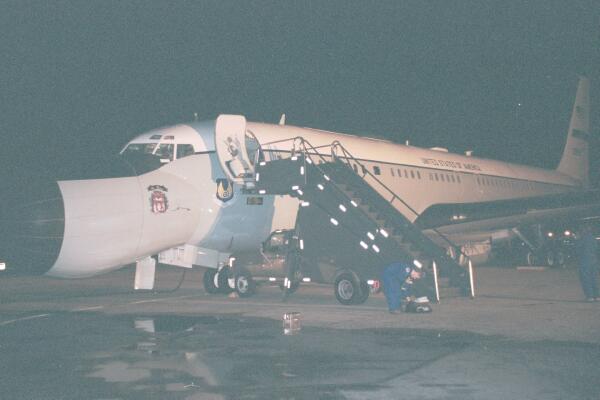
    ARIA Advanced Range Instrumentation Aircraft
    ARIA Advanced Radar Instrument Aircraft
    Jane boarding the ARIA
    Jane boarding the ARIA
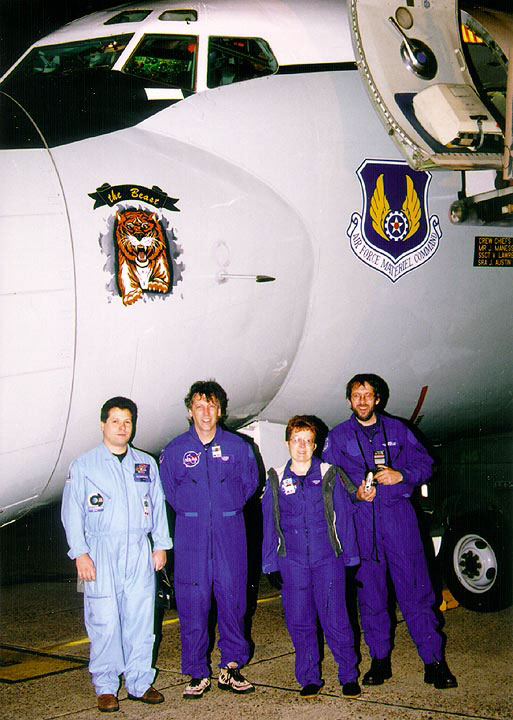
    4 of the 6 IMCU team members in front of the ARIA nose
    4 of the 6 IMCU team members in front of ARIA

    November 1999: 10 days, 40 flying hours, 65 researchers and Air Force personnel, five members of the press, seven Air Force bases (four US, two UK, one Azores), 6 amateur astronomers, three aircraft, 15,251 meteors, one amazing memory. I’d like to thank Dr. Peter Jenniskens, the Leonid MAC principal investigator for inviting me to participate on this (and other) meteor missions over the past 11 years.

    I was part of a six-person team of experienced amateur astronomers/meteor observers who were invited to fly around the world for 10 days, preparing for and then counting the Leonid Meteor Storm of 1999. We traveled from Moffat Field AFB near San Francisco over the San Andreas Fault to Edwards Air Force Base in Southern California for debriefing, badging, flight practice and setting our internal clocks a week of Leonid night flights. Then we flew across the United States and the Atlantic Ocean to England. Next, over Europe and Africa to Israel, back through the great Leonid storm to the island of Terceria in the Azores on the Mid-Atlantic Ridge. After a press conference, interviews and a celebratory dinner at Lajes Air Field we flew back to Patrick AFB in Florida for an end-of-mission party in Cocoa Beach, FL. Finally we crossed the US once again and flew right over Meteor Crater Arizona and back to Edwards AFB.

    The entire crew flew on three aircraft, the ARIA, a Boeing 707, Advanced Range Instrumentation Aircraft. It has a telemetry antenna dish in the nose of the aircraft and four INMARSAT communication channels for internet and voice mail uplink, plus lots of windows, some installed for this mission. The second aircraft was the FISTA, a modified NKC-135E tanker called the Flying Infrared Signature Technology Aircraft, with 20 upward-looking window ports. The third aircraft, a C-130 provided airlift support for parts and emergency repair capability for the FISTA and ARIA aircraft. They also provided a global command and control platform for mission coordination.

    Once the wheels were in the well, we headed for McGuire AFB in New Jersey to refuel for the trans-Atlantic flight. We took off at midnight from McGuire, and had a practice setup and observing run as we crossed the Atlantic. Seven hours later we landed at Mildenhall AFB near Cambridge. We counted 10 Leonids and 10 sporadics per hour during the practice run. We observed the Aurora Borealis and sprites, upward lightening strikes, thought to be induced by meteors.

    On the second night flight we flew from England to Israel. We tested and calibrated our instruments, then observed and recorded 15 – 20 Leonids per hour, after making comets and giving talks at an elementary school near Lakenheath RAF Base.

    On the third flight night we flew from Ben Gurion Airport in Israel to Lajes Air Field on Terceria Island in the Azores. This was the night we chased the Leonids and raced the sunrise. We observed the peak of the Leonid Storm of 1999 from 40,000 feet!

    My team, the IMCU (Intensified Meteor Counting Unit) used intensified CCD cameras aimed out the windows of the ARIA. Some cameras covered the horizon to 30 degrees above, and some from 30-60 degrees. The cameras were connected to video headsets. As we viewed the intensified images we captured Leonids and sporadic meteors by mouse clicks reported to counting software. We observed and counted a ZHR (Zenithal Hourly Rate) of 2300 Leonids per hour. I personally observed 2700 Leonids on storm night alone. Our total was over 15,000!

    On the fourth night from the Azores to Florida, we observed all night long again to collect data and measure the sporadic meteor count. Sprites and elves were captured by the airglow measuring camera on this night.

    The final flight took us from Florida back to Edwards Air Force Base. We all looked out the windows in the bright daylight and saw the remnant of an earlier cosmic collision – Arizona’s Meteor Crater!

    From the press:

    Astrobiologists on a NASA mission to study the Leonid meteors were in the right place at the right time to study a rare natural phenomenon — a meteor storm.

    At the peak of the storm, which occurred at 02:10 GMT, Nov. 18, 1999, the Leonid meteors were falling from the sky at a rate of 2,200 per hour. A meteor shower is classified as a storm when the rate exceeds 1,000 meteors per hour.

    Sixty researchers aboard the $1 million joint NASA-Air Force mission hollered and hugged as the Leonids barrage intensified, and the jets traced slow circular routes over the Mediterranean between North Africa and Cyprus. Individual meteors soon multiplied to a half-dozen white streaks screaming over the horizon at 40 miles per second.

    ”I’m not on Cloud 9 – I’m above it!” quipped Jane Houston of the California Meteor Society, one of several amateur astronomers on the meteor-counting team. A total of 15,251 meteors were counted during the six-hour observation period on the overnight flight from Israel to the Azores.

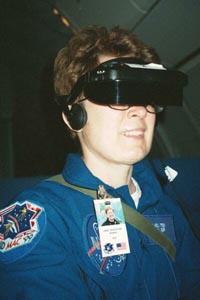
    Near real-time data on the number of meteors falling per hour was provided to NASA and the U.S. Air Force by a team of amateur astronomers who counted the meteors using virtual reality goggles and laptop computers. The meteor counting team was aboard the ARIA (Advanced Range Instrumentation Aircraft), one of two aircraft provided by the United States Air Force to support this mission. The data was sent from the ARIA, an EC-18 aircraft, to the ground via the TDRS satellite system. NASA and the Air Force are joint sponsors of the 1999 Leonid Multi-instrument Airborne Campaign.

    Leonid Multi-Instrument Aircraft Campaign team, 1998-2002 (I’m bottom row, third from left)

    Leonid memories 1998-2002

    Jane Houston’s Leonid 1999 diary

  • Dorothea Klumpke, airborne Leonid pioneer

    Dorothea Klumpke
    Dorothea Klumpke

    As I prepare a blog down memory lane, recalling my own airborne observations of the 1999 Leonid Storm, I wanted to share the adventures of the first woman airborne Leonid pioneer, Dorothea Klumpke.

    Over one hundred years ago, American born astronomer Dorothea Klumpke flew through the Leonids in a balloon. She was the first women to observe a Leonid meteor shower from above the earth. Below are excerpts from published reports about her adventure. I hope her deeds inspire you to step outside in the mornings of November 17th and 18th and observe the Leonid meteor shower this year.

    Exactly a century before the Leonid Storm of 1999, European scientists made plans to launch balloons to observe the Leonid meteor show of mid-November 1899. “I do not know what good fairy overheard my wish to take a trip in the blue sky.” Dorothea Klumpke wrote of her voyage in the balloon, La Centaure. “My surprise was great when I learned the French Society of Aerial Navigation had chosen me for the astronomical expedition of the Leonids. After reflection I accepted the unexpected invitation. I had the great mysterious and alluring anticipation of an ascent in a balloon.”

    The Leonids of 1799, 1833, and 1866 were magnificent and were confidently predicted to fill the skies with shooting stars once again in 1899. But these predictions fell far short of reality. By 1:00 a.m. on November 16th, as Klumpke waited to go aloft in La Centaure, she already knew of the disappointing reports from a flight on the previous night. Undaunted that the Leonids had failed to appear, she resolved to go ahead with her planned program.

    The balloon La Centaure, bathed in the light of the full Moon, rose over Paris into a bitter wind a few minutes before 1:00 a.m. on November 16, 1899.

    They tossed off the ballast sacks and soon the pilot, a secretary and Klumpke ascended to a height of more than 1600 feet and drifted westward over Normandy towards the English Channel. The sky was clear and pure, and despite the light of a nearly full Moon, fifth magnitude stars were visible. They saw 30 meteors during five hours of observing, of which half were Leonids. Seven hours after launch La Centaure made a dawn landing near a small coastal village. Dorothea wrote that all three occupants were “inwardly enriched a thousandfold by the wonderful experiences of the past night.”

    The seven hour flight was a scientific disappointment: only 15 Leonids were observed. But it was a great milestone for women in science. At age 38 Klumpke had become the first woman to make astronomical observations above the earth’s surface, augmenting an illustrious career that would continue well into the 20th century.

    In the late 1930’s Dorothea Klumpke Roberts endowed the Astronomical Society of the Pacific with a gift of $2,000 in honor of her parents and husband. The interest from this endowment was used to sponsor a variety of educational programs, including a series of Klumpke-Roberts lectures. In 1974 this program was renamed the Klumpke-Roberts Award. This international annual award honors an individual or group making significant contributions to the public understanding of astronomy.

    This article was compiled by Jane Houston Jones and Don Stone, past President and and Treasurer of AANC, the
    Astronomical Association of Northern California
    .

    Leonids 1998-2002, part 1. Flying through the Leonid Storm of 1999

  • Spooky Halloween Observing, 2014 edition

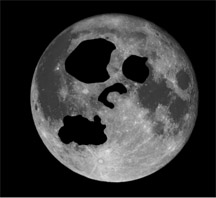
    The ghoul on the moon
    The ghoul on the moon
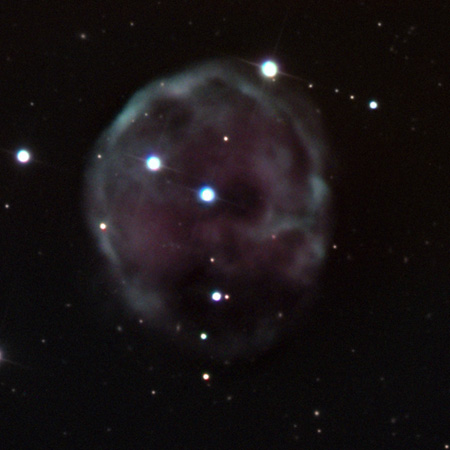
    NGC 246 the Skull Nebula
    NGC 246 the Skull Nebula
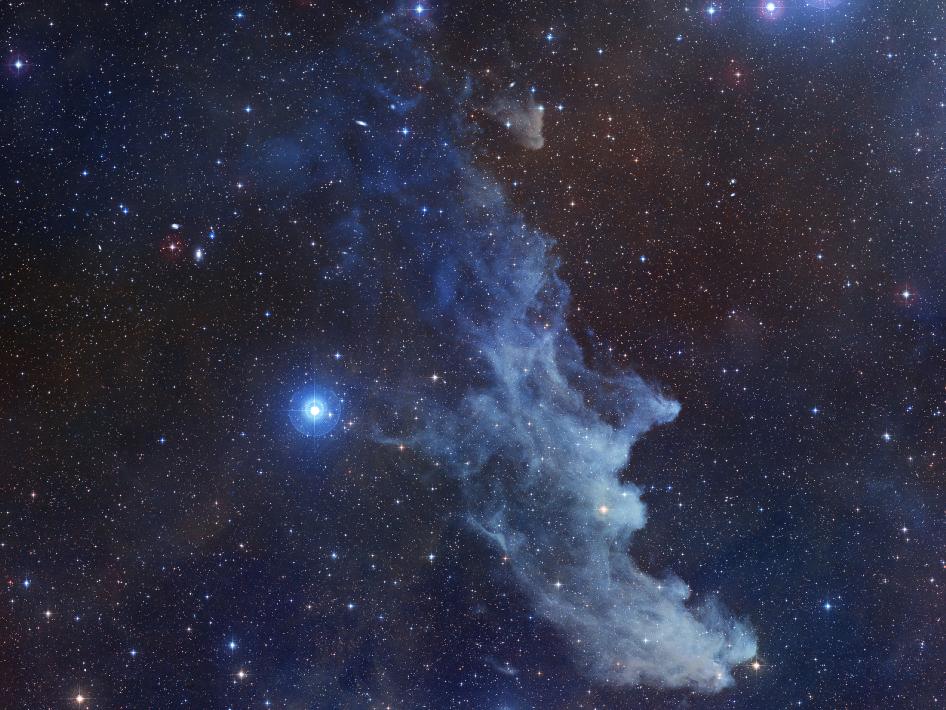
    IC 2118 Witch Head Nebula
    IC 2118 Witch Head Nebula

    It’s time to get out the Milky Way and Mars candy bars, the Moon Pies and the Starburst chews. It’s Halloween! The moon — just past first quarter — will greet your trick or treaters this year. A first quarter moon rises at noon and is high overhead at sunset. It sets around midnight. It’s the perfect Halloween moon, no trick for the astronomers to show and a real treat for their visitors to see.

    Halloween falls on the 8th day of the lunar month in October 2014, and the rugged Appenine mountains, and the oval walled plain Plato are both visible. With binoculars or telescopes, find the
    Straight Wall
    , a lunar fault line best visible on this night. Tycho and Copernicus are on the terminator the next day, and so is Clavius, the large walled plain south of Tycho. My astronomy group, the Old Town Sidewalk Astronomers shows the moon every first quarter moon Saturday night on our town square. Check your own local astronomers, museum, planetarium or college science department. I bet they do too!

    Here are my favorite spooky named objects. Some are tricks and all are treats! The galaxies and nebulae will require a dark sky, but the lunar features and double stars are city observing targets. Have fun observing and let me know your favorites and I’ll add them to the list next year!

    Mirach’s Ghost NGC 404 in Andromeda, magnitude 11,
    size 4.3′ x 3.9′ This galaxy is hard to see. Move Mirach (Beta Andromedae) out of the way for a ghostly view.

    The Phantom Streak NGC 6741 in Aquila, magnitude
    10.8, size 6″. A fast evolving planetary nebula.

    The Ghost of the Moon Nebula NGC 6781 in Aquila,
    magnitude 11.8, size 1.8′. A nice round ghostly planetary nebula.

    The Spider Galaxy NGC 5829 (Arp 42) in Bootes, magnitude
    13.8, 1.7′ x 1.5′. Pretty face-on spiral galaxy in BOOtes. Scary!

    The Skull Nebula NGC 246 in Cetus, magnitude 8,
    size 3.8′. William Herschel discovered this large planetary nebula. It’s easy to find, and a real treat! I looked at this planetary nebula through my telescope just last Saturday night, October 25th, 2014! It’s one of my favorites.

    The Witch Head Nebula. IC 2118 in Eridanis, magnitude 13, size 160′ by 80′. (About the same size as the Andromeda Galaxy which is 189′ by 61′). This very large and very faint reflection nebula is associated with the star Rigel but is almost 3 degrees west of the star. The blue color of the nebula is caused not only by blue color of Rigel, but also because the dust grains reflect blue light more efficiently than red. Earth’s daytime sky appears blue for the same reason.

    The Ghost Ring Nebula IC 5148 in Grus, magnitude 13, size 2′. A pretty little planetary nebula in the neck of Grus the crane. If you can see Fomalhaut in Piscis Austrinus, look a little more south to find Grus. I tracked this one down and captured it in my eyepiece 2 weekends ago October 18, from my favorite dark sky site, Amboy Crater, in California’s Mojave Desert.

    The Little Ghost Nebula NGC 6369 in Ophiuchus, magnitude
    12.9, size 30″. A pretty planetary nebula, also discovered by William Herschel. Look for the mag 15.9 central star in this planetary nebula.

    The Red Spider Nebula NGC 6537 in Sagittarius, magnitude
    12.5, size 9″. A bipolar planetary nebula with a hot white dwarf star.

    Phobos and Deimos (Fear and Terror) – the moons of Mars. It’s possible to see these small moons as you can see from my sketch, but easier to see when Mars is closer to Earth than it is now. Mars opposition in 2016 will be the best time to try! There’s nothing to fear!

    Any lunar map will help you find your way to all of these lunar features, and they are all visible this year on Halloween. Here is my favorite lunar website Hitchhikers Guide to the Moon. You can get the general location of each Rukl lunar chart listed in the text below, then find the chart on the Rukl Map (most lunar observers favorite book of charts). This map shows where to find all the Lunar landing sites . Drop me a note if you would like a hard copy of this map, I have a whole box of them on my desk at work.

    Hell, Rukl’s Atlas of the Moon, chart 64. 33 km crater near Deslandres, which is an amazing and very large and complex crater. The small crater Hell (actually named for 18th century Hungarian astronomer Maximilian Hell – who observed the 1769 Transit of Venus) is also near (north of) Tycho, one of the most prominent craters on the moon. Its’ bright rays will be easily visible a week after Halloween 2014 during the full moon phase. You’ll need a telescope to see Hell.

    Lacus Doloris (Lake of Suffering), Rukl chart 23, 110 km mare. This Mare is just over the Montes Haemus from Mare Serenitatis (Sea of Serenity). If you’ve spotted the bright white (tiny) crater Linne, you’re close to the Lake of Suffering. This small lake is visible visible South of the bright crater Linne.

    Lacus Mortis (Lake of Death), Rukl chart 14, 150 km diameter flooded crater. You’ll find it North of the great crater Posidonius, and North of easy-to-spot Mare Crisium, well placed for Halloween viewing this year. Through your telescope, find some great rilles (long, narrow depressions in the lunar surface that resemble channels) on the Western side of Lacus Mortis.

    Lacus Timoris (Lake of Fear) and Palus Epidemiarum (Marsh of Epidemics), Rulk chart 63. In the Southwestern section of the moon. This section of the moon deserves a careful look through the telescopes. You’ll also find lunar domes and rilles in this region of the moon. Rima Hesiodus bisects the Eastern part of the Marsh of Epidemics. Lacus Timoris is an elongated region surrounded by mountains. Best seen near full moon, 6 days after Halloween 2014.

    Palus Putrendis (Marsh of Rot), Rukl chart 22, 180 km small plain on the
    prime meridian, near Hadley Rille and the Apollo 15 site. How can you not like the name Palus Putrendis? It’s easy to find between the crater Archimedes and Montes Apenninus. Well worth a look! Here’s a nice Lunar Map showing all the Apollo landing sites and more.

    Boo Epsilon (36) (Bootes), double star, mag 2.5
    and 4.9, yellow/orange and blue/green double

    Boo Mu (51) Bootes, triple star, mag 4.3 and 7 and
    7.6 triple, yellow primary, yellow/orange pair

    Boo Xi (37) Bootes, quadruple star, mag 4.7
    and 7.0, with a 9.6 and 12.6 companion, yellow and reddish/orange

    Happy Halloween from PK 164+31.1 (Jones 1)

    Jones 1, planetary nebula in Pegasus, dim but fun to find in a big 'scope
    Jones 1, planetary nebula, faint but well worth the hunt


  • The Big Eye Candy Mountains

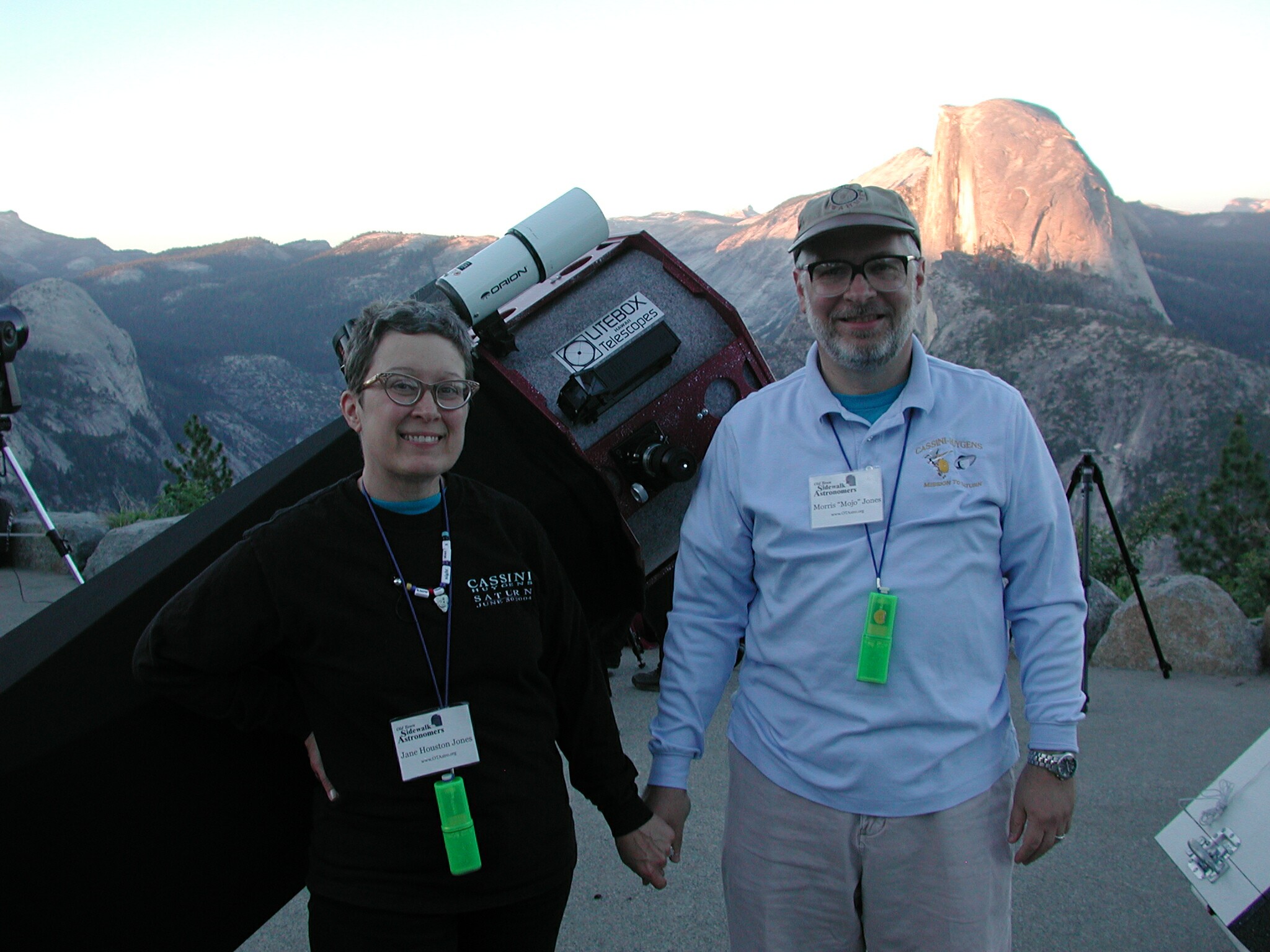
    Public star party at Glacier Point, Yosemite National Park
    Public star party at Glacier Point, Yosemite National Park
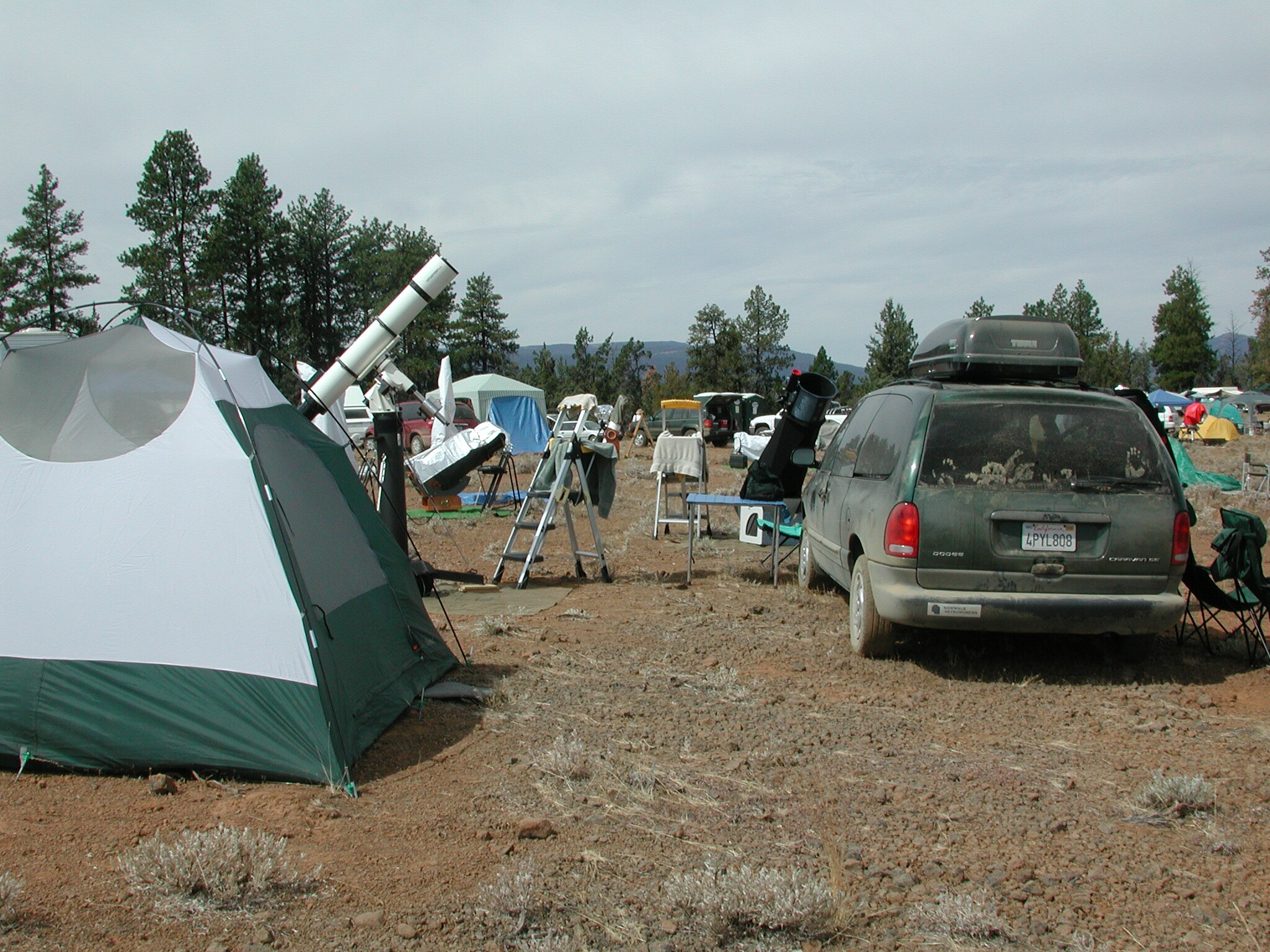
    Our tent and telescopes, OSP, Ochoco National Forest, OR
    Our tent and telescopes, OSP, Ochoco National Forest, OR

    I was inspired to hum this old hobo ballad and change the words a little
    after a summer observing trip to Glacier Point in Yosemite National
    Park. For you musicologists, I added my “observations” to the 1928
    recording of Big Rock Candy Mountain by Harry McClintock. This version
    is featured in the movie soundtrack of O Brother, Where Art Thou?.
    Feel free to hum along. 🙂

    One evening as the sun went down and the campfire light was burning
    Down the track came a star-girl hiking, and she said “boys I’m not
    turning
    I’m headed for a land that’s far away, below the starry fountains
    So come with me, we’ll go and see the Big Eye Candy Mountains”

    In the Big Eye Candy Mountains there’s a land that’s fair and bright
    Where the Naglers grow on bushes and you star gaze every night
    Where the seeing is fantastic, transparency supreme
    On the swan and the bees and the planetary seas
    The Milky Way springs where Cygnus wings
    In the Big Eye Candy Mountains

    In the Big Eye Candy Mountains all the ‘scopes have sturdy legs
    And your can use high power when the seeing condition begs
    The doubles split so easily, and planetary moons are disks
    Oh I’m bound to go where there ain’t no glow
    Where the meteors fall, and the wind don’t blow
    In the Big Eye Candy Mountains

    In the Big Eye Candy Mountains you never change your socks
    And the little streams of Fosters Beer come a-trickling down the rocks

    The horizon view is full of stars and the zenith darker yet
    There’s a universe for you and a galaxy or two
    You can starhop all around ’em with a wide-field view
    In the Big Eye Candy Mountains

    In the Big Eye Candy Mountains the restrooms are nearby
    And you can see the Milky Way above you in the sky
    There ain’t no used car dealerships, no streetlights, cars or malls
    I’m a-goin’ to stay where I sleep all day
    Snuggling in my tent with my favorite gent 🙂
    In the Big Eye Candy Mountains

    I’ll see you soon this comin’ new moon in the Big Eye Candy Mountains