The moon's summer and winter path, courtesy NASA's Starchild websiteThe winter’s moon – a smiling crescent just after sunset Feb 5, 2011 (click to see moon upper center) Closeup of winter crescent moonThe summer's "backwards C" crescent moon at sunset, late June 2007 (click to see moon in lower right)Closeup of summer crescent moon
Have you ever wondered why the crescent moon looks like a smile in the winter and spring and like a backwards “C” in the summer and fall? It looked like a smile right now – below, next to and above Jupiter for several days after the February new moon. You can see the same waxing (getting bigger) crescent in early March 2011. Just look in the western sky after sunset beginning the day after new moon, on about March 5 or 6th. You’ll also see Jupiter and Mercury just above the horizon an hour after sunset.
Early birds can see a repeat of the waning (getting smaller) crescent moon phase a few days before the new moon, too. Look in east the last days of February up until new moon on March 4th. That bright object sharing the dawn skies with the crescent moon is the planet Venus! You can read more about moon phases here on the EarthSky website.
The best way to understand the reason why, is to look where the sun is, and how and where it shines on the moon. Draw an imaginary line connecting the setting sun, the moon, and any other planets that appear in the sky. That imaginary line is the ecliptic – the path the sun takes through the stars. It’s also the Earth and planets’ orbital plane. You can think of it as a projection of Earth’s plane on a sky sphere. The planets orbit the Sun, and the moon orbits the Earth and so you will always find the planetary lineup along the ecliptic.
In the winter and spring, the ecliptic appears almost vertical and arcs higher in the sky. The moons’ lit side faces the sun. That makes the waxing crescent moon look like a smile, or a boat, or the old moon in the new moons’ arms once light reflected off the Earth – called earthshine – reveals the unlit disk of the moon lit by reflected from Earth.
In the summer/fall, the ecliptic has a lower or shallower angle in the sky, and the lit crescent, as always, faces the sun, showing us a lit crescent facing the sun, which appears like a backwards “C”. I could write more, but instead, I’ll let you enjoy the images from our own observing sessions in the winter and the summer, and then get out and see the crescent moon for yourself soon.
Red Willow Dreamcatcher with Big Dipper and Milky WayThe Fisher Stars, painting courtesy of Edwin Bighetti, Mathais Colomb First NationWesakaychak Pointing – courtesy of Edwin Bighetti, Mathais Colomb First Nation
In March 2010, I was invited to be the keynote speaker at the Manitoba First Nations Education Resource Centre’s annual Science and Career Fair. Two participating schools from the Nisichawayasihk Cree Nation in Nelson House, Manitoba invited me to visit their community. So in November 2010 I spent two days with the students, teachers at the K-8th grade Otetiskiwin Kiskinwamahtowekamik School, and the 9-12th grade Nisichawayasihk Neyo Ohtinwak Collegiate.
After a day of school presentations in early November, I was invited to a community gathering of shared songs, the music of flute, hand and water drums, and stories from several storytellers. Joe Mercredi, a school cultural coordinator and a wonderful storyteller told several stories, after he played the flute – a six-hole flute made of mountain juniper by Navajo flute maker Jonah Thompson. Joe makes flutes, too, but he chose this one for this night because “it has a sweeter voice than his own,” he told me recently. Joe also helped me remember the stories he told that night two months ago. He told me that all stories are related to each other. How we remember them depends on what we need to learn at the time.
His first story is a variation of the Dakota Woodpecker Flute story. A poor young boy with no male relatives lived with his mother. He was friends with the chief’s daughter. They were good friends and spent much time together. When of age, he asked the chief for her hand. The chief questioned his ability to support his daughter. He was mortified and left the camp. After some days he fell asleep under an old cedar tree and was woken up by a woodpecker up in the tree. This being in the time when animals could speak to men, a conversation ensued and the young man was gifted with the first flute. In the end the two become a couple and the young man found fame and fortune as a flute maker. This story can be found in one of the Joseph Bruchac series “Keepers of the Earth/Sky/Night/Life” books.
Joe then held his Dreamcatcher, and told this story. Red Willow Woman was a woman who taught the children in her community until her death, and, when given the choice by the Great Mystery to be returned to her people, she chose to return as a red willow to demonstrate that every one has the ability to achieve greatness if one reaches beyond one’s limits. Red willow forms the frame of the Dreamcatcher.
You can see the big dipper stars (or Fisher stars) on the right side of the woven web within the red willow frame. And you can see a chaotic jumble of stars on the left. The legend of how Fisher became the Big Dipper and how animals of long ago decided to share summer and winter, and how the fisher came to be in the northern sky is told by Murdo Scribe, and is known as Murdo’s Story.
Long ago, in one part of the animal world and bird world it was always summer and in the other half of the world it was very cold with no warm weather. The northern animals and birds had to find summer. Fisher (a small wolverine) carried summer, and the summer animals chased him. They shot at him and an arrow hit Fisher and took him to the northern skies, with the summer. Fisher still lives in the northern sky, and summer is now shared with all animals and birds everywhere. Fisher can be found circling the North Star. Some people call him the big dipper.
The Dreamcatcher is formed from two willow branches depicting strength and softness intertwined — the need for give-and-take in a respectful loving relationship. Joe decided to map the Big and Little Dippers in the Dreamcatcher. But just like in the Wisakechak story of the Milky Way, he mapped the big dipper, but the trickster, Wisakechak decided to mess up some of the stars. You can see an extra star in the big dipper.
Legend tells that Wisakechak was meticulous in his placement of the stars, but Fox wanted Wisakechak to play with him, and got tired of waiting for him to finish so he grabbed the blanket of stars and scattered them all over the place. Those stars represent the Milky Way. If you look in the winter sky you will see Wisakechak (sometimes spelled Wesakaychak and many other ways, too) pointing to the Pleaides, which figure in many other legends. Wisakechak is represented by the constellation Orion.
You can see the big dipper stars in the web of the Dreamcatcher. The handle star, Alkaid is near the top of the Dreamcatcher , and you can see the bowl stars at 3 o’clock. There is one “extra” star woven into the web near the bowl, put there by the trickster, Wisakechak. And you also see the other stars from the blanket of stars Fox threw into the sky on the left side of the Dreamcatcher below the center hole. You’ll also see the thirteen tie-points, where the sinew is tied to the willow hoop. These thirteen ties represent the 13 new moons of a year.
After Joe finished his stories of Red Willow Woman, Wisakechak, the Fisher stars, and the Milky Way, he walked over to me and gave me his Dreamcatcher. As I look at my Dreamcatcher now, three months after my visit, I can still hear the drums, the flute and the stories of the stars I heard in Nelson House that snowy November night. Now, when I read Murdo’s Story I can see how all of these stories are related.
Murdo Scribe was born in Norway House, Manitoba and was a World War II veteran with the Canadian Army. After the war he returned to a life of fishing, trapping and seasonal work. In 1975, he was appointed coordinator of the Traditional Individualized Education Program with the Native Education Branch of the Manitoba Department of Education. He wrote many stories based on his own experiences and those of the elders he had known.
I thank Joe Mercredi, who is a master storyteller, maker of flutes, weaver of dreamcatchers for sharing these stories with me. I must also thank science educator Wilfred Buck, of the Manitoba First Nations Education Resource Centre, who I met two years ago at the NYAA (Ontario) Starfest when he gave a talk about Atchakosuk: The Spirit Lights Up Above . I have been slowly learning more about the spirit lights above. Two years ago, Wilfred ended his presentation with a quote from one elder, “We are blessed to live under a blanket of stars.”
Map of Manitoba showing Winnipeg, Nelson House and ChurchillRASC Ron Berard and Guy Westcott at speaker dinner before my RASC talkmy school talk at Otetiskiwin Kiskinwamahtowekamik K-8th school in Nelson HouseChurchill, Polar Bear Capital of the world, on Hudson Bay
In early November 2010, I embarked on a wonderful ten-day speaking tour of Manitoba. I’ll write some separate adventure blogs, but here is the itinerary.
November 2, 2010 – I flew from LAX to Duluth Minnesota, celebrated my cousin Kathy’s birthday, and (almost) finished my presentations, by working late into the night.
November 5th – I flew to Winnipeg from Duluth early in the morning, and RASC’s Ron Berard collected me at the airport, and whisked me to the Toastmaster’s Conference Hotel, The Marlborough. That night I gave a Cassini talk and handed out Saturn lithos, NASA decals and Titan bookmarks to the RASC-Winnipeg Centre members and University students and professors that night. Before my talk we went out to dinner with the club members. After my talk we headed for Glenlea Observatory for a spot of Jupiter viewing. And after observing, it was time for beer and pizza! This was a very very long day! My wake up call was 3 a.m. in Duluth that morning and didn’t get home from the pizza after-party until 1 a.m.
November 6th – Early the next morning, I gave an educational talk to the Winnipeg Toastmaster’s District 64 Fall Conference at 10 a.m. My talk was informal and about tips and tricks to public speaking: in other words, what to do if you have a MAC and your room has a PC. Or if your computer battery dies. Or if an asteroid hits your building. (just joking about the asteroid). After my talk, RASC’s Guy Westcott took me on a lovely afternoon driving and sightseeing tour of Winnipeg. I got back in time to hear a few of the toastmaster speaking contests, and clean up for the Toastmaster’s conference banquet, where I was the keynote after-dinner speaker. The conference theme was “Out of this World”, and the table decorations were constellations punched into coffee cans, Cassini and Saturn Trading Cards (which I mailed ahead of my visit) and some (ahem) Astrology sign placards, which you can see in the picture. After the dinner and the keynote talk, there was dancing and the hospitality suite, conveniently located right next to my own suite at the Marlborough. It was wonderful to wind down after speaking to the toastmasters. I was nervous in the morning, but bring-it-on-ready after dinner. Three talks down, eleven to go!
November 7th – At 10 a.m. Sunday morning, Guy Westcott collected me at the hotel and drove me to Union Station, Winnipeg’s beautiful train station. He also lent me a sleeping bag, as the overnight train would be cold. Actually it wasn’t cold, but I loved having a sleeping bag. Thanks to the wonderful Guy! We also traded NASA for Manitoba pins, but that’s another story. About 2:00 p.m. and two hours late, the 36-hour, 1000 mile or 1800 km long Winnipeg to Churchill VIA Rail Canadatrain departed. I continued working on my school talks on the train. My curious and friendly Economy-Class seatmates Carol (a Yosemite National Park interpreter), her husband John, and daughter Isabel were on a 3-month home-school rail trip, and I practiced my Solar System elementary school talk and High School Cassini Mission talk on them.
November 8th – At about 2 p.m. the train pulled into Thompson, the “Hub of the North”, 800 km from Winnipeg. I departed the train, and was greeted by the principal and Science Coordinator from the Otetiskiwin Kiskinwamahtowekamik (OK) K-8th grade and the Nisichawayasihk Neyo Ohtinwak Collegiate 9-12th grade schools in nearby Nelson House. Nelson House is home to the Nisichawayasihk Cree Nation. We drove the 80km to Nelson House, and by just a little after 3 p.m. I was greeted by a huge gathering of the high school students, who launched a rocket to greet me! I gave a talk to the high schoolers, and settled in for some moose stew and homemade potluck goodies with the assembled teachers. My day wasn’t done yet. After dinner I was treated to a community cultural night of story, song, flute and drum performances, which will be recalled in a separate blog. At about 10p.m. I finally unpacked by bags from the 24-hour train trip, soaked in the tub and fell asleep.
November 9 – a full day at school. At 8 a.m., I was meeting and greeting the elementary school teachers as they prepared for their day. At 9:00 a.m., I conducted a teacher workshop, handing out materials I had mailed to the schools – about 13 boxes worth. At 10 a.m. it was time for my talk in the auditorium. At noon, moose soup and bannock in the cafeteria. And after lunch, I visited about a dozen of the 20 or so elementary classrooms and met and had pictures taken with the students. At about 3 p.m. I was taken on a tour of the community, and at 6 p.m. I was off to a sweat lodge ceremony out of town. Back at midnight, I had a wonderful and leisurely home-cooked dinner with my hosts, and crawled into bed at about 3 a.m. Ten talks down, four to go!
November 10 – after about 3 hours sleep, I was up and packed for a ride to the airport in Thompson, for a 7:30 a.m. flight to Churchill, Polar Bear Capital of the world. The population of Churchill is 923 and the polar bear population is 900. I arrived at about 10 a.m. and was whisked to the Duke of Marlborough school for a slate of 4 afternoon talks. It was polar bear season, so all the hotel rooms in town were booked. I was given an overnight doctor and nurse residency apartment. After dropping off my things in the apartment, I headed over to the school, where I gave talks to the 10th-12th graders, the 4th-7th graders, the 8th -9th graders and finally the adorable 2nd-3rd graders — who asked the very best questions! I talked to nearly all the 180 students of the school, just missing the first grade, who were out of school already. At about 4 p.m. I headed out in a blizzard, and walked the streets to find a grocery store, buy my Tundra Buggy ticket for the next day and have dinner at one of the colorful local restaurants, the Reef Dining Room at the Seaport Hotel. By about 10 p.m. I braved the blizzard, and slipped and slided my way back to my room. My 14 talks in 6 days were over! Whew!
November 11 – I was collected at 8 a.m. by a Tundra Buggy bus, and for the next hour, picked up passengers for a full day polar bear sightseeing trip out on the tundra. We saw 27 polar bears, and I’ll write more about that in a separate blog. I took Michel, a cuddly stuffed Polar bear belonging to a colleague at work, with me on the trip. Here’s Michel’s Polar bear adventures! At 11:11 a.m. the Tundra Buggy stopped and observed a moment of silence for Remembrance Day. The tundra was windswept and snowy white, the fierce blizzardy wind shook the buggy, as we stopped and remembered those fallen armed forces. Then I gave a little impromptu talk (to a few people) on the buggy about Auroras on Earth and Auroras at Saturn. At 6:00 p.m. I was back on the Churchill to Winnipeg train, for a 36-hour trip back to Winnipeg.
November 12 – This was a day of rolling scenery, chatting with fellow travelers, meeting new people in the dining car. I managed to give my Solar System and Cassini talks to my new seatmates gathered in the dining car, tho. 😉
November 13 – We rolled into Winnipeg at about — I forget– but it was 4 p.m. or so. I walked Anne-Marie and her dad from Vancouver to their nearby –and haunted — Fort Garry Hotel. Then I continued on to my hotel for the night, the Marlborough. Two hours later I was on my way to dinner with University of Manitoba astronomer Jayanne English. After a lovely dinner with Jayanne (and a grad student), we headed over the the Garry Hotel’s Palm Court for a nitecap. What a lovely way to end my trip!
November 14 – My flight back to Los Angeles left too early for the famed Sunday Brunch at the Fort Garry Hotel. Guy Westcott (again) was pressed into service and drove me to the airport Sunday morning. Mojo and I were reunited after a long but rewarding and very memorable trip to Manitoba – my second of the year. And lucky me! I’ll be back in Winnipeg April 6 and 7 this year, to speak once again, and to be an honorary judge at the Manitoba First Nations Education Resource Centre’s annual Science and Career Fair.
I learned about an amazing partnership this week. A partnership connecting women who suffer from lymphedema (demystified below) with free compression sleeves (also demystified below)! This is cross-posted from my friend Susan’s Toddler Planet blog post “Can’t Afford Lymphedema Sleeves?”
Crickett’s Answer, a 501(c)3 nonprofit organization founded in memory of Crickett Julius, has just joined forces with LympheDIVAs to help other breast cancer survivors who fight not just the beast that is breast cancer but also the fallout of side effects that includes lymphedema, which may limit survivors’ activities.
Crickett’s Answer to Cancer provide wigs, mastectomy and lymphedema products, massage, facials, and other pampering services, as a way to help women feel feminine and beautiful despite losing their hair and/or breasts. “By providing no-cost products and services, we honor these courageous women with breast cancer, as well as the memory of Crickett Julius.”
LympheDIVAs began in Philadelphia when two young breast cancer survivors, Rachel Troxell and Robin Miller, developed lymphedema, a side effect of breast cancer treatment that can cause permanent swelling in the arms. Their physicians and lymphedema therapists recommended a compression sleeve as the most effective way of controlling the swelling. When they researched the options for the sleeve they found that the only ones available were rough textured, heavy, hot, beige, and bandage-like. Frustrated and dismayed over the lack of options they had for compression sleeves, Robin and Rachel met with Kristin Dudley, a fashion designer, to discuss their idea of creating a more elegant and comfortable compression sleeve.
My friend Susan, played matchmaker and connected these two amazing resources. Now, lymphdema sleeves in floral, lace, tattoo and other designs or skin tones are available–at no cost–to women who can’t afford them through Crickett’s Answer! All this culminated on the very week Susan learned she has a fourth cancer/recurrence in less that four years.
What is the lymphatic system and lymphedema?
The lymphatic system is structured like a web, occasionally draining into small lumps or nodes that filter the lymphatic fluid. The system works through the pumping power of the body’s muscles. The muscles contract, increasing pressure within the lymph vessels, which causes the fluid to move. A series of one-way valves ensure that the fluid moves in the right direction. Lymphedema, the build up of protein rich fluid in the subcutaneous interstitial compartment occurs when either lymph fluid is impeded from flowing through the lymph vessels and lymphatic system or there is an excess of fluid that exceeds the carrying capacity of the lymph system. It collects in the subcutaneous and deep tissues causing swelling of the affected area and predisposes to chronic inflammation.
What are lymphedema armsleeves and gauntlets?
Lymphedema is managed and treated through a variety of therapies. Compression armsleeves and gauntlets are one such therapy. LympheDIVAs armsleeves and gauntlets are Class 1 (20-30mmHg) and Class 2 (30-40mmHg) medical devices. Like other armsleeves they utilize graduated compression, the highest pressure is at the wrist and acts as a pump to encourage the lymph vessels to push the lymph fluid toward the body.
Although lymphedema sleeves are medically necessary, they are not covered by Medicare OR most insurance plans under current law, and thousands of survivors go without the sleeves, needlessly suffering congestion, swelling, and pain that interferes with their normal activities.
To ask for help, please download and complete the forms at Crickett’s Answer, writing in “lymphedema sleeve and gauntlet” on page 2 of the application.
And please share, or recommend Lymphedivas products to your friends, physical therapists, doctors, nurses, mothers, sisters, daughters and wives, or send them a note of thanks for sharing their wonderful products with those in need.
To help or raise awareness, please feel free to copy, tweet, or link my post on your blog, Facebook page, email lists, or print it out, stick it into an envelope and mail it to a friend. Send it to your favorite local newspaper, journalist or social media outlet. And ongoing never-ending thanks to awesome Susan for connecting these resources to each other and once again, sharing news, hope and awareness with us!
Johann Bode's 1801 Uranographia, showing Quadrans Murales, Boötes and other constellationsBoötes, Canes Venatici, Coma Berenices and Quadrans MuralisThe Northeast sky Jan 4 at 1:00 a.m. PST. Look between Ursa Major and Minor, and the bright star Arcturus in Boötes for the location of Quadrans Muralis on the Boötes-Draco borderLooking Northeast before sunrise, chart courtesy of Spaceweather.com
Most meteor showers radiate from a recognizable constellation like Leo’s Leonids, Gemini’s Geminids and Orion’s Orionids. What’s up with the January Quadrantids? Where do you find their constellation? In Quadrans Muralis, a demoted constellation.
The first 60+ Roman constellations didn’t cover the sky south of the equator, so over the years, astronomers took up the task and filled in the empty spaces with new constellations, including some in the northern sky.
The International Astronomical Union divided up the sky into official constellations in 1930. 88 constellations remained, but over 30 constellations didn’t make the cut. Among those demoted was Quadrans Muralis, the location of January’s brilliant, but brief Quadrantid meteor shower. Apis, the bee, Felis, the cat, and Solarium the sundial were other constellations demoted into obsoleteness. One ancient constellation, Argo Navis, didn’t survive, either. It’s the only one of the 48 constellations listed by 2nd century astronomer Ptolemy no longer officially recognized as a constellation. Like other pieces of large real estate, it was subdivided into smaller segments in the 17th century, and those constellations — Carina the Keel, Vela the Sails, and Puppis the Poop Deck — survived demotion.
There were good reasons to define and standardize the constellation list, even if it meant losing some historic or whimsical constellations. One reason, according to the IAU was “to aid in the naming of new variable stars, which brighten and fade rather than shine steadily. Such stars are named for the constellation in which they reside, so it is important to agree where one constellation ends and the next begins.”
Quadrans Muralis was added to the constellations by Joseph J. de Lalande in 1795, to commemorate the quadrant he used to observe and measure stellar positions. The quadrant was an instrument very similar to today’s sextant. A few years later, in the early 1800’s a meteor shower was discovered to radiate from this constellation, and the meteor shower was named for the constellation.
Created from stars found to the north of Boötes, the herdsmen; Quadrans Muralis can be found in a rich area of the northern sky filled with pretty constellations. The big and little dippers (the most recognizable parts of Ursa Major and Ursa Minor) are the most familiar sights but you’ll also find the Northern Crown, Corona Borealis, Boötes and his two hunting dogs Asterion and Chara in Canes Venatici, and Coma Berenices, the hair of Bernice. Take a tour of the area through binoculars on January 3rd before midnight while waiting for the radiant to rise.
Update for 2012 for Southern California meteor observers: “The radiant rises at 1:00 am local time and the moon sets at 3:00 am. The predicted peak (2:30 am Eastern 11:30 PST (07:30 UT January 4, 2011).
The Quadrantids (QUA) or January Bootids are active from January 1st through the 10th. A sharp maximum is predicted to occur near 0730 Universal Time on the 4th. This corresponds to 02:30 EST and 23:30 PST (January 3rd). This is good timing for viewers located in eastern North America as the radiant will rising above the northeastern horizon. It would even be better if the maximum were a bit later as the radiant would be located higher in the sky, producing more activity.
Rates will depend on the exact time of maximum and whether the moon is still above the horizon. Assuming the 0730 UT timing is correct, the further one is located in North America, the better. Eastern observers may be able to see 60-75 Quadrantids per hour. If your skies are very clear and dark, allowing you to see faint meteors, your rates could top 100 per hour. Observers located in the western portions of North American will have lower rates but will also have the opportunity to see Quadrantid “earthgrazers”. Earthgrazers are meteors that skim the upper portion of the atmosphere therefore lasting much longer than normal and producing long trails in the sky. These meteors can only be seen when the radiant lies close to the horizon. As the radiant rises, the meteor paths
will become shorter with shorter durations. Observers in the northern hemisphere outside of North America can expect to see a maximum of 25 Quadrantids per hour between moon set and dawn.
At maximum the radiant is located at 15:21 (230) +49. This position lies in a barren region of extreme northern Bootes, ten degrees northeast of the fourth magnitude star Beta Bootis. At 42 km/sec. the Quadrantids produce meteors of medium velocity. During exceptional activity some Quadrantid fireballs may be witnessed. Courtesy Bob Lundsford posting on the MeteorObs Yahoo Group.
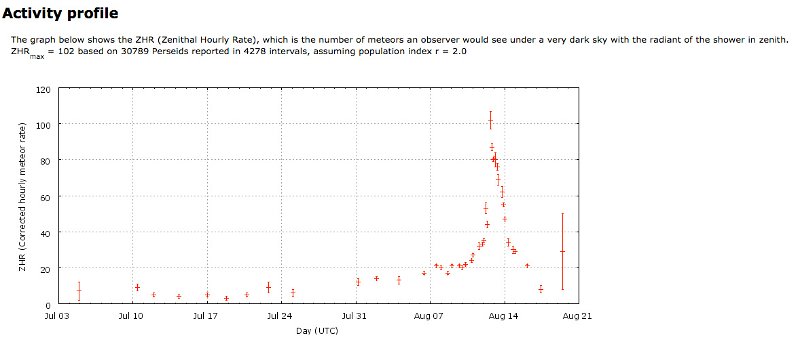
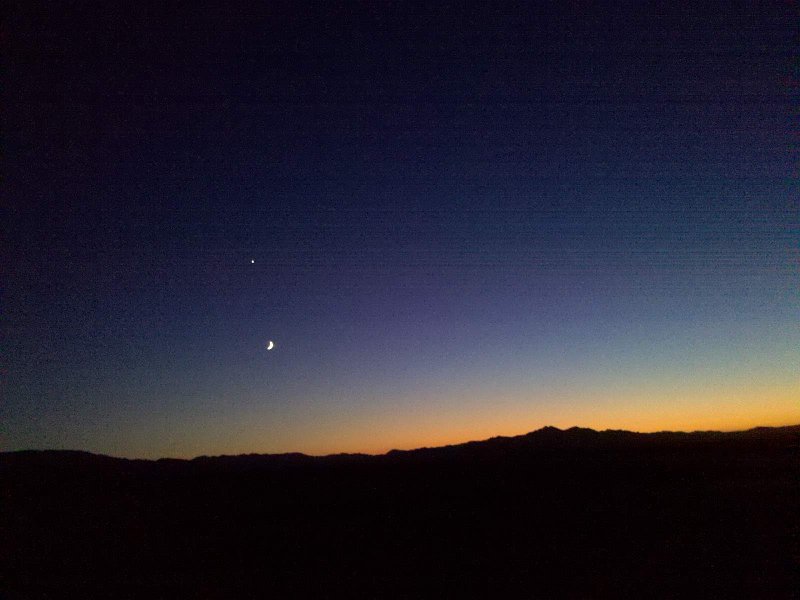
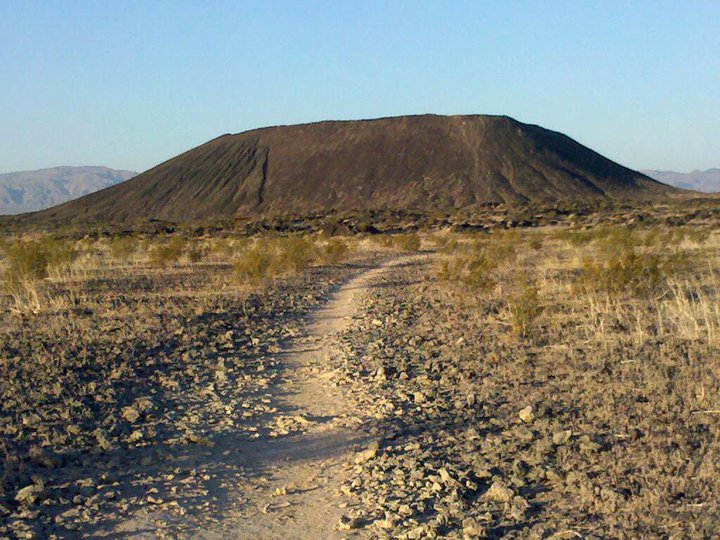
Perseid Peak Aug 12-13 18h-7h UTMy Perseid count Aug 13 06h-11h UTSunset at Amboy Crater, with moon and VenusAmboy Crater by day
For the past year I’ve been traveling to dark skies to observe and count meteors during the major showers. Armed with a clipboard and a comfy chair, I stare at a section of the sky, hoping to see members of the well known showers, and contribute my data to that of other meteor observers around the world.
This writeup is really about how I observed, recorded and submitted my 2010 Perseid meteor shower data to the International Meteor Organization. I hope I inspire you to try it, even if you don’t submit your paperwork the first time. (I didn’t, in fact it took me longer to fill out the paperwork the first time than it did to actually observe the meteors!).
The first chart shows the peak of the Perseids – August 12-13 between 18h and 7h Universal Time. That means for people like me on the west coast of the US, the peak was nearly over before I started counting! It’s important for worldwide observers to keep counting, because many showers have secondary peaks or other characteristics.
The second chart is my data. Before I arrived at the site, I recorded the latitude, longitude, elevation and name of my observing location. This is easy to do using your GPS devices these days. I wrote down my name, my IMO codename (JONJH) and the shower (Per for Perseids). I decided not to try and identify individual minor showers though there were many. I called all non-Perseids Sporadics.
Before I began observing, and several times during the night I assessed the darkness of the sky using Limiting Magnitude star charts. This field is identified as LM on my observing form. The IMO says: “The darker and more transparent the sky and the more sensitive your eyes, the more meteors you can see. To use your observations for scientific analyses a quantitative characterization of these factors has to be established. The limiting magnitude (which is defined as being the magnitude of the faintest star near the zenith that the observer can detect using the slightly averted naked eye) defines both the condition of the sky’s clarity and the quality of the observer’s eyes.”
I keep a set of these charts on a clipboard and assess the sky darkness every time I observe. My assessment was a very high limiting magnitude. I could see magnitude 6.5 stars with my unaided eyes.
On a clipboard, I clipped a bunch of blank sheets of paper – one piece for each hour of the night. I wrote down each meteor I observed and noted the time using a nearby clock. I also wrote down the magnitude of each meteor – using a shorthand of 5 magnitudes of brightness. (F for faint-mag. 4, B for bright mag. 1, etc. J for Jupiter bright bolides) I had a selection of stars in the area already memorized for comparison against the Perseids. For spectacular meteors, I plotted them on star charts I had printed out for this purpose.
In a nutshell: Mag 6.5 skies, clear, 80 degrees overnight. Amboy Crater, one of the darkest observing locations in the US, was a great location for meteor observing.
Between 9 and 11 p.m. (04h-06h UT) I unofficially saw about a dozen mostly very bright meteors while setting up my chair, eating dinner, etc. I didn’t start seriously recording the meteors until 11 p.m. (06h UT)
04h-05h UT – 2 Perseids, 1 sporadic
05h-06h UT – 4 perseids, 3 sporadics **the first Perseid came in at 9:34 p.m.
06h-07h UT – 15 Persieds, 12 sporadics
07h-08h UT – I took a nap
08h-09h UT – 27 Perseids, 8 sporadics
09:19-03:19 – 43 Perseids, 3 sporadics didn’t take a break since the rates were so high…
03:20-04:20 – 39 Perseids 1 sporadics (with a 7 minute break)
Every where you turn, you will be running into pink this month. Pink tic tacs, pink yogurt lids, pink Harry and David pears, pink airplanes, and even pink buckets of fried chicken! It’s Pinktober, aka Breast Cancer Awareness Month. There are some cancer survivors who hate the pink, calling it pink nausea, reminding us that cancer is not pretty.
The images of those who are dying of breast cancer aren’t shown alongside the pink ribbons or on the chicken buckets. And those with metasatic breast cancer, or incurable breast cancer do not adorn the pink promo advertisements, either.
Other cancer survivors — like my sister Wendy — sometimes carry a pink reminder of their survivorship, and not just during October, either. I understand both feelings and can agree with both sentiments.
This weekend, at a family get-together, Wendy had a recyclable black shopping bag with a big pink ribbon sewn into the front and back. It’s a gorgeous bag, and one that means something unique to her, as a breast cancer survivor. She sometimes wears her pink breast cancer survivor baseball cap from a cancer walk. Or a diamond “ribbon” pendant. When she does, sometimes a person will stop and ask a question, or just smile at her. But she knows these symbols carry more meaning to her, more than a purchase.
40,000 women and 400 men die each year from breast cancer, and that number is not going down. I’m glad Wendy is here to wear her pink cap, and carry her black and pink bag. I mourn for others who have lost their loved ones to breast cancer. I mourn the friends I have lost.
What I want to promote is funding for Breast Cancer Research and Metastatic Cancer Research, specifically. That is where I want my donations to go. I followed my friend Susan Niebur’s advice: to turn awareness to action: donate, educate, advocate, volunteer. I am trying to do all four this year, narrowing down my own small impact to breast cancer research. I want those numbers of men and women who die every year to go down, not stay the same.
I joined the Army of Women 2 years ago in honor of my sister Wendy, who is cancer free now after breast cancer surgery and radiation. The army is looking for volunteers to partner with scientists and researchers seeking to unlock the key to preventing breast cancer. The Army of Women welcomes women (and men) of all ages, all ethnicities and all risks. It is a chance for women, and men too — who have had breast cancer or not — to directly participate in research, through questionnaires, phone calls, blood samples or diet and exercise studies. Volunteers receive emails with research studies, which they can choose to participate in or not. I joined this army to save lives, because there is no cure for breast cancer.
There’s a great Breast Cancer weekly tweetchat Mondays at 9pm ET, 6pm Pacific: Tweetchat #BCSM for those interested in a weekly Twitter dialogue between those who have breast cancer, those who treat breast cancer, research advocates, research foundations, supporting family members, and interested lurkers and learners (like me). For those who are on Twitter, look at these hashtags in addition to #BCSM: #pink #pinktober #IBC (Inflammatory Breast Cancer) #MBC (Metastatic Breast Cancer) #pinknausea (offensive commercialism) #redefinepink and find your place or your interests, and read along or join the groups. You don’t even need to be on Twitter to read the posts!
In the meantime, I know some people are sick of the pink, especially excessive commercialism or are disgusted by Facebook breast cancer memes. But I know others who embrace the pink because it did make them aware, helps them communicate breast cancer awareness, research, or provides their own storytelling backdrop. All of these scenarios are ok with me! We must find a cure for breast cancer!
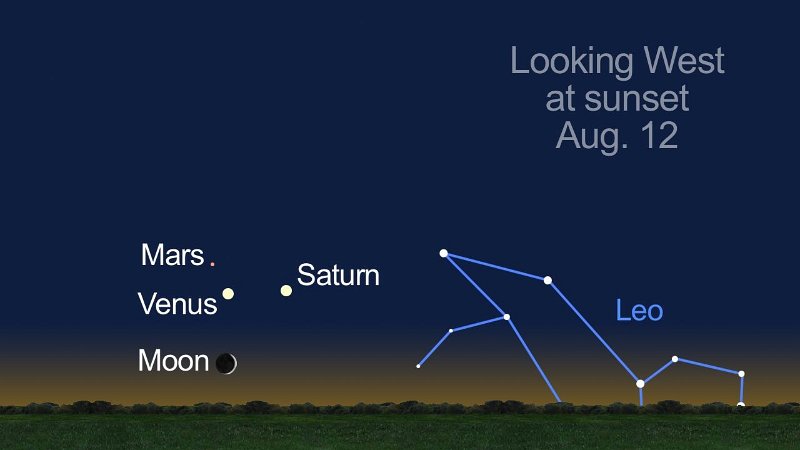
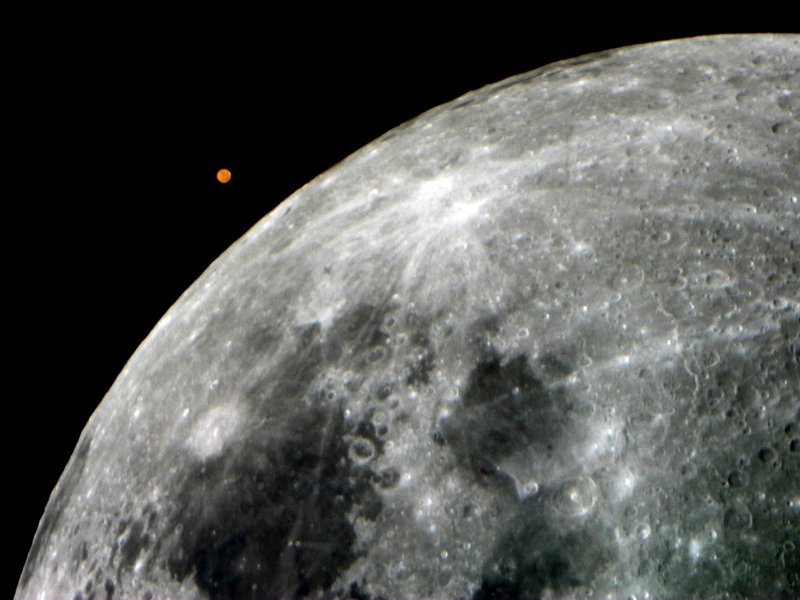
See the moon and planets low in the west August 12, courtesy NASA/JPL-CaltechThe view from Earth – the planetary lineup in orbital perspective courtesy NASA’s Solar System Simulator, courtesy NASA/JPL-CaltechMars and moon imaged same day with same equipment (in 2005) courtesy Jim KeenA trio of planets, without the moon August 7, 2010, courtesy Morris Jones
Are you eager to see the annual Perseids on Thursday night? You’ll have to wait until after 10:00 p.m. local time to see them, so why not pass the time until showtime by viewing the planets right from your doorstep? Step outside for the planetary warm-up act.
All you have to do is look towards the west as soon as the sun sets. Bright Venus is the first to appear. It’s really bright, and you can’t miss it! Now, hold your clenched fist up to the sky covering Venus. To the right of Venus, about 1/2 of a clenched fist away is a second planet. That’s Saturn. And to the upper left of Venus is another planet… That’s Mars.
But wait, there’s more! Look below Venus for the slender crescent moon. If you don’t see the moon, look again Friday night – it will be a larger crescent to the left of Venus a day later.
Though the three planets appear together in our line-of-sight they are really far apart from each other and from us on Earth. Mars is about 300 million km (186 million miles) from Earth, while Venus is 112 million km/70 million miles distant. Saturn? It’s 1,535 million km/954 million miles from Earth right now. The moon? 363 thousand km, or only 225 thousand miles away. It’s fun to compare the size of the moon and Mars, especially if you received that annual email (which incorrectly) states that Mars will be as big as the moon this month. Do the math. It’s impossible!
The Solar System Simulator is a great public resource for geeks. You can see any planet or spacecraft from any vantage point on any date you select. I picked August 12th to show the view of the planets and moon from Earth.
I hope you can sense the three-dimensional orbits of nearby Venus, far-away Mars and distant Saturn. Have some fun with it! Every day the Cassini Mission website shows a view of Saturn from Earth, from Cassini, and right now Enceladus, as we close in on a flyby of that exciting moon later this week.
In this image of the moon and Mars, Jim Keen made a “true-to-life” size comparison. He made a “blended” image of the Moon and Mars back in July 2005. He recalls, “I had set up my telescope in my backyard and stuck a camera on the back of it. I took separate images of the Moon and Mars – both of which were “up”, but in separate areas of the sky – and later combined the two images to get one, showing the actual size difference using the same equipment, same camera, same magnification, and taken within a few minutes of each other.”
Jim’s image shows the apparent size of the moon and Mars really nicely! If he took the same image this month, Mars would appear super tiny! In the 2005 image Mars was about 50 million miles from Earth, and today it is 186 million miles away.
The final image shows the trio of planets imaged Saturday night August 7th by my hubby, Morris (aka Mojo) Jones. Click on the image to see the two fainter planets above Venus. He posted several images in his blog post called Sky full of planets and lightning. It’s really worth a read! The lightning was amazing Saturday night!
I hope this little planetary warm up act will whet your appetite for more sky watching this week. The Perseids will be a real spectacle, especially if you can get away from the city lights. I’ve pretty much decided to head out to the Mojave desert and see the star show from Amboy Crater. Clear Skies everyone, and happy solar system observing to you all!
California Clear Sky Chart Black dots indicate the darkest observing areas. Amboy Crater, on the southern border of Mojave National Preserve is the closest “black dot” dark observing area and will require a drive of over 200 miles for Thursday’s Perseids.
Size comparison of Mars (at closest and furthest approach) and the moonSee Mars and the moon near one another in mid August
2010 marks the eighth annual return of 2003’s Mars In August email.
The email always says something about Mars appearing as large as the moon, but there are annual variations to the theme – one year a ridiculous Powerpoint mis-information file was attached to the email.
Sometimes the email mentions a particular date (like August 27th) when the moon and Mars will appear as two big moons. That date refers to when Mars was closest to Earth in 2003, and it did look quite large through a telescope back then. But even then, Mars was 36 million miles away from Earth, while the moon was about 250 thousand miles away. So it is just impossible for Mars to ever appear the same size as the moon!
The original email compared a telescopic view of Mars to a naked eye view of the moon. It never said Mars and the moon would appear to look the same size with the unaided eye. But every rewrite of the 2003 email omitted that telescope view comparison info. 🙁
The email does give us a great opportunity to test our critical thinking skills. Critical thinking is a way to apply the scientific method to everyday life, and everyday life includes getting weird claims delivered to your own e-mail in-box. Here’s what you can do:
First, ask yourself a question — Is Mars going to be bigger than the moon in August this year?
Next, do some research. Read up on when Mars is closest to Earth in its orbit around the Sun. I’ve included some of this information in the link at the bottom.
Then construct your hypothesis. A hypothesis is your educated guess. It might be something like this. “If I look at the moon and Mars in August they will both appear the same size.”
Now, you can test your hypothesis by doing some experiments. Find the days when both Mars and the moon will be visible in the sky. Use the star chart above or check other online resources like this to find out when and where to look.
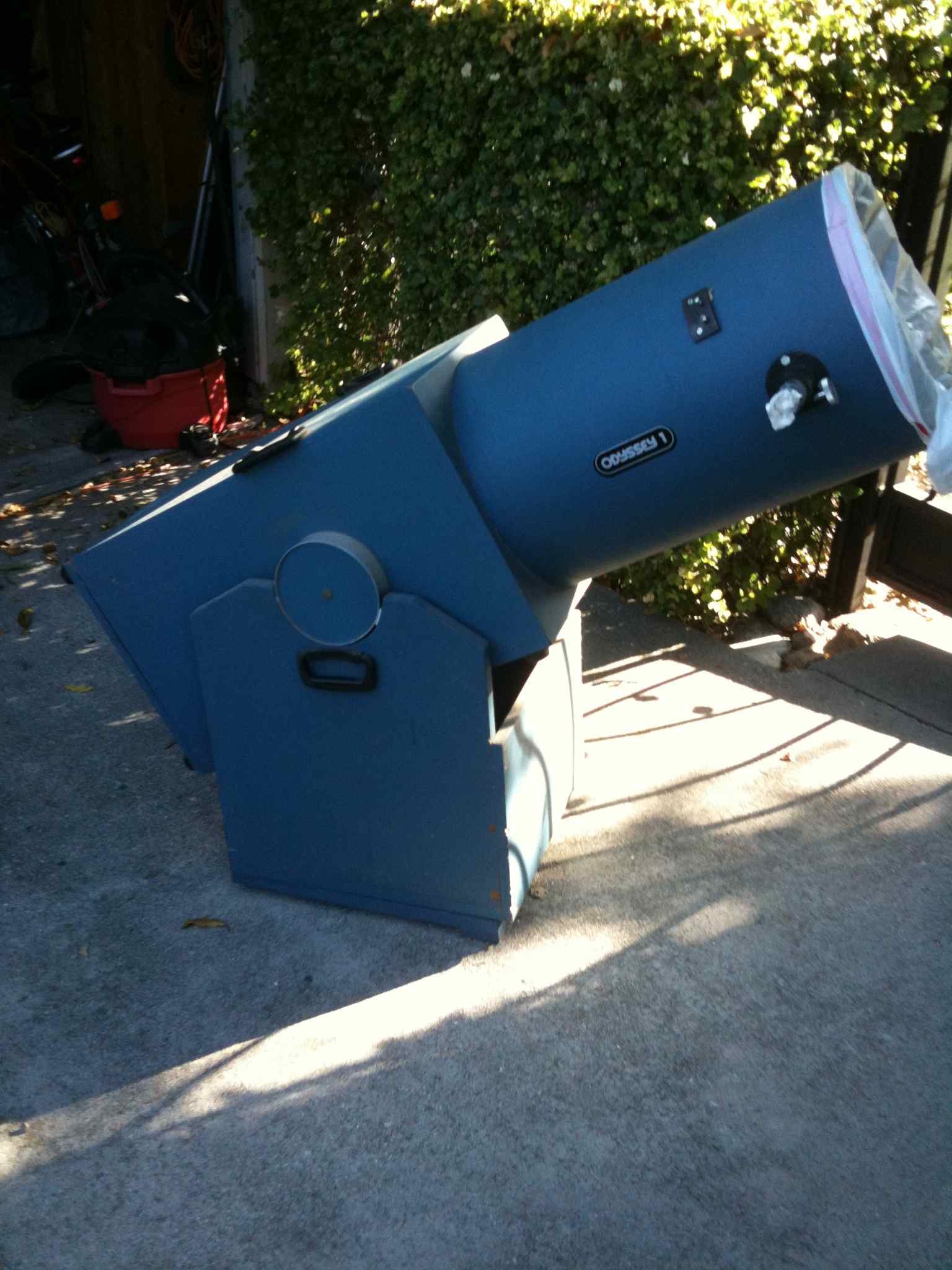
Before – 13.1-inch f/4.5 Coulter Odyssey 1After – – note the original blue ground board
Update: A colleague at work had a telescope he wanted to give away. I advertised it and found someone who wanted it. Here’s a before and after image. The telescope has been reincarnated as you can see from the second picture, which was taken December 31, 2011 at our Old town Monrovia sidewalk astronomy event.
Original post: Jane says “this is a classic blue-tube Coulter 13.1 inch f/4.5 reflector.” It has a nice short 5-foot tube, so you won’t even need a ladder. You’ll need some storage room for this telescope, and I’m not gonna lie to you, this is one heavy telescope. You can learn a little bit about this classic Coulter scope here. When Steve sent me this pictures this morning, it took me on this trip down memory lane.
See the red tubed 17.5-incher on this page? My sleek 17.5 inch Litebox reflector started out as a big red 300 pound 17.5-inch f/4.5 Coulter Odyssey II, owned by a Stanford professor, who had died. His wife called John Dobson to find out how how she could get it into the hands of a sidewalk astronomer. John and I drove down the peninsula to see it and give her some advice on a price. I brought my checkbook, just in case. John crawled into the storage shed, past the cobwebs, over the lawn furniture and under the christmas tree and exclaimed out to me “I think it is one of ours.”
I bought it on the spot for $400.00 and have used it now for almost 15 years.
The prof used to haul this behemoth to his ranch in a red El Dorado. I imagine that sight — that huge red telescope in the back of that red El Dorado — rolling down the freeway towards the Sierra foothills, every time I use the scope. I had to rent a panel truck to get it home to Marin County, and to take it to its first light star party on Mt. Tamalpais in Marin County many years ago. I remember my first look through that big, red ugly duckling of a telescope. The Swan Nebula. It was spectacular! That 17.5 inch mirror is now in my 17.5 inch Litebox truss tube reflector, and I take out to the desert or to the national parks every single month. The big red sonotube and hefty black particleboard mount have long since met their maker, literally. Bless Coulter Telescope’s Jim Bragington of Idylwild, CA for making mass-produced large telescopes back in the 1980’s.
Here’s what Steve has to say about the scope. I elaborated a little once I saw the pictures. It is truly “one of ours”, as John Dobson said so many years ago. It screams “take me out to the sidewalk.”
It’s a Dobson design Coulter “Odyssey I” reflecting telescope, 13.1″ f/4.5 mirror, with Celestron finder scope and three eyepieces, approx 25 years old. Dobsons are great for “deep sky” objects like nebula and galaxies. Body is plywood with concrete-form tube (heavy cardboard sonotube), total length approx 5′. Base is plywood/particle board, has Teflon elevation bearings, azimuth bearing probably Teflon but I’m not sure. Base and body are in fair to good shape, base has been repaired. Primary mirror glass in in very good condition, approx. 1 1/2″ center thickness, with coating in fair to good shape (minor and small imperfections, shown in photographs). Eyepieces are marked H, M and L, all in good shape.