Perseid Peak Aug 12-13 18h-7h UTMy Perseid count Aug 13 06h-11h UTSunset at Amboy Crater, with moon and VenusAmboy Crater by day
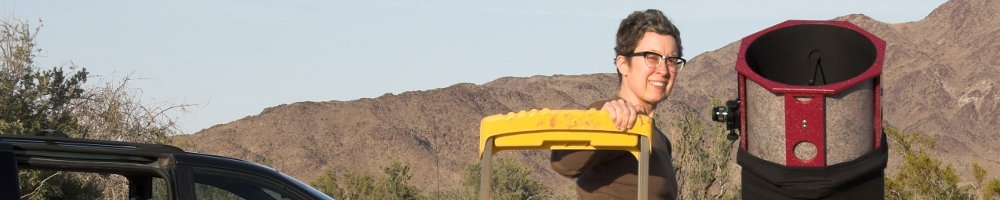
For the past year I’ve been traveling to dark skies to observe and count meteors during the major showers. Armed with a clipboard and a comfy chair, I stare at a section of the sky, hoping to see members of the well known showers, and contribute my data to that of other meteor observers around the world.
This writeup is really about how I observed, recorded and submitted my 2010 Perseid meteor shower data to the International Meteor Organization. I hope I inspire you to try it, even if you don’t submit your paperwork the first time. (I didn’t, in fact it took me longer to fill out the paperwork the first time than it did to actually observe the meteors!).
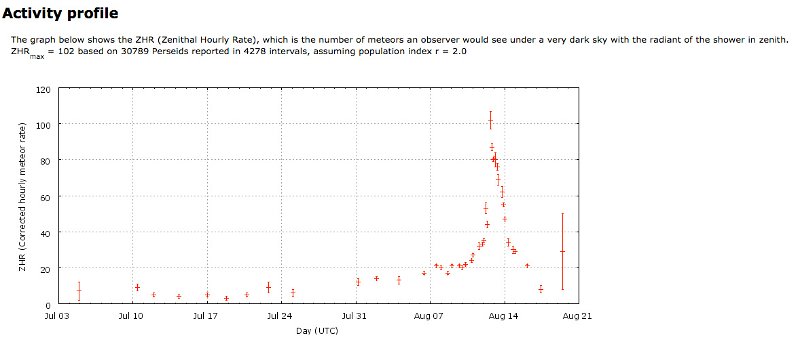
The first chart shows the peak of the Perseids – August 12-13 between 18h and 7h Universal Time. That means for people like me on the west coast of the US, the peak was nearly over before I started counting! It’s important for worldwide observers to keep counting, because many showers have secondary peaks or other characteristics.
The second chart is my data. Before I arrived at the site, I recorded the latitude, longitude, elevation and name of my observing location. This is easy to do using your GPS devices these days. I wrote down my name, my IMO codename (JONJH) and the shower (Per for Perseids). I decided not to try and identify individual minor showers though there were many. I called all non-Perseids Sporadics.
Before I began observing, and several times during the night I assessed the darkness of the sky using Limiting Magnitude star charts. This field is identified as LM on my observing form. The IMO says: “The darker and more transparent the sky and the more sensitive your eyes, the more meteors you can see. To use your observations for scientific analyses a quantitative characterization of these factors has to be established. The limiting magnitude (which is defined as being the magnitude of the faintest star near the zenith that the observer can detect using the slightly averted naked eye) defines both the condition of the sky’s clarity and the quality of the observer’s eyes.”
I keep a set of these charts on a clipboard and assess the sky darkness every time I observe. My assessment was a very high limiting magnitude. I could see magnitude 6.5 stars with my unaided eyes.
On a clipboard, I clipped a bunch of blank sheets of paper – one piece for each hour of the night. I wrote down each meteor I observed and noted the time using a nearby clock. I also wrote down the magnitude of each meteor – using a shorthand of 5 magnitudes of brightness. (F for faint-mag. 4, B for bright mag. 1, etc. J for Jupiter bright bolides) I had a selection of stars in the area already memorized for comparison against the Perseids. For spectacular meteors, I plotted them on star charts I had printed out for this purpose.
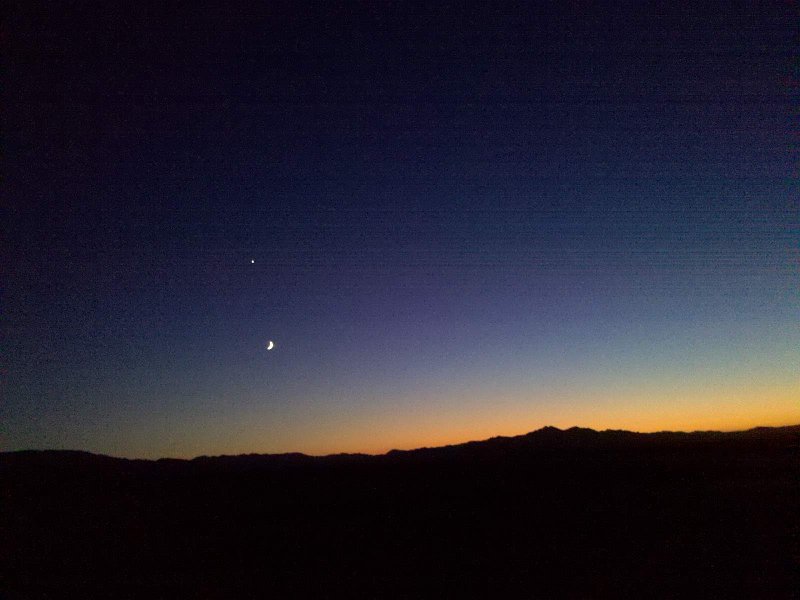
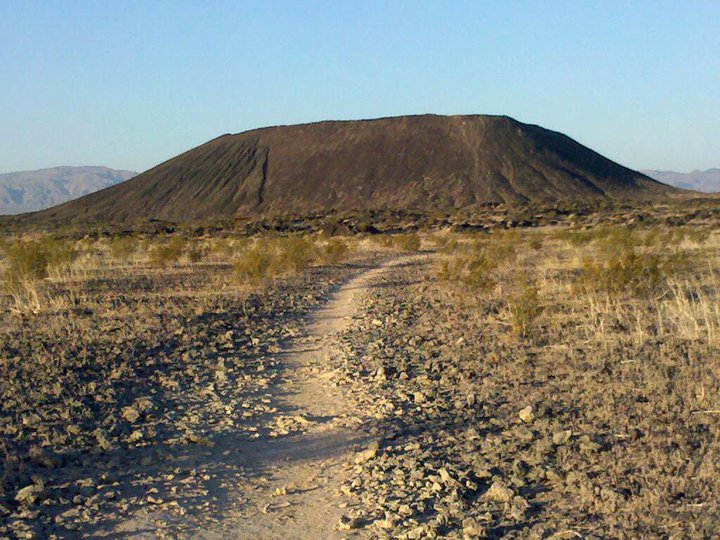
In a nutshell: Mag 6.5 skies, clear, 80 degrees overnight. Amboy Crater, one of the darkest observing locations in the US, was a great location for meteor observing.
Between 9 and 11 p.m. (04h-06h UT) I unofficially saw about a dozen mostly very bright meteors while setting up my chair, eating dinner, etc. I didn’t start seriously recording the meteors until 11 p.m. (06h UT)
04h-05h UT – 2 Perseids, 1 sporadic
05h-06h UT – 4 perseids, 3 sporadics **the first Perseid came in at 9:34 p.m.
06h-07h UT – 15 Persieds, 12 sporadics
07h-08h UT – I took a nap
08h-09h UT – 27 Perseids, 8 sporadics
09:19-03:19 – 43 Perseids, 3 sporadics didn’t take a break since the rates were so high…
03:20-04:20 – 39 Perseids 1 sporadics (with a 7 minute break)
Every where you turn, you will be running into pink this month. Pink tic tacs, pink yogurt lids, pink Harry and David pears, pink airplanes, and even pink buckets of fried chicken! It’s Pinktober, aka Breast Cancer Awareness Month. There are some cancer survivors who hate the pink, calling it pink nausea, reminding us that cancer is not pretty.
The images of those who are dying of breast cancer aren’t shown alongside the pink ribbons or on the chicken buckets. And those with metasatic breast cancer, or incurable breast cancer do not adorn the pink promo advertisements, either.
Other cancer survivors — like my sister Wendy — sometimes carry a pink reminder of their survivorship, and not just during October, either. I understand both feelings and can agree with both sentiments.
This weekend, at a family get-together, Wendy had a recyclable black shopping bag with a big pink ribbon sewn into the front and back. It’s a gorgeous bag, and one that means something unique to her, as a breast cancer survivor. She sometimes wears her pink breast cancer survivor baseball cap from a cancer walk. Or a diamond “ribbon” pendant. When she does, sometimes a person will stop and ask a question, or just smile at her. But she knows these symbols carry more meaning to her, more than a purchase.
40,000 women and 400 men die each year from breast cancer, and that number is not going down. I’m glad Wendy is here to wear her pink cap, and carry her black and pink bag. I mourn for others who have lost their loved ones to breast cancer. I mourn the friends I have lost.
What I want to promote is funding for Breast Cancer Research and Metastatic Cancer Research, specifically. That is where I want my donations to go. I followed my friend Susan Niebur’s advice: to turn awareness to action: donate, educate, advocate, volunteer. I am trying to do all four this year, narrowing down my own small impact to breast cancer research. I want those numbers of men and women who die every year to go down, not stay the same.
I joined the Army of Women 2 years ago in honor of my sister Wendy, who is cancer free now after breast cancer surgery and radiation. The army is looking for volunteers to partner with scientists and researchers seeking to unlock the key to preventing breast cancer. The Army of Women welcomes women (and men) of all ages, all ethnicities and all risks. It is a chance for women, and men too — who have had breast cancer or not — to directly participate in research, through questionnaires, phone calls, blood samples or diet and exercise studies. Volunteers receive emails with research studies, which they can choose to participate in or not. I joined this army to save lives, because there is no cure for breast cancer.
There’s a great Breast Cancer weekly tweetchat Mondays at 9pm ET, 6pm Pacific: Tweetchat #BCSM for those interested in a weekly Twitter dialogue between those who have breast cancer, those who treat breast cancer, research advocates, research foundations, supporting family members, and interested lurkers and learners (like me). For those who are on Twitter, look at these hashtags in addition to #BCSM: #pink #pinktober #IBC (Inflammatory Breast Cancer) #MBC (Metastatic Breast Cancer) #pinknausea (offensive commercialism) #redefinepink and find your place or your interests, and read along or join the groups. You don’t even need to be on Twitter to read the posts!
In the meantime, I know some people are sick of the pink, especially excessive commercialism or are disgusted by Facebook breast cancer memes. But I know others who embrace the pink because it did make them aware, helps them communicate breast cancer awareness, research, or provides their own storytelling backdrop. All of these scenarios are ok with me! We must find a cure for breast cancer!
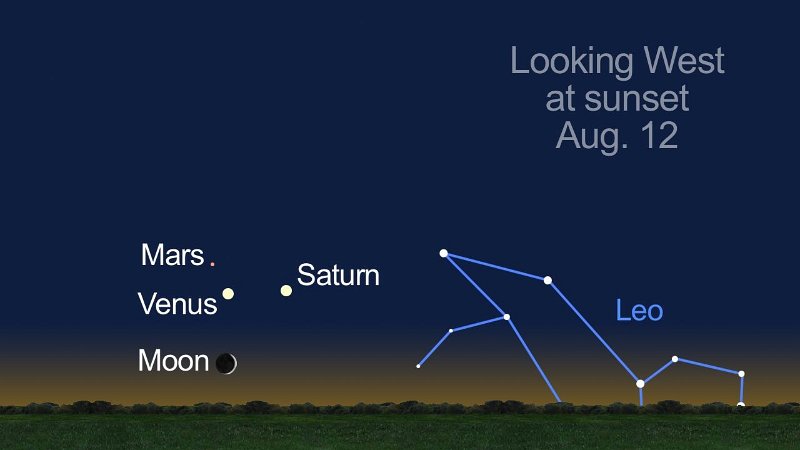
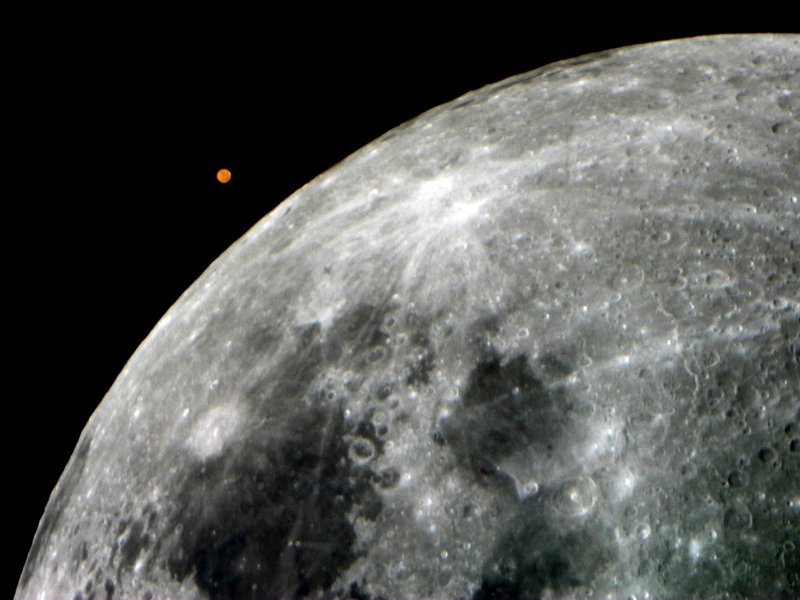
See the moon and planets low in the west August 12, courtesy NASA/JPL-CaltechThe view from Earth – the planetary lineup in orbital perspective courtesy NASA’s Solar System Simulator, courtesy NASA/JPL-CaltechMars and moon imaged same day with same equipment (in 2005) courtesy Jim KeenA trio of planets, without the moon August 7, 2010, courtesy Morris Jones
Are you eager to see the annual Perseids on Thursday night? You’ll have to wait until after 10:00 p.m. local time to see them, so why not pass the time until showtime by viewing the planets right from your doorstep? Step outside for the planetary warm-up act.
All you have to do is look towards the west as soon as the sun sets. Bright Venus is the first to appear. It’s really bright, and you can’t miss it! Now, hold your clenched fist up to the sky covering Venus. To the right of Venus, about 1/2 of a clenched fist away is a second planet. That’s Saturn. And to the upper left of Venus is another planet… That’s Mars.
But wait, there’s more! Look below Venus for the slender crescent moon. If you don’t see the moon, look again Friday night – it will be a larger crescent to the left of Venus a day later.
Though the three planets appear together in our line-of-sight they are really far apart from each other and from us on Earth. Mars is about 300 million km (186 million miles) from Earth, while Venus is 112 million km/70 million miles distant. Saturn? It’s 1,535 million km/954 million miles from Earth right now. The moon? 363 thousand km, or only 225 thousand miles away. It’s fun to compare the size of the moon and Mars, especially if you received that annual email (which incorrectly) states that Mars will be as big as the moon this month. Do the math. It’s impossible!
The Solar System Simulator is a great public resource for geeks. You can see any planet or spacecraft from any vantage point on any date you select. I picked August 12th to show the view of the planets and moon from Earth.
I hope you can sense the three-dimensional orbits of nearby Venus, far-away Mars and distant Saturn. Have some fun with it! Every day the Cassini Mission website shows a view of Saturn from Earth, from Cassini, and right now Enceladus, as we close in on a flyby of that exciting moon later this week.
In this image of the moon and Mars, Jim Keen made a “true-to-life” size comparison. He made a “blended” image of the Moon and Mars back in July 2005. He recalls, “I had set up my telescope in my backyard and stuck a camera on the back of it. I took separate images of the Moon and Mars – both of which were “up”, but in separate areas of the sky – and later combined the two images to get one, showing the actual size difference using the same equipment, same camera, same magnification, and taken within a few minutes of each other.”
Jim’s image shows the apparent size of the moon and Mars really nicely! If he took the same image this month, Mars would appear super tiny! In the 2005 image Mars was about 50 million miles from Earth, and today it is 186 million miles away.
The final image shows the trio of planets imaged Saturday night August 7th by my hubby, Morris (aka Mojo) Jones. Click on the image to see the two fainter planets above Venus. He posted several images in his blog post called Sky full of planets and lightning. It’s really worth a read! The lightning was amazing Saturday night!
I hope this little planetary warm up act will whet your appetite for more sky watching this week. The Perseids will be a real spectacle, especially if you can get away from the city lights. I’ve pretty much decided to head out to the Mojave desert and see the star show from Amboy Crater. Clear Skies everyone, and happy solar system observing to you all!
California Clear Sky Chart Black dots indicate the darkest observing areas. Amboy Crater, on the southern border of Mojave National Preserve is the closest “black dot” dark observing area and will require a drive of over 200 miles for Thursday’s Perseids.
Size comparison of Mars (at closest and furthest approach) and the moonSee Mars and the moon near one another in mid August
2010 marks the eighth annual return of 2003’s Mars In August email.
The email always says something about Mars appearing as large as the moon, but there are annual variations to the theme – one year a ridiculous Powerpoint mis-information file was attached to the email.
Sometimes the email mentions a particular date (like August 27th) when the moon and Mars will appear as two big moons. That date refers to when Mars was closest to Earth in 2003, and it did look quite large through a telescope back then. But even then, Mars was 36 million miles away from Earth, while the moon was about 250 thousand miles away. So it is just impossible for Mars to ever appear the same size as the moon!
The original email compared a telescopic view of Mars to a naked eye view of the moon. It never said Mars and the moon would appear to look the same size with the unaided eye. But every rewrite of the 2003 email omitted that telescope view comparison info. 🙁
The email does give us a great opportunity to test our critical thinking skills. Critical thinking is a way to apply the scientific method to everyday life, and everyday life includes getting weird claims delivered to your own e-mail in-box. Here’s what you can do:
First, ask yourself a question — Is Mars going to be bigger than the moon in August this year?
Next, do some research. Read up on when Mars is closest to Earth in its orbit around the Sun. I’ve included some of this information in the link at the bottom.
Then construct your hypothesis. A hypothesis is your educated guess. It might be something like this. “If I look at the moon and Mars in August they will both appear the same size.”
Now, you can test your hypothesis by doing some experiments. Find the days when both Mars and the moon will be visible in the sky. Use the star chart above or check other online resources like this to find out when and where to look.
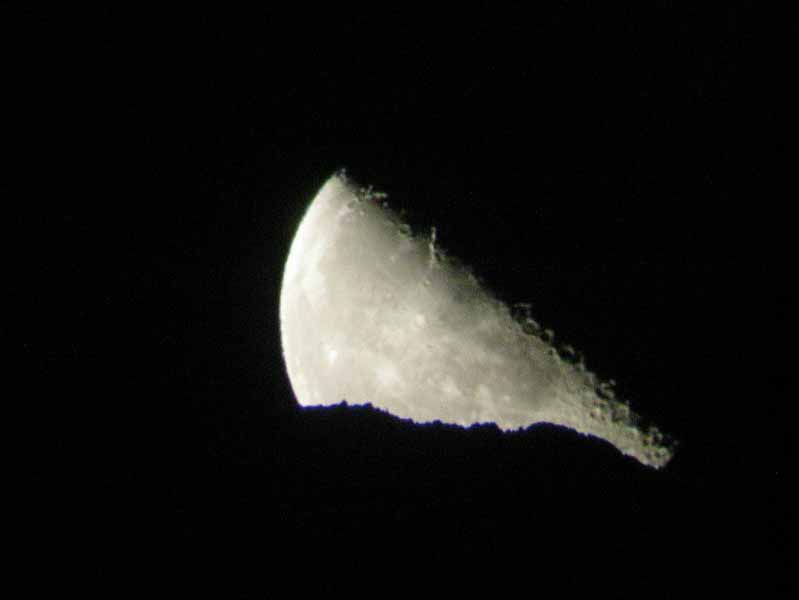
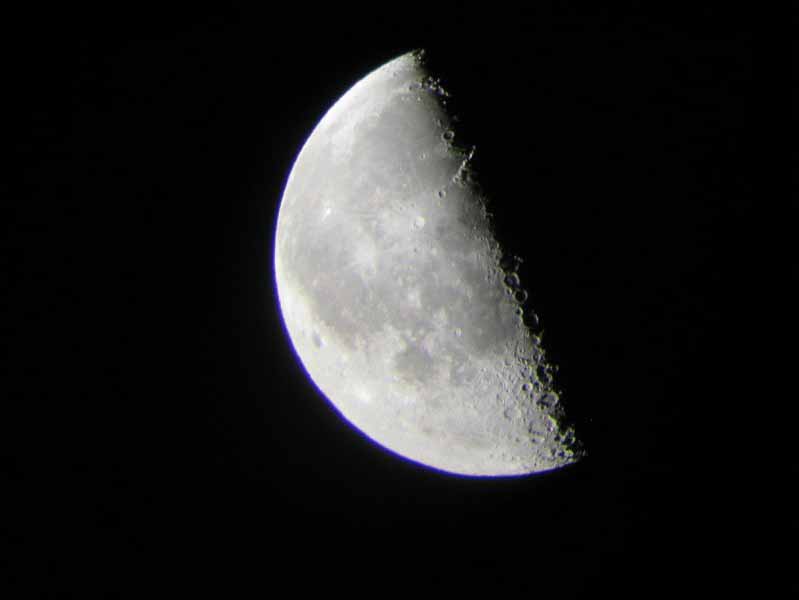
Moonrise over Chuckwalla Mountains July 3, 2010 about 11:30 p.m.Third quarter moon, a half hour laterMy small 70mm Televue Ranger was used for the moon images
Summer dark sky observing means short nights, and it’s usually too hot for comfort in the Colorado desert location we love. But Mojo and I decided to pack a cooler full of ice cubes, and take our chances. The predicted daytime high was 102 F, and it would be (we persuaded ourselves) a few degrees cooler at “our” spot. The low temperature for the night was forecast to be 75 degrees. We could live with that!
It didn’t get dark enough to observe anything except planets until 9:00 p.m. and so we only had two and a half hours of dark sky before moonrise would make it too bright.
One of the benefits of living and observing in Southern California is that at latitude 33N, we can see deep into the southern skies.
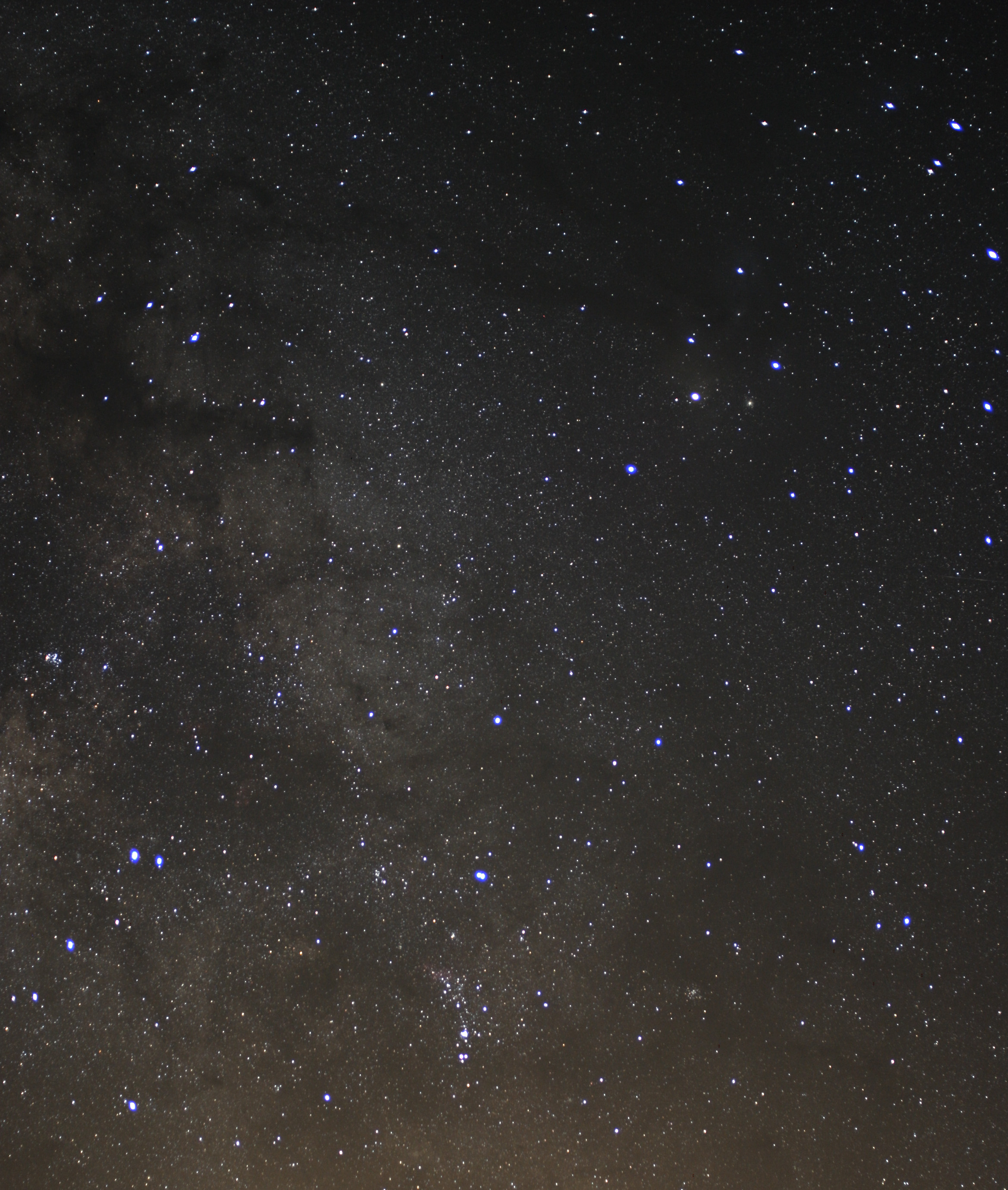
Summer nights are just made for observing Scorpius. The Bug Nebula NGC 6302 is one of my favorites ever since I saw and sketched it high in the Australian skies in 1999. NGC 6231, the Table of Scorpius is another favorite. It’s an open cluster near Zeta Scorpii, the first star marking the Scorpion’s curvy tail.
This is a delightful region (great with binos too) full of Milky Way wonders, including emission nebula IC4628. Mojo captured the area beautifully in his image of Scorpius last night. The star cluster center bottom is NGC 6231, and the reddish patch just above it is the emission nebula IC4628.
This is the area I was aiming my big telescope at until about 11 p.m. when we could see the lunar light dome emerging. We finished up our projects and waited for that first “wedge” of moonlight to breech the mountain ridge to the east.
I took some afocal images using my Canon Powershot SD870IS Digital camera held at the eyepiece of my small refractor. I’m pretty happy with the results.
Since it was a short night, this is a short observing report. 🙂
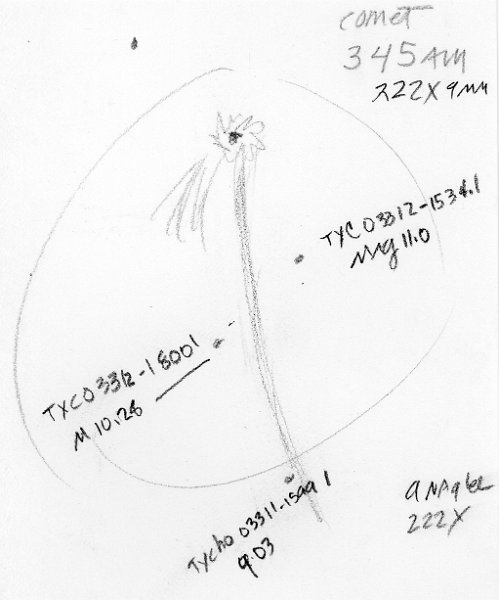
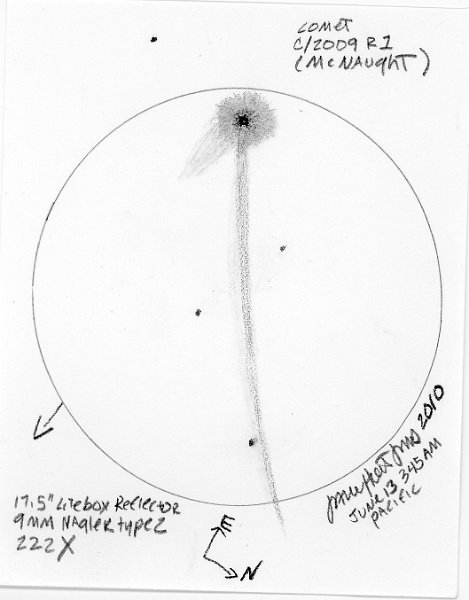
Use a chart like this to locate where to look for your objectCan you find the constellation Perseus and comet McNaught in Mojo’s lovely skyscape?Mojo's photo of Comet McNaughtQuick comet sketch with notes. See the long ion tail, the bright coma, and the short dust tail in my sketchesComet C/2009 R1 (McNaught) June 13, 3:45 am from Chuckwalla Bench observing site, Colorado Desert. Lat 33N, Long 114W, Elev 1400 ft
I wish everyone in the world could see just one comet! Right now, there is one visible just as the dawn brightens the night sky. Unfortunately, it’s not easy or convenient to see this one, and in another ten days it will disappear below our horizon. It’s just barely visible to the unaided eye. Timing your viewing window is tricky, too. You have to find a balance between the time the comet rises high enough to see, and the coming of dawn, which robs the night of its darkness and guidepost stars an hour or two later.
Here are some tips to help you have a successful comet viewing experience now or in the future. When you first hear about a visible comet, you can usually find some online sky charts from astronomy magazines such as Sky and Telescope and Astronomy. Many online sources can offer guidelines and observations, too.
Star charts are fine, but you have to go out and navigate the real sky to find unfamiliar constellations. From the city, or close to dawn, this is a real challenge. You may only see a few bright stars in the sky. Try to see the stars making up the constellation Perseus in Mojo’s image. I’ll admit, it isn’t easy, especially when you are rushing against time. Now, compare his image to the star chart. And you’ll soon see the figure of the hero, Perseus, starting to emerge.
I use the familiar “W” shaped constellation Cassiopeia as a signpost to locate Perseus. Then I see Perseus with his two running legs, joined at the bright star Alpha Perseus (Mirfak). Nearby you can see the naked-eye open cluster known as either Melotte 20 or the Alpha Perseii cluster. Next, I make a mental triangle out of Alpha, Delta and Kappa Perseii, the three bright stars closest to the comet shown on the star chart.
Finally, I aim my binoculars at the triangle of stars and hold my breath. Then I see it, and I quietly say “hello” to the swift celestial traveller. I get chills every time I see a comet. And this time is no different. A little green fuzzball is right where the comet should be.
Now I jump into action. I dust the cobwebs out of my brain, as well as I can at 3:45 am in the morning. I’ve just woken up from a short nap. I quickly sketch what I see in the eyepiece of my big telescope, taking care to mark any stars nearby, and note the time. Then I call everyone who is awake over for a look. We all move sluggishly in the near dawn light, like we are walking through sandy molasses. We share views with one another, through binoculars and a variety of telescopes large and small.
Overhead, the Milky Way has disappeared, and the glow of twilight grows brighter. I have yet another predawn observing target, so I quickly make a second sketch with a little more detail. Then I nod goodnight to the beautiful green comet, aim my binoculars just a little to the east and wait. It will be nearly one hour before Mercury will rise over the mountains.
This comet is making its first approach around the sun, in its long hyperbolic orbit from the Oort Cloud. At the time of my observation, the comet was 0.6 AU from the Sun and 1.1 AU from Earth. By the end of June, it will be lost to our view. It reaches perihelion on July 2nd when it is about 0.4 AU from the sun. Then it will fade and be seen no more.
Added postscript: According to this Space.com article, the comet may be visible “after June 22 both in the evening sky for a short while just after sunset very low above the north-northwest horizon and in the morning sky just before sunrise very low above the north-northeast horizon.” I’ll update if/when I learn more.
See more of Mojo’s photos from this observing night.
Join our Old Town Sidewalk Astronomers email list and find out when our next dark sky outing will be. Or join us at our next in-town new telescope users clinic and planet/moon viewing event. Hey, that’s tonight, June 19! Clinic (RSVP required) begins before dark at 7 p.m. Star Party continues until 9:30 p.m. at Library Park in Monrovia, CA.
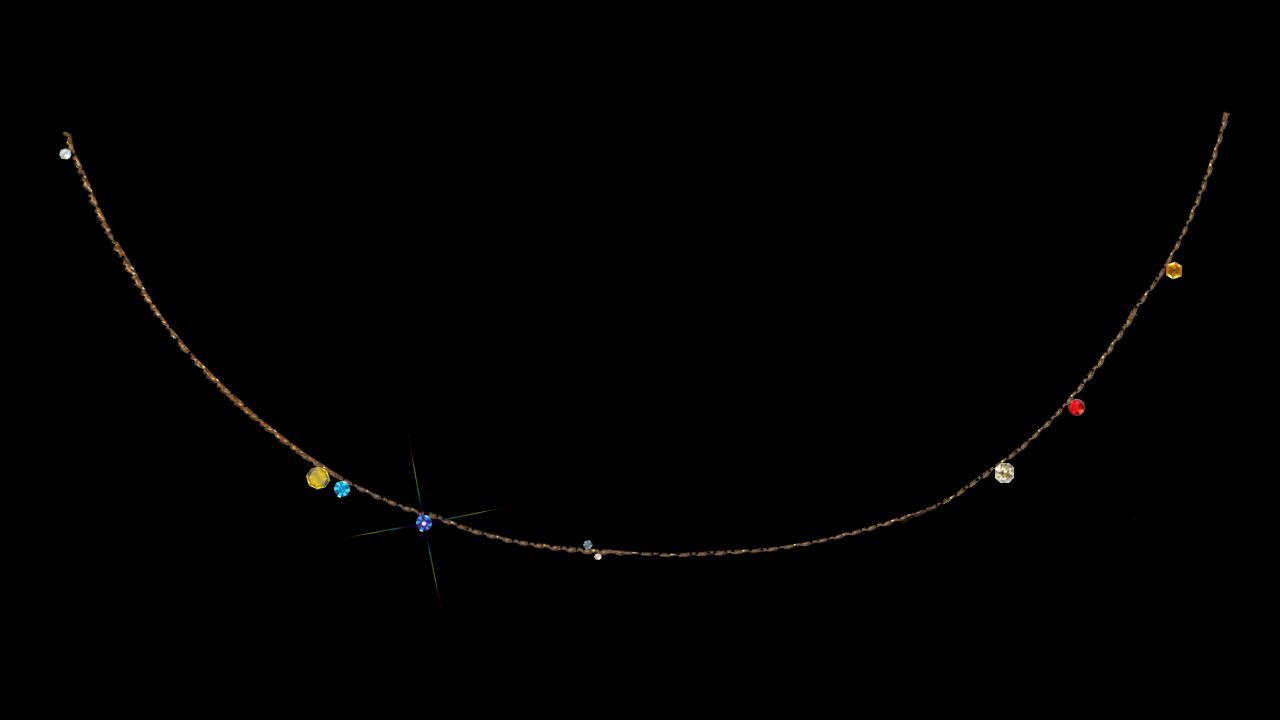
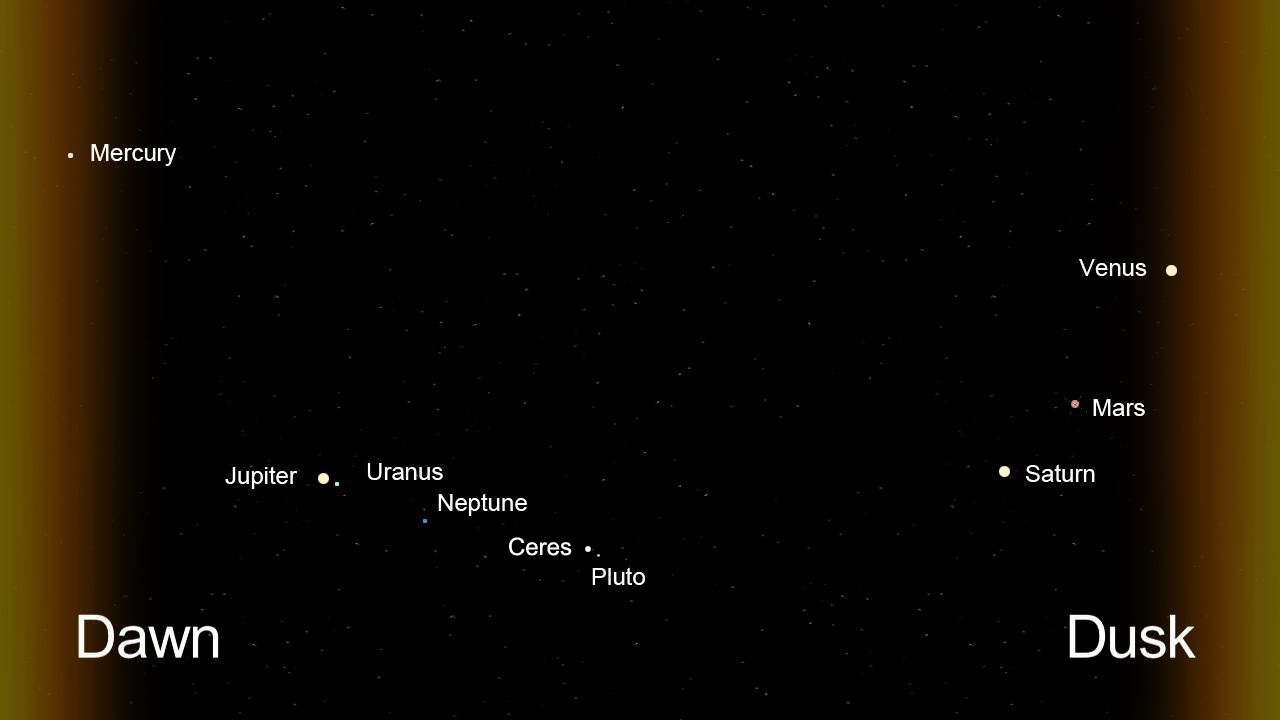
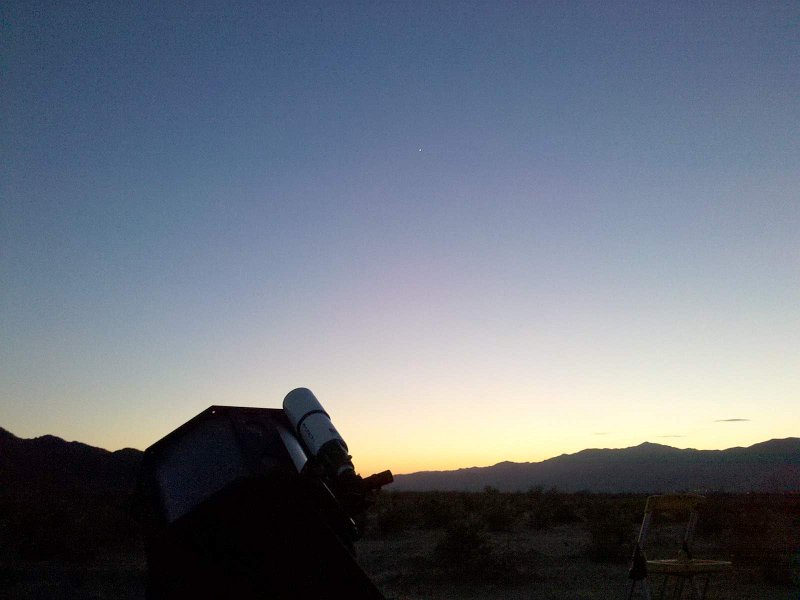
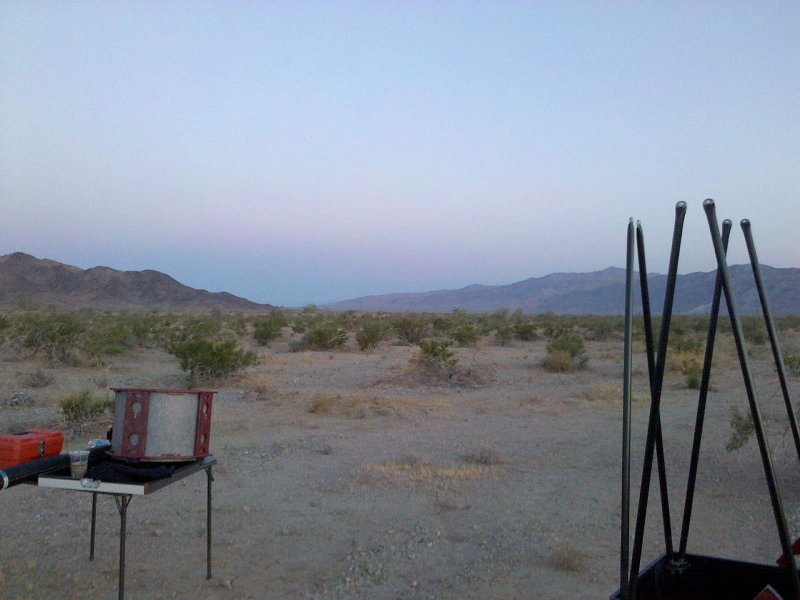
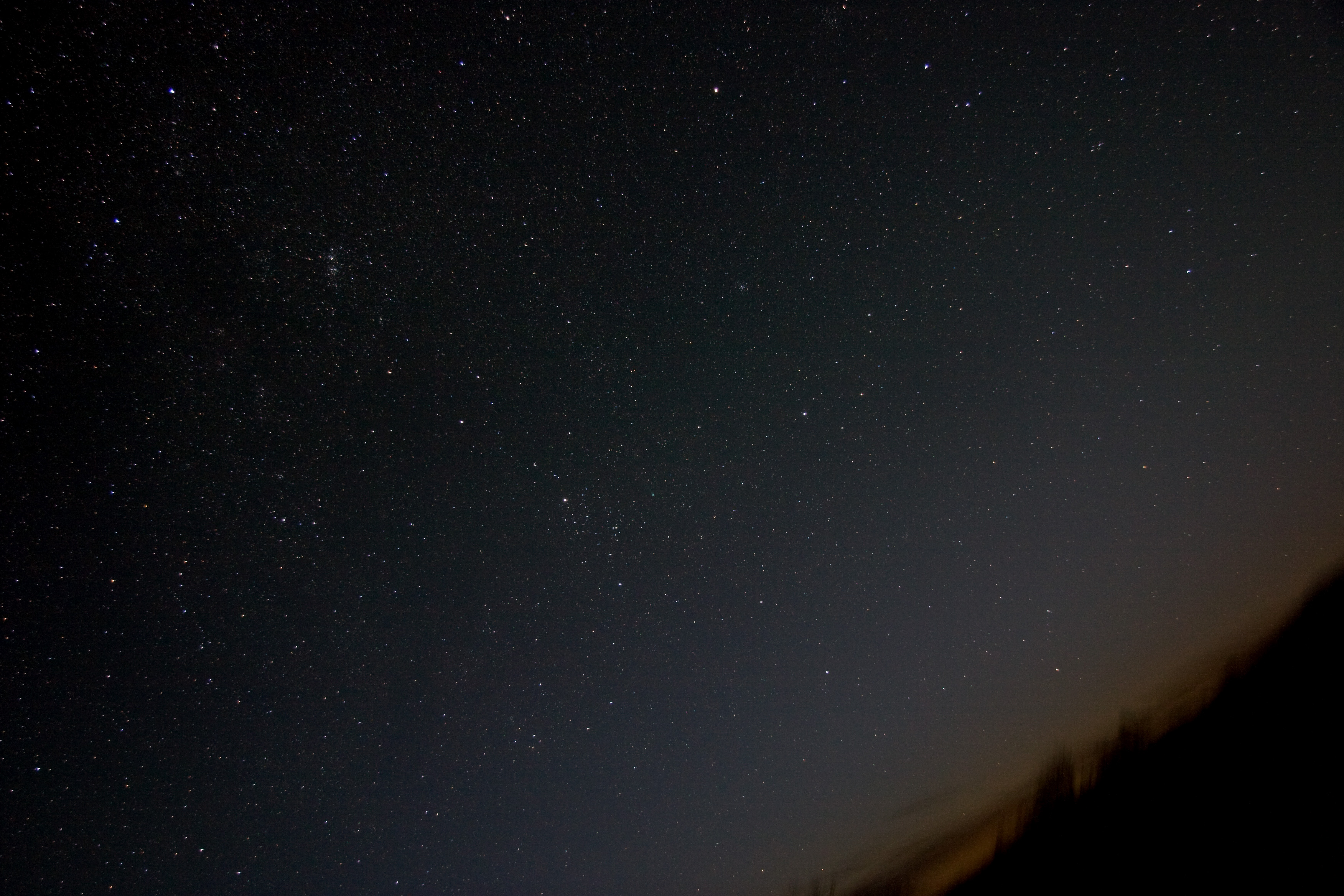
Setting up my favorite Pluto hunting telescope, a 17.5 inch f/4.5 Litebox reflector. Oh, in case you were wondering, its name is Hagrid. All my telescopes have names. Chuckwalla Bench horizonsEarth shadow at sunset, and Mojo setting up his astrophotography rigA starry necklace spans the sky from dusk to dawnThe planetary lineup from dusk to dawnTwo planets, Venus and Earth at sunsetM24 cluster and 60 day path of PlutoDo you see the Sagittarius teapot and the Milky Way "steam" rising from the spout? How about M24, the huge Sagittarius starcloud (the oval of stars 1pm above center) where Pluto hides?Earth shadow at sunriseBonus picture: This is the "naked eye" view of the sky where Comet McNaught can be found. Can you see the green comet near the Perseus Cluster? If not go to Mojo's Blog for closeup. Click to enlarge. It took binoculars for most of us to spot the first time. 🙂
Every couple of years I get the yearning to see all the planets in one night. Saturday night, June 12 seemed like the perfect opportunity. Our Old Town Sidewalk Astronomers club planned an outing to our regular observing spot, Chuckwalla Bench, which has very good horizons. We needed good horizons to catch Mercury rising just before sunrise.
Here are my planet observations, in observing order. All distances are listed in astronomical units and represent the distance from Earth on June 12, 2010, the night of my observations.
Earth! Facing away from the setting sun, the Eastern horizon turned shades of blue above the pinkish sky. That’s the shadow of the Earth! The dark blue band seems to rise above the landscape and spans 180 degrees. The pinkish sky above the shadow is the antitwilight arch. As the sun sets, the boundary between the reddened (pink) color and the horizon grows until it blends with the darkening night sky. The same thing happens at dawn of course. Look for it, and tell me what you see!
Venus! The first “star” to appear in our sky after sunset was Venus. Through the telescopes its gibbous phase is unmistakable! Its distance from Earth is 1.2 AU (astronomical units).
Mars! I was not expecting to see any features on Mars, since it is so far away and so small. Mars is 1.7 AU from Earth, but only half the diameter of Earth. I was surprised that I could see some dark markings, through a small refractor. When we checked a Mars map for the time of the observation, the large dark feature Syrtis Major was indeed right smack on the central meridian – the imaginary line in the center of the planet facing Earth at that moment.
Saturn! What’s not to love about Saturn! The brownish cloud bands contrasted against the butterscotch hued planetary globe. The slender ring, appearing nearly edge-on, bisected the planet, showing a tiny glimmer of sunlight shining on the north side of the rings. Several moons were visible, though one of the larger ones, Dione, was transiting (crossing in front of) the planet on this night. I spotted Mimas and Enceladus — tiny beacons of light — hovering near the edge of the rings. Titan and Hyperion were on the same side, only further away. Rhea was on the other side. Dione’s shadow marched across the face of the planet for astrophotographers to capture. I didn’t see it visually. Distance from Earth is 9.4 AU right now.
Pluto! This small icy world is 30 AU away from Earth. Once a planet, it is now a dwarf planet. But that doesn’t alter my enjoyment of seeing it through a telescope. For the past few years, Pluto has been marching slowly towards the richest part of our Milky Way galaxy making it a challenging object to confirm in backyard telescopes. Right now it is found skimming the Northern border of M24, the Milky Way Star Cloud. That’s a lot of stars to wade through to find one dwarf planet!
I printed out star charts showing just the few surrounding stars and Pluto, indicating the motion over the evening so I could go back and verify the observation closer to dawn. I also made zoomed out charts, showing larger and larger areas of the region. I had some galactic luck this month! A small open cluster called NGC6603 was nearby to Pluto within the larger M24 open cluster. A few distinctive star patterns separated the dwarf planet from the small star cluster, and I was able to easily starhop and make a positive ID. With Pluto bagged, I was feeling confident about the rest of my planetary to-do list.
Note: From July 4th through the 8th Pluto will pass in front of a dark nebula on the Northwest border of the M24 named B92. This should make the tiny magnitude 14 speck-of-a-former-planet easy to spot.
Ceres, another ex-planet was nearby so I hopped over to have a look at it. Ceres spent half a century after its discovery in 1801 as our 8th planet. Then it was demoted to an asteroid, but its significance was cemented by its designation, 1 Ceres. After many years working the solar system as chief #1 asteroid or minor planet, in 2006 Ceres was promoted to dwarf planethood along with Pluto. Ceres is 1.8 AU from Earth, by the way.
With the dwarf planet observations under my belt, I took a short nap to allow Jupiter, Uranus and Neptune to rise higher in the sky.
Uranus and Jupiter! When two planets are at opposition at nearly the same time they appear to pass each other from our viewing vantage point on Earth. This year we will see Jupiter pass Uranus, then appear to loop backwards–in retrograde–passing near Uranus a second time, then resuming its forward motion with third final close pass. The next time this will happen is 2037, so you might want to aim your binoculars at this pretty pair of planets this year. This is the first pas de deux, so you have many months to view the dance of the two gas giants. Through the telescope, Jupiter, which is 5.1 AU from Earth, looked unusual to me. It was my first look at the planet since the Southern Equatorial Band disappeared. A few months ago, this chunky ruddy band went missing.
Uranus has a beautiful aquamarine color. It has several moons just on the border of visibility through large amateur telescopes. I was able to spot three of the brighter moons of this planet — the ones farthest from the planet’s glow. Titania and Oberon on one side and Ariel on the other. A big ‘scope and good dark and steady skies help to see the faint moons! Uranus is 20 AU from Earth. Try looking up at Jupiter in a dark sky and see if you can spot a blue-green “star” nearby.
Neptune! Neptune sports an azure-blue hue and appears like a tiny disc. It’s nearly 30 AU away near the southern tip of Capricornus. At this time of year, that means waiting until 3 am or later for a view.
Now I had snagged all the planets except Mercury. It would be rising an hour before sunrise at 5:30 am, but the elevation of hills on the SE horizon were difficult to measure. I kept my eyes on the Pleaides star cluster as Mercury would rise directly below the famous cluster. By 4 am, with an hour and a half until sunrise, the sky was already brightening. First, the glorious Milky Way faded until it was nothing but a memory. Then, one by one the constellations disappeared, except for their brightest starry ambassadors. I steadied my binoculars as the Pleiades or “Seven Sisters” disappeared one by one. I kept the remaining Pleiades stars in my binocular view while moved back and forth, scanning the horizon for Mercury. Soon the rays of pending dawn punctuated the horizon, and I worried that I’d miss it as sunrise made the landscape visible once again. I could still see some of the Pleiades, and kept looking for over 45 minutes. Finally, just a few minutes before 5:00 am, a bright beacon appeared on the horizon. It was Mercury! I had seen ten planets in the span of nine hours!
The nine hours passed so quickly. With sunrise comes daylight and the views of the night sky fade from view but not from memory. Join us out in the desert sometime or find a local astronomy club closer to you so you can see these wonders of our solar system for yourself! You really have to see this!
December 1690 sketch of new dark spot on Jupiter by G. D. Cassini and changes to the spot over 18 daysMy first sketch of SL 9 impacts on Jupiter July 18, 1994.My July 26, 2009 sketch of the impact on Jupiter, discovered by Anthony Wesley (upper left 11-o’clock spot)
Anthony Wesley's preliminary (a raw frame from his video) showing new impact of Jupiter, June 3, 2010
On June 3, 2010, shortly before dawn in New South Wales, Australia, Anthony Wesley was imaging Jupiter. He saw a bright flash visually, and captured it on video. He quickly sent out an alert to imagers and scientists, followed soon with a preliminary raw frame from his video. Christopher Go also imaged this flash at the same time from the Philippines, and he also alerted the scientific and imaging communities.
The word spread like wildfire, and soon amateur and professional astronomers around the world were calculating when the impact area would rotate around the planet, to be hopefully visible from their own location, telescope or observatory. Would the impact leave a scar? No one knew for sure, but more observations were needed.
We’ve seen and documented three impacts to hit Jupiter since 1994 — but how many have we missed? Impact events leave no long-lasting scars on the surface of Jupiter. Jupiter’s bruises fade away.
Any science enthusiast who remembers 1994 will never forget the buildup to Shoemaker-Levy 9’s amazing impacts into Jupiter that summer. I have many sketches of what I observed visually those first nights when the world saw predicted cometary fragments hit Jupiter and leave visible impact scars. Astronomy clubs around the world saw increases in membership because of the press coverage.
I took my homemade 10-inch reflector telescope out on my back deck and observed and sketched Jupiter every clear night in the summer of 1994. I was, unwittingly at the time, continuing the tradition of citizen scientist recordings of visual astronomical observations — a tradition which goes back thousands of years.
Last year I was researching historical astronomical observations for my International Year of Astronomy (IYA) podcast series. I learned that Giovanni Domenico Cassini not only first saw Jupiter’s great red spot (called Jupiter’s permanent spot) in 1665, but he also observed and documented other large spots in December 1690.
Cassini’s sketched this feature over eighteen days in December 1690. His sketches show changes in the feature over time. His observations were published in 1792 as “Nouvelles descouvertes dans le globe de Jupiter.”
Today’s citizen scientists around the world observe their targets nearly every clear night. And when they see something unusual they immediately alert their community of colleagues. Sometimes, like in this case, other eyes or images confirm the observation. And when it is amazing enough, the world’s greatest eyes – Earth-based telescopes like Gemini, Keck, IRTF and even the orbiting Hubble Telescope — take aim.
Their eyes from Earth and space will make observations to delve deeper into Jupiter’s mysteries. Their data will complement observations of astronomy’s citizen scientists whose round-the clock and round-the-world nightly records are the eyes on the sky.
Today a friend told me about her mum. “She has cancer in her
bones, a long slow ticking time bomb” and my friend also also just found out yesterday her 48 year-old sister has breast cancer.
She wrote “I remembered how strong you were recently with Mojo and your sister’s cancer. How is your sister? Is her treatment going well?”
Compassion and fear both flowed in her words. I told her that my sister finished her radiation, and is hopeful that she has kicked cancer’s butt! Mojo is doing great too!
I wrote back to my friend immediately, and said among other things that I thought one thing that might help her was knowledge. Knowledge is power. That sure helped me cope with my sister Wendy and Mojo’s recent bouts with cancer. I read everything I could, and that made me feel in control. Well, a little bit anyway. We can wish and we can pray. We must be strong for our loved ones. I told her that she and her mum and sis might find comfort, strength, power and information by reading about others who are going through the same thing. We can all fight cancer, whether we are suffering from it now, are survivors or know someone who is fighting cancer now, or is fighting for someone who has lost their battle with cancer. We all are in one or more of these categories.
I won’t tell you to write a check, to walk or run, or anything else. When cancer touches you, you will act in the way that works for you. But for my friend and friends I don’t know yet, here are some ideas.
You can turn your fear into action. Donate, Educate, Advocate or Volunteer. Here are some ideas.
Join the Army Of Women. The goal is to recruit one million healthy women of every age and ethnicity, including breast cancer survivors and women at high-risk for the disease, to partner with breast cancer researchers and directly participate in the research that will eradicate breast cancer once and for all. I am very proud that Wendy and I joined the army. And at a recent club meeting, a friend came up to me and told me she had joined too!
Just about every town has a Relay for life cancer walk. Walkers, donations, volunteers and friends are all needed.
I want to work in every way to rid cancer from my family and every family, in what ever small or big way that I can.
And I want to honor those who have lost the fight by fighting back against cancer. I want to Donate, Educate, Advocate and Volunteer.
I want to be strong and fight strong against cancer! I hope you’ll join me!
Once the tents are pitched we put on a star party with assistance from the National Preserve staff, leaders of the National Park Conservation Association and the Mojave National Preserve Conservancy plus many of their friends and members. The public is invited too, and unsuspecting nearby campers were thrilled to chance upon a starshow. Best of all, once the star party is over, we get to explore the national preserve!
On this trip (April 2010) my observing project was to see a Chuckwalla, the big pot-bellied lizard living in this desert area. We searched for them last year with members of the Southwest Herpetologists Society but didn’t see any.
Sunday after the star party, when tents & telescopes were stowed back in our cars we headed off to Amboy Crater in search of wildflowers, and hopefully, our first Chuckwalla.
Amboy Crater — well worth a trip for Geology, spring wildflowers, and lizard hunting — was formed by ash and cinders, and last erupted 10,000 years ago. The lava field terrain (43 square miles of it, actually) surrounding the crater is prime Chuckwalla territory. It’s easy to reach Amboy Crater from Barstow or Twentynine Palms, and you even get to drive on old Route 66. It is well worth a journey!
Chuckwallas can reach 16 inches in length, weigh up to 2 pounds and are specially adapted for desert living. They are strictly vegetarians and store water from plants in special glands to survive the harsh desert heat. The surrounding landscape is very salty and the Chuckwalla absorbs enough salt to kill most living things. But they have salt-removing glands in their nostrils, and as salt builds up on these glands, the lizard sneezes, and this expels the crystallized salt!
We were walking towards the crater and most everyone was way ahead of me. I was lagging behind, checking every lava outcrop for my first Chuckwalla sighting.
I stopped at one especially large outcrop, and scanned the sunny ledges. There, sunning herself, was Mrs. Chuckwalla! She was flattened against the rock to prevent airborne predators from seeing her shadow. Her round midsection was prominent, leading one herpetologist to suggest she was pregnant. I called to my hiking party who all quickly returned to see her. Soon, this poor shy girl was the subject of paparazzi!
Then Mr. Chuckwalla came out to see what the fuss was about. Male Chuckwallas have more of the red color (and black heads) and females are more tan/yellowish brown. They are majestic large lizards, and adapt their coloring to the rocks they inhabit. They’re not really fast, and need some sunshine to warm up in the morning. So, when danger approaches, they scoot into rocky crevices, puff up by gulping air, and wedge themselves into the cracks in the rock. This makes them difficult for predators to reach.
We also observed dozens of spring wildflowers on this hike and our earlier hike to Teutonia Peak, which I didn’t even write about here. Have a look at these images of our wonderful adventure, and put a Mojave spring wildflower/Chuckwalla play-date on your calendar. This is also a prime Desert Tortoise sighting location, but it was a bit windy on this weekend, and the tortoises were in their burrows.
Mojo’s amazing panoramas and additional images from both hikes are worth a look and will encourage you to put this park on your to-visit list. You will not be disappointed!