Observing report, dark sky weekend, October, 2009, Chuckwalla Bench
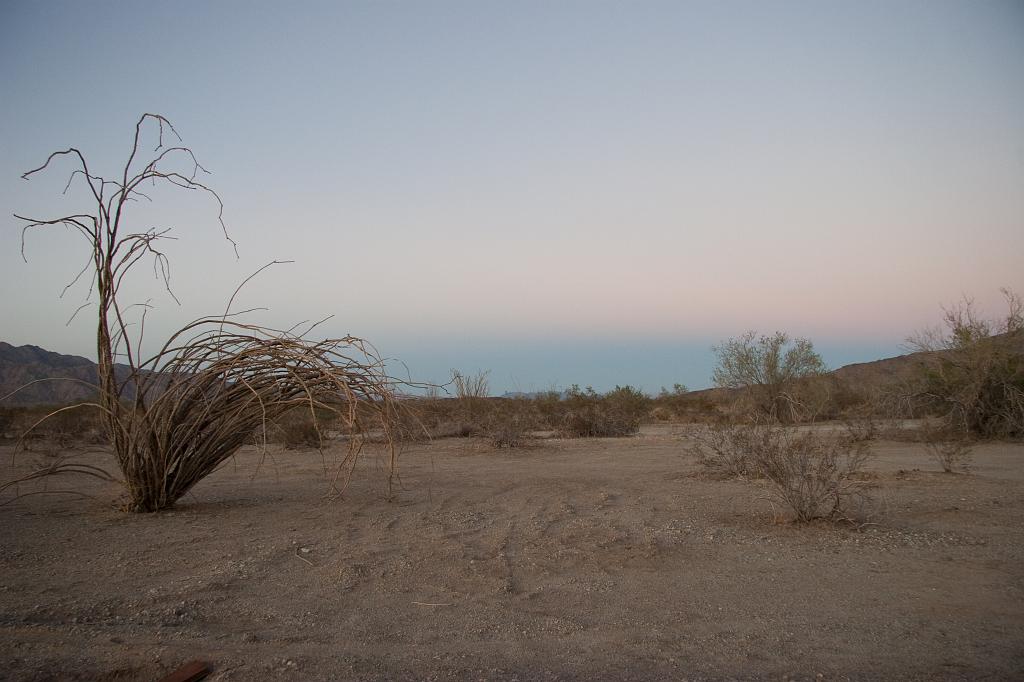
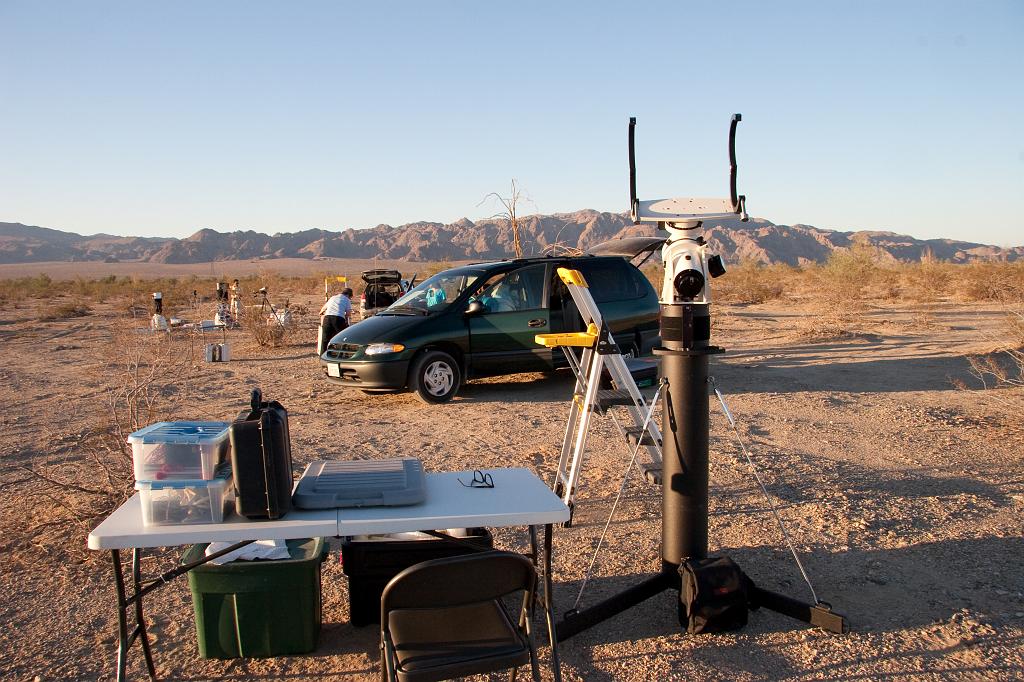
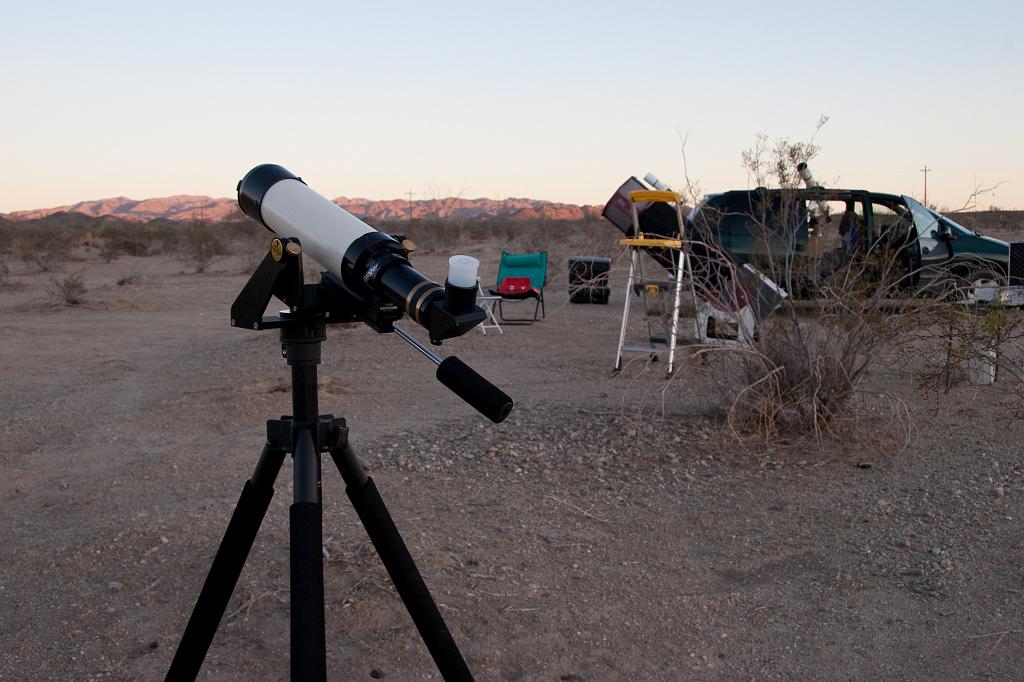
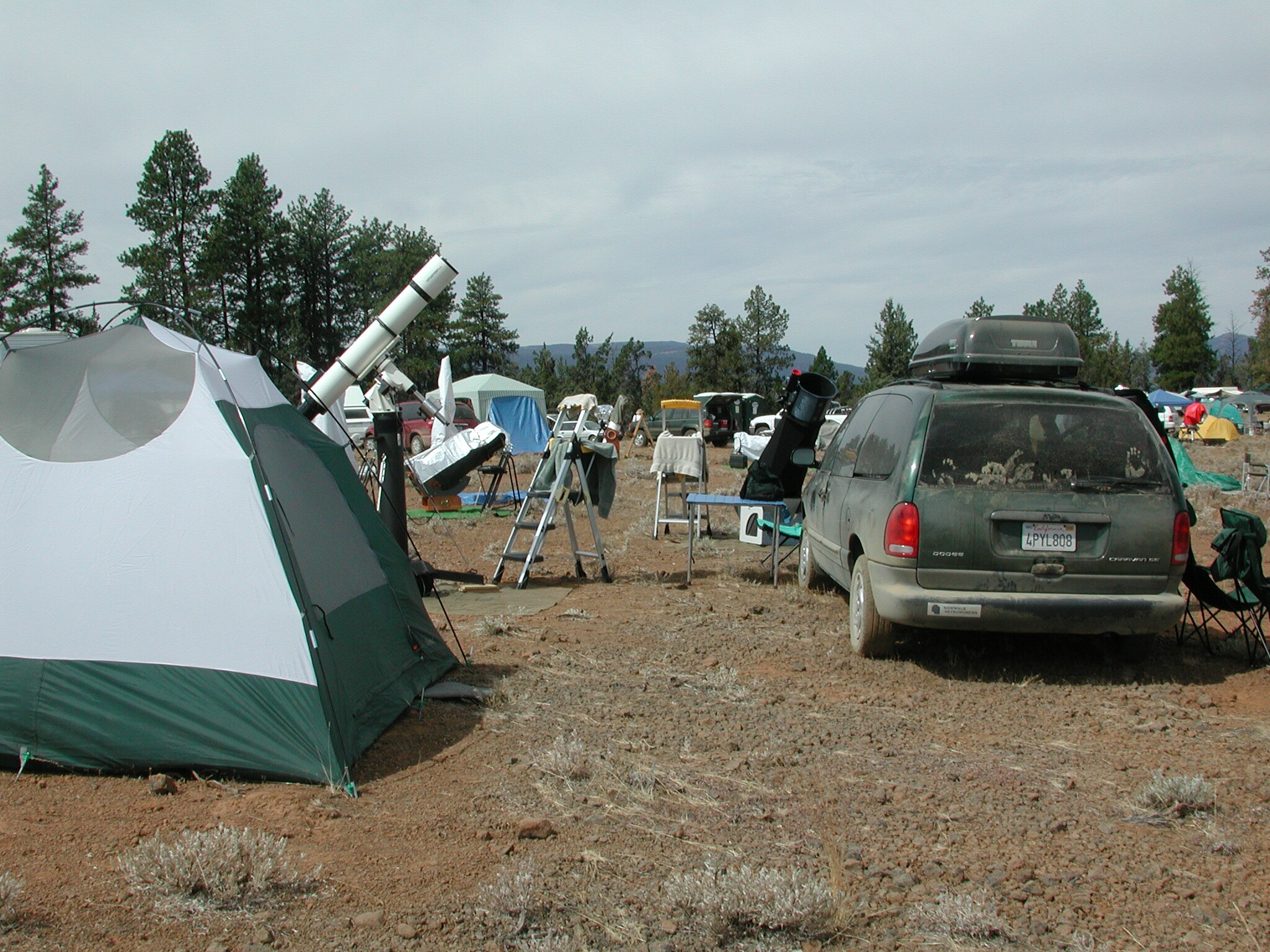
A perfect night begins with Earth's shadow climbing in the eastOne one side of the green van is the Imaging zoneOn the other side of the green van is the visual observing zone
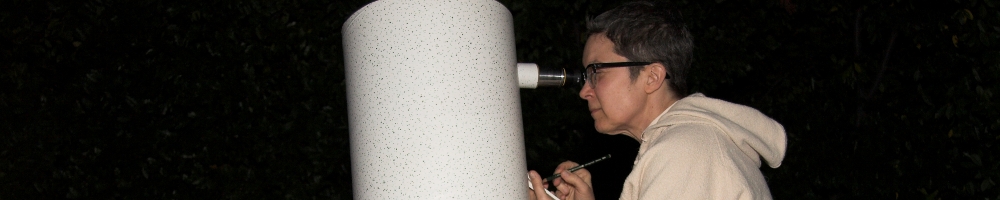
When the clear sky chart reads perfect, we can’t wait to get out to our favorite dark sky observing site, Chuckwalla Bench. I wondered what would happen when Mojo started dabbling in the dark art of imaging. I’m the old fashioned alt-az dob girl, and now my hubby would be keeping warm at the star party with the heat from electonic power supplies and batteries. Poor me! I pouted (for only about a year or so) before I learned to love the dark arts, and we now happily observe and image with only our 1998 green Dodge Caravan separating “his” imaging zone and “her” visual observing zone.
New moon Saturday night in October 2009 was another perfect observing night in the Colorado desert of Southern California. Temperatures were in the 90’s before the sunset, and cooled to about 65 by 2 a.m. when we took a pre-dawn snooze. Humidity remained in the teens.
Last month we had a great time combining visual observing and imaging. On the “visual” side of the observing field Gary and I were struggling to confirm our main project for the night, the asteroid Juno. Mojo was imaging the same target, and a quick look at his Juno image confirmed the star fields we were looking at visually. It was a lot of fun!
This month Gary and I were hunting down NGC 7640, a pretty elongated barred spiral galaxy just 4 degrees to the south of the popular Blue Snowball planetary nebula. This mag 12 galaxy should have been easy to find but its low surface brightness made it a challenge. It took my 17.5-incher to provide a great view, and then Gary was able to see it in his 12.5 incher too. In my scope the long and narrow galaxy’s core seemed bright, long and twisted, and the spiral arms were visible as wisps off both edges. We called Mojo over for a look and he thought it would make a nice imaging project, which it did!
Next it was Mojo who suggested a target he had imaged would make a nice project for us push-to observers. NGC 7541 is called a “showpiece” galaxy group in the Night Sky Observers Guide in Pisces. Soon I had a gorgeous visual view of this pretty pair of galaxies in my telescope, and called Mojo over for a view.
The other benefit of Mojo’s new hobby is that I can “suggest” targets for him to image. Then I can use them in my What’s Up podcast series. I used 4 of his lovely images in October’s Podcast about the Andromeda Galaxy. See if you can spot them. Two are views of the Andromeda galaxy. One shows the whole galaxy, and the other shows the galaxy as a smudge — exactly as it looks in a modest visual telescope. The other two are Milky Way images, one showing a washed out Milky Way (what most people actually see) with Jupiter and the other is his very pretty image of M52 and the Bubble Nebula, some of our own Milky Way’s jewels.
So it is possible to combine imaging and visual observing, and I look forward to our next outing! I’m preparing my “Honey Do” list of imaging targets to “suggest” to Mojo already. 🙂
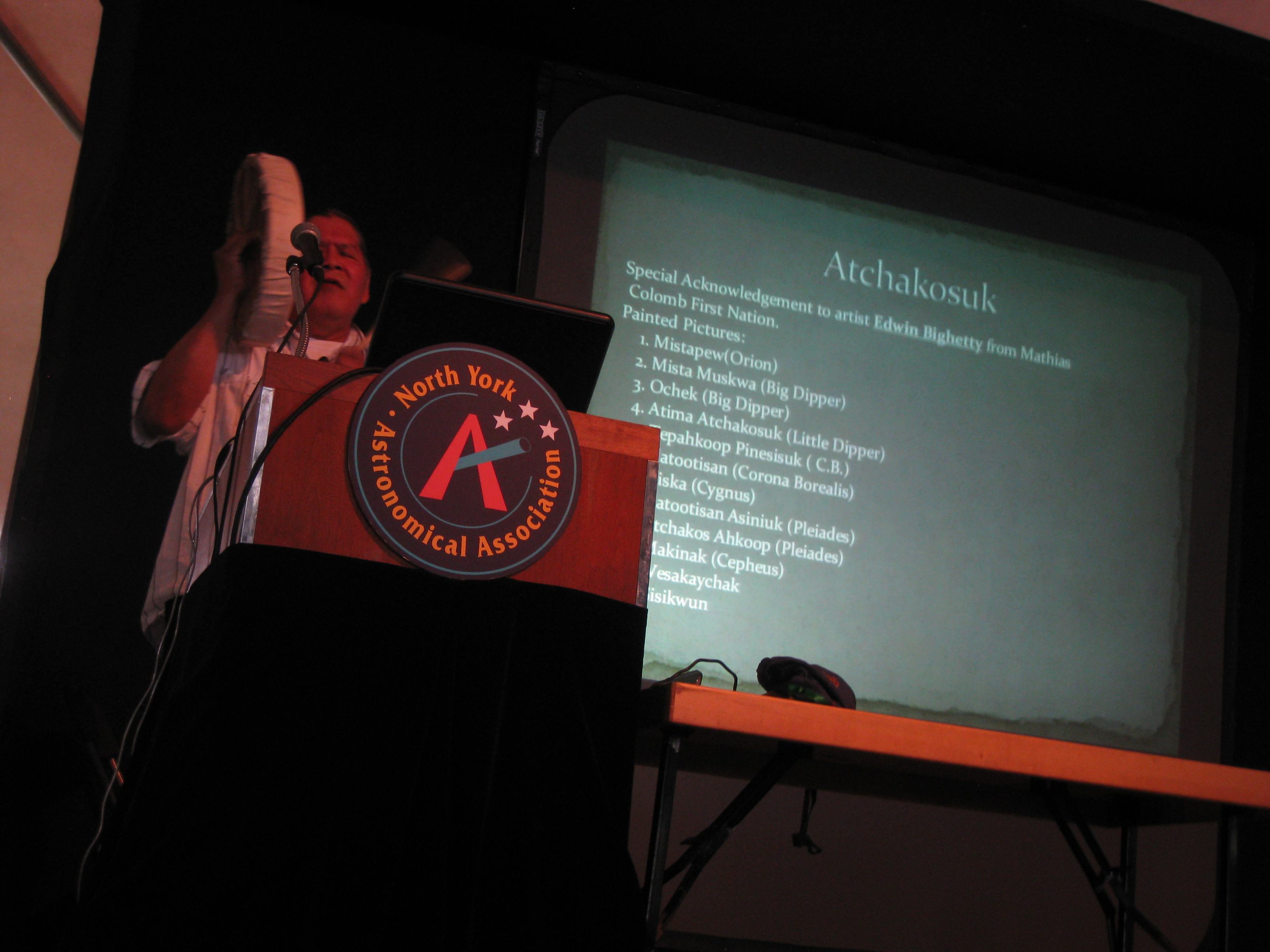
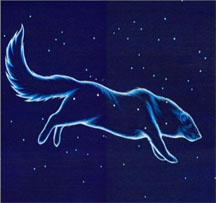
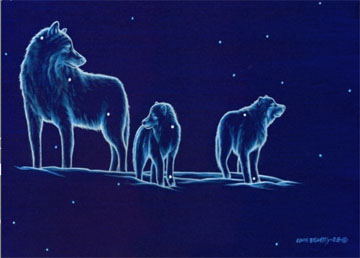
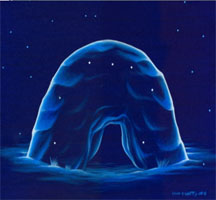
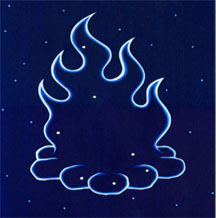
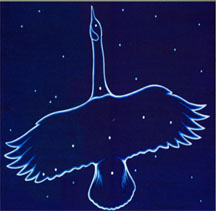
Wilfred Buck at NYAA Starfest 2009Ochek Atchakosuk – The Fisher StarsAtima Atchakosuk – the dog stars with Polaris, Mihkun Atchakos, the wolf starMatootisan – The Sweat LodgeMatootisan Assiniuk – Sweat Lodge RocksNiska flying in the Summer Bird's Path (Milky Way)
Atchakosuk are the spirit lights up above. “All people of the Earth have stories of the stars. The First People of North America are no different” — Wilfred Buck, Cree Science Educator.
The late storyteller Murdo Scribe told this story of the big dipper: Ochek Atchakosuk are the fisher stars in Cree legends from Northern Manitoba. (The fisher is a small fierce relative of the wolverine.) This legend tells us how summer was brought to the north country. Long ago there was no summer in northern Manitoba. (This may be a living memory of ice ages.) Certain animals were selected to bring summer to the northern hemisphere. The Ochek, the fisher, was given this task and in honor of this, the Creator placed the fisher in the sky to remind the people of what “was”, what “is” and what “could be again if we do not respect what is loaned to us.”
In The Dog Star story, Atima Atchakosuk, Polaris is called Mahkan Atchakos, the wolf star. Long ago the people had no dogs to protect them. Their relatives the wolf, coyote, and fox saw this. The wolves held a council and decided that two of them would go to live with the people, as did the coyote’s and foxes’ councils. Two pups from each council were also sent to all the four directions of humankind. They adapted and were domesticated. From these four came all the dogs in the world, and now they guard our homes and camps. To honor this sacrifice by the natootim-uk (our relatives) the Creator placed a reminder in the heavens. Polaris anchors the leash as the dogs run around their sky camp. The three stars of the little dipper handle represent the wolf (Polaris), coyote, and fox. The four bowl stars represent the pups sent to the four directions of humankind.
In the Ininew language, Polaris is called Keewatin Atchakos, the going home star. If First Nation people kept Keewatin on their right shoulder while traveling at night, they knew they were traveling west. The Plains Cree called Polaris the standing still star, Ekakatchet Atchakos.
Corona Borealis, the Northern Crown, is significant in many First Nation sky stories. Some First Nation legends see the half circle as Matootisan, the Sweat Lodge. The legend tells the tale of Assini Awasis, Stonechild and how he brought the Sweat Lodge to the people. He was instructed to build a domed lodge over the rocks which hold the spirit of the night. When heated, the spirits in the rocks are released. The Pleiades are Matootisan Assiniuk, the sweat lodge rocks and Polaris is the Altar. Sometimes all three can be seen in the sky at once and this reminds us where to go for comfort, hope, and healing.
In Cree, the Milky Way is called Neepin Pinesisuk Meskinaw, the summer birds path. Niska the goose or Wahpasiw the swan (the constellation Cygnus) and other birds follow this path when they migrate south and back north. In Ojibway this is Pinesi Miikana, the Thunder Bird’s Path. Other stories call it the Wolves Road and others call it “maskinaw atchakuk,” the path of souls.
I learned these stories from Wilfred Buck, a science educator with the Manitoba First Nations Education Resource Centre. Wilfred was a speaker at the North York Astronomical Association’s 2009 Starfest in Ontario Canada in August. He told these and many other First Nation astronomy stories to a captivated audience, including me. Wilfred is from the Opaskwayak Cree Nation of Northern Manitoba. He has a bachelors and post-baccalaureate degree from the University of Manitoba and has 15 years experience as an educator.
At dusk, we all stepped outside and Wilfred conducted a First Nation Sky Tour. He talked about his life and told stories of his own past. When the first stars came out he conducted a Cree sky tour with a green laser pointer to a large circle of listeners.
Now, when I look up to see the constellations in the northern sky, I imagine the views of untold storytellers long gone. I wish they could have passed their stories on. There are many more First Nation stories about the stars, and they will reveal themselves to special people who seek these stories, like Wilfred Buck.
As one elder stated, “We are blessed to live under a blanket of stars.”
Special acknowledgement to artist Edwin Bighetty from Mathias
Colomb First Nation for the painted pictures of
1. Ochek Atchakosuk (Big Dipper)
2. Atima Atchakosuk (Little Dipper)
3. Matootisan (Corona Borealis)
4. Matootisan Asiniuk (Pleiades)
5. Niska (Cygnus)
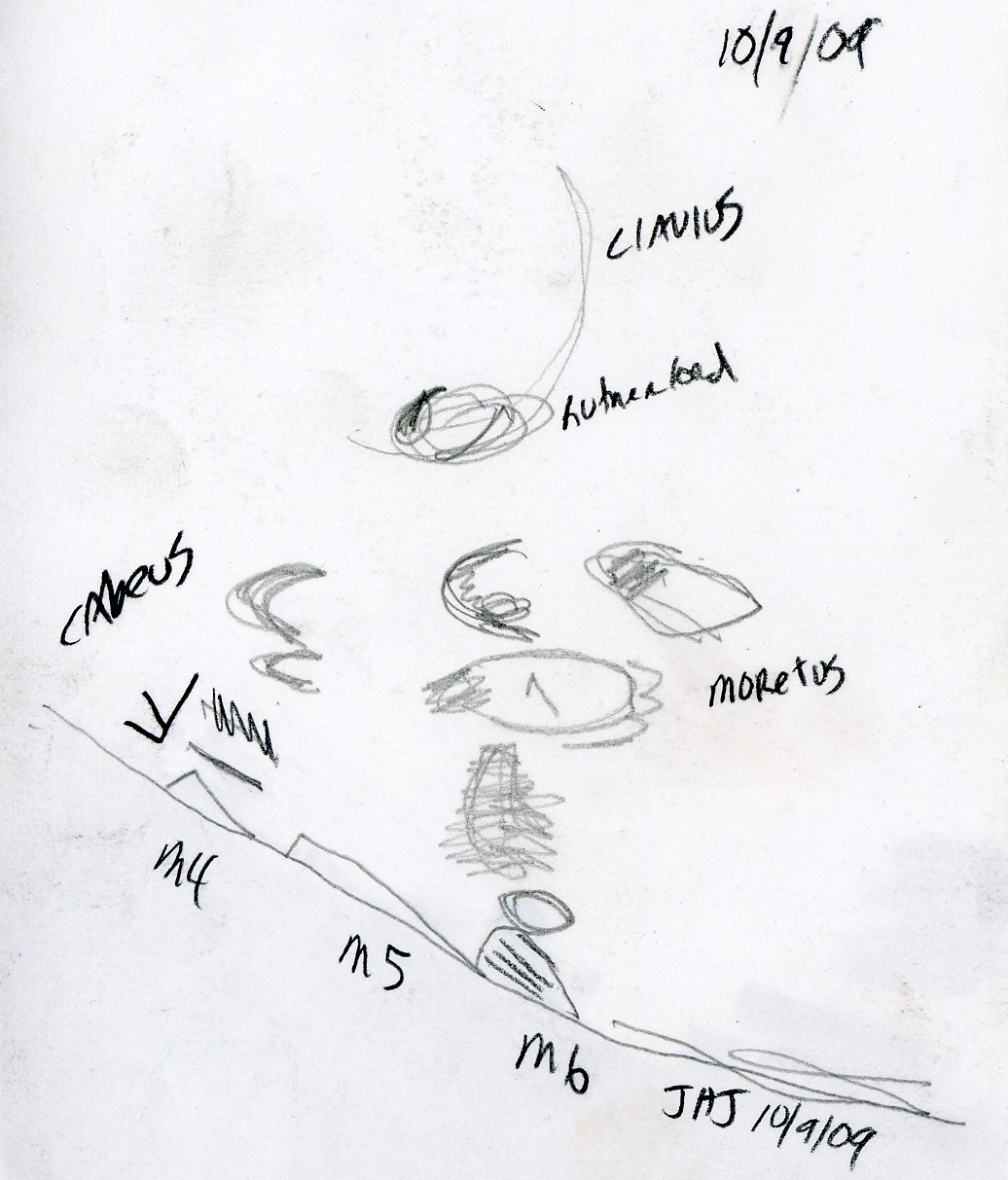
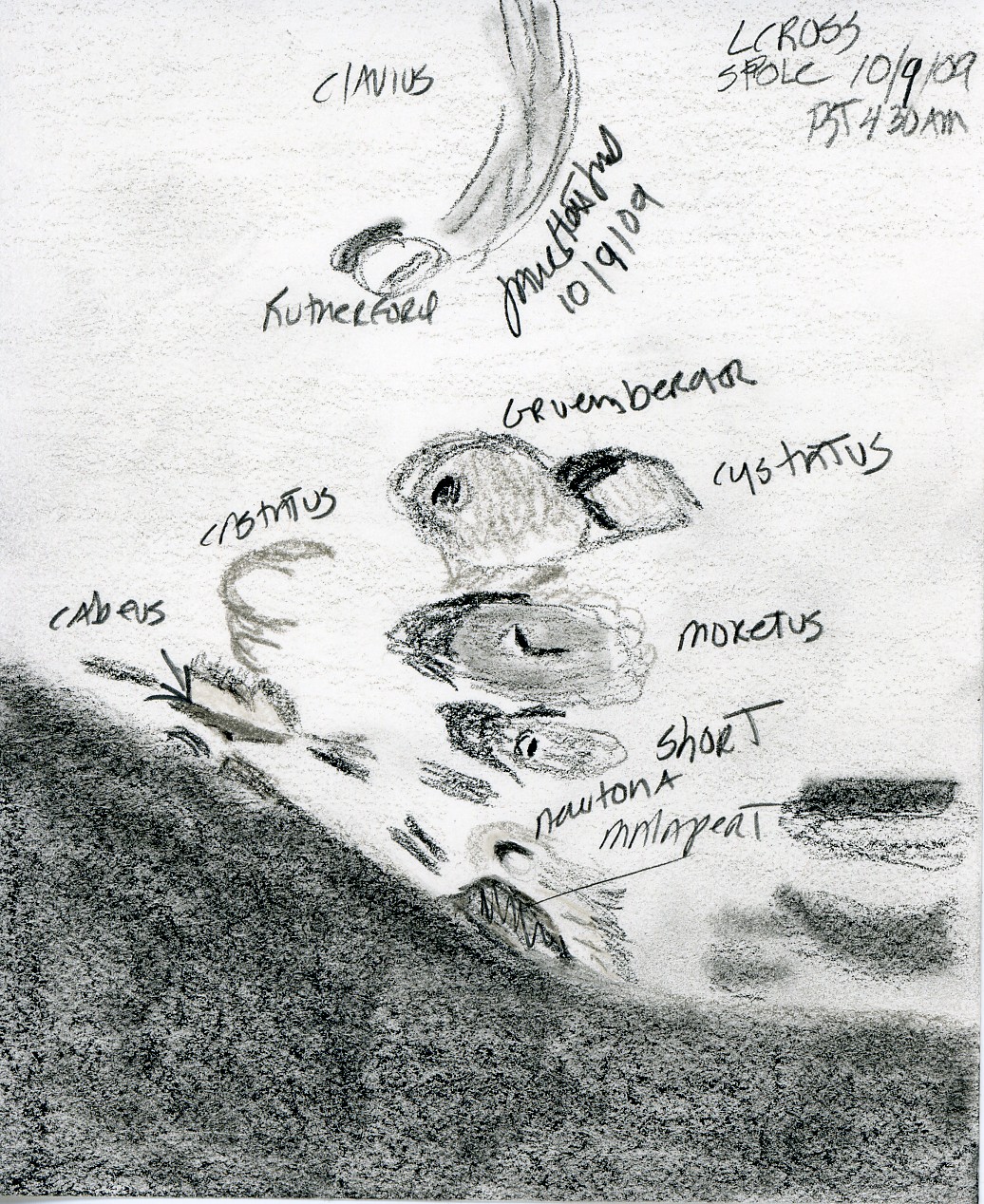
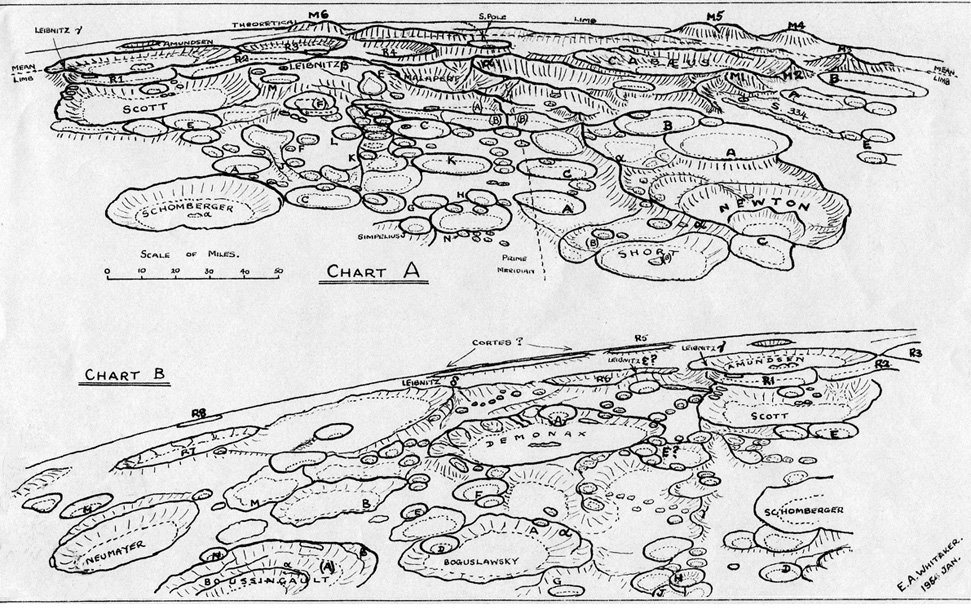
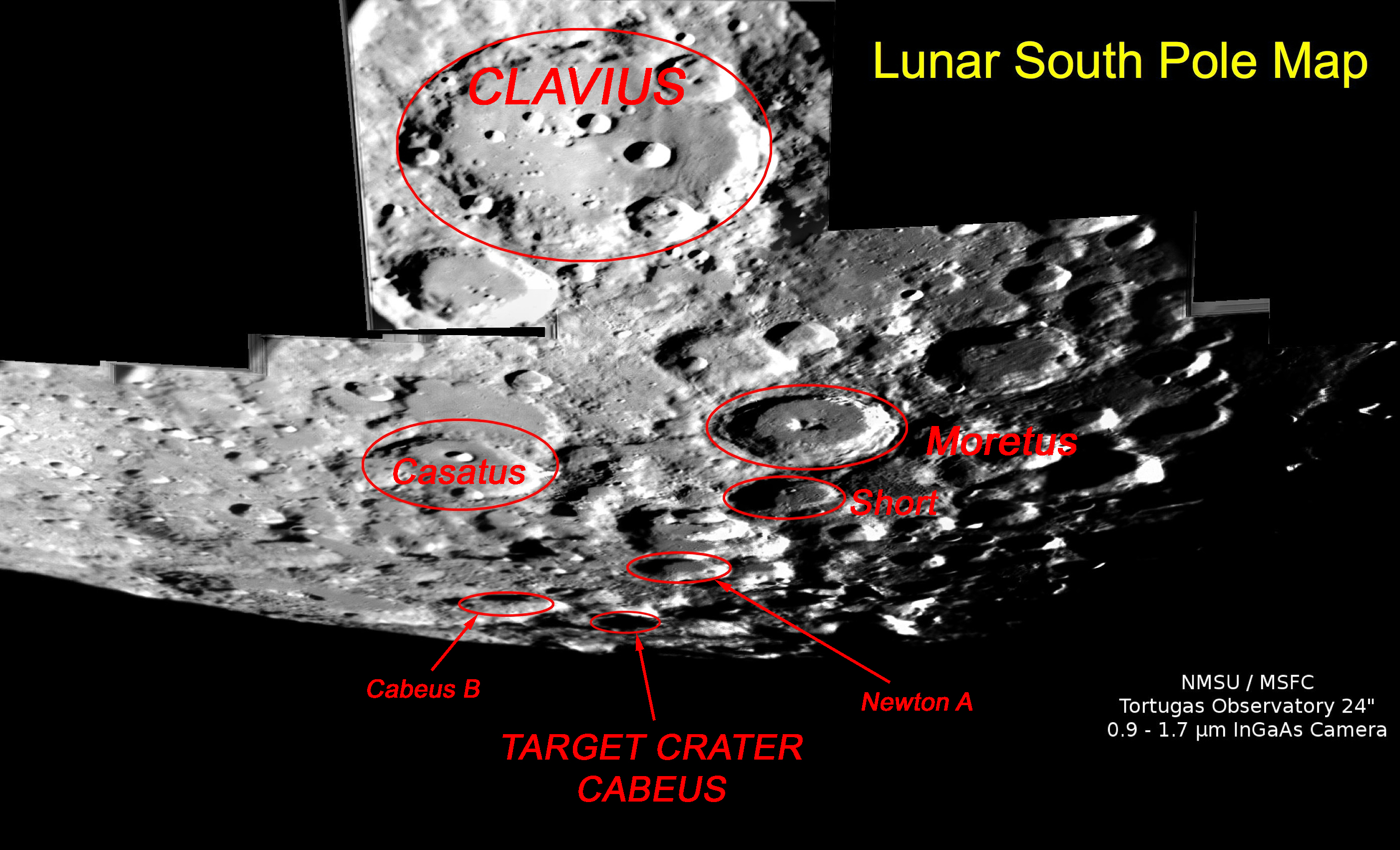
Rough sketch of LCROSS impact areafinished sketch of Cabeus and environsE. A. Whitaker 1954 sketch
Mojo and I started to setup his 14.5-inch f/4.8 Litebox reflector at 3:30 a.m. on LCROSS impact morning. There were marine layer clouds at that hour, but by the time we were set up it was clear overhead. Friends deeper in the LA basin were fogged out completely!
I thought the seeing was not too bad — I was expecting a lot worse. I was able to use pretty high magnification — a 6mm Televue Radian which magnified the view 276 times. I increased the power to 446X using a 4mm Televue Radian, but that was a little too much magnification for the seeing conditions. My first “signpost” to Cabeus was the beautiful walled plain Clavius, with its semi-circle of craterlets on the floor. Two big craters called Rutherford and Porter, named for famous American astronomers, are on the wall of Clavius. There was no shadow relief, making the whole crater nearly invisible.
Then I crater hopped to Moretus, Short, Newton and finally Cabeus. Little bumps on the limb made the crater ID easy, plus I’ve been studying those images for days. Those bumps are mountain peaks on the huge South Pole-Aitken basin, obscured from our view, except for a few peaks on the south limb.
A slick white smear on the sunlit Cabeus crater wall bisected the elongated crater. You can see it on the – APOD lunar chart just above the red ellipse identifying Cabeus. It was really fun to watch the approach from the LCROSS camera on NASA TV, then scoot out the front door for views of the crater itself through our own telescope. I was looking at Cabeus at impact time and didn’t see (and didn’t expect to see) a plume. I recalled the night in 1999 when Mojo and I spent a night waiting and watching the South pole of the moon for the Lunar Prospector impact.
Some final thoughts a few days after LCROSS impact. The GAVRT radio telescope in the Mojave desert of California was abuzz with school kids around the world tracking LCROSS. The students locked onto the LCROSS signal and passed the information on to mission control. They will never forget this exciting mission and their important contribution to it! I was really impressed with the LCROSS mission E/PO and citizen science program which encouraged thousands of amateur astronomers like me to follow the mission, prepare an observing program and report observations.
Although sketches are not the same as video and images, I like thinking that I was sketching an area of the moon in the 400+ year old tradition of citizen scientists. The LCROSS mission follows in the tradition of trailblazing lunar missions. In fact, the mountain peak called M5 on Ewan Whitaker’s 1954 lunar map (on the limb south of Cabeus) is now named Mount Clementine!
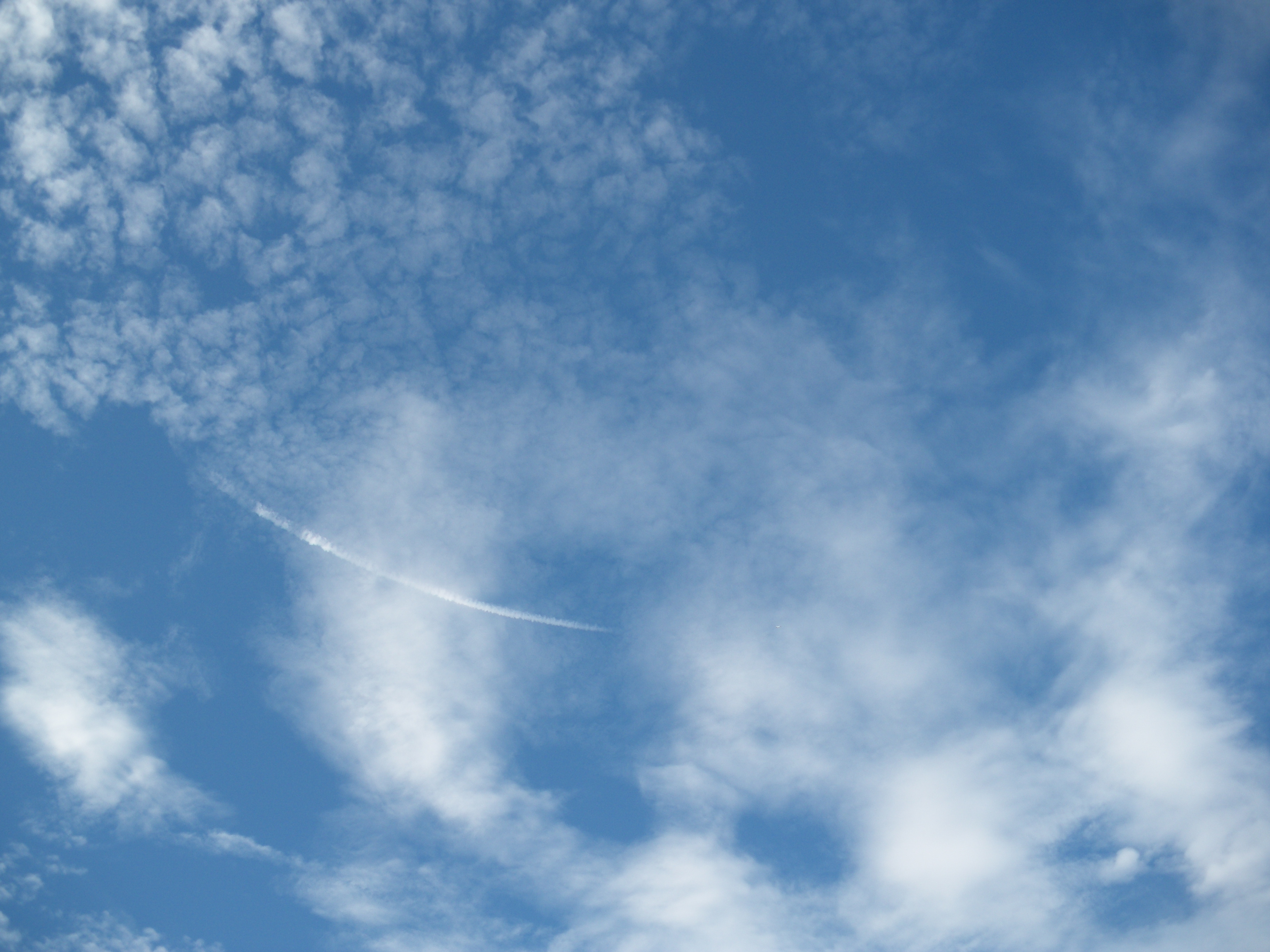
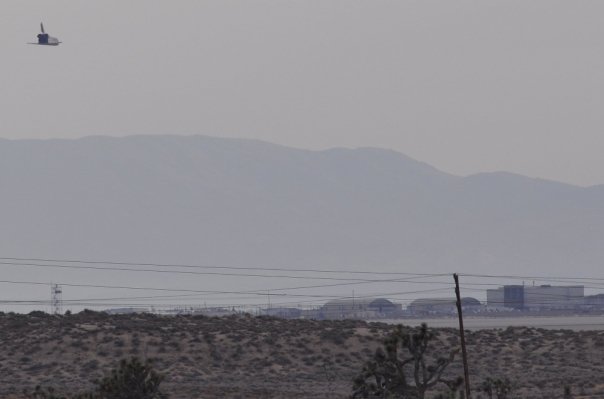
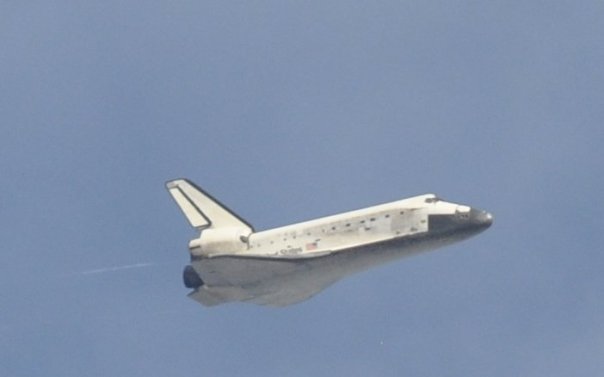
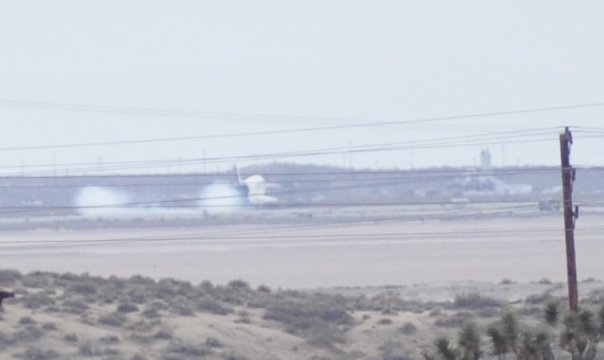
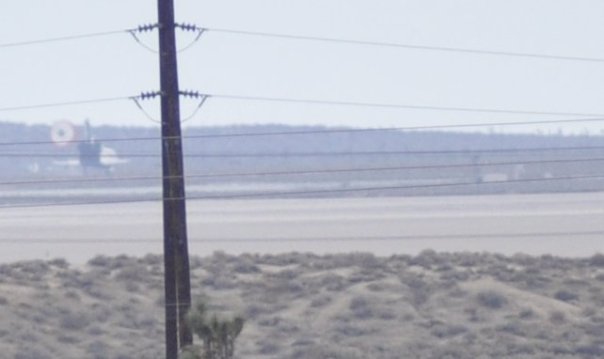
Look for the shuttle to the right of the contrail in my photo (click on the image for full res version)Shuttle and ground in one image. This photo and the rest of these photos courtesy of Gary SpiersSpace shuttle DiscoveryTouchdown – twin dustplumes from gear touching downParachute deploys
NASADryden tweeted at 9:58 a.m. “We’ve been called up to support a potential shuttle landing today, see web for details http://www.nasa.gov/centers”
1:35 p.m. “Shuttle will land at Edwards today, deorbit burn scheduled for 4:47 PDT, landing at 5:53 PDT”
With landing scheduled at 5:53 p.m. PDT September 11, 2009 fellow astronomer Gary Spiers and I sped from Pasadena to Edwards Air Force Base to see one of if not possibly the last California landing of a space shuttle. We left Pasadena at 3:15 p.m. for the 2 plus hour drive.
Navigator Gary scoped out the viewing choices while I drove. We passed Palmdale and headed for Rogers Dry Lake. Soon we saw groups of cars off California State Highway 58, and we headed further down the highway for a higher vantage point at the Northeast side of the lake bed. We turned off at the historic 20 Mule Team Road.
I was receiving the Twitter updates from NASA Dryden on my cell phone. We arrived about a half hour before touchdown and setup camera gear in the 102 degree late-afternoon heat.
We picked a perfect viewing spot. The shuttle would pass directly overhead on its loop from the West to runway 22 at Edwards Air Force Base. You can see the ground track, including the close range track of orbit 219 here.
Here are the exciting tweets from NASADryden, which I passed along to the folks nearby:
“15 minutes until touchdown, less than 1,000 miles away 5:38 PM Sep 11th
Discovery is less than 700 miles away
Right on ground track, 11 minutes until touchdown. Everything looking good
Less than 277 to go, traveling at 7 times the speed of sound
Approaching the CA coastline
7.5 minutes till touchdown
Discovery is 78 miles from Edwards
Just heard the sonic boom here at Dryden! Discovery will be here soon!
3 minutes till touchdown
All eyes at Dryden are on the runway!
Shuttle Discovery has landed at Edwards AFB, welcome back!
Wheels stopped on Discovery with the National Anthem playing in the background. I love this country and NASA! ”
Gary and I were snapping photos and recording video as honking, applause, whistles and cheers erupted from people inside, and alongside over 125 cars parked on the overpass, offramp shoulder, on and off 20 Mule Team Road.
Soon the big rig drivers and other space enthusiasts were pulling off the shoulder and driving back to their daily life. Next to us Brad and Judy from Visalia lamented the dead battery in their camera as they planned to drive three hours back home. We exchanged email addresses and I’ll be sending them this report, photos and video of our first, and maybe last real-time up-close view of a shuttle landing.
These photos courtesy of Gary Spiers whose images were shot using a Nikon D90 body with a Nikon 300mm F2.8 lens. My video and a few pre-landing snapshots were shot using a Pentax Optio M60 compact camera. Taken from 20 Mule Train Road on the Northeast side of the Rogers Dry Lake at the intersection of California Highway 58 and 20 Mule Team Road on September 11, 2009. We were over 5 miles away from the landing strip, but you can just barely see the dustplumes and parachute deployment at 1 min 42 seconds into my video.
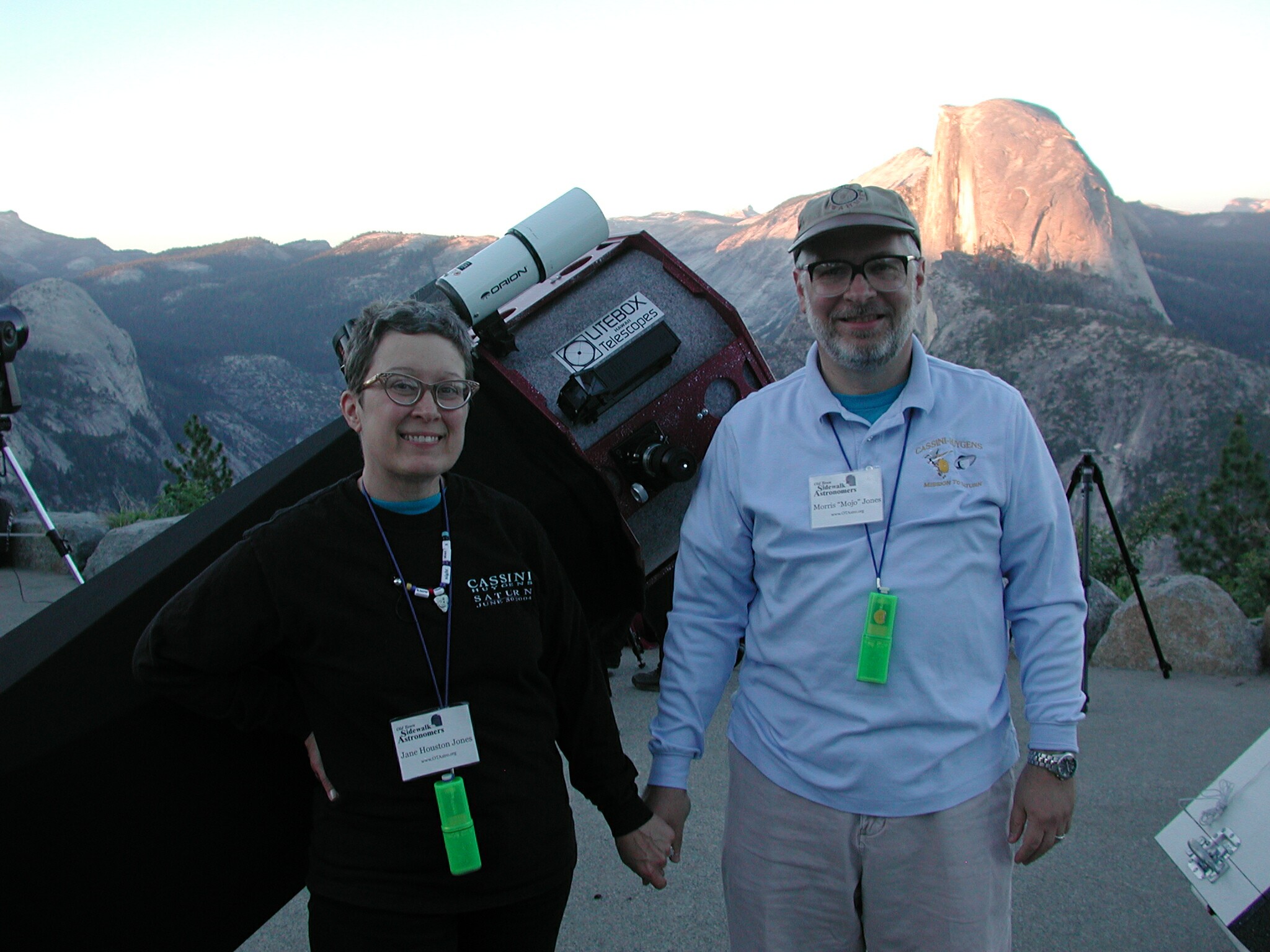
Public star party at Glacier Point, Yosemite National ParkOur tent and telescopes, OSP, Ochoco National Forest, OR
I was inspired to hum this old hobo ballad and change the words a little
after a summer observing trip to Glacier Point in Yosemite National
Park. For you musicologists, I added my “observations” to the 1928
recording of Big Rock Candy Mountain by Harry McClintock. This version
is featured in the movie soundtrack of O Brother, Where Art Thou?.
Feel free to hum along. 🙂
One evening as the sun went down and the campfire light was burning
Down the track came a star-girl hiking, and she said “boys I’m not
turning
I’m headed for a land that’s far away, below the starry fountains
So come with me, we’ll go and see the Big Eye Candy Mountains”
In the Big Eye Candy Mountains there’s a land that’s fair and bright
Where the Naglers grow on bushes and you star gaze every night
Where the seeing is fantastic, transparency supreme
On the swan and the bees and the planetary seas
The Milky Way springs where Cygnus wings
In the Big Eye Candy Mountains
In the Big Eye Candy Mountains all the ‘scopes have sturdy legs
And your can use high power when the seeing condition begs
The doubles split so easily, and planetary moons are disks
Oh I’m bound to go where there ain’t no glow
Where the meteors fall, and the wind don’t blow
In the Big Eye Candy Mountains
In the Big Eye Candy Mountains you never change your socks
And the little streams of Fosters Beer come a-trickling down the rocks
The horizon view is full of stars and the zenith darker yet
There’s a universe for you and a galaxy or two
You can starhop all around ’em with a wide-field view
In the Big Eye Candy Mountains
In the Big Eye Candy Mountains the restrooms are nearby
And you can see the Milky Way above you in the sky
There ain’t no used car dealerships, no streetlights, cars or malls
I’m a-goin’ to stay where I sleep all day
Snuggling in my tent with my favorite gent 🙂
In the Big Eye Candy Mountains
I’ll see you soon this comin’ new moon in the Big Eye Candy Mountains
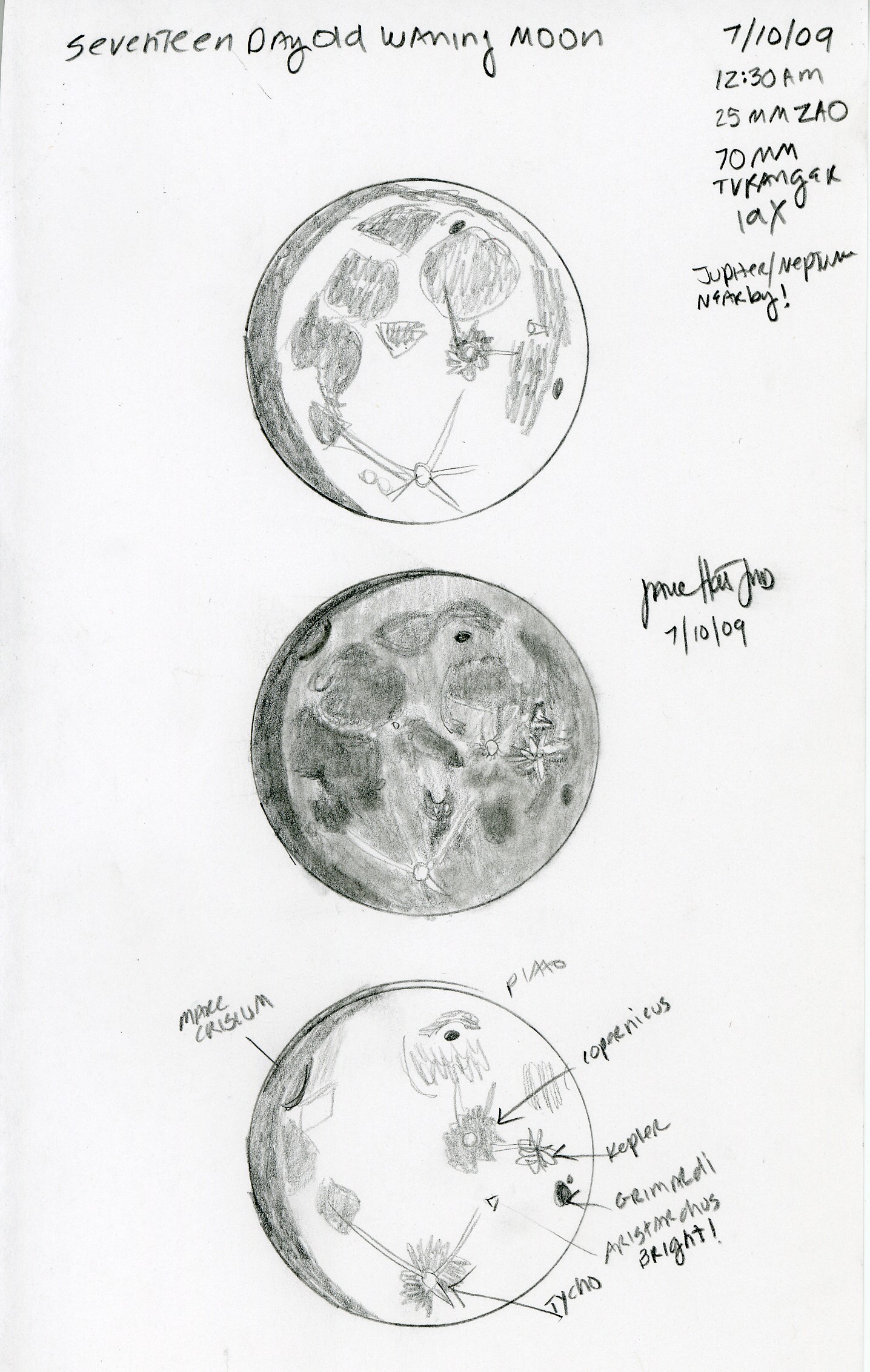
The moon rises later each evening now. That means a late night for sketchers. Luckily my small 70mm Televue Ranger on a telepod mount requires no setup. I keep it permanently set up in the garage.
The features I’ve sketched on the 18-day moon begin with sunset on Mare Crisium – on the terminator to the left on my sketch. Plato is the dark oval at north (top), with Mare Frigoris encircling it to the north.
The large mare closer to the terminator are Mare Serinitatis and Mare Tranquillatis. Mare Nectaris is the oval sea south of Tranquillatis. Mare Imbrium is the largest lunar basin on the moon – the large feature below (south of) Plato. It’s between Plato to the north and Copernicus and Kepler to the south.
Grimaldi, one of my favorite lunar features is the dark oval flooded basin to the right, south of Kepler. On nights of favorable libration, beyond Grimaldi, the ridges of Mare Orientale appear. Did I leave out Tycho? It is the magnificent crater to the south of Mare Nubium. Tycho’s long rays span 1800 km from Tycho to the small crater Rosse in Mare Nectaris. You can actually follow the ray to Rosse in my sketch!
There is so much to see and study on a the moon, especially if you have a lunar map. The nights after the full moon are wonderful lunar observing nights, if only you can stay up to observe on them!
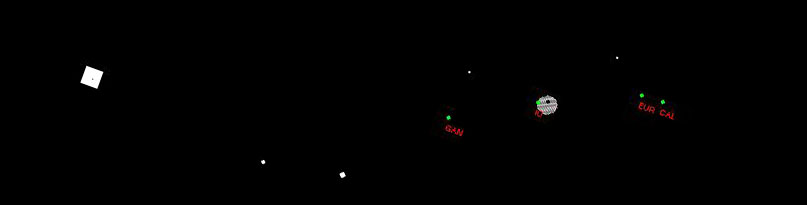
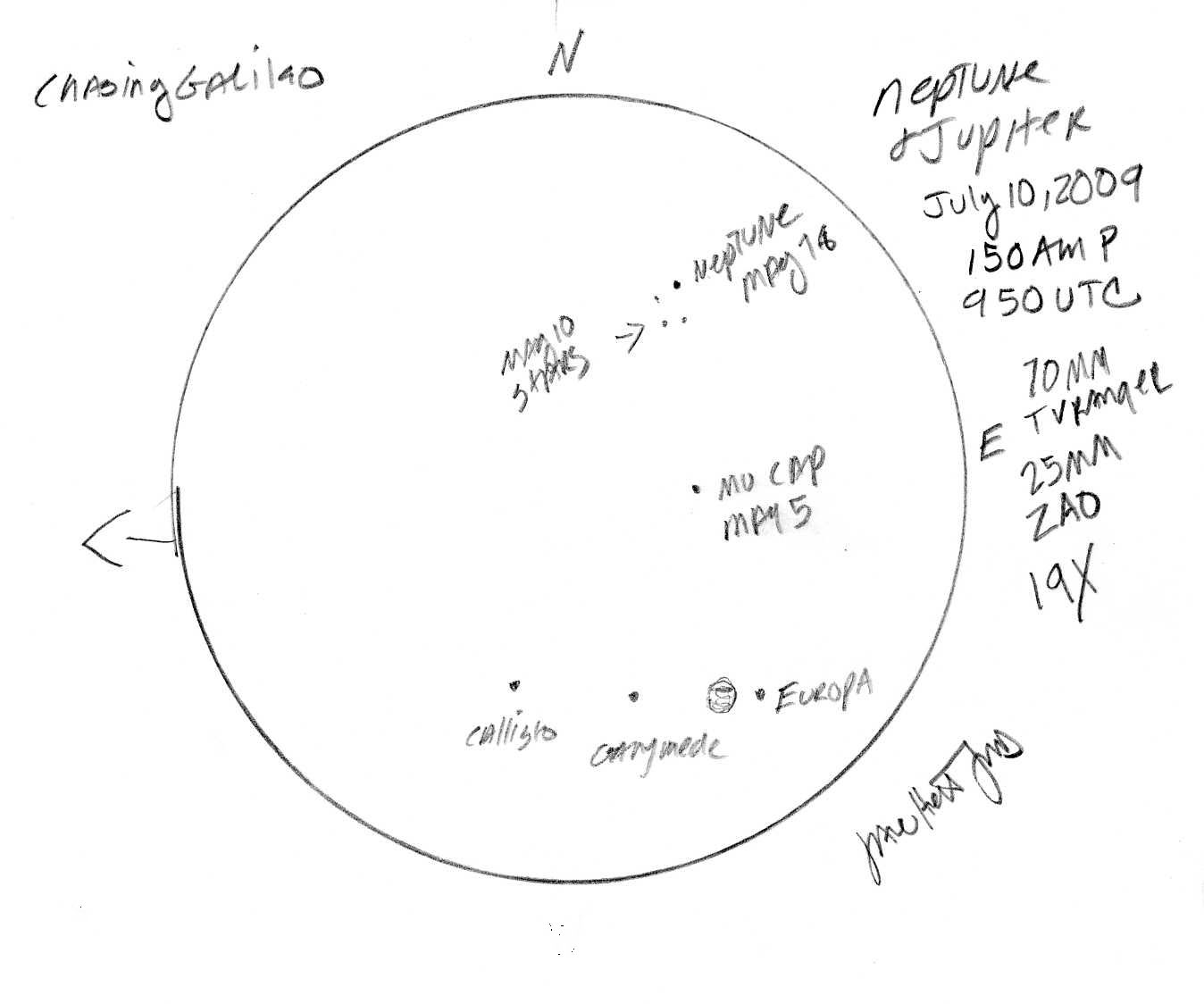
Galileo noted a fixt star (at left), now known to be Neptune on this sketch from December 28, 1612Skymap Pro chart of Jupiter and Neptune (the square at left), December 28, 1612My sketch of Neptune with Jupiter and the Galilean moons
Galileo made the first recorded observation of Neptune in 1612 when Neptune appeared to be close to Jupiter from his viewpoint on Earth. The”fixed star” Galileo noted to left of Jupiter (the left most star) on his December 28, 1612 sketch was actually Neptune! The two planets appear close to each other several times this year.
This year, both planets come to opposition in August and for several months on either side of opposition, the two planets appear to temporarily move backwards against the background stars. This is called retrograde motion, and they pass near each other three times this year. On May 26, the planets were only 23′ (or 23 arc minutes) apart. On July 9th, near when I made my sketch, the two planets appeared 33.5′ apart. And on December 21, the Winter Solstice, you can look for Neptune below Jupiter, 32′ distant. This is a great time to easily see both planets in the same low power field of view through a telescope! At higher magnification, they won’t be in the same telescopic field of view, but you’ll find Neptune with just a small nudge or “go-to” to the North.
Galileo observed Neptune in December 28, 1612 and again one month later on January 27, 1613. Then, on the next night, he noted that the two stars seemed further apart. If he had observed the two objects again on the next few nights he would have realized that one of the “stars” was moving.
If you have a chance to look at Jupiter in July 2009, you’ll easily spot Neptune if you know where to look. Here is a star chart for July 25th showing the location of both planets low in the southeast at 11:30 p.m. They are rising, and will be higher in the sky later on. And here is a closeup star chart showing the tip of Capricornus. Use this chart to locate Jupiter in your eyepiece, and then you can easily follow the stars to Neptune. These star charts are made by Sky Map Software.
Neptune’s color in the telescope view is striking! It stands out as a bluish star to the north of Jupiter – about twice the distance north as the width of Jupiter and moons. After I sketched the pair of planets, I revved up the charting software, Sky Map Pro, and entered December 28, 1612. I was amazed to see the planets and moons layed out nearly as Galileo observed them. This may sound silly to you, but that 400 year-old view of the planetary lineup on 21st century software just took my breath away!
It’s just a few days until Harry Potter And The Deathly Hallows, ‘Part 2’ opens, so I am updating my literary stargazing project. I even added a few new objects to the list. So head up to the astronomy tower at your own Hogwarts and look up into the summer night sky. Did you buy a telescope at the telescope shop in Diagon Alley like Harry Potter’s collapsible brass telescope? If not, don’t worry, most of these objects can be seen just using your eyes. Have fun and let me know if you complete your O.W.L. – in Literary Stargazing.
Here is a July 2011 star chart where you can find many of the constellations and stars listed below. Use it to find the summer Harry Potter objects such as the constellations Draco, Cygnus and Scorpius, plus stars Arcturus and Sinestra (in the constellation Ophiuchus – it’s the star at the end of the arm holding the snake Serpens Cauda). The constellation Phoenix is a challenging object in the southern sky — try looking for it in November. Many of these objects are best seen at other times of the year. Make your own StarWheel and find out when and where to look.
This article was researched, compiled, written and observed by Jane Houston Jones, Caroline Sakaguchi Kunioka, Elizabeth and Catherine Spiers. More about the authors at the end of the article.
Elizabeth, Caroline, Catherine and Jane form a girl cluster before observing the Harry Potter Objects
What do Sirius, Arcturus and Pollux have in common, besides being the brightest stars in their respective constellations? They are all characters in the popular Harry Potter books! Translated into over 70 languages, these books have universal appeal, and this project paves the way to introduce amateur astronomy to a new generation of stargazers.
This list might be just the “hook” to get your favorite muggle or wizard to step outside for a night of stargazing. “Come see Sirius Black’s star” or “Let’s try to find Draco Malfoy’s constellation” could be the beginning of a family, museum, planetarium, or community star party. Or head over to your favorite bookstore, library or movie theater for some sidewalk astronomy, especially if Luna is in the sky.
The Harry Potter Objects
Observe and/or read about these objects for your honorary O.W.L. – Ordinary Wizarding Level award in Literary Stargazing
Sirius – Sirius Black
Arcturus – Arcturus Black
Regulus – Regulus Black
Pollux – Pollux Black
Alphard – Alphard Black
Bellatrix – Bellatrix (Black) Lestrange
Merope – Merope (Gaunt) Riddle
Sinistra – Professor Aurora Sinistra, Astronomy Professor
Eta Argus – Argus Filch
Rastaban – Rastaban Lestrange
Cygnus – Cygnus Black
Orion – Orion Black
Andromeda – Andromeda aka Dromeda (Black) Tonks
Cassiopeia – Cassiopeia Black is the Great Aunt of Sirius Black
Draco – Draco Malfoy
Scorpius – Scorpius Malfoy
Luna – Luna Lovegood
Phoenix – The Order of the Phoenix
Aquila – Ravenclaw animal is a golden eagle
Leo – Gryffindor animal is a golden lion
Serpens, Hydra – Slytherin animal is a silver snake
Vulpecula, Lynx, Lupus – Hufflepuff animal is a badger. The Fox, Lynx and Wolf constellations are the closest to a badger.
Read about these additional objects and you will earn your honorary N.E.W.T. – Nastily Exhausting Wizarding Tests award in Advanced Literary Stargazing.
Albus 1 – Albus Dumbledore
Amycus 55576 – Amycus Carrow is a Death Eater
Ginevra 613 – Ginevra (Ginny) Weasley
Hermione 121 – Hermione Granger
Fenrir – Fenrir Greyback
Here is the detail on each object and each character from the books or from the Genealogy charts:
Sirius – Alpha Canis Majoris From Orion, look south and to the east to find brilliant Sirius, the brightest star in the sky. Sirius is also the brightest star in the constellation Canis Major, the Greater Dog. Canis Major is Orion’s larger hunting dog. Sirius is only 8.6 light years away, making it a popular “birthday star” for your favorite 8-year old. It’s a white class A (A1) hydrogen-fusing main sequence dwarf, shining at magnitude -1.46. Best seen in the winter.
Sirius Black is Harry Potter’s godfather. Sirius can turn himself into a black dog. His nickname, Padfoot, is a name North Englanders have for the magical black dogs who guard graveyards and can vanish instantly.
Arcturus – Alpha Boötis Arcturus is the brightest star in the constellation Boötes. Arcturus, the “Bear Watcher,” follows Ursa Major, the Great Bear, around the pole. Arcturus is 37 light years away. It is a classic orange class K (K1) giant star shining at –0.04. Best seen in the summer.
Arcturus Black is Sirius Black’s grandfather
Regulus – Alpha Leonis Regulus is the heart of Leo the Lion. At a distance of only 77 light years, it shines in our sky at magnitude 1.35. In Latin it means “the little king”. Regulus is bluish-white class B (B7) main sequence star. Best seen in the spring.
Regulus Black is Sirius Black’s younger and more beloved brother. Readers never meet him directly. Regulus became a Death Eater at the age of 16. Regulus Black was stronger, braver and more like his brother than anyone knew. Regulus, the star, is the heart of the lion, which is the sign of the house of Griffindor.
Pollux – Beta Geminorum Pollux is a star with a planet, and one of the “twin” stars Castor and Pollux of the constellation Gemini. They are twins in mythology only. Pollux is an orange-colored cool class K (K0) giant with a planet is 34 light years away, while Castor is white and 50 light years away. The planet orbiting Pollux has a mass 3 times that of Jupiter, orbits in a nearly circular path at a average distance of 1.69 Astronomical Units (11 percent farther than Mars is from the Sun) with a period of 590 days (1.6 years). Best seen in the winter.
Pollux Black – the maternal grandfather of Sirius Black.
Alphard – Alpha Hydrae Alphard is not well known, but is surprisingly prominent. Alphard dominates the dim constellation Hydra, the Water Serpent, where it marks the heart of the snake. The star is an orange class K (K3) giant 175 light years away, shining at magnitude 1.98. It is found in a blank area of the sky, and its Arabic name means “the solitary one.” Best seen in the spring.
Alphard Black – Sirius Black’s uncle. He left his money to Sirius. For this gesture, he was disowned by the Black family. He is represented by a burn mark on the family tapestry. Readers find that very few Blacks loved Sirius, and so perhaps, Alphard’s name is fitting. It is also interesting that Alphard Black was a student in the house of Slytherin.
Bellatrix – Gamma Orionis Bellatrix is a blue-white and luminous star shining at magnitude 1.64. It is one of the hotter naked eye stars, at the hot end of class B (B2) and is 240 light years distant. The name Bellatrix translates from Latin as “the female warrior”, and sometimes the “Amazon Star.” Best seen in the winter.
Bellatrix (Black) Lestrange – Sirius Black’s cousin and killer. She spent time in Azkaban prison for giving Unforgivable Curses and for torturing Frank and Alice Longbottom.
Merope – or 23 Tauri, one of the Pleiades. Merope shines at a faint 4.18 magnitude and is 385 light years distant. The Pleiades is a cluster of brilliant blue white class B (B6) stars. They are named for the daughters of Atlas and Pleione. Merope is 4th in brightness and is famous for its surrounding cloud of dusty gas which is named the Merope Nebula, or IC 349. The Pleiades stars are not hot enough to ionize the gas and make it glow. Instead, the dust grains embedded in the cloud scatter and reflect the starlight, and we see this starlight as the Pleiades Reflection nebula. Originally thought to be a remnant of the stellar birth, it is really a chance encounter. The cluster is passing through a random interstellar cloud, and the Pleiades leave a wake as the cloud rushes by. Best seen in winter.
Merope (Gaunt) Riddle – Merope tricked Tom Riddle into marrying her with a love potion. Later she gave birth to a son at a Muggle orphanage and died after naming her child Tom Marvolo Riddle. Merope Gaunt is named after a stunningly apt myth. Merope was the youngest of the sisters and the only one to marry a mortal. Accounts differ as to whether she hid herself in shame or whether her star faded away as a result.
Sinistra – Nu Ophiuchi Sinistra is a magnitude 3.5 orange spectral class K (KO) star in the constellation Ophiuchus. It carries the traditional Latin name Sinistra, meaning “left” or “left hand” despite the fact that Nu Ophiuchi marks the Serpent Bearer’s right hand. It is 155 light years from Earth. Best seen in the summer. To find Sinistra on the star chart, look for where the constellation Ophiuchus intersects Serpens Cauda. think of that as the hand of Ophiuchus, grasping the serpent.
Professor Aurora Sinistra teaches Astronomy at Hogwarts. The class is taught at midnight in the highest tower at Hogwarts offering the best view of the night sky. Students study the night sky to chart the stars, moons, and planets. For homework, students have made models of the planets, moons, and stars. Her first name “Aurora” implies the professor is a “light” witch, not a practitioner of the dark arts, and a student of the skies.
Eta Argus was formerly in the constellation Argus, now part of the keel of the constellation, Carina. English astronomer Francis Abbot was sentenced to 7 years transportation, and sent to Hobart Town,Tasmania to serve his sentence in 1844. After serving his sentence he became a flourishing businessman and respected astronomer, who was the first to draw attention to the changes in the variable star Eta Argus. This star is now known as Eta Carinae or Eta Carina. Since this object is visible to observers in the southern hemisphere, you can observe the beautiful Hubble image instead.
Argus Filch is the Hogwarts caretaker. He’s a cantankerous, nasty man who detests the students.
Rastaban – Beta Draconis Rastaban is the third brightest star in the constellation of Draco. It is a G-type giant star, with spectral class G2 and an apparent visual magnitude of approximately 2.79. Its distance from the Sun is around 360 light years. It is a binary star, with a binary star designation of ADS 10611, in which the supergiant is orbited by a dwarf companion once every four millennia or so.
Bellatrix Lestrange’s brother-in-law is Rabastan Lestrange. (I know the spelling is different)
Cygnus
Cygnus Black is Sirius Black’s Uncle
Orion
Orion Black is the Father of Sirius and Regulus Black
Andromeda
Andromeda (Black), a pure-blood witch was the widow of Ted Tonks, mother of Nymphadora Tonks, who preferred to be called Tonks or sometimes Dora. She was the mother-in-law of Remus Lupin and grandmother of Ted Lupin. She was Sirius Black’s favorite cousin
Cassiopeia
Cassiopeia Black is the Great Aunt of Sirius Black
Draco
Draco Malfoy is a Slytherin student and Harry Potter’s arch enemy.
Scorpius
Scorpius Malfoy – son to Draco, referred to in epilogue.
Luna – The name “Luna” is Latin for the moon.
Luna Lovegood is a student in Ravenclaw and in Ginny Weasley’s class. She is absentminded and has unconventional patterns of thought. The moon was once thought to induce insanity, but we now know it induces observing enjoyment. Luna’s nickname is Loony.
Phoenix
Order of the Phoenix – The Order is a group of witches and wizards, led by Hogwarts headmaster Albus Dumbledore, dedicated to fighting evil Lord Voldemort and his followers.
Aquila is the animal of the Ravenclaw House Leo is the animal of the Gryffindor Gouse Serpens, Hydra is the animal of the Slytherin House Vulpecula, Lynx, Lupus reminds us of the badger, who has no constellation, Hufflepuff’s animal.
Extra Credit – these are some challenging or impossible objects to see. But they have a Harry Potter connection, so they are fun to learn about.
Amycus 55576 is a Centaur – half asteroid, half comet.
Amycus Carrow is a Death Eater.
Ginevra 613 Ginevra is a minor planet orbiting the Sun.
Ginevra Molly “Ginny” Weasley is a pure-blood witch, and the first female to be born into the Weasley line for several generations.
Hermione 121 is an asteroid I have actually seen through my own telescope, during an occultation. Here is more information about Hermione, the asteroid.
Hermione Jean Granger is a Muggle-born Gryffindor student
Albus 1 – A Very Bright White Dwarf Candidate. Albus 1 is a DA-type white dwarf located at about 40 pc. If its nature is confirmed, Albus 1 would be the sixth brightest isolated white dwarf in the sky, which would make it an excellent spectrophotometric standard.
Albus Percival Wulfric Brian Dumbledore – headmaster of Hogwarts School of Witchcraft and Wizardry
Fenrir is a moon of Saturn. Retrograde satellites are named after Norse giants.
Fenrir Greyback is the name of a violent werewolf whose allegiance lies with the Death Eaters.
About the authors/observers: Jane Houston Jones wrote the astronomy segments and edited the whole writeup. Caroline Sakaguchi Kunioka researched and wrote the Potter segments, edited Jane’s edits and came up with the idea in the first place. Elizabeth and Catherine are our younger sidewalk astronomers, both with their own telescopes. Elizabeth is an avid Potter fan who contributed Potter lore and lots of details to the project. Catherine enjoyed looking for the objects in the night sky, and helped field test the list at our favorite desert observing locations. All four of us are active members of the Old Town Sidewalk Astronomers, and we all love to read books, too.
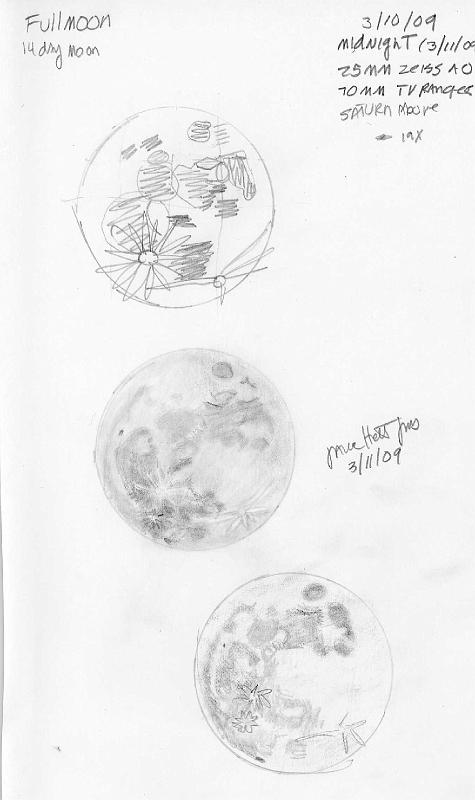
The full moon rises as the sun sets on the 14th day of the lunar month. A small telescope, such as the 70mm f.8.7 Televue Ranger I’m using for this series of sketches is a perfect instrument for full moon viewing. So are binoculars. The moon is a very generous target, and even the least expensive department store telescope will provide you many hours, days, months and years of inexpensive lunar observing fun!
The features you see on the full moon night are so different than the other nights. There are no shadows! So the features which stand out are the more reflective (bright white young craters and their ejecta) or the darker, less reflective mare.
Many new lunar observers think the full moon is too bright to view through a telescope. It’s not, but there are some tricks you can use to make your full moon view more enjoyable. One trick I like is to use a higher power eyepiece when viewing the full moon. That higher magnification dims the apparent brightness of the full moon. Another trick is to observe the full moon next to a streetlight or normal outdoor house lighting. We hate those lights when they ruin our dark skies, but they don’t hurt lunar viewing one bit, in fact they improve it! I don’t like to use moon filters or neutral density or polarizing filters when observing the moon. They diminish the sharpness of the features I want to view.
There are so many features I can identify on these sketches, but I’ll just mention the ones I have not covered before. My center sketch seems to be a little better than the “final” lower one. I can see, in addition to the great rayed craters Copernicus, Tycho and Kepler, lots of small bright white craters or ejecta. Proclus and Messier are near Mare Crisium, but it will take a map for you to find them. Proclus is a crater that is actually visible to the unaided eye at full moon, but I didn’t capture it on my sketch very well, probably because I made this sketch after midnight on a mid-week work night!
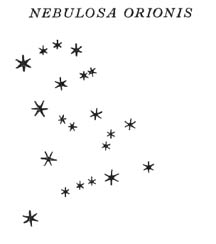
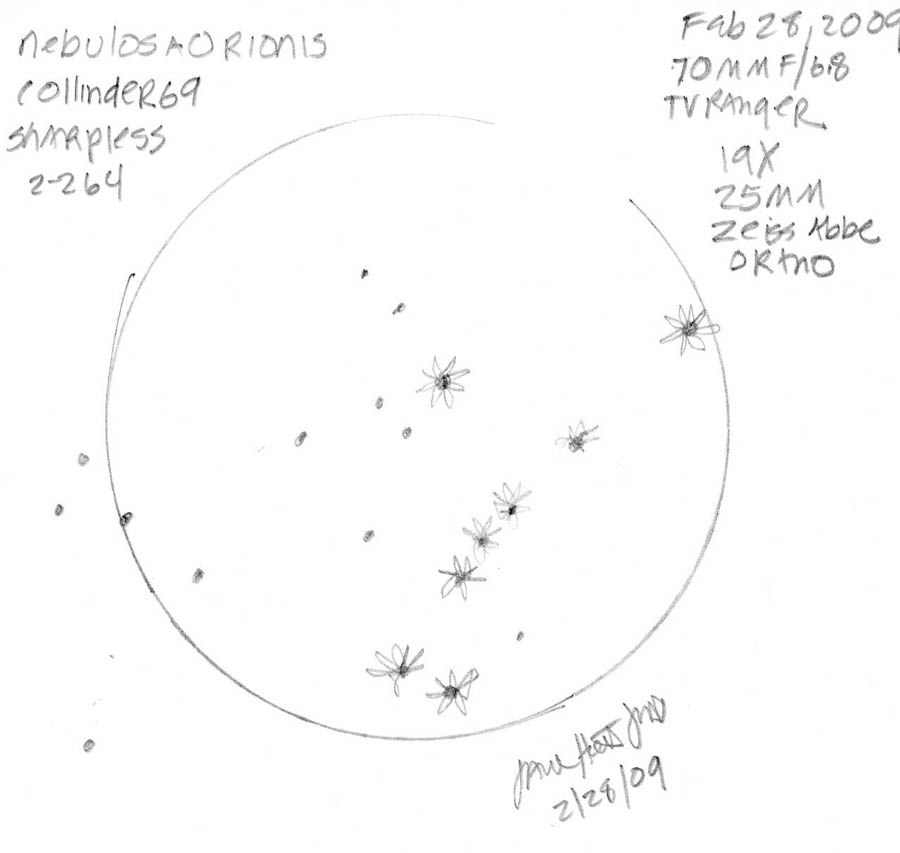
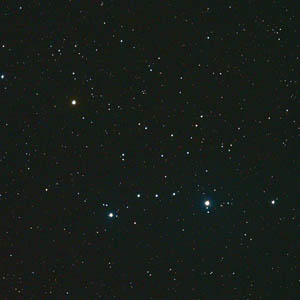
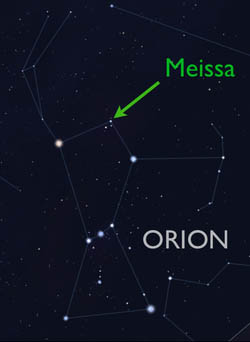
Galileo’s Head of Orion clusterJane’s Head of Orion clusterAstrophoto of Orion Head cluster by Morris JonesMap of the constellation Orion
Galileo looked at the fuzzy patch surrounding the head of Orion through a telescope, and resolved many starts not previously known. He called it Nebulosa Orionis.
Look between the shoulder stars Betelgeuse and Bellatrix of the constellation Orion. The star you see with your unaided eye is Orion 39 or Lambda Orionis. Its Arabic name is Meissa. You can find this star on Galileo’s drawing by following the stars at the bottom of the drawing. The first star at left is 37 Phi1 Orionis. Three smaller stars follow. The next one is Meissa. It’s an amazing star! Surrounding the hot class O star (which also has a double) is a 150 light year ring of gas, which you can read about at Jim Kaler’s Stars website link above.
We now refer to the open cluster which contains this star as Collinder 69 or Sharpless 2-264.